
The Quarter That Should Have Caused Fireworks
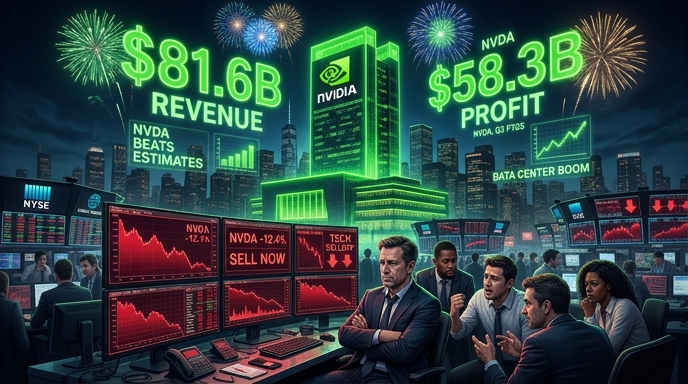
Nvidia just dropped the kind of quarterly report that would make most companies throw a parade, hire a brass band, and maybe name a conference room after itself.
For the February-to-April quarter, the chip giant reported $81.6 billion in revenue, up 85% year over year. Net income hit $58.3 billion, more than triple the year-earlier figure, while adjusted earnings also beat analyst expectations. Nvidia then looked ahead and forecast about $91 billion in revenue for the current quarter, again above Wall Street’s expectations.
That is not normal corporate growth. That is “did someone accidentally turn capitalism to turbo mode?” growth.
And yet, after the report, Nvidia shares slipped in after-hours trading. Depending on the report, the drop was described at roughly 1.3% to 1.6%.
That is the strange part. Nvidia beat expectations. It made a mountain of money, It raised its outlook. It announced an additional $80 billion share buyback and lifted its quarterly dividend from $0.01 to $0.25 per share.
And investors still crossed their arms like a restaurant critic judging fries.
The Real Product Is No Longer Just a Chip
Nvidia used to be known mostly for graphics cards. Gamers cared. PC builders cared. Crypto miners cared during their brief, sweaty reign.
Now? Nvidia sells the picks, shovels, engines, wiring, and sacred magic dust of the AI economy.
Its data-center business generated $75.2 billion in quarterly revenue, up 92% year over year. That division now drives the company’s results.
CEO Jensen Huang framed the moment in grand infrastructure terms, saying the buildout of “AI factories” is accelerating at extraordinary speed. Nvidia CFO Colette Kress made the same point another way: customers are not simply buying GPUs; they are building AI factories whose economics depend on power efficiency, uptime, utilization, speed, and durability.
That phrase matters: AI factories.
It means Nvidia wants investors to stop thinking about chips as expensive boxes of silicon. It wants them to think about chips as revenue-producing industrial equipment. Like oil rigs, Like power plants. Like railroads, if railroads could hallucinate meeting notes and generate cat videos.
That shift helps explain the valuation. Nvidia is no longer priced like a hardware supplier. It is priced like the central toll booth of the AI era.
“Demand Has Gone Parabolic”
Huang told investors that demand had gone “parabolic,” pointing to the rise of agentic AI — systems designed to do more semi-autonomous work rather than simply answer prompts.
That is the pitch. AI is moving from party trick to office worker. From chatbot to workflow machine. From “write me a haiku” to “handle this customer support queue, draft the follow-up, and update the database.”
Whether that future arrives smoothly is another question. But the spending is real. Big technology companies are building enormous AI infrastructure, and Nvidia remains the supplier everyone chases.
Bol News reported Nvidia’s estimate that AI infrastructure spending could reach $3 trillion to $4 trillion per year by 2030.
That number is almost absurdly large. But so is the behavior of Nvidia’s customers. Amazon, Microsoft, Alphabet, Meta, OpenAI-linked infrastructure projects, and other AI players have treated compute like oxygen. They need more. Then more after that. Then more because their rivals bought more.
This is the arms race. Not missiles. Not ships. Chips.
So Why Did the Stock Fall?
Here is the blunt answer: Nvidia has become a victim of its own ridiculous excellence.
A normal company beats earnings and gets rewarded. Nvidia beats earnings, prints tens of billions in profit, raises guidance, and investors ask, “Fine, but where is the miracle?”
Al Jazeera quoted Jay Goldberg of Seaport Research saying expectations are so high that it now takes a lot to excite investors when a company has performed this well for this long.
That is Wall Street in one sentence. The market does not grade on results. It grades on surprise.
Bol News described the reaction as the “law of large numbers”: once a company becomes this huge, investors start wondering how long hypergrowth can continue.
That worry is rational. Nvidia’s market value has climbed into the multi-trillion-dollar range, with reports placing it above $5 trillion. At that size, even spectacular growth starts to look harder to sustain.
The company is not being judged as a chipmaker anymore. It is being judged as the AI economy’s load-bearing wall.
No pressure.
The Competition Problem Is Real
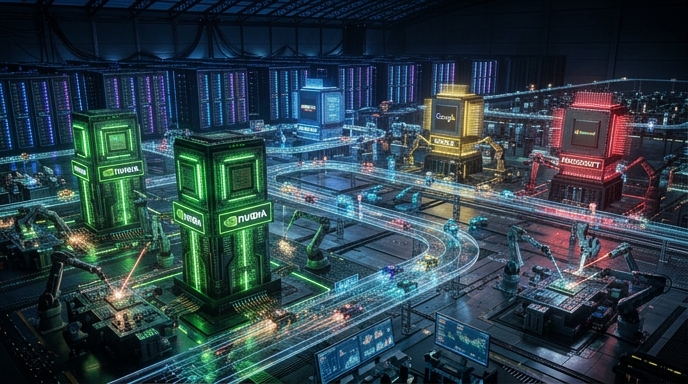
Nvidia still dominates the AI accelerator market, but the giants buying its chips are not helpless customers. They are also some of the richest companies in human history.
TechSpot noted that major Nvidia customers, including Amazon, Alphabet, and Microsoft, are spending heavily on their own AI chips.
That matters. If the hyperscalers can shift even part of their workloads to in-house silicon, Nvidia’s pricing power could weaken over time.
Bol News made the same point, citing concerns that cloud giants are developing their own AI chips.
This does not mean Nvidia is doomed. That would be silly. Nvidia has hardware, software, networking, developer loyalty, and a massive installed ecosystem. CUDA alone is not a moat; it is a moat with crocodiles and a gift shop.
But competition changes the story.
Right now, customers need Nvidia. Eventually, they may want leverage. They may still buy Nvidia’s best chips for frontier models while using custom silicon for cheaper, repetitive workloads. That would not kill Nvidia. But it could cool the fever.
And Nvidia’s valuation does not leave much room for “cool.”
China Is the Awkward Empty Chair
Another risk sits outside the clean earnings math: China.
TechSpot reported that Nvidia’s outlook assumes no data-center compute revenue from China.
That is a big deal. China is one of the world’s largest technology markets. But U.S. export controls have complicated Nvidia’s ability to sell its most advanced AI chips there.
So Nvidia is growing at breakneck speed while effectively modeling limited or no contribution from a major market in one of its most important categories. That can be read two ways.
The bullish read: Nvidia is so strong that it can post record numbers even with China constrained.
The bearish read: geopolitics has already clipped a meaningful growth channel, and future policy changes could keep doing damage.
Both readings can be true.
This is why investors are not merely staring at revenue. They are staring at durability. They want to know whether Nvidia can keep this engine roaring despite export controls, hyperscaler chip ambitions, energy constraints, and AI monetization questions.
The quarter answered the present. It did not fully settle the future.
The Buyback Says Something
Nvidia’s extra $80 billion share repurchase plan and dividend hike gave shareholders a very large treat.
But buybacks can send mixed signals.
On one hand, they show confidence. Nvidia is generating so much cash that it can return a huge pile to shareholders while still funding growth.
On the other hand, buybacks can suggest a company is beginning to mature. Al Jazeera quoted William Rhind of GraniteShares saying Nvidia is shifting into “a different kind of bullish” as capital starts moving toward buybacks and dividends.
That phrase lands because Nvidia has been treated like pure hypergrowth rocket fuel. Dividends and buybacks belong to a slightly different corporate phase. Not old. Not slow. But less feral.
Investors may now be asking whether Nvidia is still in its most explosive chapter or moving into a more mature one where it remains wildly profitable but less shocking.
That is not bad news. Mature Nvidia would still be a monster.
But for a stock priced for miracles, “excellent” can feel strangely ordinary.
The AI Bubble Question Refuses to Die
Nvidia’s numbers are real. The revenue is real. The profits are real. The demand is real.
The harder question is whether Nvidia’s customers will earn enough from AI to justify the spending frenzy.
Al Jazeera noted that Nvidia’s rise, along with sky-high valuations for other tech giants, has fueled debate over whether AI is overhyped and creating a market bubble. It also quoted Goldberg saying tech firms still have not shown a broad-based consumer case for AI.
That is the sharpest critique.
The AI infrastructure boom is easy to measure. Servers, chips, data centers, power contracts, cooling systems, networking gear — all visible.
The AI profit boom is murkier. Some companies clearly benefit. Coding tools, enterprise automation, advertising systems, cloud services, and model providers all have plausible paths. But the economy-wide payoff remains uneven.
Nvidia sells into the boom regardless. That is why its position is so powerful. During a gold rush, the shovel seller gets paid before anyone proves there is gold.
Still, if AI spending eventually slows, Nvidia will feel it first in expectations, then in orders, then in valuation.
The stock dip was small. The doubt behind it was not.
Nvidia Is Still the Company to Beat

Strip away the market theatrics, and the quarter was brutally strong.
Revenue surged. Profit exploded. Data centers carried the business. The company raised guidance. Management sounded confident. Shareholder returns increased. Demand for AI infrastructure remained intense.
The investor reaction does not mean Nvidia failed. It means Nvidia is now being judged against a fantasy version of itself.
That is the curse of becoming the world’s most important AI company. You do not merely have to win. You have to win faster than everyone already assumed you would.
For now, Nvidia remains at the center of the AI buildout. Its chips power the systems that power the models that power the apps that executives keep promising will transform everything.
Maybe the AI boom becomes the next industrial revolution. Maybe parts of it become a spectacular bonfire of overbuilt capacity and executive buzzwords. Probably, annoyingly, both.
But one thing is clear: Nvidia is not watching the AI boom from the sidelines.
It is selling the engine.
And business, for the moment, is absurdly good.
Sources
- TechSpot: “Nvidia hits record $81.6 billion revenue as AI boom shows no sign of slowing” (TechSpot)
- Al Jazeera: “Nvidia posts record profit of $58.3bn amid AI chip boom” (Al Jazeera)
- Bol News: “Nvidia’s record profits fail to amaze investors, as the stock fell 1.6%” (BOL News)
Related Companies
NVIDIA AI Strategy
NVIDIA Enterprise AI
AI Market Strategy
NVIDIA AI Systems
NVIDIA AI Infrastructure
NVIDIA Market Risk
AI Chip Competition
The Kingy Brief
Get The Kingy Brief.
AI changes, original tests and one practical thing to try. Fridays at 09:00 Vancouver time.
Free · Double opt-in · Unsubscribe anytime
Signup help and newsletter schedule
Signup form provided by Beehiiv. After submitting, check your inbox for "Confirm your subscription to The Kingy Brief" and open its confirmation link. Check Spam or Promotions if you cannot find it.
Fridays at 09:00 Vancouver time: source-checked AI changes, original tests and one practical thing to try. The weekly restart begins October 9, 2026. We skip a week when there is not enough verified material. Free. Unsubscribe anytime.