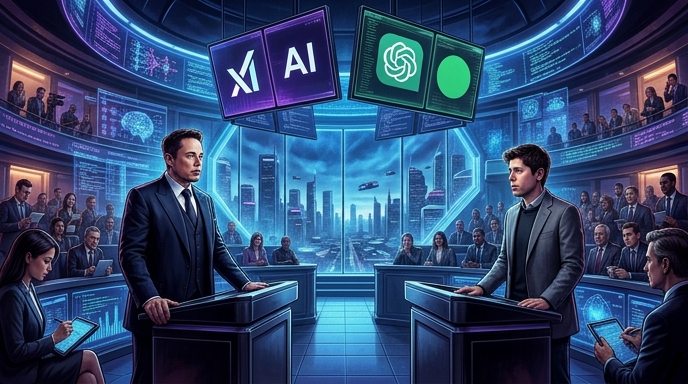
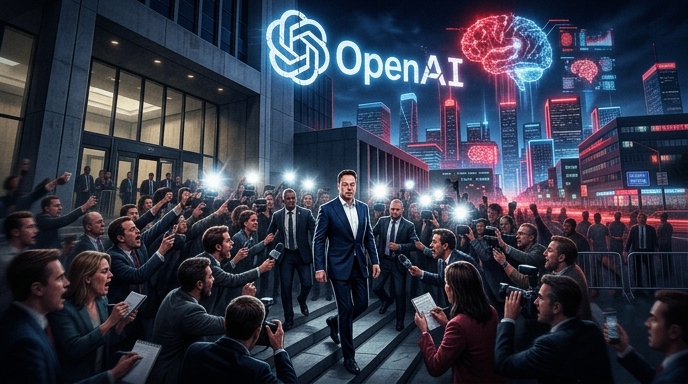
The AI industry loves to market itself as the future of humanity. Noble mission. World-changing technology. High-minded promises wrapped in sleek demos and billion-dollar valuations. Then a courtroom in California pulled back the curtain, and suddenly the whole thing looked less like humanity’s great leap forward and more like a season finale of Succession with GPUs.
A jury deliberated for only two hours before rejecting Elon Musk’s massive lawsuit against OpenAI and CEO Sam Altman. Musk had accused OpenAI of betraying its founding mission by transforming from a nonprofit research lab into a company tightly aligned with corporate interests, particularly through its partnership with Microsoft. He wanted damages that reportedly reached into the staggering territory of $134 billion.
The jury was unconvinced.
And honestly, the speed of the verdict said almost as much as the verdict itself.
According to reporting from The Verge, jurors moved quickly to reject Musk’s central claims. Other outlets, including The Decoder and Inc., painted the same picture: a dramatic legal offensive that collapsed almost instantly once ordinary people got into the deliberation room.
Still, the most interesting part of this story is not that Musk lost.
It’s that almost everyone involved managed to look bad anyway.
A Trial About AI That Barely Felt Like It Was About AI
On paper, the case sounded historic.
Musk co-founded OpenAI in 2015 alongside Sam Altman and others. The organization originally positioned itself as a nonprofit focused on building artificial general intelligence safely and openly. The stated mission was unusually idealistic for Silicon Valley: develop AI for humanity, not just shareholders.
Then reality arrived carrying venture capital term sheets.
OpenAI evolved. Microsoft poured in billions. GPT products exploded into the mainstream. Corporate structures became more complicated. The nonprofit remained technically involved, but the commercial arm became the engine driving the AI boom.
Musk argued this transformation violated OpenAI’s founding principles. He claimed the company effectively abandoned its original mission in pursuit of profit and market dominance.
That argument resonated emotionally with a lot of people. Even critics of Musk admit there is something uncomfortable about a company called “OpenAI” becoming increasingly closed, secretive, and commercially aggressive.
But emotional resonance is not legal proof.
And the courtroom exposed a major weakness in Musk’s case: much of the dispute appeared rooted in ideological disappointment rather than enforceable contractual betrayal.
That distinction matters.
A lot.
The Jury Didn’t Buy the “Betrayed Visionary” Narrative
Musk has cultivated a public image as the prophetic outsider warning humanity about AI dangers while everyone else races toward disaster. Sometimes that image works spectacularly well. Sometimes it crashes headfirst into contradictory reality.
This case landed in the second category.
As several reports noted, OpenAI’s legal team hammered away at an inconvenient fact: Musk himself had once pushed for OpenAI to become more commercially aggressive. Evidence presented during the trial reportedly included communications showing Musk discussing funding pressures and organizational restructuring years earlier.
That complicated the narrative immediately.
It is difficult to portray yourself as the lone defender of nonprofit purity when your own historical record suggests you also wanted scale, money, and competitive firepower.
The jury apparently noticed.
According to , deliberations moved with remarkable speed, signaling that jurors may have viewed the case as comparatively straightforward. That is brutal for Musk. Complex billion-dollar disputes are not supposed to evaporate in two hours.
Two hours suggests clarity.
Or exhaustion.
Possibly both.
Sam Altman Won the Case. That Doesn’t Mean He Won the Argument.
Here is where things get interesting.
Legally, OpenAI emerged victorious. Publicly, though, the company still carries a growing credibility problem.
The lawsuit forced people to revisit uncomfortable questions that OpenAI has spent years trying to move past:
- Is OpenAI genuinely committed to openness?
- Can a nonprofit structure realistically govern one of the most commercially valuable technologies on Earth?
- Does “AI safety” remain a guiding principle or merely a branding layer?
- Who actually controls the future of artificial intelligence?
Those questions did not disappear when the verdict arrived.
If anything, they became louder.
One of the sharpest observations came from The Verge analysis piece, which argued that the trial revealed a deeper dysfunction inside the AI industry itself. The courtroom became a public stage where billionaires fought over ideology, ownership, ego, and power while claiming to speak for humanity’s future.
That is not reassuring.
Not even slightly.
The AI Industry Has a Leadership Problem
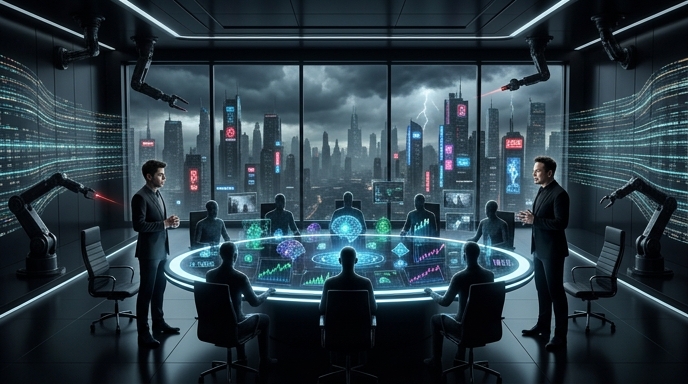
The most damaging takeaway from the trial may be this: the people building transformative AI systems increasingly look incapable of governing them responsibly.
That sounds harsh. It is also difficult to avoid.
Consider the cast of characters.
Elon Musk warns about existential AI dangers while simultaneously building his own AI company, xAI, to compete aggressively in the same market he criticizes.
Sam Altman talks constantly about safety and regulation while leading one of the fastest commercialization efforts in tech history.
Major AI firms advocate caution publicly while racing privately for market dominance, talent acquisition, and infrastructure control.
Everyone claims to fear uncontrolled AI development.
Nobody stops accelerating.
The contradiction is glaring.
The Musk-OpenAI trial unintentionally highlighted this better than any policy paper ever could. These are not philosopher-kings carefully stewarding civilization-changing tools. They are ambitious executives, investors, and founders operating under extreme competitive pressure.
In other words, they are human.
And humans are messy.
Silicon Valley’s Favorite Myth Just Imploded
For years, the tech industry sold a comforting myth: brilliant founders, if left alone, would naturally build a better future.
The OpenAI saga demolishes that mythology.
OpenAI started with lofty rhetoric about transparency and collaboration. Then market incentives arrived, and suddenly secrecy became strategic. Partnerships became essential. Competitive advantage mattered more than openness.
Again, this is not shocking. It is capitalism functioning exactly as designed.
The important point is that the AI industry still pretends otherwise.
Companies continue framing commercial decisions as moral crusades. Executives speak in near-religious language about “benefiting humanity” while simultaneously fighting for market share worth hundreds of billions of dollars.
The Musk trial stripped away some of that performance.
At times, the proceedings sounded less like a dispute over civilization’s future and more like former business partners arguing over who lost control of the rocket ship.
Because that is basically what happened.
Microsoft Stayed Quiet — And That Was Smart
One fascinating subplot involved Microsoft.
Microsoft largely avoided becoming the public face of the conflict despite sitting at the center of OpenAI’s commercial transformation. That restraint mattered.
While Musk and Altman dominated headlines, Microsoft maintained distance and stability. It looked corporate, disciplined, and boring. In a legal and media circus, boring is a superpower.
The company also benefited from a simple reality: regardless of courtroom drama, OpenAI’s technology remains commercially dominant.
Businesses still use ChatGPT. Developers still build on OpenAI APIs. Enterprises still sign contracts.
The trial generated spectacle, not operational collapse.
That distinction matters more than social media outrage.
Musk’s Bigger Problem Is Credibility Drift
Musk’s supporters will argue that he lost the legal battle but won the philosophical argument. There is partial truth there. Public skepticism toward OpenAI has grown substantially over time.
But Musk faces a separate issue: credibility fragmentation.
When Musk criticizes AI commercialization while commercializing AI himself, the message weakens.
When he attacks concentrated AI power while building his own vertically integrated ecosystem across social media, compute, data, and AI models, critics see contradiction rather than principle.
That does not automatically make him wrong.
It does make persuasion harder.
And persuasion was central to this case.
The jury apparently saw enough ambiguity, inconsistency, or insufficient evidence to reject the claims decisively.
That outcome will likely echo beyond this lawsuit. Musk’s future attempts to position himself as the industry’s ethical counterweight may face greater skepticism now.
The Public Finally Saw the AI Power Struggle Up Close
Most AI debates happen through abstract headlines.
Alignment.
Safety.
Scaling laws.
Inference costs.
AGI timelines.
Normal people tune out because the language feels distant and technical.
This trial changed that.
Suddenly the AI industry looked personal, emotional, and political. The public saw billionaires fighting over control, promises, governance structures, and money. Lots of money.
That visibility matters because AI is no longer a niche technology story. It is becoming infrastructure. Economic infrastructure. Military infrastructure. Educational infrastructure.
And the institutions governing it remain astonishingly unstable.
Remember: OpenAI’s leadership crisis in late 2023 nearly detonated the company overnight. Employees threatened revolt. Microsoft maneuvered behind the scenes. Executives scrambled publicly.
Now add this lawsuit to the pile.
For an industry supposedly building civilization-scale intelligence systems, the governance often resembles group project chaos with better lawyers.
What Happens Next?

Probably more acceleration.
That is the uncomfortable reality underneath all the rhetoric.
The verdict removes a major legal distraction for OpenAI. The company can continue scaling products, partnerships, and infrastructure without the existential threat Musk hoped to create through litigation.
Meanwhile, Musk will keep building xAI. Competition will intensify. Capital spending will explode further. Governments will struggle to regulate technology they barely understand.
And everyone involved will continue insisting they are acting in humanity’s best interests.
Maybe some of them genuinely believe it.
But belief does not eliminate incentives.
That is the central lesson from this entire saga.
The AI race is not being governed primarily by ethics, philosophy, or caution. It is being governed by competition, capital, prestige, and survival pressure. The courtroom simply made that impossible to ignore.
The jury rendered a legal verdict in two hours.
The larger verdict on the AI industry is still unfolding.
And it may be much uglier.
Sources
- The Verge – Jury delivers verdict in Musk v. Altman OpenAI trial
- The Verge – Musk v. Altman proved that AI is led by the wrong people
- The Decoder – Elon Musk loses his $134 billion lawsuit against OpenAI after jury deliberates for just two hours
- Inc. – Elon Musk Was Just Handed a Big Loss by a Judge and Jury in Major AI Trial
- The Straits Times – Elon Musk loses lawsuit against OpenAI
Musk vs OpenAI
- Musk vs Altman trial
- Altman invites Musk to GPT-5.5 launch
- Elon vs OpenAI lawsuit history
- OpenAI lawsuit journal entries
- Musk revives OpenAI lawsuit
OpenAI Governance
Musk xAI Antitrust
The Kingy Brief
Get future Kingy Brief editions.
Source-checked AI changes, original tests and one practical thing to try.
Free · Choose your subjects · Double opt-in · Unsubscribe anytime
Regular sending is paused; no restart date is set.