For years, the Philippines occupied an awkward place in the global technology conversation. The country produced world-class talent. It powered customer support for Silicon Valley giants. It exported nurses, engineers, seafarers, and coders. Yet it rarely appeared in the same sentence as semiconductor dominance, artificial intelligence infrastructure, or industrial strategy.
That is changing fast.
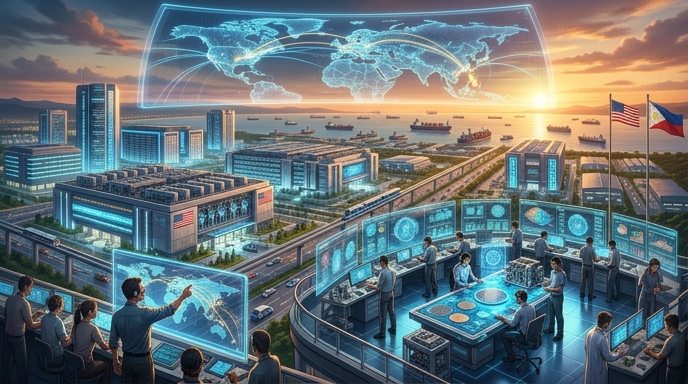
The United States now wants the Philippines to become part of a new economic and technological corridor stretching across the Indo-Pacific. Not as a symbolic partner. Not as a diplomatic accessory. As an operational hub.
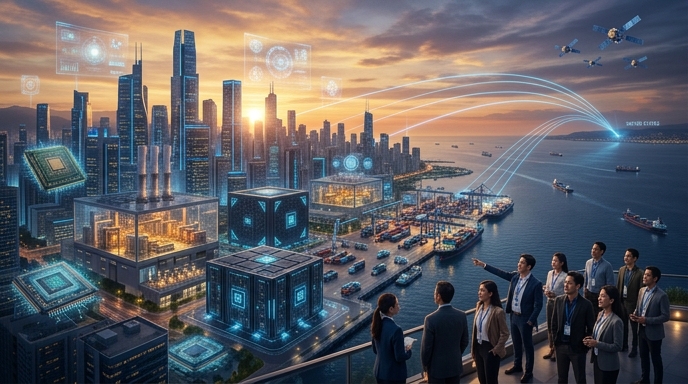
At the center of this shift sits a proposed 4,000-acre economic security zone in Central Luzon, alongside a parallel push to develop a massive AI and semiconductor ecosystem in New Clark City. Together, these projects signal something bigger than ordinary foreign investment. They reveal a strategic attempt to redesign global supply chains while reducing dependence on China.
And suddenly, the Philippines is no longer just answering customer service calls. It may soon help power the next generation of AI infrastructure itself.
A Quiet Announcement With Massive Implications
In ordinary times, a diplomatic press release about an “economic security zone” would barely register outside policy circles. But these are not ordinary times.
The announcement from the U.S. Embassy in the Philippines described plans for a 4,000-acre economic security zone designed to strengthen supply chains, attract high-tech manufacturing, and deepen U.S.-Philippines cooperation. The project aims to support industries tied to semiconductors, clean energy, logistics, and advanced technology.
That sounds bureaucratic. Dry, even.
It is not.
This is part of a larger geopolitical restructuring already underway across Asia. Washington has realized something uncomfortable: modern economies depend on fragile supply chains concentrated in too few places. The pandemic exposed the weakness. The semiconductor shortage amplified it. Rising tensions with China turned the issue from an economic concern into a national security obsession.
The United States now wants redundancy. It wants resilience. It wants friendly nations handling critical production.
And the Philippines suddenly checks several important boxes.
It has a young population. English proficiency remains strong. Labor costs stay lower than many regional competitors. The country already possesses an established electronics manufacturing sector. Geography also matters. The Philippines sits directly inside one of the world’s most strategically important maritime corridors.
That combination makes investors pay attention.
The proposed economic zone is not merely about building factories. It is about building a strategic node inside a new American-led industrial network.
The language sounds technical. The implications are enormous.
Why Semiconductors Changed Everything
To understand why this matters, start with a simple truth: semiconductors run modern civilization.
Cars use them. Smartphones use them. Hospitals use them. Fighter jets use them. AI systems devour them by the millions.
No chips, no digital economy.
For decades, the semiconductor industry evolved toward hyper-efficiency. Manufacturing concentrated in a handful of countries. Taiwan became indispensable. China dominated parts of the supply chain. The model worked brilliantly — until it didn’t.
Then came COVID-19.
Factories shut down. Shipping collapsed. Automakers halted production. Electronics companies scrambled for inventory. Suddenly governments realized that relying on geographically concentrated supply chains was not efficiency. It was strategic vulnerability.
Now AI is making the problem even more urgent.
Training advanced AI systems requires staggering computational power. Computational power requires advanced chips. Advanced chips require stable supply chains. Every major economy now wants secure access to semiconductor infrastructure.
That explains why countries everywhere have launched industrial policy programs. The U.S. passed the CHIPS Act. Europe introduced semiconductor initiatives. Japan ramped up subsidies. India entered the race aggressively.
The Philippines now wants a seat at that table.
And Washington appears willing to help pull up a chair.
Enter New Clark City, the Philippines’ High-Tech Gamble
The second major development may prove even more ambitious.
According to reporting from The Next Web, American AI infrastructure firm Pax AI and semiconductor company Silica announced plans connected to New Clark City. Their vision is striking: transform the area into a large-scale AI and semiconductor hub capable of attracting advanced computing infrastructure and manufacturing investment.
New Clark City already carries enormous symbolic weight inside the Philippines. The government designed it as a next-generation urban center intended to reduce pressure on Metro Manila while showcasing modern infrastructure planning.
Now it may become something else entirely: an AI industrial city.
That phrase sounds futuristic because it is.
The project reportedly includes plans tied to data centers, semiconductor facilities, AI computing infrastructure, and energy systems capable of supporting enormous processing requirements. AI infrastructure consumes huge amounts of electricity. Reliable energy therefore becomes central to any serious AI ecosystem.
This is where the story gets interesting.
The Philippines historically struggled with infrastructure bottlenecks. Power costs remain relatively high compared with some neighbors. Internet infrastructure has improved but still lags elite regional hubs. Bureaucratic friction often slows large projects.
Yet investors increasingly seem willing to tolerate those problems because the strategic logic outweighs the inefficiencies.
That alone represents a remarkable shift.
Five years ago, few people discussed the Philippines as a future AI infrastructure destination. Today international firms openly discuss building AI ecosystems there.
That is not incremental change. That is narrative transformation.
The China Factor Looms Over Everything
Let’s stop pretending geopolitics is a side issue here. It is the issue.
The U.S.-China rivalry hangs over every supply chain discussion in Asia. Every semiconductor project, every AI infrastructure deal. Every industrial zone announcement.
The proposed Philippine initiatives cannot be separated from that reality.
Washington increasingly views economic dependency on China as a strategic risk. Beijing, meanwhile, continues expanding its own technological ambitions while asserting influence across the South China Sea.
The Philippines occupies a critical position in this contest.
Geographically, the country sits near major maritime trade routes and close to Taiwan. Politically, Manila has strengthened security ties with Washington under recent agreements expanding U.S. military access to Philippine bases.
Economics now follows strategy.
The industrial zone and AI infrastructure plans fit neatly into broader American efforts to strengthen alliances while diversifying production networks away from China.
That does not mean the Philippines wants confrontation. Quite the opposite. Philippine leaders generally seek economic relationships with everyone. China remains an important trading partner.
But reality intrudes.
When major powers compete, middle countries often become arenas where economic influence gets negotiated through investment, infrastructure, and industrial partnerships.
The Philippines now finds itself inside that dynamic.
Some will call this opportunity. Others will call it dependency. Both arguments contain truth.
Can the Philippines Actually Pull This Off?
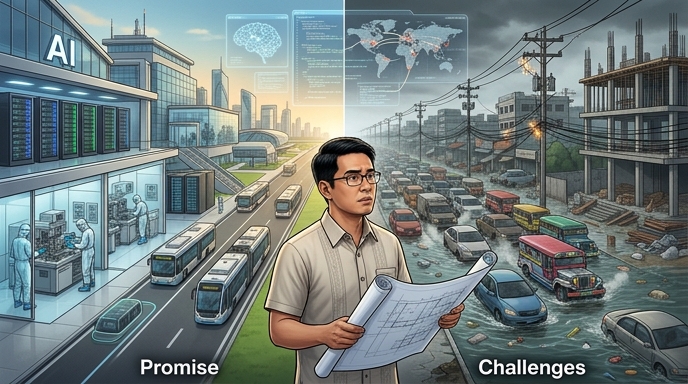
This is the uncomfortable question many analysts whisper privately.
Ambition is easy. Execution is brutal.
The Philippines has announced transformative economic visions before. Some succeeded partially. Others stalled inside bureaucratic paralysis, infrastructure limitations, political turnover, or regulatory confusion.
So skepticism is justified.
Large-scale semiconductor and AI ecosystems require more than enthusiasm. They demand reliable electricity, world-class logistics, water infrastructure, political stability, legal predictability, and specialized talent pipelines.
Taiwan did not become a semiconductor powerhouse overnight. South Korea spent decades building industrial capacity. Singapore relentlessly optimized governance and infrastructure. These ecosystems emerge slowly.
The Philippines still faces significant constraints.
Electricity prices remain relatively high. Infrastructure gaps persist. Corruption concerns continue damaging investor confidence. Regulatory processes can become maddeningly slow. Education quality varies sharply.
And AI infrastructure introduces additional complications.
Modern AI data centers consume astonishing amounts of power and cooling resources. Countries competing in AI increasingly resemble countries competing in heavy industry. Cheap, stable energy matters enormously.
That creates a potential contradiction.
Can the Philippines simultaneously become a green-energy advocate while supporting energy-intensive AI infrastructure? Maybe. But the balancing act will be difficult.
Still, dismissing the country outright would be shortsighted.
The Philippines possesses genuine strengths. Its workforce remains highly adaptable. The country already exports electronics components globally. English fluency provides an edge in international business integration. Demographics favor long-term labor availability.
Most importantly, global conditions changed.
Countries no longer seek perfect manufacturing locations. They seek diversified manufacturing networks. “Good enough plus strategically aligned” now matters more than “perfect efficiency.”
That shift benefits the Philippines enormously.
AI Is Reshaping Industrial Strategy
For years, artificial intelligence existed mostly as software hype. Chatbots. Recommendation engines. Image generators. Viral demos.
That phase is ending.
AI now drives infrastructure policy.
Governments increasingly view AI capabilities the way previous generations viewed oil reserves or steel production. Whoever controls computing infrastructure gains strategic leverage.
That is why countries everywhere race to build data centers, semiconductor capacity, cloud infrastructure, and energy grids capable of supporting massive AI workloads.
The Philippines wants in.
And frankly, it has reasons to move quickly.
AI threatens portions of the country’s traditional outsourcing economy. Call centers and business process outsourcing created millions of jobs, but generative AI increasingly automates some routine functions. That does not mean BPO disappears tomorrow. It does mean the sector faces pressure.
So the Philippines needs industrial upgrading.
Moving from service outsourcing toward higher-value AI infrastructure and semiconductor participation offers one possible path forward. It is risky. But remaining static may be riskier.
The global AI economy will not wait politely for slower countries to catch up.
The New Geography of Technology
Something deeper is happening beneath all this investment talk.
The geography of technology is fragmenting.
For decades, globalization pushed toward concentration. Companies optimized relentlessly for efficiency. Production clustered wherever costs fell lowest. Nations specialized aggressively.
Now resilience matters more.
The future likely involves regionalized technology blocs rather than one fully integrated global system. The United States and its allies build parallel supply chains. China builds its own ecosystem. Other countries navigate between them.
That creates openings for nations like the Philippines.
Instead of competing directly with China’s manufacturing scale, the Philippines can position itself as part of a trusted regional network aligned with American and allied technology ecosystems.
This strategy will not make the country the next Taiwan overnight. That comparison would be fantasy. Taiwan possesses decades of accumulated expertise and industrial density that cannot simply be replicated.
But the Philippines may not need to become Taiwan.
It simply needs to become useful enough, stable enough, and strategically valuable enough to attract sustained investment flows.
That goal looks increasingly achievable.
What Success Would Actually Look Like
People often misunderstand industrial transformation. They imagine instant skylines filled with futuristic factories.
Real success looks slower and less cinematic.
If these initiatives work, the first signs may appear quietly. More engineering jobs. Expanded electronics manufacturing. Increased foreign direct investment. Better logistics infrastructure. Specialized training programs. New energy projects supporting data centers.
Over time, ecosystems compound.
Suppliers cluster near manufacturers. Universities adapt curricula. Technical expertise spreads. Venture capital follows infrastructure. Talent stays local instead of emigrating.
That is how industrial capability grows.
The Philippines already has partial foundations. Electronics exports are substantial. Semiconductor assembly and testing operations already exist. The country is not starting from zero.
What changes now is strategic importance.
Washington increasingly sees Philippine industrial development as aligned with American security interests. That changes funding dynamics, diplomatic attention, and investor confidence.
In geopolitics, perceived importance often becomes self-reinforcing.
The Risks Nobody Wants to Talk About
Every optimistic story hides uncomfortable risks.
Here are several.
First, geopolitical escalation could destabilize everything. If U.S.-China tensions worsen dramatically, countries caught between both powers may face enormous pressure.
Second, infrastructure ambitions frequently outrun implementation capacity. Grand announcements generate headlines. Actual construction exposes institutional weaknesses.
Third, AI hype can distort investment decisions. Many countries now chase AI branding without fully understanding long-term economics. Some projects will fail spectacularly.
Fourth, industrial policy carries political risk. Leadership changes can disrupt continuity. Investors hate uncertainty.
Fifth, climate vulnerability matters. The Philippines faces typhoons, flooding, and environmental stress. High-tech infrastructure requires resilience planning at serious scale.
And finally, there is the workforce challenge.
Advanced semiconductor and AI ecosystems require deep technical talent pools. Building those pools takes years. Sometimes decades.
No press release solves that overnight.
Why This Moment Still Feels Different
Despite all those caveats, something genuinely shifted.
For decades, conversations about the Philippines often centered on labor export, remittances, outsourcing, or tourism. Those sectors remain important. But they rarely conveyed technological centrality.
Now the conversation includes AI infrastructure, semiconductor ecosystems, supply chain resilience, and industrial strategy.
That matters psychologically as much as economically.
Countries partly become what global capital believes they can become.
Right now, major players increasingly believe the Philippines can play a larger technological role in Asia. That belief itself changes investment behavior.
Will every project succeed? No chance.
Will timelines slip? Almost certainly.
Will political complications emerge? Absolutely.
But the underlying strategic trend appears real.
The world’s largest economies are redesigning supply chains for an era defined by geopolitical rivalry and AI competition. The Philippines has positioned itself as a participant in that redesign.
That alone marks a historic shift.
Conclusion: From Outsourcing Nation to Strategic Tech Partner
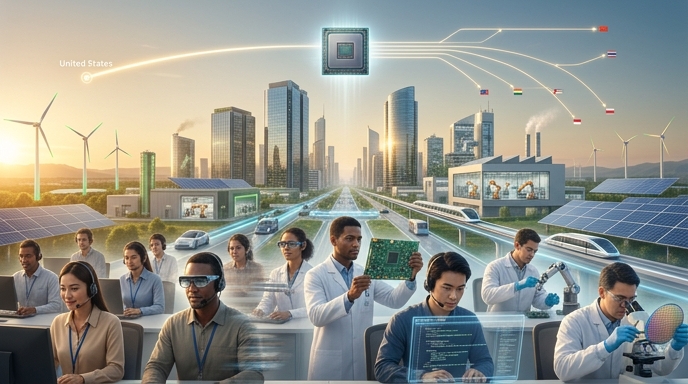
The Philippines stands at a strange crossroads.
One path preserves the old model: labor exports, outsourcing dominance, steady remittance flows, incremental growth. Familiar. Stable. Limited.
The other path aims much higher. Semiconductor integration. AI infrastructure. Strategic manufacturing. Industrial upgrading tied directly to global geopolitical realignment.
That second path carries enormous risk. It also carries enormous possibility.
The proposed economic security zone and New Clark City AI hub are not isolated projects. Together they represent an attempt to reposition the Philippines inside the architecture of twenty-first-century technology power.
The stakes extend beyond economics.
Supply chains now shape national security. AI infrastructure shapes geopolitical influence. Semiconductor access shapes industrial competitiveness. Countries that participate meaningfully in these systems gain leverage. Countries left outside them risk irrelevance.
The Philippines clearly does not want irrelevance.
Neither does the United States.
That convergence explains why Washington suddenly talks about industrial zones in Central Luzon with unusual urgency.
Underneath the diplomatic language lies a blunt strategic reality: America wants trusted partners capable of supporting the technologies that will define the next era of global power.
And for the first time in a long time, the Philippines may be positioned to become one of them.
Sources
- U.S. Embassy in the Philippines — “The United States and the Philippines Launch Plans for 4,000-Acre Economic Security Zone to Shore Up Supply Chains”
U.S. Embassy Source Article - The Next Web — “US and Philippines Back AI Hub in Clark City”
The Next Web Source Article - The Straits Times — “The US Wants an Industrial Hub in the Philippines. What Does It Mean for Supply Chains?”
The Straits Times Source Article
The Kingy Brief
Get future Kingy Brief editions.
Source-checked AI changes, original tests and one practical thing to try.
Free · Choose your subjects · Double opt-in · Unsubscribe anytime
Regular sending is paused; no restart date is set.