Apple spent years building a reputation on control. Tight control. Ruthless control. The company controlled hardware, software, distribution, payments, accessories, repairs, and increasingly, services. If Apple were a landlord, it would charge Siri rent for speaking too loudly in the hallway.
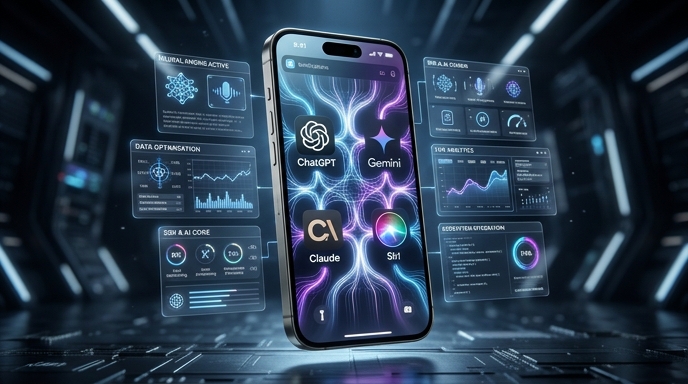
Now comes iOS 27. And suddenly Apple appears ready to do something that would have sounded absurd just a few years ago: let users choose rival AI systems to power core iPhone features.
Not just a chatbot app. Not just a web shortcut. System-wide AI integration.
According to multiple reports, Apple plans to introduce a new “Extensions” framework in iOS 27, iPadOS 27, and macOS 27 that would allow users to select third-party AI models such as Google Gemini or Anthropic Claude to work across Apple Intelligence features. That includes Siri, Writing Tools, and Image Playground.
This is not a cosmetic tweak. It is a strategic admission.
Apple is effectively saying: “We may not have the best AI model, so we’re going to turn the iPhone into a platform for everyone else’s.”
That changes everything.
Apple’s AI Problem Finally Became Impossible to Hide
For years, Apple got away with being late.
Late to large phones, Late to OLED screens, Late to widgets. Late to foldables, Late to generative AI.
Usually, it didn’t matter. Apple entered markets slowly, polished the experience, and vacuumed up profits anyway.
AI looks different.
OpenAI detonated the consumer AI market with ChatGPT. Google responded with Gemini. Anthropic built Claude into a favorite among writers, coders, and researchers. Microsoft embedded AI into Windows and Office at terrifying speed. Meanwhile Apple launched Apple Intelligence with great fanfare — and then immediately ran into delays, feature gaps, and mounting skepticism.
The most damaging issue involved Siri.
Apple heavily promoted advanced Siri capabilities during its AI push, but many of the promised features failed to arrive on schedule. The backlash became severe enough that Apple reportedly agreed to a $250 million settlement related to delayed Siri AI features. (TechRadar)
That matters because Apple’s entire ecosystem depends on trust. The company sells the idea that everything “just works.” AI exposed cracks in that image.
Consumers discovered something uncomfortable: Apple’s AI wasn’t leading. It was chasing.
And chasing badly.
The “Extensions” Strategy Is Apple’s Escape Hatch
The reported iOS 27 solution is elegantly pragmatic.
Instead of trying to beat OpenAI, Google, Anthropic, and every other frontier AI lab simultaneously, Apple may simply become the operating system layer that routes users to whichever model they prefer.
Think of it as the App Store model applied to AI cognition.
Under the reported system, users could install compatible AI apps and designate them as preferred models for Apple Intelligence features. Siri could hand requests to Gemini. Writing Tools could use Claude. Image generation could rely on another provider entirely. (The Verge)
That is an astonishing philosophical shift.
Historically, Apple hated abstraction layers it didn’t own. The company resisted third-party defaults for years. It fought browser competition. It dragged its feet on alternative app stores. It tightly constrained system integrations.
Now Apple may allow competing AI systems to sit directly inside the operating system experience.
Not because Apple suddenly became ideologically open.
Because it had to.
Siri Is No Longer the Star of the Show
This may be the most important part of the entire story.
Siri is quietly being demoted.
For over a decade, Siri functioned as Apple’s AI identity. Even when Siri lagged behind Alexa or Google Assistant, Apple insisted Siri remained central to the iPhone experience.
But generative AI changed user expectations overnight.
People no longer want a voice assistant that can merely set timers and mishear restaurant names. They want reasoning. Context. Writing assistance. Coding help. Research synthesis. Image generation. Multi-step planning.
Siri was not built for that world.
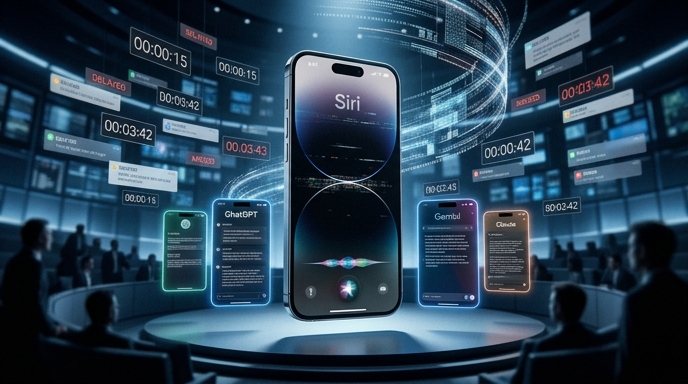
Apple’s rumored AI architecture essentially transforms Siri into a routing layer. Siri becomes the traffic cop rather than the intelligence itself.
That’s a dramatic downgrade in strategic importance.
Reports suggest Apple may even allow different Siri voices depending on which external AI model is responding.
That sounds minor. It isn’t.
Voice identity matters psychologically. If users begin associating the “smart” responses with Gemini or Claude instead of Siri, Apple risks turning its own assistant into invisible plumbing.
Apple may be preserving Siri’s interface while outsourcing its brain.
Why Google and Anthropic Stand to Gain Massive Ground
If these reports prove accurate, Google and Anthropic could gain unprecedented access to Apple’s user base.
That is an enormous opportunity.
Apple devices represent one of the richest consumer ecosystems on Earth. iPhone users spend more money, engage more deeply with apps, and historically remain loyal longer than Android users.
Until now, AI companies largely reached Apple users through standalone apps.
That is clunky.
Native integration changes the economics completely.
If Gemini becomes deeply integrated into Siri workflows, Google suddenly gains daily conversational access to hundreds of millions of premium users. Claude could become the preferred writing assistant for professionals, students, journalists, and developers inside Apple’s ecosystem.
Apple becomes the distributor. Rivals become the intelligence providers.
It resembles what happened with search.
Google became massively powerful partly because Apple made Google the default search engine on Safari. That partnership reportedly became worth billions annually. AI integration could become an even bigger strategic dependency.
And Apple knows it.
OpenAI Could Lose Its Privileged Position
Until now, OpenAI enjoyed a special relationship with Apple Intelligence.
ChatGPT became the first major external AI integrated into Siri workflows and Apple’s Writing Tools. That partnership gave OpenAI prestige and visibility that competitors envied.
But exclusivity appears to be ending.
Reports indicate iOS 27 may open the floodgates to multiple providers, including Gemini and Claude.
That creates a brutal new reality for OpenAI.
Instead of being “the AI inside Apple devices,” ChatGPT may become just another selectable option in a menu.
And once users compare models directly, things become unpredictable.
Claude has built a reputation for nuanced writing and coding assistance. Gemini benefits from Google’s search infrastructure and multimodal capabilities. OpenAI still leads in brand recognition, but AI loyalty remains fragile. Users switch fast when performance changes.
Apple may unintentionally create an AI free market inside iOS.
That could spark relentless competition between AI providers for default status.
The Real Winner May Be Apple Itself
At first glance, Apple looks weak here.
The company appears unable to dominate AI internally, so it’s outsourcing the hard part.
But that interpretation misses the deeper strategy.
Apple may be trying to become the Switzerland of AI.
Instead of winning the model war, Apple could win the orchestration war.
If every major AI company wants access to iPhone users, Apple becomes the gatekeeper. Again.
That means Apple can collect platform fees, dictate privacy rules, manage integrations, and preserve ecosystem control without necessarily building the best frontier model itself.
It is classic Apple behavior disguised as openness.
The company is essentially saying:
“You can compete for intelligence. But you still compete inside our house.”
That may actually be the smartest move Apple could make.
Building frontier AI models costs staggering amounts of money. OpenAI, Google, Meta, Anthropic, and xAI are burning capital at industrial scale. Apple historically hates low-margin arms races.
So Apple may sidestep the model war entirely and focus on integration, hardware optimization, privacy layers, and user experience.
That is a very Apple answer to the AI problem.
Privacy Is About to Become the Central Marketing Weapon
Apple has another advantage here: trust.
Consumers increasingly worry about AI systems harvesting data, profiling users, and vacuuming personal information into giant training pipelines.
Apple sees an opening.
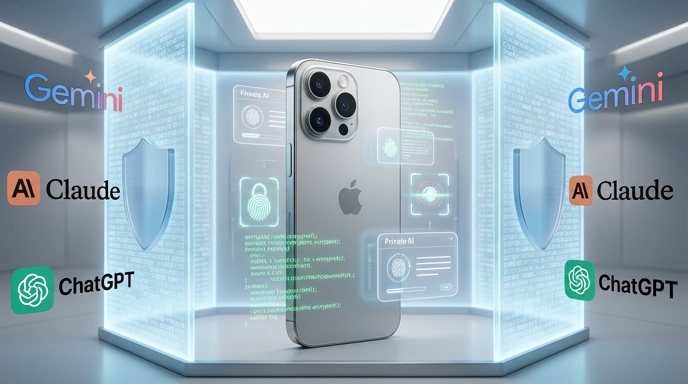
By acting as the intermediary layer between users and third-party AI systems, Apple can position itself as the privacy buffer.
The company will likely market this aggressively.
Expect phrases like:
- “Private AI routing”
- “On-device safeguards”
- “User-controlled intelligence”
- “Secure AI extensions”
And frankly, it may work.
Apple already built much of its modern brand identity around privacy differentiation. In an AI era filled with paranoia about data scraping and surveillance, Apple can exploit that positioning ruthlessly.
Whether the protections are genuinely superior remains another question entirely.
Still, perception matters.
And Apple remains exceptionally good at shaping perception.
Developers Could Benefit From the Chaos
This move may create a new software gold rush.
If Apple opens AI integrations through APIs and App Store-compatible extensions, developers suddenly gain access to system-level AI distribution channels.
Smaller AI startups could potentially plug specialized models into Apple workflows.
Imagine:
- Legal AI extensions
- Medical research assistants
- Academic citation engines
- Finance-focused copilots
- Coding-specialized models
- Creative writing assistants
One report suggested Apple may release developer tools allowing third-party chatbot makers to integrate directly with Siri and Apple Intelligence.
That matters because platform access determines survival in technology markets.
The companies embedded into operating systems tend to dominate.
Everyone else becomes a browser tab.
This Could Also Become a Complete Mess
Now for the ugly part.
AI fragmentation risks creating user confusion at massive scale.
Most consumers barely understand the differences between ChatGPT, Gemini, Claude, Copilot, and other models. Asking average iPhone users to choose AI engines may produce chaos.
Which model handles what?
Which one stores data?
Which one hallucinates less?
Which one is best for writing?
Coding?
Research?
Images?
Voice interaction?
Most people do not want an AI marketplace. They want something that works.
Apple historically succeeded because it reduced complexity. This approach potentially increases complexity dramatically.
Worse, inconsistent AI behavior across apps and workflows could make the user experience feel fragmented.
One AI might answer cautiously. Another aggressively, Another creatively. Another incorrectly.
Apple risks turning the iPhone into a personality disorder machine.
The Competitive Pressure Is Crushing Apple
The broader context matters here.
Apple did not make this move from a position of overwhelming strength.
The company is under intense pressure to prove it still matters in AI.
Google is embedding Gemini everywhere. Microsoft transformed Windows into an AI-centric platform. OpenAI became a consumer technology giant almost overnight. Meta is flooding its ecosystem with AI assistants.
Apple cannot afford another failed AI cycle.
The company already suffered reputational damage from delayed Apple Intelligence promises and Siri criticism.
If Apple waited another two or three years trying to build a fully competitive in-house AI stack before opening the platform, it risked irrelevance.
That sounds extreme. It isn’t.
Technology leadership can evaporate surprisingly fast.
BlackBerry looked invincible until it didn’t.
Nokia dominated until the smartphone transition destroyed it.
Intel missed mobile.
IBM missed personal computing.
Apple understands platform shifts better than almost anyone alive. That’s why this rumored pivot matters so much.
It signals urgency.
The iPhone Is Becoming an AI Router
The most important conceptual shift is this:
The iPhone may no longer be defined primarily by apps.
It may increasingly be defined by AI orchestration.
Historically, smartphones acted like launchpads for apps. You opened software intentionally.
AI changes that paradigm.
Now intelligence becomes ambient. Persistent. Embedded everywhere.
You ask questions system-wide.
Generate text system-wide.
Edit images system-wide.
Summarize notifications system-wide.
Automate workflows system-wide.
The operating system itself becomes conversational.
That changes platform power dramatically.
Whoever controls the orchestration layer controls user attention.
Apple appears determined to remain that orchestrator — even if the underlying intelligence comes from rivals.
What Happens Next?
Several questions remain unresolved.
First, Apple has not officially announced these features. Most reporting traces back to Bloomberg reporting echoed by multiple outlets. The details could change before launch.
Second, pricing remains unclear.
- Will premium AI integrations require subscriptions?
- Will Apple take revenue shares?
- Will users pay per model?
- Will advanced models require separate accounts?
Third, regulation could complicate everything.
If Apple selectively privileges certain AI providers, regulators may scrutinize those arrangements closely. Antitrust pressure already surrounds Apple’s App Store policies and search partnerships.
Adding AI gatekeeping to the mix could intensify those battles.
Finally, the technology itself remains unstable.
AI models evolve at absurd speed. The “best” model changes constantly. Apple may struggle to maintain coherent integrations across rapidly shifting AI ecosystems.
Still, the direction is becoming unmistakable.
The smartphone industry is entering its AI platform phase.
And Apple appears ready to stop pretending it can do everything alone.
Apple’s Most Un-Apple Decision in Years

There’s a strange irony here.
The company most famous for vertical integration may be preparing for one of the most horizontally open moves in its modern history.
Apple spent decades building walled gardens.
Now it may invite rival intelligences directly into the castle.
- Not because Apple became generous.
- Not because Apple suddenly embraced openness.
- Not because executives developed ideological enthusiasm for interoperability.
Because AI changed the rules.
Frontier AI development now moves too quickly, costs too much, and evolves too unpredictably for any single ecosystem to dominate comfortably.
Apple recognized reality.
That alone is significant.
If these reports prove accurate, iOS 27 may represent the moment Apple quietly redefined its role in the AI era — not as the sole intelligence provider, but as the infrastructure layer sitting above all of them.
And honestly? That may be the smartest survival strategy available.
The company that once insisted on controlling every detail may ultimately win by controlling the doorway instead.
Sources
- The Verge – Apple could let you pick a favorite AI model in iOS 27
- AppleInsider – iPhone users will get to select a preferred AI model in iOS 27
- MLXIO – iOS 27 could let users choose Gemini and Claude AI
- Reuters – Apple to let users choose rival AI models across iOS 27 features
- 9to5Mac – iOS 27 will let you choose between Gemini, Claude, and more for AI features
Related Companies
Apple AI Partnerships
- Apple and ChatGPT partnership
- Apple OpenAI and Anthropic Siri talks
- Apple and Google Gemini for Siri
Apple Siri Strategy
Apple iOS AI
The Kingy Brief
Get future Kingy Brief editions.
Source-checked AI changes, original tests and one practical thing to try.
Free · Choose your subjects · Double opt-in · Unsubscribe anytime
Regular sending is paused; no restart date is set.