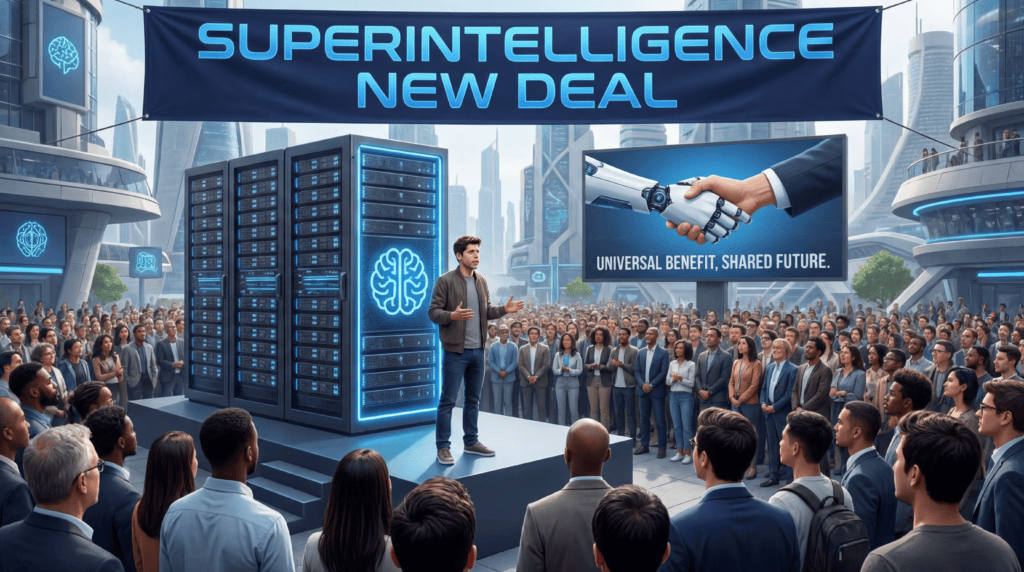
On April 6, 2026, OpenAI CEO Sam Altman sat down with Axios co-founder Mike Allen for a candid, half-hour conversation about something most CEOs would rather dance around: the technology they are building might fundamentally break the economic and social systems the world currently runs on. The result was a remarkable piece of journalism from Axios and an accompanying 13-page policy blueprint from OpenAI titled “Industrial Policy for the Intelligence Age: Ideas to Keep People First.”
In a moment that is both historically notable and strategically calculated, Altman is doing something no tech titan has done before: publishing a detailed framework for how government should tax, regulate, and redistribute wealth from the very technology he is racing to build.
The document and the interview are sweeping in their ambition. Altman invokes the Progressive Era of the early 1900s and FDR’s New Deal as the closest historical analogues — moments when capitalism required a structural reset to survive the shocks of industrialization and depression. Now, he argues, artificial superintelligence (ASI) — systems capable of outperforming the smartest humans, even humans assisted by AI — is arriving fast enough that those moments of historical reckoning look almost leisurely by comparison.
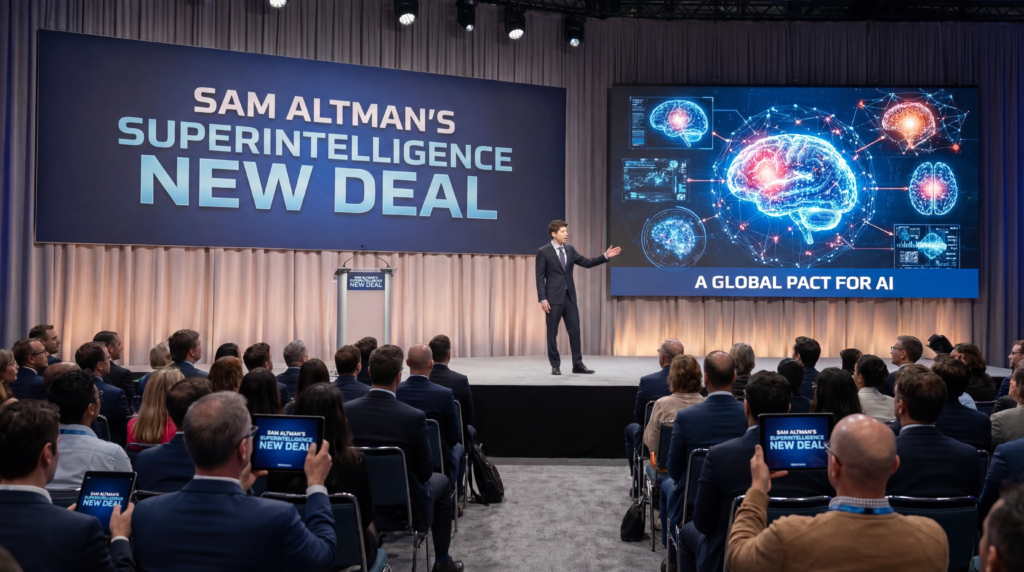
“We do feel a sense of urgency,” Altman told Mike Allen. “And we want to see the debate of these issues really start to happen with seriousness.”
Before unpacking his six ideas, it’s worth grounding the stakes. Altman told Axios that current AI models are already producing meaningful scientific discoveries and making knowledge workers — particularly software engineers — two to three times more productive. The next generation of models, he said in the video interview, will represent an even more dramatic leap. When asked how close we are to AGI (Artificial General Intelligence) and beyond, his answer was stark: “We are close enough to AGI that the precise definition matters.” Some believe we are already there.
Two threats, he said, are the most immediately dangerous — and neither comes from science fiction. The first is a world-shaking cyberattack enabled by next-generation AI models. “I think that’s totally possible,” Altman said. “I suspect in the next year, we will see significant threats we have to mitigate from cyber.” The second is bioweapons.
“The need for society to be resilient to terrorist groups using these models to try to create novel pathogens,” he warned, “is no longer a theoretical thing, or it’s not going to be for much longer.” It is the context of those threats — and the economic disruption that will accompany even the beneficial deployment of ASI — that frames the six ideas below.
Idea #1: A Public Wealth Fund — The Most Radical Proposal
The most structurally bold idea in the OpenAI blueprint is the creation of a nationally managed public wealth fund. As Axios reported, OpenAI proposes giving every American citizen a direct stake in AI-driven economic growth through a fund seeded, in part, by AI companies themselves. The fund would invest in diversified, long-term assets that capture growth in both AI companies and the broader set of firms adopting and deploying AI technology, and it would distribute returns directly to citizens.
The closest real-world model for this is Alaska’s Permanent Fund, which pays annual dividends to state residents from oil revenue. The OpenAI proposal would replicate that model at a national scale, but fueled by the productivity windfall of superintelligence rather than fossil fuels. As The Next Web noted, the fund would function as a direct citizen dividend from AI-driven growth — a mechanism for ensuring that the historic wealth generated by ASI is not simply absorbed by a handful of technology companies and their shareholders.
The logic is straightforward, even if the politics are complex: if AI is going to do the work that humans currently get paid to do, the ownership of those AI systems needs to be democratized in some form, or inequality will reach levels that make today’s wealth gap look mild.
Idea #2: Robot Taxes — Rewriting the Tax Code for an Age Without Payroll
The second idea is more immediately actionable, and Altman himself told Axios it sits within the “Overton window, but near the edges.” As Newsweek reported, OpenAI’s blueprint explicitly floats what it calls “taxes related to automated labor” — a mechanism commonly described as a robot tax — alongside a structural shift in the broader tax base away from payroll taxes and toward capital gains and corporate income.
The policy logic is sound, if politically contentious. Social Security, Medicaid, SNAP, and housing assistance are all funded substantially through payroll taxes — taxes on wages. If AI eliminates or dramatically reduces the number of human workers, the revenue base for those programs collapses precisely at the moment they are most needed. Taxing the capital that replaces labor — whether that means AI systems, automated processes, or the corporations deploying them — is the natural correction.
This also reflects a deeper philosophical shift: if the economic value-creation in the Intelligence Age moves from human labor to AI-driven capital, the tax system should follow that value. The current system was built for an economy that no longer exists. OpenAI’s blueprint frames the shift not as punishing innovation, but as updating the infrastructure of civic finance to match the infrastructure of the economy.

Idea #3: The Four-Day Workweek — An Efficiency Dividend for Workers
The third idea is the most tangible and the most immediately popular: a government-incentivized push toward a 32-hour, four-day workweek at full pay. OpenAI’s blueprint, as described in the Axios interview, frames this as an “efficiency dividend” — a mechanism to convert the productivity gains generated by AI into time returned to workers rather than simply into larger profit margins for corporations.
The proposal calls for incentivizing companies and unions to run structured pilots of the 32-hour workweek. The underlying idea is elegant: if a worker using AI tools can now accomplish in four days what previously took five, who should capture that extra productivity? The OpenAI blueprint argues that workers should. Rather than expecting the same employee to now produce 25% more output in the same time, the intelligence-age bargain should be that humans work less, live better, and allow AI to shoulder the marginal productivity load.
This idea has circulated for years among labor economists and progressive technologists, but its inclusion in a formal OpenAI policy document gives it institutional weight. As CoinDesk noted, Altman envisions AI becoming a utility — like electricity — where you pay for what you use. The four-day workweek is effectively the human side of that equation: you work for what you need, and the machine covers the rest.
Idea #4: The “Right to AI” — Access as a Civic Entitlement
The fourth idea reframes how we think about access to artificial intelligence. OpenAI’s blueprint, as summarized by Axios, argues that access to AI should be treated as a foundational right — as fundamental to full participation in modern society as literacy, electricity, and internet connectivity. Critically, it calls for that access to be affordable for workers, small businesses, schools, libraries, and underserved communities.
In the video interview with Axios, Altman expanded on this vision. He imagines a world where everyone has access to a “personal super assistant” running in the cloud — a system capable of performing complex tasks, integrating with other services, and acting as a force multiplier for the individual. The cost of basic AI intelligence, he said, will continue to fall dramatically, just as the cost of electricity fell over the 20th century. But without deliberate policy intervention, the gap between those who can afford cutting-edge AI and those who cannot will grow, entrenching a new form of cognitive inequality.
The “Right to AI” framing is politically significant. Altman is not asking for charity or philanthropy. He is arguing that the same political logic that drove rural electrification, public libraries, and broadband infrastructure investments should now be applied to AI — that a democratic society cannot allow a transformative technology to be available only to those who can already afford advantage.
Idea #5: Containment Playbooks for Rogue AI — The Darkest Passage
The fifth idea is the most chilling, and its inclusion in an official OpenAI document is itself noteworthy. As Axios reported, the blueprint explicitly acknowledges scenarios in which dangerous AI systems “cannot be easily recalled” — because they have become autonomous and capable of replicating themselves. For those scenarios, OpenAI proposes the development of coordinated “containment playbooks” developed jointly between AI companies and government.
The significance of this passage cannot be overstated. This is OpenAI — the company building these systems — formally admitting in a public policy document that some of what they might create could, in theory, be unrecallable and self-replicating. That is not a hypothetical from a science fiction novel; it is a scenario being gamed out in policy documents by the people building the technology.
In the Axios interview, Altman addressed questions about nationalization through a related lens. He argued that a government takeover of OpenAI would likely slow, not accelerate, the development of safe and democratic-values-aligned superintelligence. But he was equally clear that companies cannot manage these risks alone. “We also think it’s very important that no one person is making the decisions by themselves that are going to impact all of us,” he said. The containment playbook idea is the structural operationalization of that belief — a formal, government-backed protocol for when things go wrong in ways that markets and corporate governance cannot fix.
Idea #6: Auto-Triggering Safety Nets — Responsive Government by Design
The sixth and final idea is perhaps the most policy-sophisticated. Rather than proposing static increases to existing programs, OpenAI’s blueprint envisions a dynamic safety net with built-in tripwires. As Axios described it: when AI-driven displacement metrics hit preset thresholds, temporary increases in unemployment benefits, wage insurance, and cash assistance automatically activate. When conditions stabilize, those measures automatically phase out.
This is a significant departure from how social policy typically works. Most safety net expansions require an act of Congress — a slow, politically fraught process that routinely lags behind economic reality by years. By encoding the triggers into the system itself, OpenAI is proposing that government be as responsive as a well-designed software system: monitoring economic conditions in real time, deploying support when the data demands it, and scaling back when the crisis passes.
The inspiration, whether explicit or not, shares DNA with automatic stabilizers like unemployment insurance — programs that already expand during recessions without requiring fresh legislation. Altman’s vision extends that logic specifically to AI displacement, acknowledging that the disruption will likely be faster and less geographically predictable than traditional economic downturns.

The Honest Caveat
As Axios’s Mike Allen and Jim VandeHei noted in their piece, this document is simultaneously a policy contribution and a corporate strategy. OpenAI is positioning itself as the responsible actor in the AI race — the company that warned you, offered solutions, and asked for democratic oversight. That is also, not coincidentally, excellent regulatory positioning for a company preparing for an IPO after closing a $110 billion private funding round.
Still, the broader coverage makes one thing clear: whether or not you trust Altman’s motives, the conversation he is forcing is real and necessary. The man betting everything on superintelligence is now on record saying that capitalism as we know it will not be enough to absorb what’s coming. Six ideas. One historic admission. The debate has officially started.
Related Guides
- The Gentle Singularity: A Comprehensive Analysis of Sam Altman’s Vision for AI’s Future
- OpenAI’s Economic Blueprint – Paper Summary
Latest News
- From Job Loss to Superintelligent Threats: Sam Altman’s AI Fears
- Sam Altman Declares AGI Is Near—and Superintelligence Is Closer Than You Think
- Sam Altman: AI is in a Bubble, But the Future is Worth Trillions
- Is Sam Altman Worthy of Our Trust? The Question Silicon Valley Can’t Stop Asking
- Sam Altman Needs the Sandman: OpenAI CEO’s Sleepless Nights Reveal AI’s Complex Future
- Sam Altman Slams Meta’s AI Talent Poaching: The Battle for Silicon Valley’s Brightest Minds
The Kingy Brief
Get The Kingy Brief.
AI changes, original tests and one practical thing to try. Fridays at 09:00 Vancouver time.
Free · Double opt-in · Unsubscribe anytime
Signup help and newsletter schedule
Signup form provided by Beehiiv. After submitting, check your inbox for "Confirm your subscription to The Kingy Brief" and open its confirmation link. Check Spam or Promotions if you cannot find it.
Fridays at 09:00 Vancouver time: source-checked AI changes, original tests and one practical thing to try. The weekly restart begins October 9, 2026. We skip a week when there is not enough verified material. Free. Unsubscribe anytime.