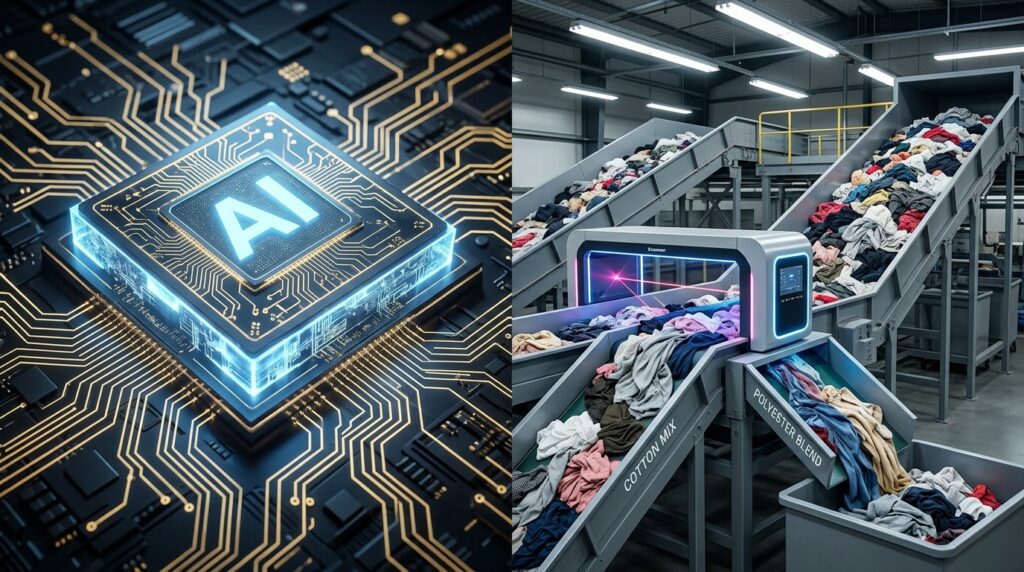
How a humming machine in eastern China is quietly rewriting the rules of fashion waste — one polyester shirt at a time.
The Pile of Clothes Nobody Wants to Deal With
Let’s be honest. Most of us have a bag of old clothes sitting in a corner somewhere. Maybe it’s been there for months. You keep telling yourself you’ll donate it. You’ll recycle it. You’ll do something with it.
Now multiply that bag by a billion people.
That’s the reality of global textile waste. And it’s ugly. The fashion industry generates an estimated 92 million tonnes of textile waste every year, according to the United Nations Environment Programme. A massive chunk of that ends up in landfills or gets incinerated — not because people don’t care, but because the infrastructure to deal with it simply hasn’t kept up.
Until now, maybe.
In a small industrial city on China’s east coast, a machine is humming and hissing its way through mountains of used clothing. It doesn’t get tired. It doesn’t make mistakes. And it’s doing in two minutes what used to take a human worker four hours.
Meet the Fastsort-Textile — and it just might be the most important recycling invention you’ve never heard of.
What Exactly Is This Thing?
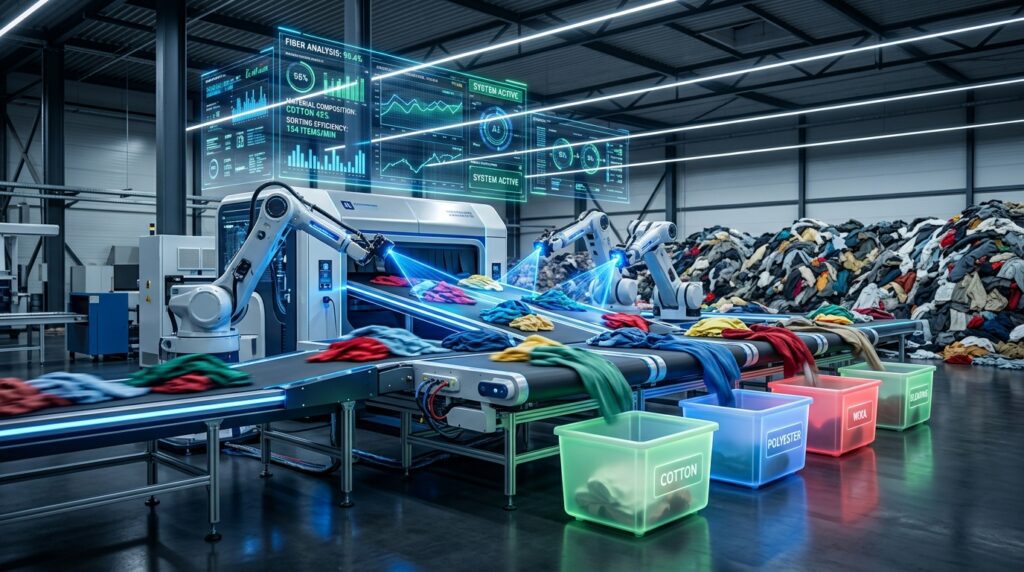
Picture a scanner the size of a small room — 5 by 2 meters, or roughly 16 by 6.5 feet. Workers load stacks of used clothes onto conveyor belts. The belts carry the garments through the scanner. The machine reads each item’s fiber composition in under one second. Then it sorts everything automatically into the right recycling stream.
That’s it. That’s the magic.
According to Fortune, the Fastsort-Textile can process 100 kilograms — that’s 220 pounds — of clothing in just two to three minutes. Compare that to a human worker, who takes roughly four hours to sort the same amount. The machine can handle two tons per hour. Two people doing the same job manually would need two full days — and they’d still be less accurate.
The machine was built by DataBeyond, a Chinese AI recycling company founded in 2018. It’s currently deployed at one facility: Shanhesheng Environmental Technology Ltd. in Zhangjiagang, Jiangsu province. And it earned a spot on Time magazine’s Best Inventions of 2025 list.
Yeah. It’s kind of a big deal.
Why Sorting Clothes Is Harder Than It Sounds
Here’s something most people don’t think about: recycling clothes is nothing like recycling paper or glass.
When you toss a glass bottle in the recycling bin, it’s pretty straightforward. Glass is glass. But a single bag of donated clothes? That’s a chaotic mix of cotton, polyester, nylon, elastane blends, metal zippers, plastic buttons, and everything in between. Each material needs a completely different recycling process.
The most valuable form of textile recycling — fiber-to-fiber recycling, where old garments become raw material for new ones — demands extremely accurate sorting. Even a small amount of the wrong fiber type can contaminate an entire batch and ruin it.
As Startup Fortune explains, human sorters have to feel, stretch, and visually inspect each garment. They check care labels that are often missing or illegible. Their speed drops. Their accuracy degrades over long shifts. The result? The Ellen MacArthur Foundation estimates that less than 1% of clothing material is recycled back into new clothing. Less than one percent. That number should make you put down your coffee.
The Fastsort-Textile attacks this problem head-on. Its AI scanner identifies material composition in fractions of a second — consistently, accurately, and without ever needing a lunch break.
The Numbers Don’t Lie
Let’s talk about what this machine is actually doing on the ground.
Before Fastsort-Textile arrived at Shanhesheng, up to 50% of processed textiles were deemed unrecyclable and sent to landfills or incinerators. That’s half of everything coming through the door going straight to waste.
With the machine? That number has dropped to 30%, according to Sales Director Li Bin, as reported by the Seattle Post-Intelligencer.
That’s a 20-percentage-point improvement. In an industry dealing with millions of tonnes of waste, that’s enormous.
Sales Manager Cui Peng put it plainly: “This sort of thing saves money on labor costs, it saves time. When people sort materials, they can’t tell accurately if it’s 80 or 90% polyester. This machine rarely makes mistakes.”
Rarely makes mistakes. That’s the kind of reliability that changes an industry.
After scanning, the textiles move to designated sorting areas for nylon and polyester recycling. Items that fall below the quality benchmark get routed separately — mostly for incineration or landfill. It’s not a perfect system yet. But it’s a dramatically better one.
The Bigger Picture: China’s Textile Problem

To understand why this matters so much, you need to understand the scale of China’s role in global textiles.
China is the world’s largest textile producer and exporter. According to Fortune, China led global textile exports at $142 billion — more than double the European Union — according to the World Trade Organization’s 2025 Key Insights and Trends report.
That’s a staggering amount of production. And with production comes waste. Synthetic textiles — polyester, nylon, acrylic — are derived from fossil fuels. They’re cheap. They’re popular. And they account for around 70% of global textile production, according to Amsterdam-based nonprofit Circle Economy.
When synthetic fabrics end up in landfills, they don’t biodegrade. They sit there for decades, slowly releasing microplastics and chemicals into the soil and water. When they’re incinerated, they release carbon emissions. Either way, the planet loses.
DataBeyond CEO Mo Zhuoya sees the machine as a direct response to this crisis. “We can make full use of textile waste and reduce the amount that is incinerated, which will be a great help to recycling resources,” she said, as quoted by Mid-Day.
That’s not just a business pitch. That’s a mission statement.
The Dream of the “Dark Factory”
Here’s where things get really interesting — and maybe a little sci-fi.
Li Bin, the Sales Director at Shanhesheng, didn’t mince words about where this is all heading. “People can’t work for 24 hours straight, so robots may take over the roles in the end. The ultimate goal is a ‘dark factory’ with the robots running 24 hours.”
A dark factory. No lights needed. No humans on the floor. Just machines, running around the clock, sorting and recycling textiles at a scale no human workforce could ever match.
DevDiscourse notes that the Fastsort-Textile represents a shift toward exactly this kind of industrial environment — where AI and robotics operate independently, continuously, and with minimal human oversight.
It sounds futuristic. But the technology is already here. The machine is already running. The only question is how fast the rest of the world catches up.
What This Means for the Global Recycling Industry
China isn’t the only country watching this closely.
Startup Fortune reports that venture capital has been flowing into textile recycling technology across Europe and North America. Companies like Tomra, Circ, and Worn Again Technologies are developing their own approaches to automated sorting and chemical recycling.
The global textile recycling market is projected to reach $5.6 billion by 2028, driven by tightening regulations in the European Union and growing corporate sustainability commitments from major fashion brands. Any company that can demonstrate reliable, high-speed sorting at commercial scale will find eager buyers among recycling facility operators.
The broader implication is significant. AI and robotics are finally reaching a maturity level where they can handle complex, high-variability physical tasks that were previously uneconomical to automate. Textile sorting is one of the most demanding use cases out there — the sheer diversity of materials and conditions makes it incredibly difficult. If AI can crack this problem, similar approaches will likely follow in electronics dismantling, construction debris sorting, and other waste streams.
The infrastructure for circular fashion — the idea that clothing can be made, used, collected, and remade in an endless loop — will not scale without automation. The Fastsort-Textile is proof that the automation is ready.
One Machine, One City, One Big Idea
Right now, the Fastsort-Textile operates in exactly one location. One machine. One city. One facility in Zhangjiagang.
That might sound small. But every revolution starts somewhere.
The fact that this machine already cut the unrecyclable waste rate from 50% to 30% at a single facility is remarkable. Scale that across hundreds of facilities worldwide, and you’re talking about millions of tonnes of textiles being saved from landfills and incinerators every year.
The fashion industry has a waste problem it has been ignoring for decades. Fast fashion made it worse. Cheap synthetic fabrics made it even worse. And the sorting bottleneck — the sheer human impossibility of keeping up with the volume — has kept recycling rates embarrassingly low.
The Fastsort-Textile doesn’t solve everything. It doesn’t fix overproduction. It doesn’t stop consumers from buying more than they need. But it does something critically important: it makes recycling work at a scale that actually matters.
The Takeaway: AI Is Coming for Your Closet (In a Good Way)
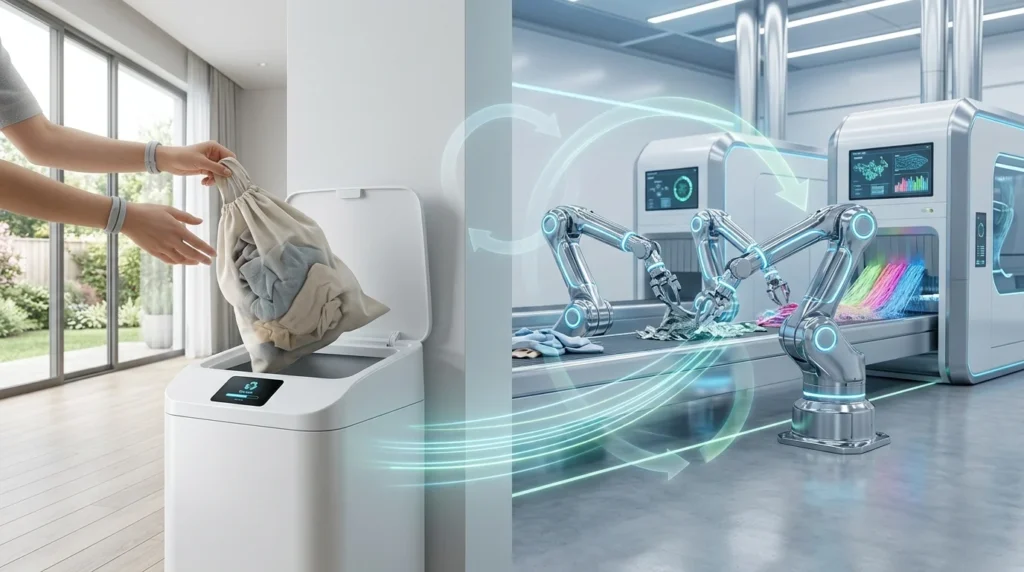
So what does all of this mean for you, sitting there with that bag of old clothes in the corner?
It means the system that processes those clothes is getting smarter. Faster. More accurate. It means that polyester hoodie you donated last year has a better chance of becoming something new instead of ending up in a landfill.
It means AI isn’t just writing emails and generating images. It’s sorting through mountains of used clothing in eastern China, one hiss and hum at a time, quietly building the infrastructure for a more sustainable world.
The Fastsort-Textile is a Time Best Invention of 2025 for a reason. It’s not flashy. It doesn’t have a slick app or a celebrity endorsement. It’s a big, loud machine in an industrial park — and it’s doing something genuinely important.
Go donate that bag of clothes. The machine is ready for it.
Sources
- Fortune — Meet China’s AI-powered recycling robot that sorts 220 pounds of clothes in 2 to 3 minutes
- Mid-Day — FastsortTextile uses AI to revolutionize clothing recycling, reduces waste
- Startup Fortune — Chinese AI Sorting Machine Outpaces Humans in Textile Recycling Breakthrough
- Seattle Post-Intelligencer — AI machine sorts clothes faster than humans to boost textile recycling in China
- DevDiscourse — Revolutionizing Recycling: AI’s Impact on Textile Waste
The Kingy Brief
Get future Kingy Brief editions.
Source-checked AI changes, original tests and one practical thing to try.
Free · Choose your subjects · Double opt-in · Unsubscribe anytime
Regular sending is paused; no restart date is set.