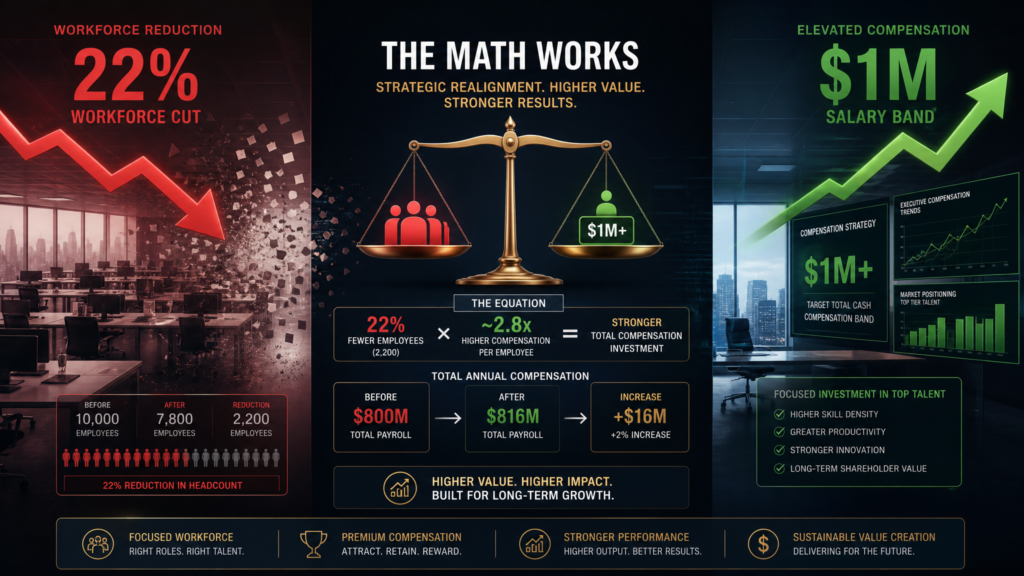
ClickUp just cut 22% of its workforce and announced million-dollar pay bands for the people who stayed. The math is more interesting — and more fragile — than the headline.
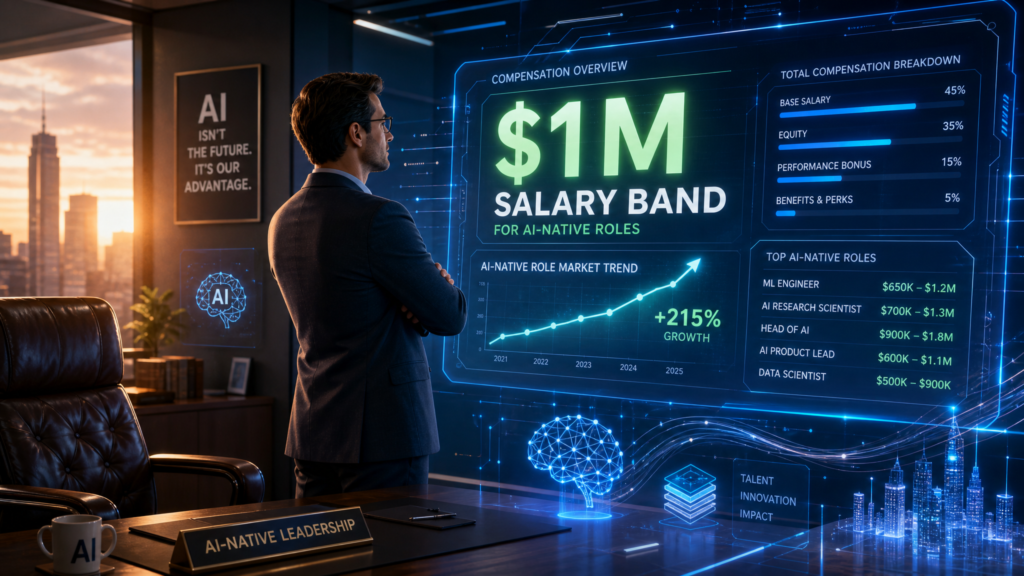
On May 21, 2026, ClickUp CEO Zeb Evans posted a long thread on X announcing that the company had reduced headcount by 22%. In the same breath, he announced something almost no SaaS CEO has said out loud before: ClickUp is introducing $1 million cash salary bands with “a path available to nearly everyone in the company if they produce 100x impact by creating or managing AI systems.”
The framing was deliberate. This wasn’t, Evans wrote, a cost-cutting exercise. “Most savings from this change will flow directly back into the people who stay.”
That’s a striking sentence. It inverts the entire grammar of tech layoffs over the past three years, where savings have flowed to shareholders, AI infrastructure spend, or the next round of efficiency targets. Evans is making a different claim: that the savings from a smaller workforce should be paid out, in cash, to the humans still doing the work.
It’s worth taking the claim seriously — and also taking it apart.
What ClickUp actually announced
According to reporting by The Next Web, the 22% cut affects roles across product, engineering, design, and customer-facing teams at a company that had been hiring aggressively through 2025. StartupHub.ai puts the affected count “in the low hundreds.” Severance, per Evans, is calibrated to “honor contributions and ease the transition.”
Evans laid out a thesis he calls the “100x org,” organized around three categories of remaining employee:
- Builders — engineers and PMs whose job is to direct AI agents rather than write code or ship features directly.
- System managers — people who automate their own jobs and become owners of the resulting agentic workflows. Evans calls them “agent managers.”
- Front-liners — customer-facing humans whose meeting time, he argues, is the one bottleneck that should not be automated even when AI is technically capable of it.
The $1M bands sit on top of this structure. The gating criterion is “100x impact” delivered through creating or managing AI systems. Evans has not publicly specified how many employees qualify, what the measurement methodology is, or how often it’s reviewed.
That last point matters more than it sounds.
This is not ClickUp’s first restructuring
The 2026 cut is the third in four years, and the pattern is worth tracing because it shapes how seriously to take the framing.
In May 2022, ClickUp laid off 7% of its staff, characterized at the time by a company spokesperson as a “one-time decision” aimed at maintaining a trajectory toward profitability. In July 2023, TechCrunch reported a further 10% cut — roughly 90 of 900 employees — with Evans saying the company was relocating support roles to lower-cost regions to become “a best-in-class IPO-ready company in efficiency while continuing to overachieve in growth.”
That’s three distinct rationales across three rounds: profitability discipline in 2022, IPO readiness and geographic arbitrage in 2023, and structural AI-driven obsolescence in 2026. Each was framed as decisive and forward-looking. Each followed periods of aggressive hiring. The 2026 framing is the most ambitious of the three, but it’s also the third time in four years that ClickUp employees have been told a workforce reduction was the start of a new chapter rather than the continuation of an ongoing one.
This isn’t necessarily a critique. Companies adjust. But the 100x org pitch lands differently when you read it against the prior two announcements, both of which used similarly definitive language.
ClickUp’s AI posture, by the numbers
The 100x org didn’t appear from nowhere. ClickUp has been positioning aggressively around AI for over two years.
The company’s flagship AI product, ClickUp Brain, is marketed as a neural network connecting projects, docs, people, and company knowledge. Late in 2025, ClickUp acquired the AI coding platform Codegen, per The Next Web, folding agentic engineering capabilities into its core platform. ClickUp’s reported ARR as of 2025 sits around $300M, on a $4B valuation last set during its 2021 Series C co-led by Andreessen Horowitz and Tiger Global (TechCrunch). The IPO ambition Evans first articulated in 2023 is still on the table.
The most striking internal data point, surfaced by The Next Web from a Fortune profile published days before the layoff: ClickUp now runs roughly 3,000 internal AI agents — a 3:1 ratio of agents to employees. Evans had previously mandated that staff route through an AI agent trained on his communication patterns before contacting him directly.
Whether the 3:1 figure represents meaningful production agents or includes lightweight automations is unclear from public reporting. But the directional point is real: ClickUp has been operationalizing agents internally at a pace that very few mid-stage SaaS companies have matched. The 22% cut is the logical conclusion of that internal trajectory, not a sudden pivot.
This is also the context that makes the $1M band plausible rather than aspirational. If you accept Evans’s premise that agent orchestration is the actual production work of the company, the people who can do it well become disproportionately valuable. The bands are the comp version of an architectural choice the company has already made.
The compensation logic, in plain numbers
The economic case for paying a small number of people $1M in cash is not new. It’s been the default in elite quant trading, FAANG senior staff comp, and parts of the AI lab market for years. What’s new is the source of funds: ClickUp is explicitly framing the bands as a redistribution from headcount savings.
The arithmetic, simplified: if you cut roughly 200 roles with a fully-loaded cost of $200K each, you’ve freed up around $40M in annual payroll. That’s enough to fund 40 people at the new $1M band — or a larger group at meaningful uplifts below the top. Whether that ratio is what ClickUp is actually targeting is unknown, but the order of magnitude is the reason the math works at all.
This is the same logic Jensen Huang articulated at GTC 2026, when he proposed that Nvidia engineers receive token budgets worth roughly half their base salary on top of cash comp. As Kingy AI’s deep-dive on Claudeonomics documents, the underlying belief is that a well-equipped senior engineer with AI tooling can do the work of several mid-level engineers — and that the company should pay accordingly rather than diluting that productivity across a larger team.
ClickUp is essentially making the cash-comp version of the same bet.
Why the framing is more honest than most
Most AI-attributed layoffs in 2025 and 2026 have used careful language. Amazon, Salesforce, Workday, Dropbox, IBM, Google, and Microsoft have all reduced headcount with some form of AI productivity narrative attached, but typically wrapped in efficiency, realignment, or strategic refocusing language. Digital Applied’s analysis of ten major AI-first layoffs notes the same pattern: the AI rationale is present but rarely the sole, named cause.
Evans broke that pattern. He said, directly, that he believes the roles being eliminated are structurally obsolete and that the operating model of the company has to change. He owned the decision personally. He named the trade-off.
The reaction from operators read the directness as the most useful part of the post. Lenny Rachitsky flagged it as an “important read” and pushed his audience to read the whole thread rather than the snippet. Investor Bojan Tunguz called it “brutal, honest, and direct.”
The reaction from a meaningful portion of X was less generous. The Digg cluster of responses skewed 82% negative, with multiple high-profile posters framing the announcement as a polished rebrand of a normal layoff — one widely-shared parody asked an AI to “write me a LinkedIn post announcing I fired 22% of my company. make it sound visionary not sad… add something about $1M salary bands so people think we’re generous.”
Both reads can be true. The substantive thesis can be sharper than peers’ messaging and the announcement can be doing PR work for what is, in operating terms, the third workforce reduction in four years. Which read holds up depends on what the company actually does with the savings.
The Klarna problem
The most important reference point for ClickUp’s announcement isn’t another SaaS company. It’s Klarna’s reversal.
In 2023 and 2024, Klarna publicly announced that AI had effectively replaced around 700 customer service roles. CEO Sebastian Siemiatkowski took the story on tour, told 20VC that the company would shrink from 7,000 to 2,000 employees through attrition, and presented Klarna as the empirical proof that AI could displace knowledge work at scale.
By early 2026, Klarna was quietly rehiring. Business Insider reported the company was reassigning engineers and marketers to customer support after AI quality concerns. Throughput metrics had held up. Customer satisfaction on complex interactions had not. Gary Marcus coined “the Klarna Effect” to describe the full arc — premature declaration followed by a quiet 180.
The lesson isn’t that AI doesn’t work. It’s that throughput metrics measured over short horizons systematically overstate the case for full replacement, and the cost of reversing the decision is rarely modeled in the original business case.
ClickUp’s announcement is not Klarna’s announcement. Evans is explicit that customer-facing meeting time should remain human, which is the exact thing Klarna got wrong. But the structural risk — that the 100x productivity claim is measured before the failure modes have time to surface — applies to any company making a similar bet. ClickUp’s customers — including Booking.com, IBM, Spotify, T-Mobile, and Netflix per TechCrunch — will be the ones who feel the answer first.
Three questions worth asking
If you’re an operator, investor, or employee trying to evaluate this kind of move, three things are worth pressing on:
1. What’s the actual measurement methodology for “100x impact”?
This is the variable that determines whether the $1M bands are real or a recruiting story. The same Goodhart’s Law problem documented in Meta’s “Claudeonomics” leaderboard applies here: the moment you publish a target, the metric gets gamed. If “100x impact” is measured by tokens consumed, pull requests merged, or agents deployed, the company will get a lot of all three — and not necessarily more customer outcomes.
2. What happens to people between the band and the floor?
A $1M band for top performers funded by eliminating a percentage of the workforce creates a clear winner-take-all dynamic inside the company. The mid-tier engineer who’s competent but not “100x” now sits in an awkward position: more productive than before because of AI tooling, but compensated as if that productivity is the baseline rather than the upside. The Kyndryl Institute’s analysis of agentic capabilities describes this as the “capability revaluation” problem — and it’s the part of the new operating model that’s most likely to drive voluntary attrition among the people companies most want to keep.
3. Does the savings actually flow back, or does it flow to the P&L?
This is the question that will determine whether ClickUp’s framing holds up over time. Evans said “most savings” will flow to remaining employees. If 12 months from now the operating margin has expanded but the new comp bands haven’t materially shifted total payroll, the answer is clear. If they have, the model is real. The IPO posture sharpens the stakes: ClickUp has been telegraphing public-market ambition since at least 2023, and IPO underwriters tend to reward margin expansion more than they reward payroll redistribution. The pressure to let savings settle into the P&L rather than into salaries will be real.
Where this lands
The most useful way to read Evans’s announcement is not as a finished playbook but as a thesis under test. The thesis is that AI’s productivity dividend is concentrated, not distributed; that the right response is to pay the concentration in cash rather than dilute it across a larger team; and that the company’s customer outcomes will be better with a smaller, better-paid, more agent-leveraged workforce than with the company it replaces.
Each of those claims is plausible. None of them is proven. Klarna’s reversal is the cautionary case; Anthropic, OpenAI, and the elite quant shops are the proof-of-concept that very small, very expensive teams can produce outsized impact in specific contexts.
ClickUp is an unusually clean test case for the middle ground. It’s not a frontier lab. It’s not a consumer-facing fintech. It’s a mid-stage B2B SaaS company with real recurring revenue, real enterprise customers, a real product roadmap, and a real IPO clock. If the 100x org works there, the model travels. If it doesn’t — if the next 12 to 18 months bring slipped releases, customer churn, or a fourth restructuring — the post-mortem will be more instructive than the announcement.
What we’ll learn from ClickUp over the next 18 months is whether the model works for a mid-stage SaaS company with real customers, a roadmap, and an IPO ambition — not just for frontier labs with effectively unlimited capital.
The headline that “AI is taking jobs” obscures a more specific shift: AI is restructuring how value is created inside companies, and how it’s paid out. ClickUp is the most explicit example yet of a company trying to redirect the second half of that equation to the humans still in the building.
Whether that’s a durable model or a recruiting narrative is something the next four quarters will decide.
Continue Reading
Latest News
- China AI layoffs and jobs law
- AI and middle management evidence review
- Meta layoffs 2026 leaked memo
Recent Launches
Related Companies
Compare
The Kingy Brief
Get future Kingy Brief editions.
Source-checked AI changes, original tests and one practical thing to try.
Free · Choose your subjects · Double opt-in · Unsubscribe anytime
Regular sending is paused; no restart date is set.