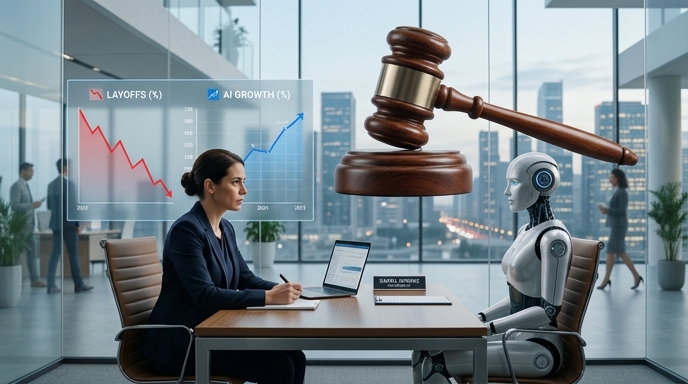
The Pink Slip That Started It All
Picture this. You’ve worked at a tech company since 2022. You earn a solid 25,000 yuan a month, roughly $3,500. Your job? You work directly with AI large language models, you review outputs, you filter sensitive content. You make sure the machine doesn’t go off the rails.
Then one day, the company decides the machine is good enough to do your job for you.
They offer you a demotion. A 40% pay cut. A new salary of 15,000 yuan. You say no. They fire you.
That’s exactly what happened to Zhou, a quality assurance supervisor at a tech firm in Hangzhou, China. And instead of quietly accepting his severance package of roughly $43,000, Zhou did something bold, he fought back.
He filed for arbitration. The panel ruled in his favor. The company appealed. The Hangzhou Intermediate People’s Court upheld the ruling. The dismissal was illegal.
Just like that, a single fired worker in eastern China sparked a legal precedent that’s now echoing around the world.
What the Court Actually Said, And Why It’s a Big Deal
Here’s the key question the court had to answer: Does AI replacing your job count as a “major change in objective circumstances” under China’s Labour Contract Law?
That legal clause typically covers things like natural disasters, government-mandated shutdowns, or force majeure events, things genuinely outside a company’s control. Companies argued that AI disruption was exactly that kind of seismic, unavoidable shift.
The court disagreed. Loudly.
According to the Hangzhou court’s ruling, adopting AI is a strategic business choice, not an unforeseeable external shock. The company chose to implement AI. Nobody forced them. That means the consequences of that choice, including making certain roles redundant, fall squarely on the company’s shoulders.
The court also pointed out something important: the company never proved that Zhou’s job had become impossible to perform. AI doing something doesn’t automatically mean a human can’t still do it. And offering a lower-paying role with a 40% salary cut? That’s not a “reasonable reassignment.” That’s a demotion dressed up in legal language.
The ruling was clear: “Companies cannot unilaterally lay off employees or cut salaries due to technological progress.”
Short. Sharp. Powerful.
This Wasn’t a One-Off — There’s a Pattern Here
Here’s where it gets really interesting. Zhou’s case wasn’t the first of its kind. It was the second.
Back in December 2025, a Beijing court ruled on a strikingly similar case. An employee surnamed Liu had worked as a manual map data collector since 2009. In early 2024, his company switched entirely to AI-driven automated data collection. They shut down the navigation products department. They terminated Liu’s contract, citing — you guessed it — a “major change in objective circumstances.”
The arbitration panel didn’t buy it. Neither did the trial court. Neither did the appeals court.
The Beijing Municipal Human Resources and Social Security Bureau was so impressed by the ruling that they included it in their list of the ten most significant labor arbitration decisions of 2025.
Two separate cities. Two separate courts. Two identical conclusions. That’s not a coincidence — that’s a legal pattern forming in real time.
The courts drew a clean, logical line: there’s a difference between an external shock that makes a job impossible and an internal decision that makes a job redundant. The first can justify termination. The second cannot.
Meanwhile, the Rest of the World Is Firing People at Record Speed
Let’s zoom out for a second, because the timing of these rulings is not accidental.
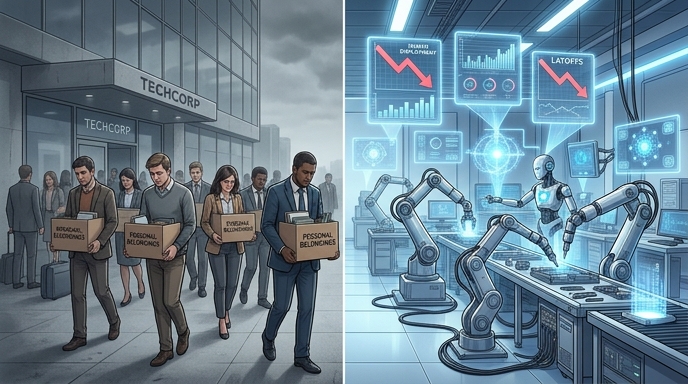
The global tech industry is cutting jobs at a pace not seen since the post-pandemic corrections of 2022 and 2023. More than 78,000 tech workers were laid off in just the first four months of 2026, and nearly half of those cuts were directly attributed to AI replacing human roles.
The names are familiar. Meta cut approximately 8,000 positions in May alone. Oracle eliminated between 20,000 and 30,000 employees in March. Block’s CEO openly stated that the company’s reduction from 10,000 to 6,000 employees was driven by growing AI capabilities.
The playbook is almost identical across companies: eliminate traditional roles, redirect the savings to AI infrastructure, and rebuild headcount around building and operating AI systems rather than doing the tasks those systems now handle.
It’s efficient. It’s profitable. And in China, it’s now illegal — at least when companies use AI as the sole justification for firing someone.
The Klarna Warning Nobody Wants to Talk About
Before we get too deep into the legal weeds, let’s talk about something that should give every CEO pause.
Klarna — the Swedish fintech giant — fired 700 customer service workers in 2024 and replaced them with an AI chatbot. The headlines celebrated it as a triumph of automation. Costs down. Efficiency up. Humans out.
Then 2026 arrived.
Repeat customer contacts jumped 25%. Customer satisfaction deteriorated on complex interactions. The CEO admitted publicly that the strategy had failed. Klarna began rehiring human agents.
This is the part of the AI-jobs story that doesn’t get enough airtime. AI replaces tasks more effectively than it replaces jobs. The judgment calls, the escalations, the nuanced context that a model simply cannot hold — that’s where humans still win. And the companies that cut deepest are often the first to discover that the remaining human work is far more valuable than they estimated when they decided to automate.
China’s courts seem to understand this intuitively. They’re not saying AI is bad. They’re saying: slow down, think it through, and don’t use a chatbot as an excuse to dump your workforce.
What About the US and Europe? (Spoiler: Not Much)
Here’s the uncomfortable truth. No Western country has done what China just did.
In the United States, employment law operates on an at-will basis in almost every state. Employers can fire workers for any reason that isn’t specifically prohibited by law. Being replaced by AI? Not prohibited. A Senate bill has been introduced that would require companies to report AI-driven layoffs to the Department of Labor quarterly — but it hasn’t passed and isn’t expected to in the current Congress.
Illinois requires employers to notify workers if AI is used in hiring or firing decisions. Colorado’s AI Act, taking effect in mid-2026, mandates risk management policies and annual assessments of AI’s employment impact. But neither state has established anything resembling what Chinese courts have now created: a legal principle that says AI replacement alone is not grounds for termination.
The European Union’s AI Act classifies AI systems used in workplace decisions as high-risk, requiring human oversight, worker notification, and logging. Those obligations take full effect in August 2026. But the EU’s AI Act doesn’t prohibit AI-driven layoffs. It regulates how AI is used in employment decisions — not whether a company can eliminate positions because of AI.
The European Trade Union Confederation has called for stronger protections. Legal scholars have proposed a European AI Social Compact. None of it has been enacted.
The gap between China and the West isn’t about awareness. Everyone knows the problem exists. It’s about political will — and so far, the West hasn’t found it.
China’s Bigger Picture: Stability Over Speed
Now, let’s be honest about something. China’s courts didn’t rule this way purely out of the goodness of their hearts.
China’s urban youth unemployment rate hit 15.3% in March 2026. The economy is wrestling with deflation, a property crisis, and weak consumer demand. Mass layoffs in that environment aren’t just an economic problem — they’re a political one.
As The Next Web reported, the Chinese government’s approach is not to restrict AI but to regulate its applications while ensuring that the economic benefits don’t come at the expense of social stability. China launched a months-long enforcement campaign against AI misuse in 2026, targeting deepfakes, fraud, and disinformation. It introduced mandatory labeling standards for AI-generated content and new regulations governing AI chatbots and virtual human services.
The court rulings fit neatly into that framework. They don’t slow down AI adoption. They just force companies to absorb the costs of that adoption — rather than passing those costs onto workers.
That’s a fundamentally different philosophy from the West’s approach. And it’s worth asking: which one is right?
What This Means for Companies Operating in China
If you run a company in China and you’re thinking about deploying AI to automate roles, the message from the courts is clear: you can do it, but you can’t fire the people whose jobs you’re automating.
You have three options. Retrain them. Reassign them to equivalent positions at equivalent pay. Or keep employing them in roles the company has decided are no longer necessary.
None of those options are cheap. All of them are now the law.
As crypto.news noted, the courts have essentially said that the costs of technological transformation should not be borne solely by workers. Companies chose to transform. Companies bear the cost.
Whether this makes Chinese companies less competitive globally — or more resilient internally — remains to be seen. But it forces a specific organizational behavior that no other major economy currently demands.
The Bottom Line
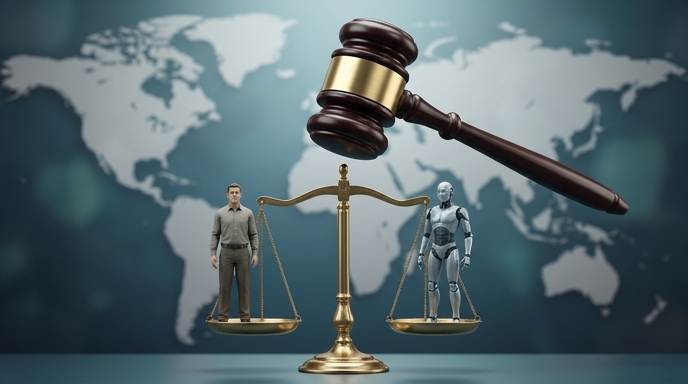
Two courts. Two cities. One unmistakable message.
China has drawn a line in the sand. You can use AI, you can automate. You can innovate. But you cannot hand someone a pink slip and point at a chatbot as your excuse.
The rest of the world is watching. Workers everywhere are watching. And as 78,000 tech layoffs pile up in 2026 — with AI cited as the cause in nearly half of them — the question isn’t whether other countries should follow China’s lead.
The question is whether they have the courage to.
Sources
- The Next Web — China has decided that firing a worker because an AI can do their job is illegal. No Western country has done the same.
- Crypto.news — China court rules companies can’t replace employees with AI to cut costs
- Economic Times — AI can’t steal your job: A China twist can avert AI jobs apocalypse
- Times Now News — China Court Says AI Can’t Replace Employees As An Excuse For Layoffs
- Deccan Chronicle — Chinese Court Bans Firms from Firing Workers to Replace Them with AI
The Kingy Brief
Get the next Kingy Brief.
Source-checked AI changes, original tests and one practical thing to try.
Free · Choose your subjects · Double opt-in · Unsubscribe anytime