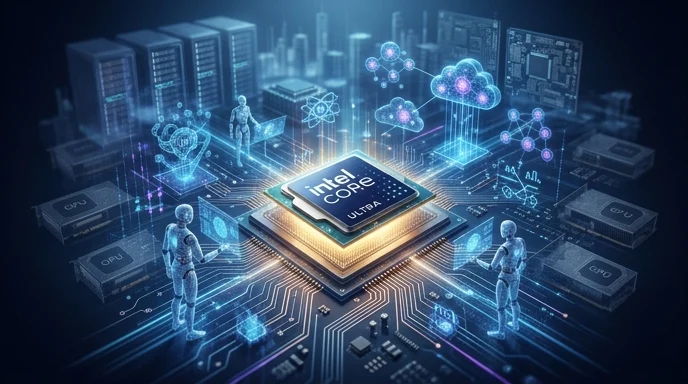
The Comeback Nobody Saw Coming
Let’s be honest. A year ago, nobody was writing glowing headlines about Intel.
The company was bleeding. Analysts were whispering about breakups. Former board members were openly questioning whether Intel should even exist as a single entity. The GPU era had arrived, Nvidia was printing money, and Intel looked like a relic — a once-great giant stumbling through a world it no longer understood.
Fast forward to April 2026. Intel’s stock surged more than 24% in a single day. It blew past its dot-com era peak from the year 2000. Its market cap crossed $416 billion. At least 23 brokerages rushed to raise their price targets.
So what on earth happened?
The short answer: AI happened — but not in the way you’d expect.
“Only the Paranoid Survive” — And Intel Got Paranoid Again
CEO Lip-Bu Tan didn’t mince words on Intel’s Q1 2026 earnings call. He went straight back to the company’s roots, invoking the legendary philosophy of Intel co-founder Andy Grove.
“We are embracing our roots as data driven, paranoid, and engineering driven,” Tan told analysts, channeling Grove’s famous “only the paranoid survive” mantra.
That paranoia paid off. Intel reported $13.6 billion in Q1 revenue — a 7% jump year-over-year. Analysts had expected a 2% decline. Instead, Intel delivered a beat that left Wall Street scrambling.
The company also raised its Q2 guidance to between $13.8 billion and $14.8 billion. Analysts had penciled in $13 billion. Intel blew right past that too.
Tan put it bluntly: “A year ago the conversation around Intel was about whether we could survive. Today it’s about how quickly we can add manufacturing capacity and scale our supply to meet enormous demand for our products.”
That’s not a turnaround. That’s a resurrection.
The CPU Is Back at the Center of the AI Universe
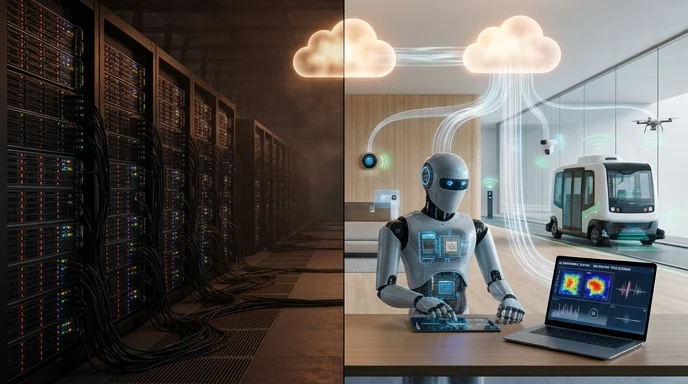
Here’s the thing that’s really shaking up the tech world right now. For the past few years, the AI story was almost entirely about GPUs. Nvidia dominated. Everyone else played catch-up. The narrative was simple: train massive AI models, use massive GPU clusters, repeat.
But AI is evolving. Fast.
The industry is shifting from training AI models to running them — a process called inference. And inference, it turns out, loves CPUs.
Intel’s data center business generated $5.1 billion in Q1 revenue, smashing expectations of $4.5 billion. That’s a 22% year-over-year jump. The segment runs on Xeon server CPUs — the kind of chips Intel has been making for decades.
CFO David Zinsner explained the shift with a striking statistic. In AI training setups, you typically see eight GPUs for every one CPU. But in inference workloads, that ratio drops to three or four GPUs per CPU. And as agentic AI — systems where AI models autonomously take actions — becomes mainstream, the ratio could flip entirely.
“As you get into agentic and multi-agent, it’s one potentially even flip in the other direction a little bit,” Zinsner said.
That’s a seismic shift. And Intel is sitting right in the middle of it.
AI Agents, Robots, and the Edge: Intel’s New Frontier
Lip-Bu Tan isn’t just talking about data centers. He’s thinking bigger. Much bigger.
AI is moving out of the cloud and into the physical world. Robots. Edge devices. Autonomous systems. All of these need chips that can run AI locally, efficiently, and at scale. That’s where CPUs shine.
“The next wave of AI will bring intelligence closer to the end user, moving from foundational models to inference to agentic,” Tan said. “This shift is significantly increasing the need for Intel’s CPUs and wafer and advanced packaging offerings.”
He’s not just guessing. Intel’s customers are telling them the same thing. Demand for Intel’s Xeon 6 processors is booming. In fact, Intel sold chips it had originally written off as unsellable — digging into finished goods inventory just to meet demand.
“It was either de-spec product or legacy product we had shelved and then we worked with customers,” CFO Zinsner told Reuters. “That helped a lot.”
When you’re selling chips you thought nobody wanted, that’s not a market recovery. That’s a market explosion.
The Numbers Behind the Noise
Let’s talk specifics, because the Q1 2026 results are genuinely impressive.
According to Verdict, Intel’s Client Computing Group brought in $7.7 billion — a 1% increase. The Data Center and AI segment hit $5.1 billion, up 22%. Intel Foundry Services generated $5.4 billion, a 16% jump. Total Intel Products revenue rose 9% to $12.8 billion.
AI-driven business lines now account for 60% of Intel’s total revenue — up 40% year-on-year. That’s not a company dabbling in AI. That’s a company that has made AI its core business.
Yes, Intel posted a net loss of $3.7 billion for the quarter. But that figure is misleading. The loss was driven by $4.07 billion in one-time restructuring and impairment charges, largely tied to its stake in Mobileye. Strip those out, and Intel earned $1.5 billion — or 29 cents per share — well ahead of expectations.
The gross margin improved to 39.4%, up from 36.9% a year ago. The company generated $1.1 billion in cash from operations. This is a company that’s cleaning up its balance sheet while growing its top line. That’s a hard combination to pull off.
Intel, Nvidia, and TSMC: A New Kind of AI Ecosystem
Here’s where the story gets really interesting. The AI chip world isn’t a zero-sum game anymore.
According to Nasdaq, Intel’s stock has surged roughly 248% over the last 12 months. That’s more than Nvidia’s 106% gain and TSMC’s 149% rise. Intel is outperforming the kings of the AI chip world — at least on the stock chart.
But this isn’t about Intel beating Nvidia. It’s about something more nuanced. These three companies are becoming complementary pillars of the American AI ecosystem.
Nvidia dominates AI chip design and compute architecture. TSMC leads in fabrication. Intel is carving out a role as a critical manufacturing and infrastructure provider — especially on American soil.
In early 2026, Nvidia made a $5 billion strategic investment in Intel, taking roughly a 4% stake. That’s not a competitor move. That’s a supply chain diversification play. Nvidia is heavily reliant on TSMC, which sits uncomfortably close to China. Intel offers a domestic alternative.
Meanwhile, Intel’s advanced packaging technology — which integrates multiple chips into a single high-performance system — is becoming a key differentiator. With TSMC’s advanced packaging capacity largely sold out, Intel has a real opening to grab share.
The Terafab Wild Card
No Intel story in 2026 is complete without mentioning Elon Musk.
Intel has joined Musk’s “Terafab” project as a strategic partner, alongside SpaceX, xAI, and Tesla. The project aims to produce a terawatt’s worth of AI computing power annually. It’s ambitious. It’s audacious. And it’s very Elon.
The details are still fuzzy. Tan was deliberately tight-lipped on the earnings call. But the broad strokes are clear: both Tan and Musk believe the global chip supply chain isn’t keeping pace with AI demand.
“Clearly, Elon and I believe that the global supply chain is not keeping pace with the rapid acceleration in the demand,” Tan said. “We can learn a lot together.”
CFO Zinsner added a colorful note: “Elon looks at a process and figures out what doesn’t work about it and then fixes it. Applying that to foundry is really exciting to us.”
If Terafab becomes a major customer for Intel’s next-generation 14A chipmaking process, it could be the catalyst that fully validates Intel’s foundry ambitions. Investors are watching closely.
Challenges Still Lurk in the Shadows
Let’s not get carried away. Intel still has real problems.
The company trails Nvidia and AMD in high-performance AI accelerators. Its foundry business has struggled to consistently attract major external customers. PC chip demand remains soft. And the 14A process node — Intel’s most advanced — still needs committed customers before Intel will fully invest in building it out.
Tan acknowledged the challenge directly: “We’re making great progress in terms of yield and cycle time. And clearly we’re engaging with multiple customers; heavy engaging. My style is underpromise, over delivering.”
The stock now trades at around 90 times its 12-month forward earnings — its highest on record. That’s a lot of optimism baked in. Intel needs to keep delivering.
But here’s the thing: Intel is delivering. Six consecutive quarters of revenue above expectations. A CEO who’s rebuilding the culture from the ground up. A product lineup that’s suddenly relevant again. And a macro tailwind — the AI inference boom — that’s only getting stronger.
The Bottom Line: Don’t Count Out the Old Guard
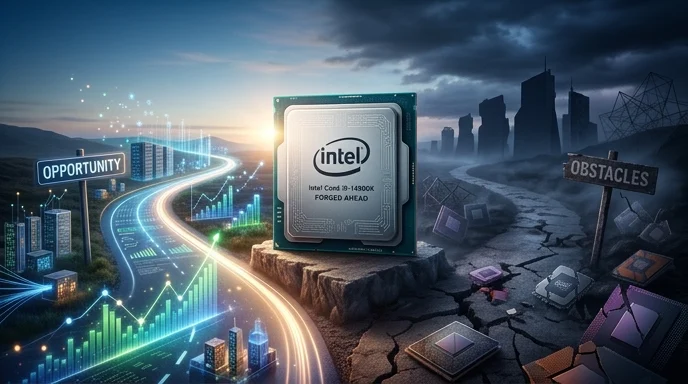
The AI revolution didn’t kill Intel. It gave it a second life.
The shift from GPU-dominated training to CPU-friendly inference is real. The demand for agentic AI systems is accelerating. The need for domestic chip manufacturing is a national priority. Intel sits at the intersection of all three trends.
As The Globe and Mail reported, rival AMD and Arm also surged more than 11% each on the same day Intel’s results dropped — a sign that the market believes the CPU renaissance is real, not just an Intel story.
Bob O’Donnell, president and chief analyst at TECHnalysis Research, summed it up well: “If the foundry business can start contributing in a meaningful way in 2027 — as expected — that should really show that the company’s turnaround is complete.”
Intel isn’t just surviving. It’s competing. And in the AI era, that’s the most surprising plot twist of all.
Sources
- TechSpot — Intel’s stock is back to near-record highs as AI boom moves beyond GPUs
- The Register — Intel bets the farm on AI inference to drag CPU back to the top table
- Nasdaq / Zacks — Nvidia vs. Intel vs. TSMC: The American AI Ecosystem
- Fortune — Intel CEO Lip Bu Tan crushed Wall Street targets on his 1-year anniversary
- The Globe and Mail — Intel soars on signs AI boom for CPUs is here
- Verdict — Intel reports $3.7bn net loss in Q1 2026
Compare
Recent Launches
Latest News
The Kingy Brief
Get the next Kingy Brief.
Source-checked AI changes, original tests and one practical thing to try.
Free · Choose your subjects · Double opt-in · Unsubscribe anytime