Executive summary
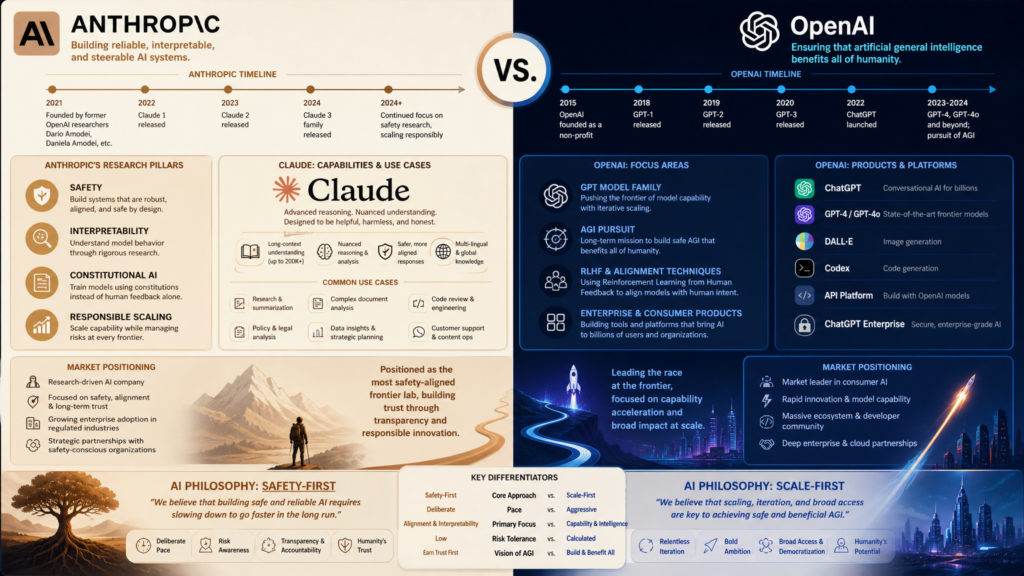
OpenAI still has the stronger mass-market mindshare. The clearest evidence is scale: OpenAI said on February 27, 2026 that ChatGPT had more than 900 million weekly active users and more than 50 million consumer subscribers; Similarweb estimated 5.5 billion visits to chatgpt.com in April 2026, with a #7 global rank and #1 U.S. AI-chatbot category rank; and the main @OpenAI X account had about 4.86 million followers by mid-May 2026. Anthropic is much smaller on those broad consumer metrics: Similarweb estimated 823.5 million visits to claude.ai in April 2026 with a #44 global rank and #3 U.S. AI-chatbot category rank, while Anthropic’s executive Mike Krieger said in March 2026 that more than 1 million people were signing up for Claude every day, but Anthropic had not publicly disclosed a comparable total active-user base by May 15.
Anthropic, however, looks like the stronger momentum brand in developer and coding circles. The strongest evidence is GitHub and developer-surface concentration: Anthropic’s claude-code repo alone had about 124,000 stars and 20,400 forks, far above OpenAI’s largest official SDK repo, openai-python, at about 30,800 stars and 4,800 forks. Anthropic also built visible open-source adjacency around claude-plugins-official, claude-code-action, and its SDK repos, while OpenAI’s public GitHub footprint remains more centered on official API libraries and tooling. That pattern strongly suggests that OpenAI’s open-source brand is still “official SDK provider,” whereas Anthropic’s is increasingly “workflow-native coding platform.”
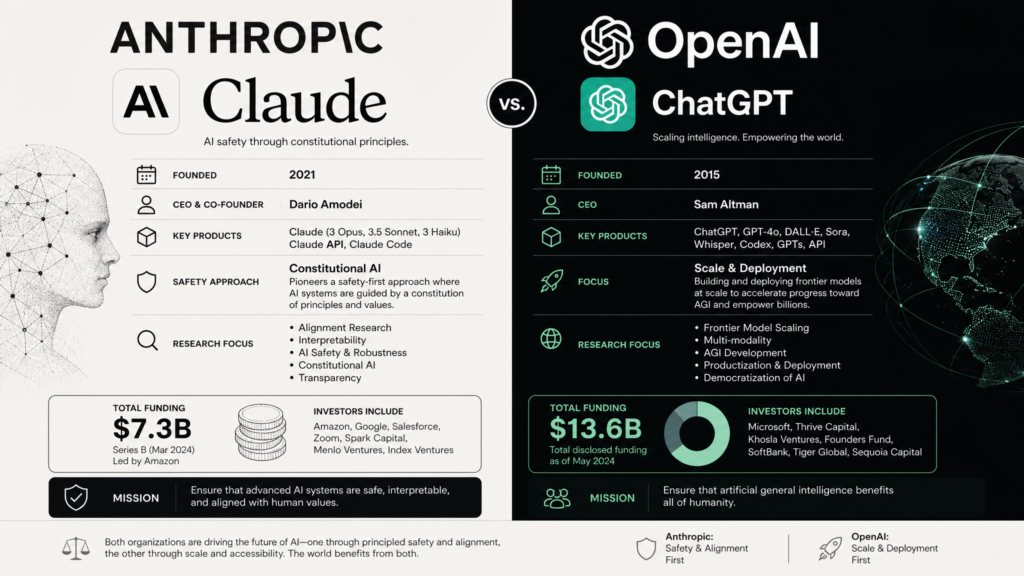
The two companies are also winning different narrative territories. OpenAI’s narrative is breadth, scale, multimodality, and distribution: AGI mission, ChatGPT ubiquity, agents platform, cyber/government programs, and a large capital base. Anthropic’s narrative is safety-first enterprise intelligence, coding, and professional workflows: Claude Code, Managed Agents, Project Glasswing, legal-industry integrations, and a public anti-ad framing. Anthropic explicitly wrote in February 2026 that its revenue model is built on enterprise contracts and paid subscriptions, and that it does not want to sell users’ attention or data to advertisers; OpenAI, by contrast, formally announced advertising tests in ChatGPT in January 2026 and expanded those pilots in May 2026.
On recent growth optics, Anthropic has the better story. Similarweb showed chatgpt.com down 3.84% month over month in April 2026, while claude.ai was up 34.18%. In social/product discourse, Anthropic’s product account @claudeai had already reached roughly 1.36 million followers, more than OpenAI’s @ChatGPTapp account at about 551,000, even though the corporate @OpenAI brand remained far larger than @AnthropicAI. This is a meaningful sign: OpenAI still dominates the umbrella brand, but Anthropic’s product-specific mindshare is now strong enough to compete directly in the category narrative.
The best bottom-line read is therefore not “OpenAI or Anthropic won,” but “they are winning different layers of mindshare.” OpenAI leads in default consumer awareness, total reach, and capitalized distribution. Anthropic leads in coding-native enthusiasm, safety-first brand differentiation, and some professional-use narratives. If the question is who owns the public AI category by sheer awareness, the answer is OpenAI. If the question is who has gained the most incremental mindshare among developers, founder-operators, and AI power users in the last year, the answer is Anthropic.
That conclusion is high-confidence even though some requested metrics—most notably a clean official Google Trends export and comparable Bing search-interest data—were unavailable in this environment and are therefore marked as unspecified below.
Comparative dataset
The table below summarizes the highest-confidence side-by-side metrics available through May 15, 2026.
Two observations matter most. First, OpenAI’s advantage is still overwhelming on consumer scale and broad brand awareness. Second, Anthropic’s gap is much smaller—or reversed—on developer-native surfaces, especially GitHub, coding tutorials, and workflow tooling. Those are different kinds of mindshare, and investors, startup buyers, and technical talent often weight them differently.
Search, web, and brand reach
On web reach, OpenAI remains the default entry point. Similarweb’s April 2026 pages show chatgpt.com at 5.5 billion visits versus claude.ai at 823.5 million. The ranking gap is similarly wide: chatgpt.com was #7 globally, while claude.ai was #44 globally. That is not a close consumer-awareness race. Even if one assumes measurement error in traffic-estimation platforms, the order-of-magnitude difference is too large to dismiss.
The growth vectors, however, point in opposite directions. chatgpt.com fell 3.84% month over month in April 2026, while claude.ai rose 34.18%. That does not mean Anthropic is “bigger”; it does mean Anthropic was, at least in observed web traffic, gaining attention much faster into mid-2026. For a mindshare study, that distinction matters: leadership and momentum are not the same thing. OpenAI has the larger installed base; Anthropic has the more visibly accelerating challenger curve.
Both brands are also unusually direct-navigation heavy. Similarweb shows direct traffic accounting for roughly three quarters of desktop visits for each site—75.3% for chatgpt.com and 74.28% for claude.ai—with organic search only the second-largest acquisition channel for both. In practical terms, that implies both companies are already brands people remember and type directly, not just keywords people discover through search. That is a strong sign of mature mindshare. It also means traditional search-volume comparisons understate the real strength of brand recall for both firms.
The geographic mix is slightly different. ChatGPT’s top desktop traffic source country in April 2026 was the United States at 19.9%, followed by India, Brazil, Japan, and the United Kingdom. Claude.ai’s traffic was more U.S.-concentrated at 27.82% from the United States, followed by India, the United Kingdom, France, and South Korea. That pattern fits the broader narrative: OpenAI looks more globally mainstream; Anthropic looks somewhat more concentrated in high-value English-speaking and technical markets.
What cannot be cleanly asserted from the evidence gathered here is a full official Google Trends or Bing search-interest time series. Because the official Google Trends comparison export was not retrievable in this environment, and comparable Bing time-series data were not publicly available through the collected sources, this report treats exact search-interest indices and related-query leaderboards as unspecified rather than guessing.
Social, video, and creator mindshare
OpenAI’s social graph is much larger at the corporate-brand level. By mid-May 2026, @OpenAI had about 4.86 million followers, far above @AnthropicAI at about 1.264 million. OpenAI also had a substantial developer-side account, @OpenAIDevs, at roughly 336,000, and a product-focused @ChatGPTapp account at roughly 551,000. Anthropic’s most interesting social fact is that the product account, @claudeai, had already reached roughly 1.364 million followers, slightly above the company account and well above @ChatGPTapp. That suggests Anthropic’s product brand is already carrying more of the company’s public mindshare than OpenAI’s product account does for OpenAI, which still leans on the umbrella brand.
YouTube shows a similar split between absolute scale and niche intensity. OpenAI’s official channel had roughly 1.95 million subscribers and 546 videos, versus Anthropic’s 612,000 subscribers and 169 videos. On raw channel size, OpenAI wins comfortably. But Anthropic’s most successful corporate content is unusually strong for a B2D/B2B company: “Mastering Claude Code in 30 minutes” passed 1.2 million views, and other coding-oriented videos such as “Prompting 101 | Code w/ Claude” and “Claude ran a business in our office” were in the hundreds of thousands of views. OpenAI’s biggest visible official videos on the retrieved pages were much larger in absolute terms—”What Codex Unlocks for Notion” at 19 million and “Multi-Agent Hide and Seek” at 11 million—but Anthropic’s content appears especially concentrated around practical creator/developer use cases.
Recent video velocity cuts both ways. OpenAI’s channel snippet showed “Codex for Everyday Work: AI Agents Beyond Coding” at roughly 18-20K views in about a day, a solid corporate-launch pace. Anthropic’s channel snippet showed a newer video posted 8 days earlier, but the retrievable snippet did not expose a comparable view count, so a precise direct velocity comparison is unavailable. The safest interpretation is that OpenAI’s release-marketing engine is still stronger in broad audience distribution, while Anthropic’s coding/tutorial content has stronger evergreen depth relative to its size.
The most defensible X engagement comparison available here is a sample-post comparison, not a platform-wide average. Secondary captures of public X posts showed an OpenAI GPT-5.5 announcement post at roughly 1.67 million views, 144 replies, 372 reposts, and 4.99K likes; an Anthropic “81,000 people want from AI” post at roughly 1.76 million views, 282 replies, 783 reposts, and 5.42K likes; and an OpenAI Developers “Pets. Now in Codex” post at roughly 3.27 million views, 794 replies, 795 reposts, and 9.24K likes. On a visible-engagement-by-views basis, the OpenAI and Anthropic sample corporate posts were in the same rough band, while the OpenAI Developers post showed exceptionally strong developer-audience response.
The social/media conclusion is straightforward. OpenAI still owns the largest top-of-funnel public conversation, while Anthropic has built a very strong product-native following around Claude and especially Claude Code. OpenAI’s media presence is broader, Anthropic’s is denser in the communities that most directly influence pipeline adoption among engineers, tool creators, and technical founders.
Developer ecosystem and GitHub momentum
The clearest source-backed difference between the two companies is the shape of their developer ecosystems. OpenAI’s documentation emphasizes the OpenAI API, official SDKs, the CLI, and the Agents SDK, while its public GitHub organization prominently features official Python, Node, Go, Ruby, and Java libraries. Anthropic’s docs explicitly list official client SDKs in Python, TypeScript, Java, Go, Ruby, C#, PHP, and the command line, and Anthropic’s public repos extend further into workflow-native products such as Claude Code, Claude Code Action, and an official plugins directory. OpenAI looks like a classic platform company; Anthropic looks like a platform company that also turned its best internal workflow into a public product.
That difference shows up starkly in GitHub metrics.
| Company | Repo | Stars | Forks | Commits visible on repo page |
|---|---|---|---|---|
| OpenAI | openai-python | 30.8K | 4.8K | 1,366 |
| OpenAI | openai-node | 10.9K | 1.5K | 1,604 |
| OpenAI | tiktoken | 18.2K | 1.5K | 71 |
| OpenAI | openai-go | 3.2K | 319 | 726 |
| Anthropic | claude-code | 124K | 20.4K | 625 |
| Anthropic | claude-plugins-official | 19.4K | 2.4K | 377 |
| Anthropic | claude-code-action | 7.6K | 1.8K | 594 |
| Anthropic | anthropic-sdk-python | 3.5K | 676 | 1,108 |
| Anthropic | anthropic-sdk-typescript | 1.9K | 321 | 1,078 |
The important analytical point is not just that Anthropic has one very large repo. It is that Anthropic’s highest-mindshare repository, claude-code, is a user-facing workflow product, not just an SDK. OpenAI’s biggest public repos are still mostly core libraries and utilities. That is excellent for platform reliability, but it does not generate the same kind of day-to-day social proof as a repo developers actually use as a collaborator inside their own workflows. This is one of the strongest pieces of evidence that Anthropic is outperforming OpenAI on developer-culture mindshare, even while losing on broad consumer mindshare.
The repository maturity story is more nuanced. OpenAI’s top libraries show high commit counts and frequent releases, which supports the idea of a mature, actively maintained platform. Anthropic’s SDK repos are also active—more than 1,100 commits for the Python SDK and more than 1,000 commits for the TypeScript SDK—but the disproportionate mindshare sits in coding-assistant repos rather than pure client libraries. In other words: Anthropic’s GitHub attention is concentrated where developers feel value directly.
One requested metric—active contributors—could not be extracted consistently from the public snapshot pages accessed here. GitHub exposed contributor sections, but not reliable contributor counts in the retrieved text. Those are therefore marked as unspecified.
Strategy, funding, partnerships, regulation, and controversies
The capital backdrop favors OpenAI in absolute firepower, though Anthropic’s trajectory is steep. OpenAI announced $40 billion at a $300 billion post-money valuation in March 2025, then announced $110 billion in new investment at a $730 billion pre-money valuation on February 27, 2026, and then said on March 31, 2026 that it had closed a $122 billion round at an $852 billion post-money valuation. Anthropic announced a $13 billion Series F at $183 billion in September 2025 and a $30 billion Series G at $380 billion in February 2026. On official, confirmed financing disclosures, OpenAI remains materially larger in capitalization.
OpenAI’s partnership strategy is broad and expansionary. The February 2026 financing announcement tied in SoftBank, NVIDIA, and Amazon, and said OpenAI had signed a strategic partnership with Amazon while securing next-generation inference compute with NVIDIA. Reuters also reported a $200 million Snowflake partnership in February 2026, and Reuters reported in May 2026 that OpenAI created the OpenAI Deployment Company with more than $4 billion in backing to accelerate enterprise adoption. Fiserv separately announced a May 14, 2026 collaboration with OpenAI. These moves reinforce OpenAI’s positioning as the largest-scale deployment and distribution machine in the field.
Anthropic’s partnership map is denser around compute, professional work, and safety-labeled enterprise deployment. Anthropic said on May 6, 2026 that it had raised Claude limits and struck a compute deal with SpaceX, while also outlining agreements with Amazon, Google and Broadcom, and a strategic partnership with Microsoft and NVIDIA. Its official newsroom listed May 2026 announcements for PwC, Claude for Small Business, and a $200 million partnership with the Gates Foundation; Reuters also described expanding Anthropic’s legal-industry integrations with Thomson Reuters, Harvey, Box, Everlaw, and DocuSign. Project Glasswing added another visible cluster of launch partners including AWS, Apple, Google, JPMorganChase, the Linux Foundation, Microsoft, NVIDIA, and Palo Alto Networks. That is a strong signal that Anthropic’s brand is increasingly attached to “trusted enterprise/cyber/professional stack,” not just a chatbot.
The two firms’ market positioning statements are unusually divergent for such close competitors. OpenAI’s official materials still foreground the AGI mission and increasingly present the company as an all-in-one platform for agents and real-world deployment. Anthropic’s site and policy pages foreground being a public benefit corporation, putting safety at the frontier, and explicitly emphasizing revenue from enterprise contracts and paid subscriptions rather than ads. That makes Anthropic’s safety-first narrative more legible and differentiated, while OpenAI’s narrative is more expansive, consumer-facing, and ecosystem-wide.
Recent regulatory and legal events also shaped perception. On OpenAI’s side, Reuters reported in May 2026 on the high-stakes Musk v. OpenAI trial, where Musk sought around $150 billion and the case focused on whether OpenAI’s leadership had strayed from its nonprofit mission. Reuters also reported that the European Commission was analyzing whether ChatGPT should be treated as a large online search engine under the Digital Services Act, and separately that the EU publicly noted OpenAI’s willingness to give trusted European actors preview access to cyber capabilities.
Anthropic’s legal/regulatory narrative has been almost the mirror image: safety credibility on one hand, operational controversy on the other. Reuters reported in March 2026 that Anthropic sued the U.S. government after being designated a supply-chain risk by the Pentagon, and Reuters reported in May 2026 that a federal judge was reviewing Anthropic’s proposed $1.5 billion settlement of authors’ copyright claims. Anthropic also published an official April 2026 postmortem acknowledging recent Claude Code quality regressions and explaining the product changes behind them.
Creator and startup point of view
The creator/technical-founder conversation in 2026 is no longer “ChatGPT versus nobody”; it is “ChatGPT versus Claude for different jobs.” Public creator output reflects that shift. Search results show AI creator Matt Wolfe publishing both a Codex workflow video and a Codex-vs-Claude Code comparison episode in 2026, which is itself a useful mindshare signal: the market now treats OpenAI and Anthropic as the two products serious technical users most want compared.
For creators and solo operators, the pattern in secondary coverage is fairly consistent. Business Insider profiled startup founders who switched meaningful parts of their workflow from ChatGPT to Claude, citing stronger writing quality, contextual nuance, and coding helpfulness; another Business Insider piece described a marketing founder using Claude as the primary work model while keeping ChatGPT for other tasks. These are anecdotes, not market-share studies, but they align closely with the measurable GitHub and tutorial evidence: creators increasingly talk about Claude as the model that “thinks with me,” while they still talk about ChatGPT/OpenAI as the broader platform with more consumer-facing features and wider distribution.
For enterprise software buyers and startups, Anthropic’s coding/workflow brand appears unusually sticky. Reuters reported Anthropic’s expansion into the legal stack with Thomson Reuters and Harvey-linked workflows, and Anthropic’s own partnership/news pages emphasized PwC deployment, small-business packaging, and Project Glasswing. Reuters, meanwhile, reported OpenAI’s launch of a large deployment arm precisely because enterprises were turning large buying decisions into hands-on implementation challenges.
Among developers specifically, the evidence is strongest for Anthropic momentum. Claude Code’s 124K GitHub stars, Anthropic’s 1.2M-view official tutorial, and the size of the official plugins/action ecosystem are all signs of a product that moved beyond “API vendor” into “developer workbench.” OpenAI is clearly pushing in the same direction—Codex-related videos, the agents platform, and strong official SDKs—but its public repo surface still signals platform infrastructure more than daily workflow companionship. In creator terms, Anthropic increasingly seems to own the phrase “I use this to build.” OpenAI still owns “this is the default AI everyone already knows.”
Methodology and confidence
The methodology used in this report is intentionally multi-surface. Mindshare was measured through six observable layers: consumer reach, web traffic, social audience, video audience, developer ecosystem activity, and strategic narrative intensity. Within each layer, official and primary sources were given highest weight: company newsrooms, documentation, GitHub organizations, YouTube channels, X profile pages, and partner press releases. Similarweb was used as a secondary but structured source for traffic estimation; Reuters, Bloomberg, the Wall Street Journal, and similar outlets were used for recent legal, financing, and partnership events; lower-priority secondary captures were used only where official public snapshots did not expose post-level X engagement counts.
Confidence is high on the main conclusion that OpenAI leads in mass-market mindshare while Anthropic has stronger recent momentum in developer/coding circles. Confidence is also high on the numeric GitHub, traffic-rank, disclosed-funding, and official-user-scale statistics used above. Confidence is medium on post-level X engagement comparisons and startup/creator sentiment, because those rely partly on public search captures and secondary reporting rather than privileged platform analytics. Confidence is low to unavailable for requested Google Trends/Bing time-series comparisons, related-query lists, and active-contributor counts—those remain unspecified here rather than estimated.
Neither OpenAI nor Anthropic is publicly traded, so there were no SEC filings to use as primary evidence on operating financials; where financial scale appears in this report, it comes from company announcements or high-quality reporting on private financings and partnerships. The private-company nature of both firms is itself part of the methodological constraint.
The Kingy Brief
Get future Kingy Brief editions.
Source-checked AI changes, original tests and one practical thing to try.
Free · Choose your subjects · Double opt-in · Unsubscribe anytime
Regular sending is paused; no restart date is set.