
Reviewed October 7, 2026. OpenAI’s general-availability post, pricing, model documentation and linked benchmark sources were rechecked. Kingy has not independently reproduced every score.
Current-generation boundary: OpenAI’s current model catalogue now directs buyers to GPT-6 Astra, GPT-6.1 Sol and GPT-6 Luna. The GPT-5.6 analysis below is retained as a dated July–September 2026 family comparison. GPT-5.6 Sol remains on OpenAI’s pricing page with promotional pricing stated to run at least through November 21, 2026; confirm model availability and rates before deployment.
Frontier model analysis
Short version: GPT-5.6 is not one model. OpenAI released a three-tier family: GPT-5.6 Sol for the hardest work, GPT-5.6 Terra for balanced production, and GPT-5.6 Luna for lower-cost volume. Sol is a serious frontier model, but the most important business story may be that Terra and Luna move a lot of GPT-5.6 capability into cheaper deployment lanes.
GPT-5.6 reached general availability on July 9, 2026, after a restricted June preview and a period of U.S. government review and coordination. OpenAI positions it as a frontier family for professional work, coding, long-horizon agents, computer use, cybersecurity, science, health, tool use, and internal research acceleration. The main question is not just whether GPT-5.6 Sol is “the best model.” The better question is where Sol is genuinely ahead, where competitors still lead, and when Terra or Luna is the smarter model to ship. Kingy.ai separately covered the general availability after U.S. government review.
This article uses OpenAI’s GPT-5.6 launch post, the GPT-5.6 System Card, the OpenAI model docs, the OpenAI pricing page, and linked benchmark documentation. It treats OpenAI-published benchmark rows as vendor-reported launch data, not independent proof of universal superiority. Where a source does not publish a number, this article says “not published” rather than filling the blank.
Kingy verdict: GPT-5.6 Sol looks like a new top-tier frontier model, especially for browsing, terminal work, BenchCAD, SEC-Bench Pro, CTF-style security, and several science rows. But it does not sweep the field. Claude Fable 5, Claude Mythos 5, GPT-5.5, and even Terra beat or match Sol on important benchmark rows. The practical win is the family design: Sol for peak capability, Terra for everyday agents, Luna for cost-sensitive scale.
For direct head-to-head analysis, see GPT-5.6 vs Claude, Grok, Muse and Gemini; for deployment choices, see the best AI model API by use case. For release history, read the GPT-5.6 limited-preview safety and rollout history and how U.S. government review shaped the July 9 launch.
What Is GPT-5.6?
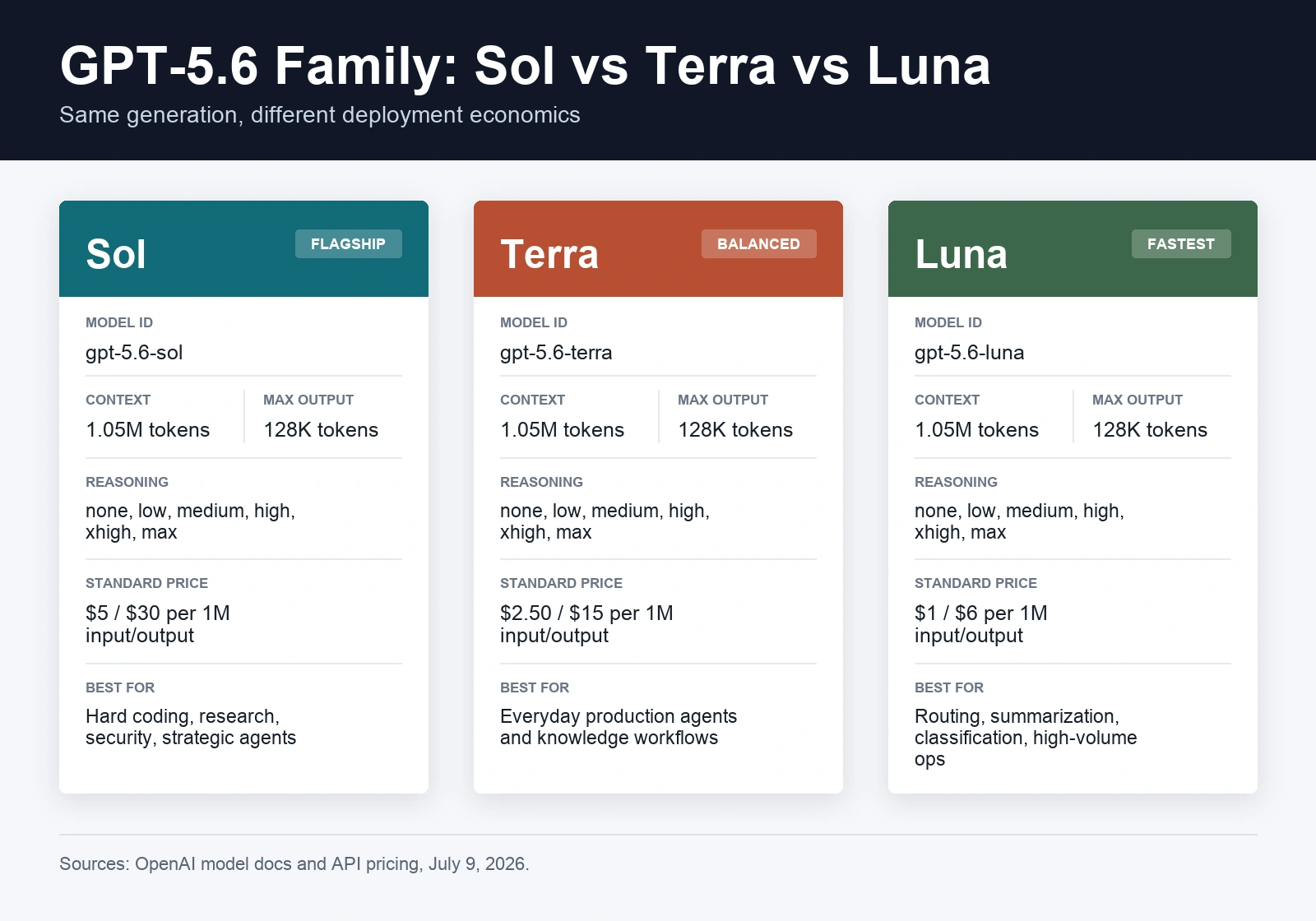
GPT-5.6 is OpenAI’s July 2026 frontier model family. OpenAI describes Sol as the flagship, Terra as a lower-cost balanced model, and Luna as the fastest and most affordable model. The number marks the generation; the names mark durable capability tiers. That naming matters because developers can now think in three lanes instead of one: pay for Sol when mistakes are expensive, use Terra when a production workflow needs strong quality at lower cost, and route simple high-volume work to Luna.
The model IDs are straightforward. The API exposes gpt-5.6-sol, gpt-5.6-terra, and gpt-5.6-luna. The alias gpt-5.6 routes to Sol. OpenAI’s docs list the same 1.05M token context window, 128K token max output, February 16, 2026 knowledge cutoff, and reasoning effort choices across all three models. The current model pages list web_search, file_search, image_generation, code_interpreter, hosted_shell, apply_patch, skills, computer_use, mcp, and tool_search for all three. Function calling is documented separately as a supported feature.
For Kingy.ai readers who follow model launches, this is not just another “bigger model” story. It connects to the broader shift we covered in our June limited-preview chronology and State of AI Coding Tools 2026: models are becoming infrastructure. The winning deployment is not necessarily the single highest benchmark row. It is the routing system that can choose the right intelligence per token.
GPT-5.6 Sol: The Flagship Model
Sol is the headline act. OpenAI’s launch post emphasizes long-horizon agentic work, professional tasks, coding, cybersecurity, science, and research acceleration. In plain English, Sol is the model you reach for when the task is complex enough that cheaper retries are not really cheaper: a tricky code migration, a security review, a deep research synthesis, a multi-document legal or finance workflow, or an agent that must keep track of constraints for a long time.
Sol’s strongest launch rows are not all from traditional academic benchmarks. BrowseComp, Terminal-Bench, BenchCAD, SEC-Bench Pro, CTF challenges, GeneBench Pro, LifeSciBench, HealthBench Professional, and several long-context rows matter more for builders because they resemble work: browse, inspect, coordinate tools, write code, compare evidence, validate a result, and recover when the first attempt is wrong.
The catch is important: “frontier” does not mean “wins every line.” OpenAI’s own table shows Claude Mythos 5 leading Sol on SWE-Bench Pro and ExploitBench, and Claude Fable 5 leading on GDPval-AA v2, FrontierMath Tier 4, Toolathlon, HealthBench Professional by a small margin, and Artificial Analysis Intelligence Index v4.1. GPT-5.5 edges Sol on the 512K-1M MRCR long-context row. Sol leads the published FrontierMath Tier 1-3 row and beats GPT-5.5 and Terra on Tier 4. That makes the story more useful, not less. Sol is powerful, but model choice still needs workflow testing.
Why Terra And Luna Matter
Terra and Luna are easy to underestimate because they are not the flagship. That would be a mistake. Most deployed AI systems are not running one heroic prompt a day. They route thousands or millions of smaller calls: support classification, retrieval summaries, spreadsheet checks, CRM updates, content operations, QA reviews, ingestion pipelines, and agent subtasks.
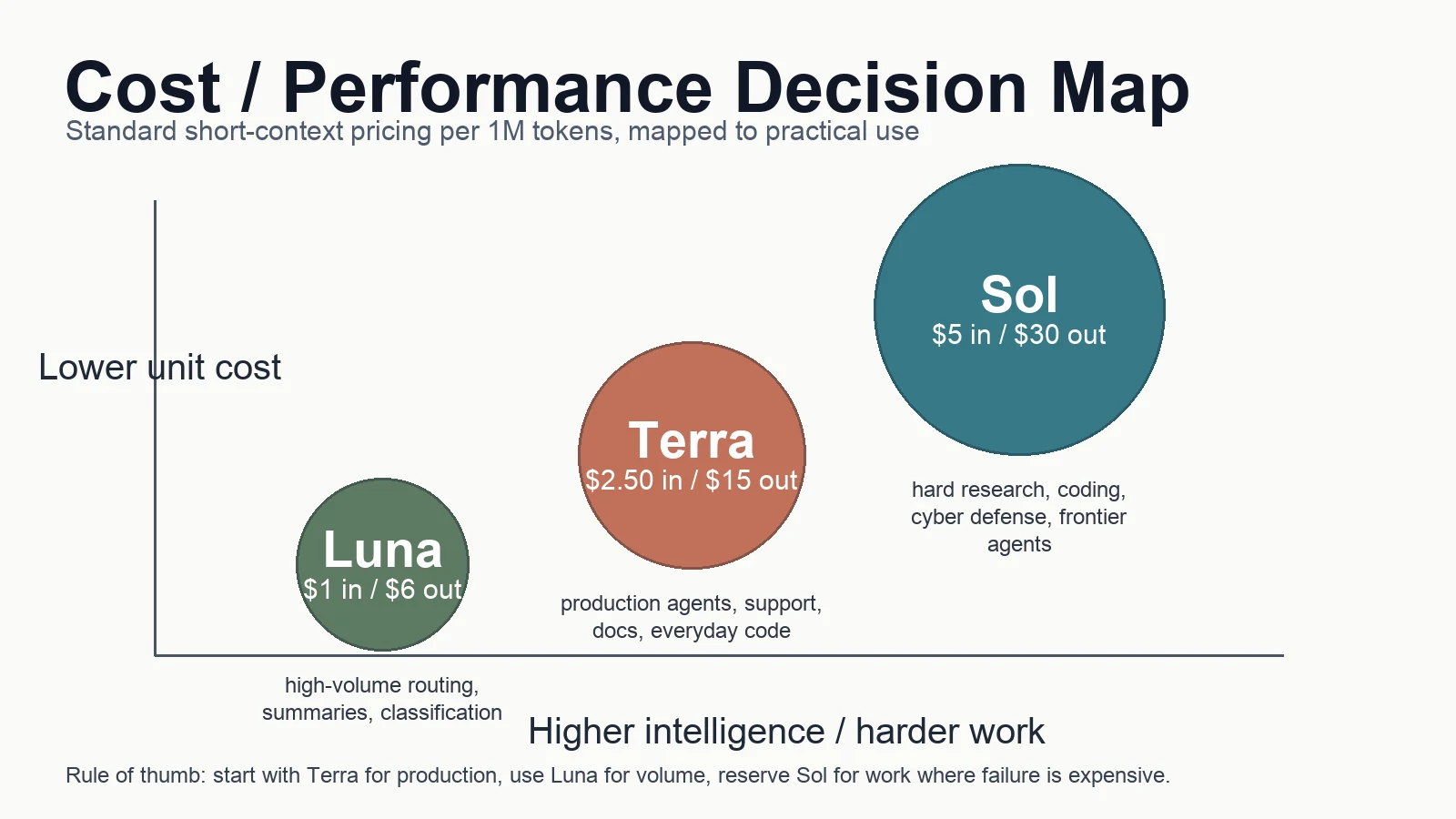
Terra is the practical center of gravity. It costs half Sol’s standard input price and 60% of its output price, but remains close to Sol on many professional and agentic rows. It even beats Sol on two narrow rows inside OpenAI’s self-improvement section: NanoGPT and PostTrainBench Lite. That does not make Terra “smarter” overall. It does mean teams should test Terra before assuming Sol is required.
Luna is the volume play. It is much cheaper than Sol, and OpenAI calls it the fastest and most cost-efficient model. The tradeoff is real: Luna falls hard on GeneBench Pro, MRCR long-context, GraphWalks 1M, ARC-AGI-3, and several cyber rows. But for routing, lightweight summarization, extraction, classification, basic agent subtasks, and operational triage, Luna can be the model that makes a product economically workable.
GPT-5.6 Specs, Model IDs, Pricing, And API Details
The cleanest API fact is that the three models share the same core window and output limits: 1.05M token context and 128K token max output. The OpenAI docs list the same knowledge cutoff, February 16, 2026, and the same reasoning effort choices: none, low, medium, high, xhigh, and max. The model docs list web search, file search, image generation, code interpreter, hosted shell, apply patch, skills, computer use, MCP, and tool search for all three; function calling is a supported feature.
Pricing is more nuanced because GPT-5.6 introduces explicit prompt caching and separate cache-write pricing. Standard short-context pricing is Sol at $5 input and $30 output per 1M tokens, Terra at $2.50 input and $15 output, and Luna at $1 input and $6 output. The pricing page also lists 90% cached-input discounts and cache writes at 1.25x uncached input. OpenAI’s launch post says explicit cache breakpoints and a 30-minute minimum cache life are part of the new predictable caching story.
| Model | Model ID | Role | Context Window | Max Output | Knowledge Cutoff | Reasoning Efforts | Tool Support | Standard Short-Context Price / 1M Tokens | Standard Long-Context Price / 1M Tokens | Best For |
|---|---|---|---|---|---|---|---|---|---|---|
| GPT-5.6 Sol | gpt-5.6-sol; alias gpt-5.6 | Flagship frontier model | 1.05M | 128K | Feb 16, 2026 | none, low, medium, high, xhigh, max | Web search, file search, image generation, code interpreter, hosted shell, apply patch, skills, computer use, MCP, tool search; function calling supported | $4 input / $0.40 cached / $5 cache write / $20 output | $8 input / $0.80 cached / $10 cache write / $30 output | Hard reasoning, coding, research, cyber defense, long-horizon agents |
| GPT-5.6 Terra | gpt-5.6-terra | Balanced lower-cost model | 1.05M | 128K | Feb 16, 2026 | none, low, medium, high, xhigh, max | Web search, file search, image generation, code interpreter, hosted shell, apply patch, skills, computer use, MCP, tool search; function calling supported | $2 input / $0.20 cached / $2.50 cache write / $12 output | $4 input / $0.40 cached / $5 cache write / $18 output | Production agents, support, documents, routine coding |
| GPT-5.6 Luna | gpt-5.6-luna | Fastest and most cost-efficient model | 1.05M | 128K | Feb 16, 2026 | none, low, medium, high, xhigh, max | Web search, file search, image generation, code interpreter, hosted shell, apply patch, skills, computer use, MCP, tool search; function calling supported | $0.20 input / $0.02 cached / $0.25 cache write / $1.20 output | $0.40 input / $0.04 cached / $0.50 cache write / $1.80 output | Routing, classification, summarization, high-volume workflows |
Sources: OpenAI model docs and OpenAI pricing docs. Prices checked September 5, 2026. Sol’s current rate is promotional through at least November 21, 2026; prompts above 272K input tokens use 2x input and 1.5x output pricing for the full request. Batch, Flex, Priority, regional data-residency uplift, and tool-call fees can change the effective bill.
GPT-5.6 Benchmarks Vs GPT-5.5, Claude, And Gemini
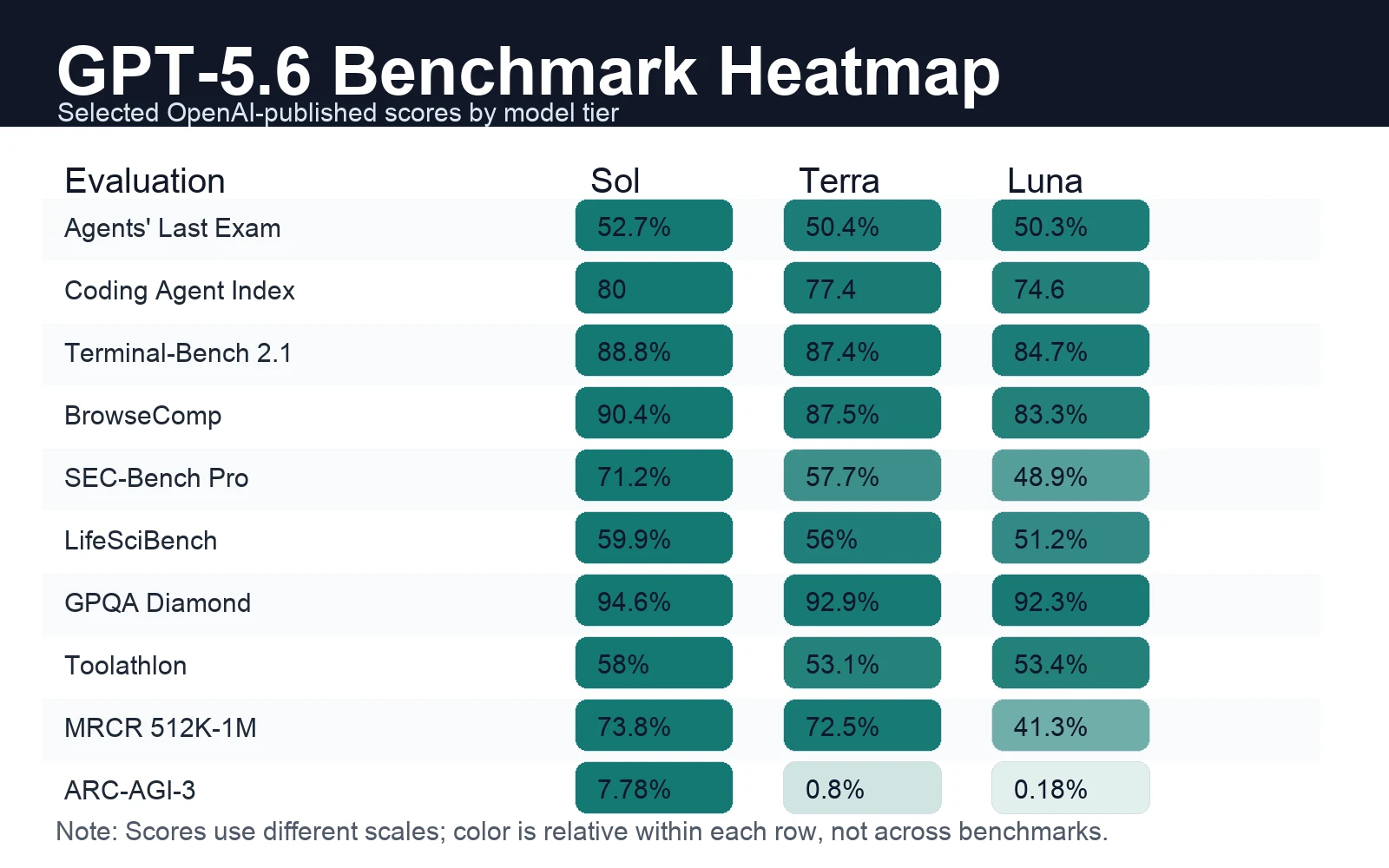
Benchmarks are useful only when you read them with friction. Some are independent leaderboards. Some are internal OpenAI evaluations. Some use vendor-selected harnesses. Some compare a base model with another vendor’s preview model. Some allow tools; some do not. Some report percent success, others Elo, index scores, or F1. For that reason, the tables below are not averaged into one fake master score. They are grouped by task family.
Professional And Knowledge Work
Professional work is where the GPT-5.6 family looks commercially important. Agents’ Last Exam measures real-world professional workflows with verifiable success criteria. Artificial Analysis tracks independent model and provider performance. GDPval-AA v2 adapts OpenAI’s GDPval-style occupational tasks into a leaderboard. Management Consulting Tasks and Big Finance Bench are closer to the enterprise use cases founders actually sell into.
| Eval | GPT-5.6 Sol | GPT-5.6 Terra | GPT-5.6 Luna | GPT-5.5 | Claude Fable 5 | Claude Opus 4.8 | Gemini 3.1 Pro Preview | Gemini 3.5 Flash |
|---|---|---|---|---|---|---|---|---|
| Agents’ Last Exam | 52.7% | 50.4% | 50.3% | 46.9% | 40.5% | 45.2% | 32.1% | not published |
| GDPval-AA v2 | 1747.8 Elo | 1593 Elo | 1591.8 Elo | 1493.7 Elo | 1759.6 Elo | 1600.1 Elo | 962.3 Elo | 1348.8 Elo |
| Management Consulting Tasks (internal) | 43.2% | 37.2% | 35.4% | 31.3% | 35.5% | 31.6% | 13.2% | not published |
| Big Finance Bench | 53% | 51% | 36% | 49% | not published | 44% | not published | not published |
| Artificial Analysis Intelligence Index v4.1 | 58.9 | 55 | 51.2 | 54.8 | 59.9 | 55.7 | 46.5 | 50.2 |
Sol leads Agents’ Last Exam among the listed models, and it beats GPT-5.5 across all five professional rows shown. But it is not a clean sweep across competitors. Claude Fable 5 is higher on GDPval-AA v2 and the Artificial Analysis Intelligence Index. On Big Finance Bench, Sol’s 53% is ahead of GPT-5.5’s 49%, but Terra is close at 51% and Luna drops to 36%. The message: Sol is strong for professional work, but specialized finance and occupational evals still need workflow-specific testing.
Coding And Agentic Software Engineering
Coding is the most complicated GPT-5.6 story. Sol is excellent on Terminal-Bench 2.1, and Sol Ultra reaches 91.9%. But on SWE-Bench Pro, Claude Mythos 5 and Claude Fable 5 are far ahead of Sol in OpenAI’s own table. That matters for builders of coding agents, IDE tools, QA bots, and repo-maintenance systems. The “best coding model” depends heavily on whether your task is terminal operation, issue resolution, repository edits, or long-horizon planning.
| Eval | GPT-5.6 Sol | GPT-5.6 Sol Ultra | GPT-5.6 Terra | GPT-5.6 Luna | GPT-5.5 | Claude Mythos 5 | Claude Mythos Preview | Claude Fable 5 | Claude Opus 4.8 | Gemini 3.1 Pro Preview |
|---|---|---|---|---|---|---|---|---|---|---|
| Artificial Analysis Coding Agent Index v1.1 | 80 | not published | 77.4 | 74.6 | 76.4 | not published | not published | 77.2 | 72.5 | 42.7 |
| SWE-Bench Pro | 64.6% | not published | 63.4% | 62.7% | 59.4% | 80.3% | 77.8% | 80% | 69.2% | 54.2% |
| DeepSWE v1.1 | 72.7% | not published | 69.6% | 67.2% | 67% | not published | not published | 69.7% | 59% | 11.8% |
| Terminal-Bench 2.1 | 88.8% | 91.9% | 87.4% | 84.7% | 85.6% | 88% | not published | 83.1% | 78.9% | 70.7% |
For teams already comparing Codex, Claude Code, Cursor, Gemini Antigravity, and other coding stacks, this is the table to stare at. Sol is clearly stronger than GPT-5.5 on these launch rows, but Claude Mythos 5 dominates SWE-Bench Pro. Terminal-Bench is friendlier to GPT-5.6, especially Ultra. DeepSWE is also strong for Sol, while Gemini 3.1 Pro Preview is much weaker in OpenAI’s listed DeepSWE row. For a practical coding stack, benchmark your own repo classes rather than buying the headline.
Computer Use And Browsing
Computer-use benchmarks test whether a model can operate interfaces, keep state, inspect screens, and complete messy workflows. BrowseComp is about hard-to-find web information. OSWorld 2.0 focuses on long-horizon computer-use tasks. BenchCAD tests computer-aided design work, including a variant with a Python tool.
| Eval | GPT-5.6 Sol | GPT-5.6 Sol Ultra | GPT-5.6 Terra | GPT-5.6 Luna | GPT-5.5 | Claude Mythos 5 | Claude Mythos Preview | Claude Opus 4.8 | Gemini 3.1 Pro Preview |
|---|---|---|---|---|---|---|---|---|---|
| OSWorld 2.0 | 62.6% | not published | 50.2% | 45.6% | 47.5% | not published | not published | 54.8% | not published |
| BrowseComp | 90.4% | 92.2% | 87.5% | 83.3% | 84.4% | 88% | 87.9% | 84.3% | 85.9% |
| BenchCAD | 70.6% | not published | 62.3% | 63.1% | 44.4% | 38.4% | 35.5% | 27.3% | not published |
| BenchCAD with Python tool | 83.4% | not published | 78.2% | 73.9% | 55.8% | 65% | 61% | 51.8% | not published |
This is one of Sol’s cleaner stories. It leads OSWorld 2.0 among the published values in OpenAI’s table, and Sol Ultra pushes BrowseComp to 92.2%. BenchCAD is especially interesting because Sol is strong without tools and even stronger with the Python tool. That is exactly the pattern agent builders care about: the model is not just answering; it is coordinating action, context, and external computation.
Cybersecurity
Cybersecurity needs careful wording. These are capability evaluations, not instructions for misuse. Stronger cyber models can help defenders find vulnerabilities, validate patches, write detections, and triage incidents. They can also increase misuse risk if safeguards fail. OpenAI’s system card says GPT-5.6 is more capable in cybersecurity than earlier models but does not cross its Critical threshold.
| Eval | GPT-5.6 Sol | GPT-5.6 Sol Ultra | GPT-5.6 Terra | GPT-5.6 Luna | GPT-5.5 | Claude Mythos 5 | Claude Mythos Preview | Claude Opus 4.8 |
|---|---|---|---|---|---|---|---|---|
| Capture-the-Flag Challenges | 96.7% | not published | 91.8% | 85.2% | 88.1% | not published | not published | not published |
| SEC-Bench Pro | 71.2% | 74.3% | 57.7% | 48.9% | 45.8% | not published | not published | not published |
| CyberGym | 84.5% | not published | 81.8% | 77.9% | 81.8% | 83.8% | 83% | 78.1% |
| ExploitBench | 73.5% | not published | 52.9% | 33.2% | 47.9% | 78% | 74.2% | 40% |
| ExploitGym | 33.7% | not published | 23.2% | 12.4% | 15.1% | not published | not published | not published |
Sol has huge gains over GPT-5.5 on SEC-Bench Pro and ExploitGym, and it leads CTF challenges in the published OpenAI table. But ExploitBench is a notable caveat: Claude Mythos 5 is listed at 78%, ahead of Sol’s 73.5%. SEC-Bench Pro Ultra at 74.3% is the highest value in that row. In real defensive work, the key question is not just score; it is whether the model can operate inside authorized scopes without triggering unnecessary safeguards or generating unsafe material.
Method note: OpenAI says ExploitBench used its API harness with five seeds and reasoning continuity. ExploitGym ran on an alpha API, with latency rescaled to expected public-API speed; the resulting estimated latencies can exceed nominal two- and six-hour caps even when the original evaluation run obeyed them.
Science And Health
Science rows are promising but need caution. GeneBench Pro evaluates long-horizon genomics and quantitative biology workflows. LifeSciBench and MedChemBench point toward scientific reasoning and chemistry. HealthBench Professional is clinical-work oriented, but OpenAI specifically notes that its HealthBench Professional scoring approach is not comparable to some Anthropic system-card results.
| Eval | GPT-5.6 Sol | GPT-5.6 Terra | GPT-5.6 Luna | GPT-5.5 | Claude Fable 5 | Claude Opus 4.8 | Gemini 3.1 Pro Preview | Gemini 3.5 Flash |
|---|---|---|---|---|---|---|---|---|
| GeneBench Pro | 28.7% | 23.3% | 10.8% | 12% | not included | 16% | 3.1% | 8.14% |
| LifeSciBench | 59.9% | 56% | 51.2% | 50.4% | not included | 53.6% | not published | not published |
| MedChemBench (internal) | 48.3% | 35% | 30.4% | 35.5% | not published | not published | not published | not published |
| HealthBench Professional | 60.5% | 57.7% | 55.7% | 49.5% | 60.9% | 53% | not published | not published |
Sol is strong on GeneBench Pro and LifeSciBench. HealthBench Professional is nearly tied at the top, with Claude Fable 5 listed at 60.9% and Sol at 60.5%. OpenAI says Claude Fable 5 was not included on GeneBench Pro because it refuses the majority of questions in that evaluation. That caveat matters: a model can look absent, weak, or strong depending on refusal policy, scoring method, and task framing.
Academic Reasoning, Math, And Abstract Reasoning
Academic benchmarks are familiar, but they are not always the best product guide. GPQA Diamond tests hard graduate-level science questions. FrontierMath uses extremely difficult math problems. ARC-AGI-3 is an interactive reasoning benchmark where agents must explore and adapt rather than answer static text questions.
| Eval | GPT-5.6 Sol | GPT-5.6 Terra | GPT-5.6 Luna | GPT-5.5 | Claude Mythos 5 | Claude Mythos Preview | Claude Fable 5 | Claude Opus 4.8 | Gemini 3.1 Pro Preview |
|---|---|---|---|---|---|---|---|---|---|
| GPQA Diamond | 94.6% | 92.9% | 92.3% | 93.6% | 94.1% | 94.6% | 92.6% | 92% | 94.3% |
| FrontierMath Tier 1-3 (v2) | 89% | 84.9% | 78.6% | 85.3% | not published | not published | 87% | 80% | 59.6% |
| FrontierMath Tier 4 (v2) | 83% | 68.3% | 58.5% | 72.5% | not published | not published | 87.8% | 56.1% | not published |
| ARC-AGI-3 | 7.78% | 0.8% | 0.18% | 0.43% | not published | not published | not published | 1.5% | 0.42% |
This table is the best antidote to one-dimensional hype. Sol is excellent on GPQA Diamond and leads the published FrontierMath Tier 1-3 row at 89%. Claude Fable 5 leads FrontierMath Tier 4 at 87.8%, with Sol second at 83%. ARC-AGI-3 remains low across the board, with Sol at 7.78% and Opus 4.8 at 1.5% in the published comparison. OpenAI notes that the Opus 4.8 ARC-AGI-3 result used high—not max—reasoning effort. That row is a reminder that interactive adaptive reasoning is still far from solved.
Tool Use And Long Context
Tool use and long context are where “1M context” claims meet reality. Toolathlon measures tool-using agents across realistic environments. AutomationBench tests end-to-end workflows across simulated business tools. MRCR and GraphWalks stress long-context retrieval, state tracking, and graph reasoning.
| Eval | GPT-5.6 Sol | GPT-5.6 Terra | GPT-5.6 Luna | GPT-5.5 | Claude Mythos 5 | Claude Mythos Preview | Claude Fable 5 | Claude Opus 4.8 | Gemini 3.1 Pro Preview | Gemini 3.5 Flash |
|---|---|---|---|---|---|---|---|---|---|---|
| AutomationBench | 18.1% | 15.2% | 14.9% | 12.9% | not published | not published | 17.4% | 15.5% | not published | 14.5% |
| Toolathlon | 58% | 53.1% | 53.4% | 55.6% | 61.7% | 61.1% | 61.7% | 59.9% | 48.8% | not published |
| OpenAI MRCR v2 8-needle 256K-512K | 91.5% | 89.6% | 41.3% | 81.5% | not published | not published | not published | not published | not published | not published |
| OpenAI MRCR v2 8-needle 512K-1M | 73.8% | 72.5% | 41.3% | 74% | not published | not published | not published | not published | not published | not published |
| GraphWalks BFS 256K F1 | 90.7% | 76.9% | 81.3% | 73.7% | 91.1% | 85.7% | not published | 85.9% | not published | not published |
| GraphWalks BFS 1M F1 | 77.1% | 71.2% | 51.2% | 45.4% | 79.4% | 74.3% | not published | 68.1% | not published | not published |
OpenAI’s table shows mixed results. Sol leads AutomationBench among the published values and is strong on MRCR 256K-512K. But Claude Mythos 5 and Claude Fable 5 lead Toolathlon, GPT-5.5 narrowly beats Sol on MRCR 512K-1M, and Claude Mythos 5 leads both GraphWalks rows. Luna’s long-context MRCR scores show the danger of assuming that every model with a big context window behaves equally well across the full window.
What Is Ultra Mode?
OpenAI describes Ultra as a multi-agent, parallel-agent capability in ChatGPT Work and Codex. The launch post says ChatGPT Work makes Ultra available to Pro and Enterprise users, while Codex offers it to Plus and higher plans. In the benchmark footnotes, OpenAI says Ultra is run with four agents, with latency derived from the root agent while output token and API cost totals include all tokens.
That detail matters. Ultra can improve hard agentic work because independent agents can explore, check, and synthesize in parallel. It can also increase token use. Developers should not treat Ultra as a magical free quality switch. It is closer to asking several competent agents to attack the same problem from different angles and then reconcile the answer. That is valuable for code review, security triage, research synthesis, and complex document work. It is wasteful for short deterministic tasks.
Programmatic Tool Calling Explained
Programmatic Tool Calling is one of the most important API changes in the GPT-5.6 launch. OpenAI’s docs say it lets a model write and run JavaScript that coordinates tools inside a Responses API request. The generated program can call eligible tools in parallel, use loops and conditions, and keep intermediate results in the hosted runtime. The runtime is isolated V8, not Node.js: no package installation, direct network access, general filesystem, subprocesses, or persistent JavaScript state.
The simple version: GPT-5.6 can write a small temporary program to organize tool calls and reduce intermediate data before handing a result back to the model. That matters for agents that need to fetch many records, filter them, compare rows, validate outputs, or avoid repeatedly asking the model to reason over giant tool dumps. It is especially relevant to finance workflows, research workflows, legal review, engineering analysis, and operations tasks where structured intermediate processing beats pure chat.
OpenAI’s Multi-agent beta is the sibling capability. The docs say it lets a model spin up and coordinate subagents in parallel inside a Responses API request, and that it is available as a beta feature with all GPT-5.6 models. Programmatic Tool Calling is code orchestration; Multi-agent is model orchestration. Used well, they let builders split deterministic data handling from judgment-heavy synthesis.
Design And Frontend Improvements
OpenAI’s launch post also claims stronger design judgment, including better frontend aesthetics, hierarchy, and rendered-result inspection. For app builders, this is not cosmetic. A coding model that can implement a UI is useful; a coding model that can notice cramped spacing, awkward visual hierarchy, broken responsive behavior, or confusing controls is much more useful.
The practical implication is straightforward. If you build AI coding tools or internal product agents, test GPT-5.6 Sol on full UI tasks: generate the component, run it, inspect the rendered page, fix layout issues, and explain the tradeoffs. This is exactly where agentic coding differs from autocomplete. You can see the connection to broader AI coding agent stack work: the model is becoming planner, implementer, QA reviewer, and design critic.
Safety And GPT-5.6 System Card Analysis
The GPT-5.6 System Card and launch post say the models are more capable than earlier models in both biology and cybersecurity, but do not cross OpenAI’s Critical threshold in either category. OpenAI says the cyber profile is better at finding and fixing vulnerabilities than reliably carrying out autonomous end-to-end attacks against hardened targets. For biology, OpenAI says GPT-5.6 can support legitimate research but does not provide end-to-end capability to create, engineer, or synthesize a highly dangerous novel threat.
OpenAI’s safety stack is layered: model training, real-time checks, monitoring, account-level enforcement, reasoning monitors, red teaming, bug bounty work, and Trusted Access for verified cyber or biology use cases. The launch post says GPT-5.6 Sol cyber safeguards block roughly ten times more potentially harmful activity than previous models, and acknowledges that this can create friction for benign users. That is the real-world tradeoff: more capable models need stronger controls, but overblocking can hurt legitimate defensive work.
For the historical detail behind these controls, see Kingy.ai’s June 2026 limited-preview safety and cyber review.
For developers, the safe takeaway is practical. Do not build cyber, bio, health, or legal workflows that depend on the model making the final authority call. Use scoped environments, approvals, audit logs, and human review. For security work, keep tasks inside authorized systems and expect some safeguard friction. For health and science, treat model output as decision support, not a clinician, principal investigator, or compliance officer.
Strengths, Weaknesses, And Caveats
Where Sol looks strongest
BrowseComp, Terminal-Bench, BenchCAD, SEC-Bench Pro, CTF challenges, GeneBench Pro, LifeSciBench, and broad professional work.
Where it is complicated
Claude leads or matches on SWE-Bench Pro, ExploitBench, Toolathlon, FrontierMath Tier 4, HealthBench Professional, and some Artificial Analysis rows.
Main deployment caveat
Ultra, max reasoning, long context, tools, and multi-agent orchestration can improve quality while increasing tokens, latency, and cost.
The strongest GPT-5.6 story is that OpenAI is making frontier capability more routable. Sol gives teams a high-end model for difficult work. Terra gives a cheaper option that is often close. Luna gives a high-volume option that can be used as the default for simpler tasks. The weakness is that every benchmark is conditional. Internal benchmarks should be labeled internal. Vendor-reported tables should be treated as launch evidence, not gospel. Preview models may change. Different harnesses and reasoning settings can move scores.
Which GPT-5.6 Model Should You Use?
| Model | Use It For | Why |
|---|---|---|
| GPT-5.6 Sol | Hard reasoning, frontier coding, strategic research, long-context analysis, cyber defense, science workflows, multi-agent review | Highest family score on most GPT-5.6 comparisons; best when quality is worth the token cost. |
| GPT-5.6 Terra | Production agents, customer support, business documents, everyday code, workflow automation, knowledge-base operations | Often close to Sol and ahead on narrow self-improvement rows such as NanoGPT and PostTrainBench Lite, at half Sol’s input price and 60% of its output price. |
| GPT-5.6 Luna | Routing, classification, extraction, summarization, lightweight agents, monitoring, high-volume content operations | Cheapest GPT-5.6 model; much weaker on some long-context and high-difficulty tasks, but strong enough for many scaled workloads. |
For most production teams, the smart starting point is Terra. Build a routing layer. Send routine work to Luna, normal high-quality work to Terra, and escalations to Sol. Use Sol when the task is long, ambiguous, high-risk, or expensive to redo. Use Terra when quality matters but the workload is repetitive. Use Luna when the cost of overthinking exceeds the cost of a retry or escalation.
For startups, this changes product math. A customer-support agent, finance operations assistant, legal intake system, sales research workflow, or coding QA bot can use different model tiers inside the same product. That is how AI products stop being demos and become margins. The system should not ask “what is the best model?” It should ask “what is the cheapest model that clears the quality bar for this step?”
Business Implications
GPT-5.6 matters for AI startups because it pushes intelligence into the routing layer. The default architecture is becoming multi-model: one tier for high-volume classification, one for production-grade work, one for escalations, and optional parallel-agent modes for the hardest cases. That is useful for AI tools, coding products, legal and finance workflows, research tools, design systems, and internal knowledge work.
It also raises the bar for evaluation. If you are building with GPT-5.6, do not stop at OpenAI’s benchmark table. Create your own eval set. Include realistic documents, awkward edge cases, bad data, stale instructions, tool failures, latency targets, and budget caps. Measure Sol, Terra, Luna, GPT-5.5, Claude, and Gemini where appropriate. Then route dynamically. The winners will be the teams that turn model families into operating systems for work.
GPT-5.6 Verdict: Sol vs Terra vs Luna
GPT-5.6 Sol is plausibly one of the new frontier models, and in several launch-table categories it looks excellent. It is especially compelling for browsing, terminal work, CAD-like tool use, security evaluations, life-science workflows, and complex professional agents. But the honest answer is not “Sol wins everything.” It does not. Claude Mythos 5, Claude Fable 5, GPT-5.5, Terra, and other comparators lead on meaningful rows.
The more important verdict is that GPT-5.6 makes OpenAI’s model lineup more deployable. Sol is the top-end model. Terra is the serious production default. Luna is the economic lever. For builders, the frontier is no longer just raw intelligence. It is intelligence you can route, cache, parallelize, and afford.
FAQ
What is GPT-5.6 Sol?
GPT-5.6 Sol is OpenAI’s flagship GPT-5.6 model. It is exposed in the API as gpt-5.6-sol, and the gpt-5.6 alias routes to Sol.
What are GPT-5.6 Terra and Luna?
Terra is the balanced GPT-5.6 model for lower-cost production work. Luna is the fastest and most cost-efficient GPT-5.6 model for high-volume workflows.
How much does GPT-5.6 cost?
Standard API pricing is $4 input and $20 output per 1M tokens for Sol, $2 input and $12 output for Terra, and $0.20 input and $1.20 output for Luna. Sol’s current pricing is promotional through at least November 21, 2026; cached inputs are discounted and cache writes cost 1.25x uncached input.
Does GPT-5.6 support multi-agent workflows?
Yes. OpenAI says Multi-agent is available in beta with all GPT-5.6 models in the Responses API, and Ultra mode in ChatGPT Work and Codex uses a multi-agent style for harder work.
Is GPT-5.6 safe for cyber and biology tasks?
OpenAI says GPT-5.6 is more capable in cybersecurity and biology than prior models but does not cross its Critical threshold in either category. Dual-use workflows still need controls, verification, and human oversight.
Sources
- OpenAI: GPT-5.6 launch post
- OpenAI: Previewing GPT-5.6 Sol
- OpenAI Deployment Safety Hub: GPT-5.6 System Card
- OpenAI API model docs
- OpenAI API pricing docs
- OpenAI GPT-5.6 model guidance
- OpenAI Programmatic Tool Calling docs
- OpenAI Multi-agent docs
- OpenAI prompt caching docs
- Artificial Analysis model leaderboard
- Agents’ Last Exam
- SWE-Bench Pro public dataset
- Terminal-Bench 2.1
- OSWorld 2.0 leaderboard
- OpenAI BrowseComp benchmark
- SEC-Bench Pro paper
- ExploitBench
- ExploitGym
- GeneBench Pro
- HealthBench Professional
- ARC-AGI-3
- FrontierMath Tiers 1-4
- Toolathlon
- AutomationBench
- OpenAI GraphWalks dataset
- Anthropic: Claude Fable 5 and Claude Mythos 5
- Google: Gemini 3.5 family
The Kingy Brief
Get The Kingy Brief.
AI changes, original tests and one practical thing to try. Fridays at 09:00 Vancouver time.
Free · Double opt-in · Unsubscribe anytime
Signup help and newsletter schedule
Signup form provided by Beehiiv. After submitting, check your inbox for "Confirm your subscription to The Kingy Brief" and open its confirmation link. Check Spam or Promotions if you cannot find it.
Fridays at 09:00 Vancouver time: source-checked AI changes, original tests and one practical thing to try. The weekly restart begins October 9, 2026. We skip a week when there is not enough verified material. Free. Unsubscribe anytime.