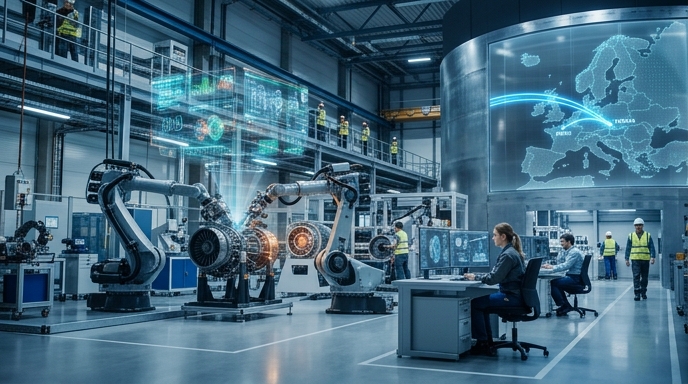
Europe’s AI Challenger Makes an Unexpected Move
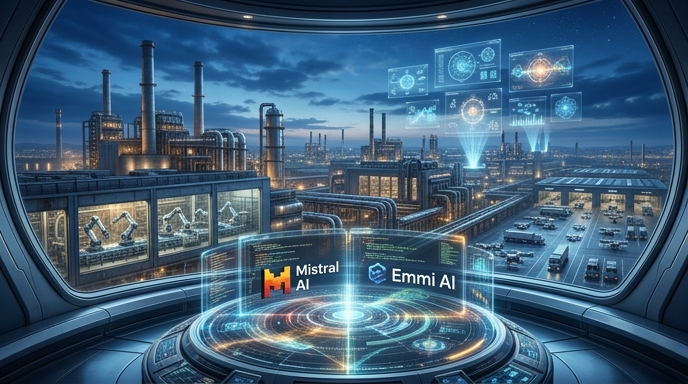
French AI company Mistral AI built its reputation on large language models. Fast models. Open-weight models. Models designed to challenge American dominance in generative AI without burning through tens of billions of dollars.
Then it made a sharp turn.
Instead of buying another chatbot startup or a synthetic data company, Mistral acquired Austrian industrial AI startup Emmi AI. At first glance, the move looked oddly niche. Industrial engineering software does not generate the same headlines as AI agents or humanoid robots. It does not flood social media feeds with viral demos either.
But that reaction misses the point.
This acquisition signals something larger. Mistral is not merely trying to compete with OpenAI or Anthropic in consumer AI. It is trying to build a European AI stack tied directly to industry, manufacturing, engineering, and physical systems. In other words, the real economy.
That matters.
Europe never dominated consumer internet platforms. It largely missed the cloud revolution too. But Europe still possesses deep industrial power. Germany’s factories. Austria’s engineering sector. French aerospace. Italian manufacturing. Scandinavian robotics. Europe knows how to build physical things.
Mistral appears to understand that the next AI war may not revolve around who creates the funniest chatbot response. It may revolve around who controls industrial intelligence.
And that changes the stakes completely.
According to reports from The Next Web, The Decoder, Seeking Alpha, Verdict, and EconoTimes, the deal centers around “physical AI” and industrial simulation systems.
That phrase sounds abstract. It is not.
It means AI that interacts with physics instead of just words.
And that is where things get interesting.
What Exactly Is Emmi AI?
Most people have never heard of Emmi AI. That is normal. The company operated in a highly specialized domain far away from mainstream AI hype cycles.
Emmi AI focused on industrial simulation. More specifically, it developed AI systems capable of accelerating engineering and physics-based simulations used in manufacturing and industrial design.
That sounds dry until you realize how enormous this market actually is.
Modern industries run on simulations. Car manufacturers simulate crash dynamics. Aerospace firms model airflow. Energy companies model thermal systems. Robotics companies simulate movement. Semiconductor firms simulate heat transfer and materials behavior.
These simulations are expensive. Very expensive.
Traditional computational fluid dynamics and finite element analysis often require massive compute infrastructure. Engineers can wait hours or even days for results. That slows down design cycles, product testing, and manufacturing optimization.
Emmi AI attempted to change that equation.
Its technology reportedly used AI-driven approaches to approximate or accelerate complex physical simulations. Instead of brute-forcing every calculation through traditional physics engines, AI models learn patterns from simulation data and generate high-speed predictions.
Think of it as predictive compression for physics.
A simulation that once took six hours might eventually take six minutes.
That is not a small improvement. That is an industrial productivity bomb.
According to coverage from The Decoder, Emmi AI positioned itself in the emerging category of “physical AI,” where machine learning models interact with real-world engineering systems rather than text alone.
This sector attracts enormous interest right now because generative AI alone does not create factories, optimize supply chains, or manufacture turbines. Industrial AI does.
And unlike consumer chatbots, industrial AI customers often pay real money.
A car manufacturer saving millions in design costs does not care whether the interface feels cute or witty. It cares about speed, reliability, and cost reduction.
That creates a very different business model from the chatbot economy currently dominating headlines.
Why Mistral Is Looking Beyond Chatbots
Mistral could have stayed in the safer lane.
The company already gained global recognition through its language models and open-weight strategy. It emerged as Europe’s strongest counterweight to American AI giants like OpenAI, Anthropic, and Google.
But language models are rapidly becoming commoditized.
That is the uncomfortable truth hanging over the entire AI industry.
Every major company now has an LLM. Open-source models improve constantly. Price wars have begun. Performance gaps shrink every quarter. Even frontier models increasingly compete on marginal gains rather than revolutionary breakthroughs.
Mistral likely understands this reality better than most.
If every company eventually gets access to high-quality language models, differentiation must come from somewhere else. The obvious next frontier is domain-specific AI tied to valuable workflows.
Industrial systems fit perfectly.
Factories produce recurring revenue. Engineering software creates lock-in. Simulation systems integrate deeply into industrial processes. Once embedded, they become difficult to replace.
This acquisition therefore looks less like diversification and more like strategic insulation.
Mistral may be trying to avoid the fate awaiting many AI startups: becoming another interchangeable model provider fighting endless pricing pressure.
Industrial AI offers higher barriers to entry.
Physics expertise matters. Manufacturing relationships matter. Regulatory knowledge matters. Data pipelines matter. Integration with real-world systems matters.
You cannot simply fine-tune a chatbot and suddenly dominate industrial simulation.
That complexity protects incumbents.
And Mistral appears eager to become one.
The Rise of “Physical AI”
The term “physical AI” sounds like Silicon Valley branding nonsense. Unfortunately, it also describes a very real technological shift.
The first wave of generative AI focused almost entirely on information. Text. Images. Audio. Video. Code.
The second wave increasingly targets the physical world.
That includes robotics, autonomous systems, industrial optimization, scientific simulation, manufacturing automation, logistics, and engineering design.
AI is moving from digital content generation toward interaction with physical systems governed by mathematics and physics.
This transition matters because physical industries contain vastly larger economic value than social media advertising or chatbot subscriptions.
Global manufacturing alone represents trillions of dollars.
If AI can meaningfully reduce design time, optimize supply chains, improve predictive maintenance, or accelerate engineering workflows, the economic upside becomes staggering.
NVIDIA CEO Jensen Huang has repeatedly emphasized this shift toward physical AI and industrial simulation. NVIDIA itself heavily invests in digital twins, robotics simulation, and industrial AI platforms.
Mistral’s move fits that broader trend almost perfectly.
Instead of chasing consumer AI virality, the company appears to be building infrastructure for industrial intelligence.
And frankly, that may be the smarter long-term bet.
Consumer AI markets are noisy and unstable. Users jump between apps constantly. Enterprise industrial systems behave differently. Once deployed, they often remain embedded for years or decades.
Industrial customers value stability over novelty.
That creates slower growth initially. But it can create deeper moats later.
Europe’s Hidden Advantage in AI
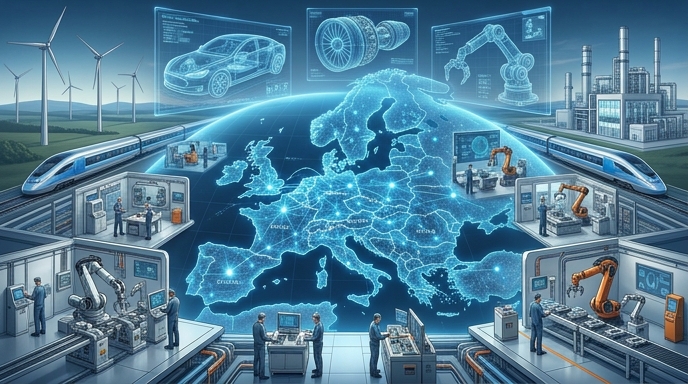
The American AI narrative dominates headlines so completely that people forget Europe still controls major industrial sectors.
Europe lacks hyperscale cloud dominance. It lacks social media giants. It lacks trillion-dollar platform monopolies comparable to Microsoft or Meta.
But Europe remains an engineering powerhouse.
That distinction matters enormously in industrial AI.
German manufacturers generate oceans of engineering data. European automotive companies possess decades of simulation expertise. Aerospace firms operate some of the world’s most advanced industrial processes.
This creates a potential opening.
If Europe cannot dominate consumer AI, it may still dominate industrial AI.
That possibility likely influences Mistral’s strategy.
The acquisition of an Austrian industrial AI startup aligns with broader European ambitions around technological sovereignty. European policymakers increasingly fear total dependence on American AI infrastructure.
Industrial AI offers a domain where Europe can realistically compete.
Not because Europe suddenly discovered better transformers.
Because Europe already owns substantial industrial ecosystems where AI can integrate directly into production environments.
The combination matters.
AI without industrial infrastructure risks becoming another layer of software abstraction. Industrial infrastructure without AI risks stagnation.
Mistral appears to be trying to fuse both together.
That is strategically coherent.
Why Industrial AI Could Become More Valuable Than Generative AI
Here is the uncomfortable possibility most AI hype ignores:
Industrial AI may eventually matter far more economically than chatbot AI.
Not more culturally. Not more visibly. But economically.
A chatbot that writes emails faster saves minutes. An industrial AI system that cuts automotive design cycles by 30% saves billions.
The value density differs enormously.
Consider aerospace engineering. A small efficiency gain in simulation can reduce fuel costs, material waste, and testing expenses across entire fleets of aircraft.
Or energy systems. Faster simulation enables quicker optimization of turbines, battery systems, and thermal processes.
Or semiconductors. AI-assisted physics modeling could accelerate chip design at a moment when compute demand explodes globally.
These are not consumer conveniences. These are infrastructure multipliers.
And infrastructure multipliers usually generate durable wealth.
That explains why industrial AI increasingly attracts serious investment despite receiving less mainstream attention than flashy generative demos.
The real AI economy may end up looking surprisingly boring from the outside.
Factories. Simulation pipelines. Predictive maintenance systems. Engineering optimization layers.
No dancing avatars, No AI girlfriends, No synthetic influencers.
Just massive productivity gains quietly compounding behind the scenes.
Mistral’s acquisition suggests the company sees that future coming.
The Timing Is Not Accidental
This acquisition arrives during a strange moment in the AI industry.
The first phase of generative AI enthusiasm produced a flood of experimentation. Every startup became an “AI company.” Investors funded almost anything involving transformers and APIs.
Now reality is setting in.
Margins compress. Competition intensifies. Infrastructure costs remain brutal. Enterprises demand actual ROI instead of novelty.
The industry is shifting from spectacle toward utility.
That transition favors companies solving expensive operational problems.
Industrial simulation qualifies immediately.
Engineering bottlenecks cost real money. Manufacturing inefficiencies cost real money. Delayed product cycles cost real money.
AI solutions targeting those problems possess clearer economic justification than many consumer-facing applications.
Mistral likely understands this macro shift.
The company cannot outspend American hyperscalers indefinitely. But it can specialize strategically.
Industrial AI specialization gives Mistral something many AI companies currently lack: a plausible long-term positioning strategy beyond “better chatbot.”
That matters.
Because the AI industry is about to discover how difficult sustainable monetization actually is.
The Real Battle: Proprietary Data
Everyone talks about models. Almost nobody talks enough about data ecosystems.
That is where industrial AI becomes especially powerful.
Industrial environments generate proprietary operational data unavailable on the open internet. Manufacturing systems produce unique datasets tied to machinery, materials, workflows, and engineering constraints.
Those datasets become strategic assets.
Once AI systems train on industrial workflows, they gain domain-specific advantages difficult for competitors to replicate.
This creates compounding defensibility.
A general-purpose chatbot trained on public text competes in a crowded field. An industrial AI system deeply integrated into manufacturing operations competes inside protected ecosystems.
That distinction matters enormously for long-term competitive positioning.
Mistral may not simply want Emmi AI’s technology.
It may want access to industrial integration pathways and specialized data environments.
If successful, that could transform Mistral from a model provider into a vertically integrated industrial AI platform.
That is a much more durable business.
Challenges Ahead: This Will Not Be Easy
None of this guarantees success.
Industrial AI remains extraordinarily difficult.
Physics simulations require precision. Approximation errors can create catastrophic consequences in engineering environments. Industrial customers demand reliability levels far beyond consumer software standards.
A buggy chatbot creates embarrassment.
A flawed industrial simulation can create defective machinery, safety risks, or financial disasters.
The tolerance for error collapses dramatically.
Integration challenges also remain severe. Industrial systems often operate on legacy infrastructure decades old. Manufacturing environments resist rapid software changes for good reasons.
Then there is competition.
Major industrial incumbents already exist. Companies like Siemens, Schneider Electric, and Bosch possess deep industrial relationships and extensive operational expertise.
Meanwhile, American AI giants are unlikely to ignore industrial AI forever.
Mistral enters a strategically attractive market. But attractive markets rarely remain uncontested.
The company now faces the hard part: execution.
What This Means for the AI Industry
This acquisition may ultimately symbolize something larger than one corporate deal.
It may represent the beginning of AI’s migration from internet software into industrial infrastructure.
The first AI wave transformed information access.
The next wave may transform physical production itself.
That shift could redefine the global economy more profoundly than chatbot interfaces ever will.
Factories may become AI-native. Engineering workflows may compress dramatically. Simulation systems may evolve into real-time predictive engines integrated directly into manufacturing operations.
If that happens, the companies controlling industrial AI layers could become extraordinarily powerful.
Mistral appears determined to participate in that future early.
Whether it succeeds remains uncertain.
But the strategic logic behind the Emmi AI acquisition is far more sophisticated than it initially appears.
This is not merely an AI company buying another AI company.
It is a European attempt to anchor artificial intelligence inside the continent’s deepest economic strengths: engineering, manufacturing, and industrial systems.
That is a serious strategy.
And unlike much of the AI industry’s noise machine, it is grounded in real-world economics.
Final Thoughts: The Quiet AI Revolution
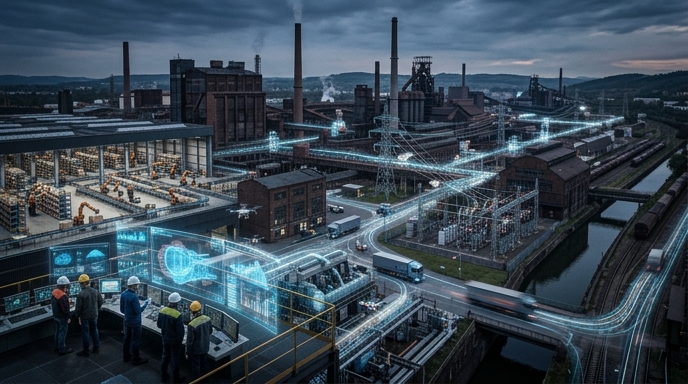
The loudest parts of the AI industry often distract from the most important ones.
Chatbots dominate headlines because people can see them immediately. Industrial AI evolves quietly inside engineering departments, manufacturing plants, and simulation labs.
But quiet revolutions still change the world.
Possibly more than loud ones.
Mistral’s acquisition of Emmi AI suggests the company believes the future of AI will not belong solely to whoever builds the most entertaining assistant.
It may belong to whoever embeds intelligence deepest into physical infrastructure.
That means factories.
Supply chains.
Engineering systems.
Energy networks.
Robotics.
Industrial simulation.
In other words, the machinery underneath civilization itself.
That is a much bigger prize than generating clever paragraphs on demand.
And increasingly, the smartest AI companies seem to know it.
Sources
- The Next Web – “Mistral snaps up physics AI startup Emmi AI”
- The Decoder – “Mistral AI acquires Viennese physical AI startup Emmi AI”
- Seeking Alpha – “Mistral AI acquires industrial engineering AI startup Emmi”
- Verdict – “Mistral AI acquires Emmi AI”
- EconoTimes – “Mistral AI Acquires Emmi AI to Expand Industrial AI Solutions in Europe”
Related Guides
Compare
Popular Tools
Related Companies
Latest News
The Kingy Brief
Get The Kingy Brief.
AI changes, original tests and one practical thing to try. Fridays at 09:00 Vancouver time.
Free · Double opt-in · Unsubscribe anytime
Signup help and newsletter schedule
Signup form provided by Beehiiv. After submitting, check your inbox for "Confirm your subscription to The Kingy Brief" and open its confirmation link. Check Spam or Promotions if you cannot find it.
Fridays at 09:00 Vancouver time: source-checked AI changes, original tests and one practical thing to try. The weekly restart begins October 9, 2026. We skip a week when there is not enough verified material. Free. Unsubscribe anytime.