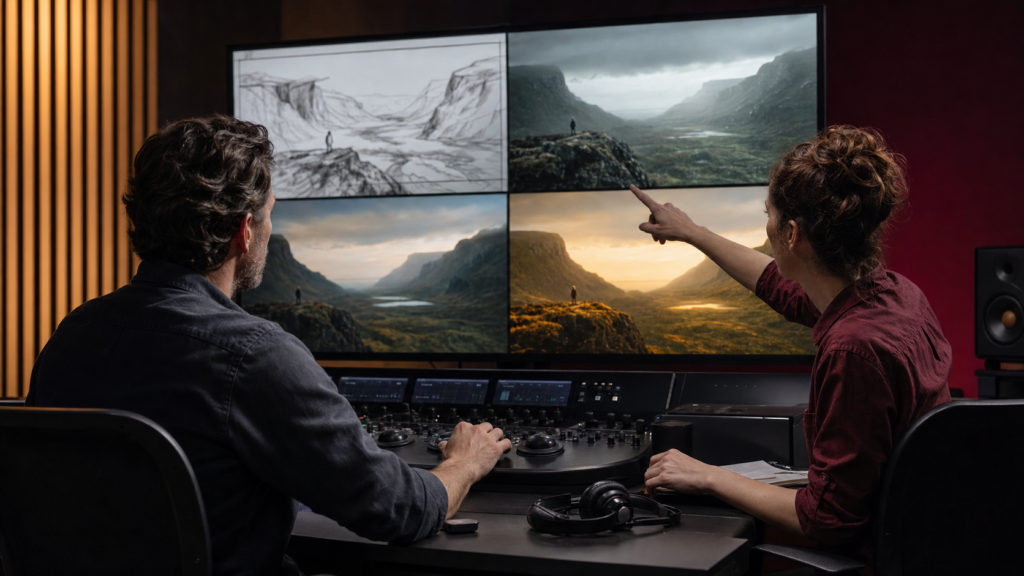
The State of AI video tools 2026 is not a single leaderboard. It is a category split into several different jobs: cinematic generation, avatar video, editing, localization, ad-variant production, product demo assets, and creative operations.
That distinction matters because the wrong comparison creates bad buying decisions. Runway and Google Flow are fighting over cinematic control. Luma is pushing toward creative agents and multi-model production. Pika is creator-friendly short-form experimentation. HeyGen and Synthesia are business-video and avatar systems. Descript is an editing workflow. Adobe Firefly Video is an Adobe ecosystem play. OpenAI Sora is now a cautionary procurement lesson: do not cite old demo energy as current buying availability when official docs say the Sora web and app experiences were discontinued.
Kingy.ai built this report for founders, AI companies, creators, marketers, investors, and video buyers who need a practical way to judge the market without pretending every tool solves the same problem. For the broader series, start with the Kingy AI Reports hub and the published State of AI Coding Tools 2026. For launch coverage and company submissions, use the AI Launch Tracker, AI Launch Intelligence, and Submit an AI Launch.
Executive Summary
- AI video is moving from prompt-to-clip novelty into a creative workflow market.
- The most important split is cinematic generation versus avatar/business video versus editing and repurposing.
- Runway, Google Flow/Veo, Luma, Pika, HeyGen, Synthesia, Descript, Adobe Firefly Video, and OpenAI Sora-related docs each tell a different buyer story.
- Pricing comparison is fragile. Credits, seconds, resolution, watermarking, export rights, model access, collaboration, and enterprise controls change the real cost.
- The strongest buyer metric is not “best demo.” It is time to an approved asset that can actually be used.
- The governance layer matters more in video than text because likeness, rights, claims, customer logos, training data concerns, and disclosure can create real brand risk.
- This report uses public sources only. No private Kingy.ai campaign data, sponsor spend, customer traction, funding, or unverified usage claims are included.
Table of Contents
- What changed in AI video
- The Kingy AI video workflow stack
- Buyer lanes
- Main tool comparison
- Kingy Workflow Score
- Pricing and credit traps
- The Sora lesson
- Risk, rights, and production readiness
- Tools to test this month
- FAQ, sources, and changelog
What Changed In AI Video
The early AI video category was easy to explain: type a prompt, get a weird clip. The current category is harder and more useful. The demo still matters, but the demo is no longer enough.
Runway says Gen-4 is built for world consistency and can use references to generate consistent characters, locations, objects, styles, subjects, and cinematic elements. Google introduced Flow as an AI filmmaking tool built for Veo, Imagen, and Gemini, with camera controls, scene building, asset management, and Flow TV. Luma positions itself as creative agents that plan, generate, iterate, and refine with context across creative work. HeyGen’s pricing page emphasizes avatars, digital twins, languages, credits, 4K on higher plans, collaboration, SAML/SSO, and SCORM. Descript’s pricing page points to the editing and repurposing lane, not just generation.
Here is where this gets interesting. Video is not one artifact. It is a workflow with many handoffs: brief, storyboard, references, generation, voice, edit, captions, localization, approval, export, distribution, and performance feedback. The tool that makes a spectacular five-second clip may fail at approval history. The boring editor that saves three hours on captions may be more valuable than the clip generator for a creator with daily output pressure.
For founders, this is the real question: are you buying an inspiration machine, a production system, or a distribution machine? Those are different products.
The Kingy AI Video Workflow Stack
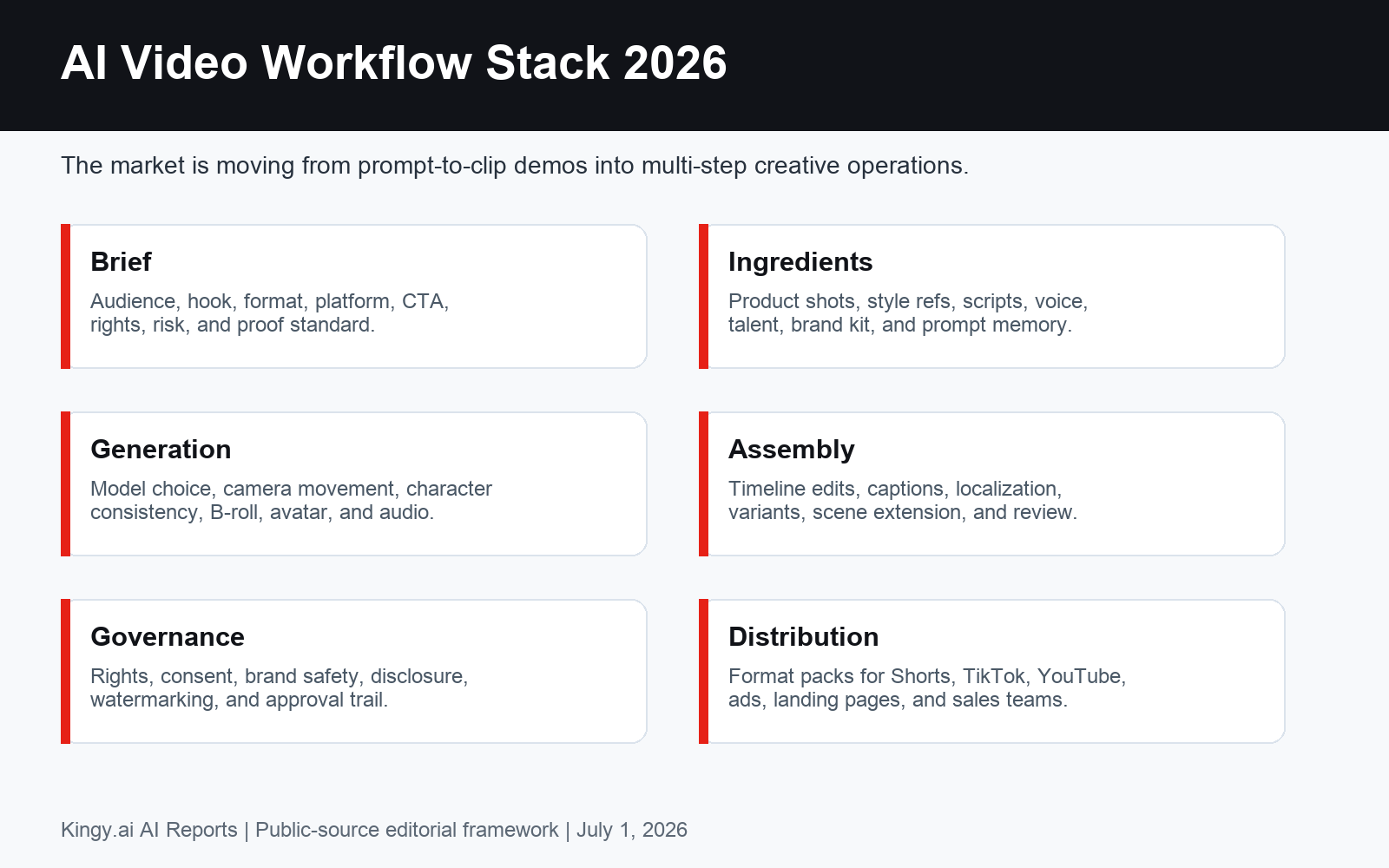
Kingy’s framework for 2026 is the AI video workflow stack:
| Layer | What it means | What to test |
|---|---|---|
| Brief | Audience, hook, format, platform, CTA, rights, risk, and proof standard. | Can the tool preserve the actual marketing job, not just create a pretty scene? |
| Ingredients | Product shots, references, scripts, brand kit, voice, talent, prompt memory, and approved assets. | Can it keep style and subject consistency across variants? |
| Generation | Model choice, camera movement, character consistency, B-roll, avatar, and audio. | Does it create usable clips at the needed aspect ratio and resolution? |
| Assembly | Timeline edits, captions, voice, localization, variants, scene extension, and review. | How many manual handoffs are still required? |
| Governance | Rights, likeness consent, brand safety, disclosure, watermarking, and approval trail. | Can your team prove how the asset was made and approved? |
| Distribution | Shorts, TikTok, YouTube, paid ads, landing pages, sales enablement, and training. | Does the tool export the formats your channels actually need? |
The catch is that most vendor pages talk about the middle of the stack. They show generation. Buyers need to test the entire stack.
Buyer Lanes
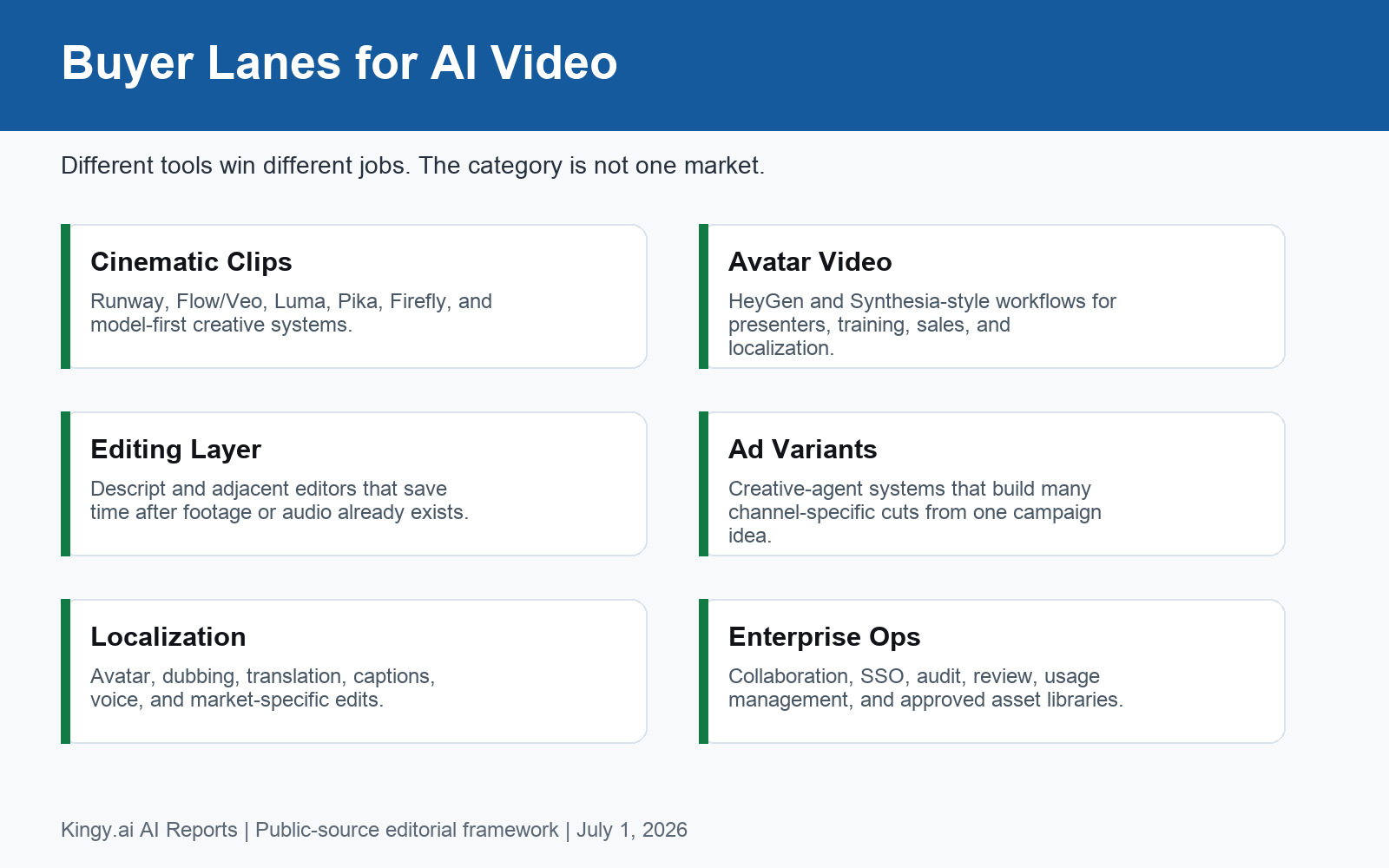
The AI video market is easier to understand when split into lanes.
1. Cinematic Clip Generation
Runway, Flow/Veo, Luma, Pika, Adobe Firefly Video, and related tools compete here. The job is to generate, extend, stylize, or transform clips with enough visual quality to support a campaign, product story, film concept, or social asset.
This lane should be judged on prompt adherence, motion quality, shot control, subject consistency, reference handling, export quality, cost per approved second, and how often the output needs a human workaround.
Use the AI Camera Simulator to define the movement, framing, lens, and end composition before comparing models.
2. Avatar And Presenter Video
HeyGen and Synthesia-style products solve a different problem. The job is not “make a cinematic world.” The job is “turn a message into a presentable video at scale.” That can mean sales enablement, onboarding, training, localization, customer education, internal comms, or creator-style talking-head content.
This lane should be judged on avatar realism, voice quality, languages, editing controls, approval workflow, identity/consent handling, exports, SCORM/LMS needs, and whether viewers trust the result.
3. Editing And Repurposing
Descript and adjacent tools live after recording or generation. They help turn podcasts, screen recordings, demos, voiceovers, and rough footage into finished assets. This is less glamorous than model demos, but it can be brutally useful.
The useful metric is not “can it generate a clip?” It is “how much edit time did it remove without damaging quality?”
4. Creative Agents And Ad Variants
Luma’s positioning around creative agents is an important signal. AI video is moving toward systems that plan campaigns, generate assets, carry context, create variants, localize, caption, and assemble final deliverables. The product story shifts from clip generator to creative operating layer.
This is attractive for AI companies, ecommerce teams, and agencies because their problem is not one clip. Their problem is many versions, many platforms, repeated approvals, and constant creative testing.
5. Enterprise Governance
The bigger the organization, the less “cool clip” is enough. Enterprises need SSO, team workspaces, permissions, audit logs, asset ownership clarity, localization review, and policies around real people, customer logos, product claims, and sensitive content.
That is why the avatar and business-video lane often looks less exciting but more purchasable. It knows the buyer has governance needs.
Main Tool Comparison
Pricing and packaging change quickly, so every pricing note below should be verified on the linked official page before procurement. Kingy did not run a private video benchmark suite. Scores are editorial and based on public product signals, workflow coverage, buyer clarity, governance fit, and repeat-use potential.
| Tool | Lane | Best current use case | Pricing note | Buyer caution | Kingy Workflow Score | Source |
|---|---|---|---|---|---|---|
| Runway | cinematic generation and creative suite | Short cinematic clips, visual references, consistent subjects, creative teams, and AI film workflows. | Free tier plus Standard, Pro, Max, and Enterprise plans; Runway lists Standard from 12 USD/month billed yearly and credit-based video usage. | Credit math and model availability require procurement checks before high-volume production. | 9.1/10 | Source |
| Google Flow / Veo | AI filmmaking workspace tied to Google models | Cinematic scene exploration, Veo clips, camera controls, ingredients, scene building, and Google AI plan users. | Google says Flow is available to Google AI Pro and Ultra subscribers, with Pro generation limits and Ultra higher limits/early Veo access. | Availability and usage limits depend on country and Google AI plan details. | 8.9/10 | Source |
| Luma | creative agents and multi-model production workspace | Teams that want ideation, generation, editing, variants, collaboration, and production export in one environment. | Luma lists Plus at 30 USD/month, Pro at 90 USD/month, Ultra at 300 USD/month, with Team and Enterprise contact-sales options. | It is positioning as an agentic creative system, so buyers should test workflow reliability, not only clip quality. | 8.7/10 | Source |
| Pika | social video generation and effects | Fast social concepts, short clips, transformations, and creator-friendly experimentation. | Official pricing page should be checked immediately before purchase; packaging and credits can change. | Buyer diligence should focus on export rights, watermarking, resolution, and repeatable character/object control. | 7.9/10 | Source |
| HeyGen | avatar, localization, and business video | Presenter videos, multilingual localization, sales enablement, learning content, and teams that need avatars more than cinematic clips. | HeyGen lists Free, Creator at 29 USD/month, Pro at 49 USD/month, Business at 149 USD/month, and Enterprise contact sales. | Not the same job as Runway or Veo; it wins when the video is a message, not a film scene. | 8.3/10 | Source |
| Synthesia | enterprise avatar video and training content | Learning, enablement, internal comms, compliance-style videos, and governed avatar production. | Official pricing should be checked before procurement; Synthesia separates free/paid/business style plans. | Less useful for cinematic motion generation; stronger for structured business communication. | 8.1/10 | Source |
| Descript | AI editing, podcast/video assembly, and repurposing | Editing existing recordings, clips, podcasts, creator videos, captions, rough cuts, overdubs, and repurposed social assets. | Official pricing lists a free-start path and paid creator/team plans; verify minutes/features before buying. | Do not compare it only by generation quality; compare it by time saved in the edit. | 8.0/10 | Source |
| Adobe Firefly Video | brand-aware AI generation inside Adobe creative workflows | Creative teams that already live in Adobe and need commercially oriented AI video generation with familiar tooling. | Adobe pricing and entitlement details should be checked on the current Firefly/Creative Cloud plan pages. | Its strategic value is Adobe workflow integration, not just standalone model novelty. | 7.8/10 | Source |
| OpenAI Sora | model signal and transition case | Strategic watchlist; not a normal procurement target while Sora 1 web/app has been discontinued and API discontinuation is dated. | OpenAI Sora purchasing should not be assumed. Official help says Sora web/app experiences were discontinued April 26, 2026 and API discontinuation is September 24, 2026. | Do not cite old Sora demos as current buying availability. | 6.4/10 | Source |
Kingy Workflow Score
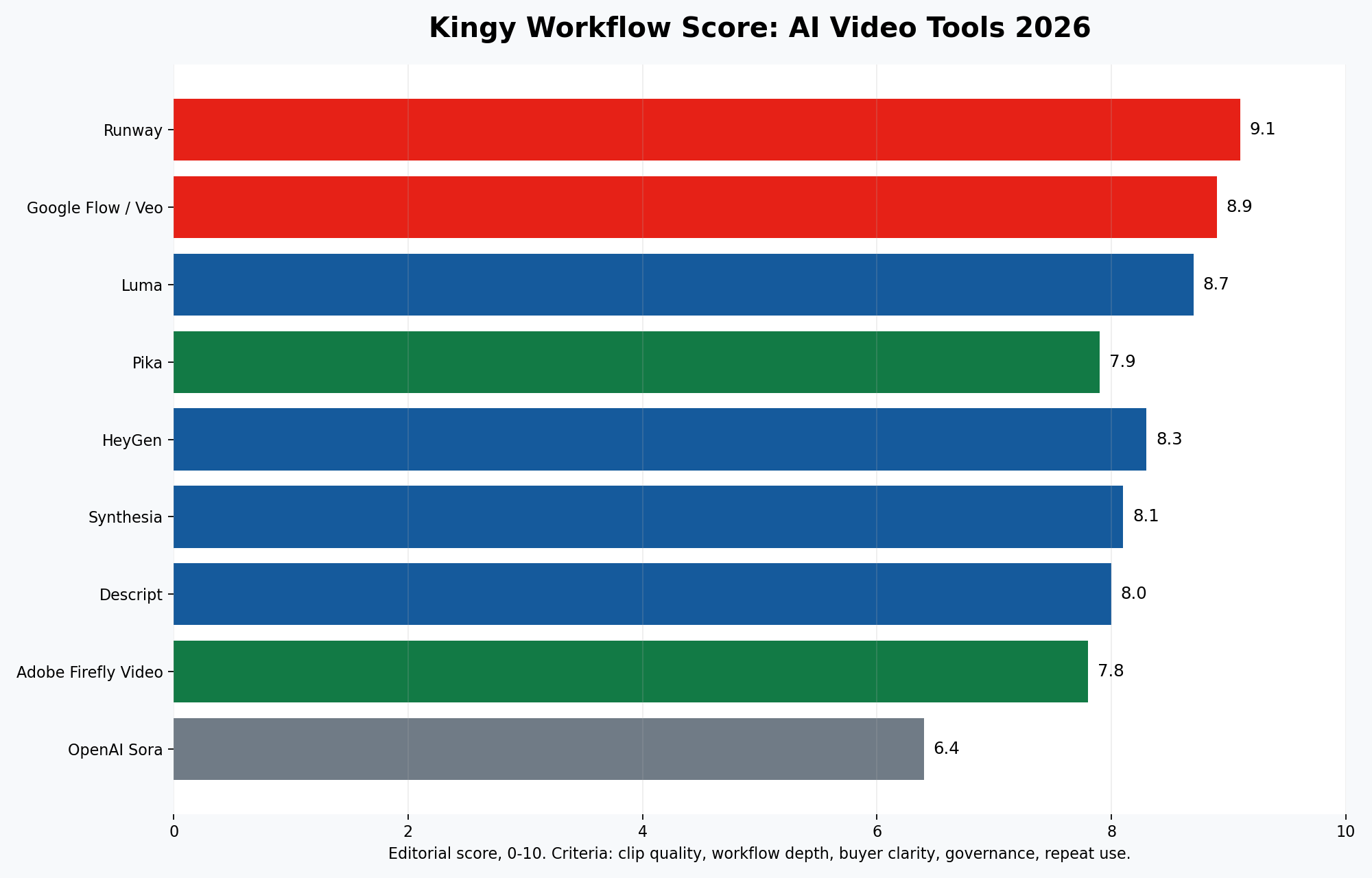
The Kingy Workflow Score is editorial, not scientific. It uses five criteria:
- Clip or output quality: how useful the generated or edited video appears from public product evidence.
- Workflow depth: whether the tool supports briefing, ingredients, editing, export, collaboration, and iteration.
- Buyer clarity: whether the product is clear about who it is for and what it costs.
- Governance fit: whether business teams can manage rights, users, privacy, approvals, and scale.
- Repeat-use potential: whether the product looks like a durable workflow, not a one-off demo.
| Tool | Score | Readout | Public proof used |
|---|---|---|---|
| Runway | 9.1 | Core creative workflow | Strong official pricing, Gen-4 consistency claims, film/community footprint, and broad creative workflow. |
| Google Flow / Veo | 8.9 | Core creative workflow | Official Google launch and DeepMind model pages support Flow, Veo, camera controls, scenebuilder, and native audio direction. |
| Luma | 8.7 | Strong specialist | Official pages describe creative agents, team workspaces, video ads, localization, storyboards, Ray models, and third-party model access. |
| Pika | 7.9 | Useful specialist | Public product and pricing pages show a dedicated AI video product with creator-oriented use. |
| HeyGen | 8.3 | Strong specialist | Official pricing lists avatars, digital twins, languages, credits, 4K export on higher plans, collaboration, SAML/SSO, and SCORM. |
| Synthesia | 8.1 | Strong specialist | Official pricing page supports a mature avatar-video buyer path. |
| Descript | 8.0 | Useful specialist | Descript is strongest as an editing workflow rather than pure text-to-video generation. |
| Adobe Firefly Video | 7.8 | Useful specialist | Official Firefly AI video page supports text-to-video and creative workflow positioning. |
| OpenAI Sora | 6.4 | Watchlist / transition state | Official OpenAI help center documents the discontinuation and a Sora 1 deprecation notice while pointing customers toward future Sora for Business details. |
The most important thing in that table is not the decimal point. It is the lane. A founder choosing between Runway and HeyGen may be asking the wrong question. If the video is a cinematic product teaser, Runway or Flow/Veo may be the first test. If the video is onboarding in six languages, HeyGen or Synthesia may be the practical answer. If the raw material is a podcast, Descript may do more useful work than a text-to-video generator.
Pricing And Credit Traps
AI video pricing is where buyers get surprised.
Runway’s pricing page shows a free tier and paid plans with credits, and it gives examples of how monthly credits translate into seconds of Gen-4.5, Gen-4 Turbo, or images. Luma’s pricing page lists individual tiers and a cost-per-video-generation table by model, action, resolution, audio, and credits. HeyGen’s pricing page uses credits and plan limits across video length, export resolution, avatars, languages, collaboration, and enterprise controls.
This is why a simple monthly price comparison is weak. The buyer has to ask:
- How many approved seconds or approved videos do we need per month?
- Which model is included?
- Are we paying per second, per credit, per generation, per seat, or per export?
- Does the plan allow commercial use, watermark removal, 1080p/4K export, and the needed aspect ratios?
- Are avatar, voice, translation, captions, and localization included or separately metered?
- Does team collaboration require a higher plan?
- Is there SSO, audit, permissions, and legal review support?
- What happens when a generation fails or is unusable?
The boring part matters. If a tool makes beautiful clips but the cost per approved asset is unpredictable, it will be hard to scale.
The Sora Lesson
OpenAI’s Sora is still strategically important, but current procurement language needs care. OpenAI’s official help center says the Sora web and app experiences were discontinued on April 26, 2026, and the Sora API is set to be discontinued on September 24, 2026. Another OpenAI help page says the Sora 1 web experience is actively being deprecated and customers should transition away from Sora 1 web while OpenAI looks toward future Sora for Business details.
That does not mean OpenAI is irrelevant to video. It means a buyer should not use old Sora demo memory as if it were current product availability. The market changes too fast for that.
The Sora lesson is broader: in AI video, product availability matters as much as model reputation. If the workflow cannot be bought, governed, exported, and repeated today, it is a watchlist item, not a production system.
Risk, Rights, And Production Readiness
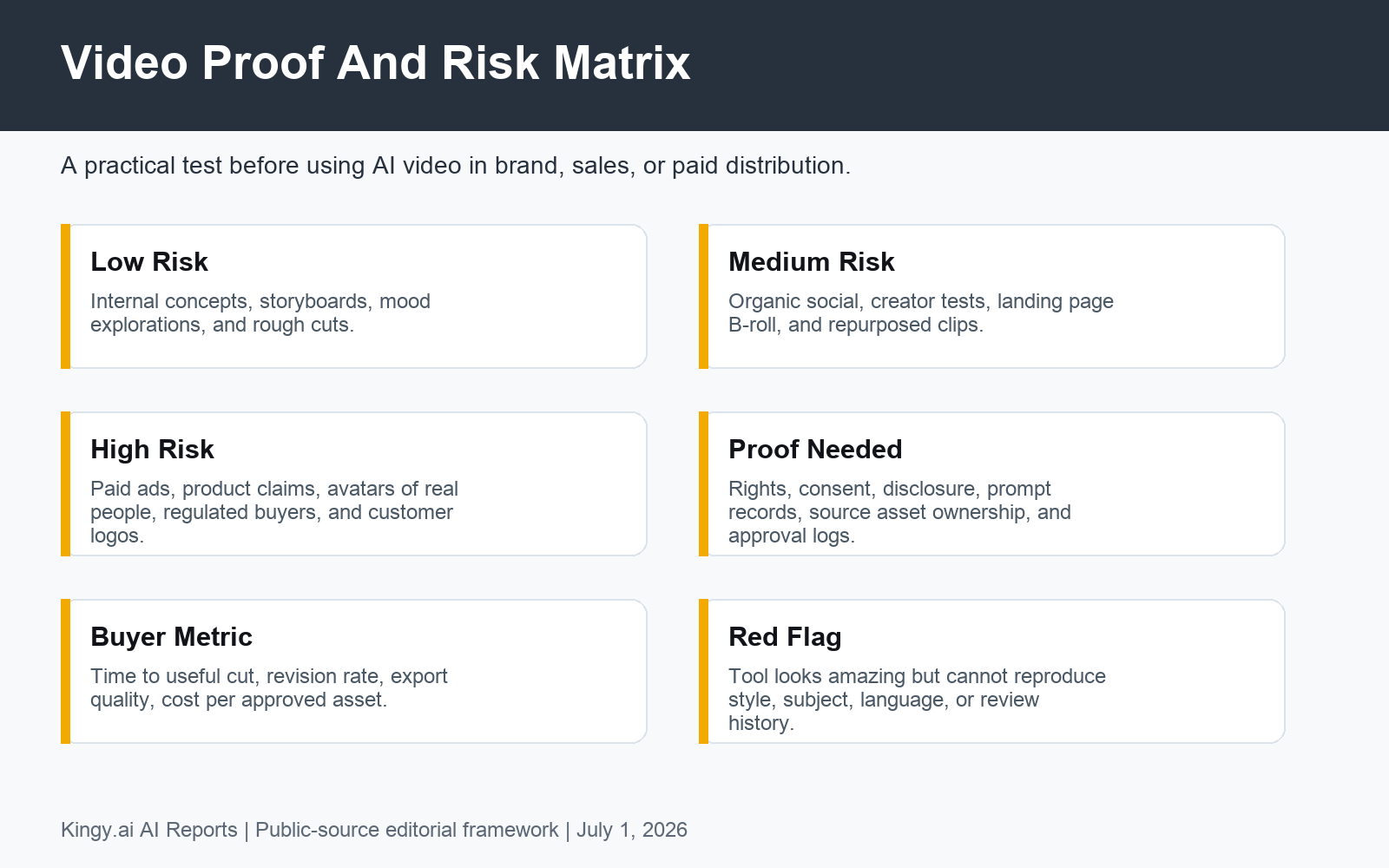
AI video has higher brand risk than many text or code workflows because it can involve likeness, voice, product claims, customer logos, cultural context, and paid-media rules.
Use this matrix:
| Risk level | Example use | Minimum proof standard |
|---|---|---|
| Low | Internal storyboards, mood boards, rough campaign concepts, non-public creative exploration. | Source prompt, asset ownership check, no real-person impersonation, basic brand review. |
| Medium | Organic social, creator drafts, landing page B-roll, product explainer variants, newsletter clips. | Rights review, export-quality check, claims review, brand review, disclosure decision. |
| High | Paid ads, enterprise sales videos, real-person avatars, regulated industries, customer logos, before/after claims. | Legal/brand approval, consent records, claims substantiation, audit trail, platform policy review. |
Do not use fake screenshots or fake charts in AI video. If a tool creates a UI mockup or product screen, label it as illustrative unless it is a real product capture. Do not imply a customer uses a product unless the customer relationship is publicly confirmed by the company or a reputable source.
Tools To Test This Month
| Test | Best candidates | Why it matters | Success signal |
|---|---|---|---|
| Make a 15-second product teaser from a static product image | Runway, Flow/Veo, Luma, Adobe Firefly Video, Pika | Tests visual consistency, camera control, usable motion, and brand tone. | Two usable cuts with minimal manual cleanup. |
| Create six localized presenter videos from one script | HeyGen, Synthesia | Tests avatar workflow, language handling, voice quality, and review. | Natural enough for the audience, with clear approval controls. |
| Turn a podcast or webinar into three social clips | Descript, Luma-style agent workflows | Tests editing time saved and social packaging. | Captions, hooks, and exports ready for publishing. |
| Generate ad variants for three audience angles | Luma, Runway, Flow/Veo, Pika | Tests repeatable creative iteration, not just one lucky output. | Distinct variants that preserve the product truth. |
| Run a governance review | HeyGen, Synthesia, Adobe, enterprise tiers of generation tools | Tests whether the tool can work inside a real company. | Clear roles, permissions, legal review path, and asset history. |
Kingy would test Runway, Flow/Veo, Luma, HeyGen, and Descript first for a balanced founder/marketer stack. Add Synthesia if the job is enterprise training or internal comms. Add Pika when social experimentation speed matters. Add Adobe Firefly Video when the team already lives in Adobe workflows.
Internal Kingy.ai Reading Path
Use this report with Kingy’s related resources:
- Start at the Kingy AI Reports hub.
- Read State of AI Coding Tools 2026 for the adjacent agent/workflow framing.
- Track launches in the AI Launch Tracker.
- Browse broader launch coverage in AI Launch Intelligence.
- Submit new video launches through Submit an AI Launch.
- For AI company distribution, use For AI companies, Sponsor Kingy AI, the Media Kit, Clients, the AI Sponsored Video ROI Calculator, and Editorial Sponsorship Standards.
- Browse AI Category Maps, AI Tools, and AI News for related coverage.
- Compare the market map with Kingy’s published Video Tests; the hub exposes evidence-complete companion records rather than a benchmark leaderboard.
Kingy Verdict
The State of AI video tools 2026 is a shift from model demos to creative operations.
The winners will not only generate beautiful clips. They will help teams make the right video, preserve the right assets, edit the result, localize it, review it, export it, and prove it can be used safely. That is why a boring feature like asset management can matter as much as an impressive camera move.
For founders, the best first question is not “which tool is most advanced?” It is “what video job are we actually trying to repeat?” For creators, the question is “which tool saves time without making the channel feel fake?” For AI companies, the question is “can this help us show the product clearly without inventing proof?”
The demo looks great. The workflow still needs proof.
Download the visual packet: state-ai-video-tools-2026-visual-report.pdf.
FAQ
What is the best AI video tool in 2026?
There is no single universal winner. Runway, Google Flow/Veo, Luma, Pika, HeyGen, Synthesia, Descript, Adobe Firefly Video, and OpenAI Sora-related workflows solve different problems. The right choice depends on whether you need cinematic clips, avatar videos, editing, localization, ad variants, or enterprise governance.
Are AI video tools production-ready?
Some AI video tools are already useful in production workflows, especially for ideation, short clips, avatars, localization, editing, captions, and variants. But production-ready does not mean risk-free. Buyers should test rights, likeness consent, source asset ownership, review workflows, export quality, and cost per approved asset.
Should buyers compare AI video tools by model quality only?
No. Model quality matters, but the better procurement test is workflow quality: how quickly the team can move from brief to approved usable asset. A slightly less flashy product can be more valuable if it handles captions, localization, revisions, permissions, and exports reliably.
Is Sora still a normal buyer option?
Do not assume that. OpenAI’s official help center says the Sora web and app experiences were discontinued on April 26, 2026 and the Sora API is scheduled to be discontinued on September 24, 2026. Any current Sora buying decision should be based on current OpenAI business availability, not old demos.
Which AI video tools should founders test first?
Founders should test Runway or Flow/Veo for cinematic product storytelling, Luma for creative-agent campaign workflows, HeyGen for presenter/localization videos, Descript for editing and repurposing, and Pika for fast social experimentation. The right stack depends on the content job.
How often should this report be updated?
Source review cutoff: July 1, 2026. Publication date: July 9, 2026. The report should be reviewed after major pricing, availability, model, rights, or enterprise-plan changes, and during the next Kingy AI Reports maintenance pass.
Source List
- Runway pricing
- Runway Gen-4 research
- Google Flow announcement
- Google DeepMind Veo
- Google Flow product
- Luma product
- Luma pricing
- Pika pricing
- Pika product
- HeyGen pricing
- Synthesia pricing
- Descript pricing
- Adobe Firefly AI video
- OpenAI Sora discontinuation
- OpenAI Sora generation docs
The Kingy Brief
Get The Kingy Brief.
AI changes, original tests and one practical thing to try. Fridays at 09:00 Vancouver time.
Free · Double opt-in · Unsubscribe anytime
Signup help and newsletter schedule
Signup form provided by Beehiiv. After submitting, check your inbox for "Confirm your subscription to The Kingy Brief" and open its confirmation link. Check Spam or Promotions if you cannot find it.
Fridays at 09:00 Vancouver time: source-checked AI changes, original tests and one practical thing to try. The weekly restart begins October 9, 2026. We skip a week when there is not enough verified material. Free. Unsubscribe anytime.