
The State of AI Agents 2026 is not really about chatbots getting a nicer name. It is about software that can plan, call tools, retrieve context, operate across systems, ask for approval, remember state, and take bounded action. That sounds simple until the agent is allowed to send an email, change a CRM record, open a pull request, update a ticket, move money, publish content, or touch customer data.
That is why the agent market is splitting into two races at once. One race is the developer race: frameworks, SDKs, tool calling, graph orchestration, evals, traces, and model interoperability. The other race is the enterprise workflow race: copilots, CRM agents, automation agents, support agents, browser agents, and internal assistants that have to survive procurement, permissions, and messy business process reality.
Here is where this gets interesting. The tools that win will not just be flashy. They will be sticky. They will sit near real workflows, connect to real systems, produce evidence, and give humans enough control to trust the work.
Kingy.ai built this report for AI founders, product teams, investors, developers, GTM teams, and buyers deciding where agents are useful now and where the category is still mostly theater. For the broader series, start with the Kingy AI Reports hub, the State of AI Coding Tools 2026, and the State of AI Video Tools 2026. For launch monitoring, use the AI Launch Tracker, AI Launch Intelligence, and Submit an AI Launch.
Executive Summary
- AI agents in 2026 are moving from prompt demos into tool-using workflow systems.
- The serious market is not one category. It includes developer frameworks, enterprise copilots, cloud agents, CRM agents, app-action agents, multi-agent frameworks, and interoperability layers.
- OpenAI Agents SDK, LangGraph, Google ADK, Copilot Studio, AWS Bedrock Agents, Salesforce Agentforce, CrewAI, Vercel AI SDK, AutoGen, Zapier Agents, IBM watsonx Orchestrate, and MCP each represent a different lane.
- The agent buyer question is not “can it reason?” The better question is “can it safely complete a bounded workflow with evidence?”
- Tool calling is the category’s power source and its risk source. Every new action right creates a new failure mode.
- Human gates, traces, evals, permissions, rollback paths, and cost controls are now product features, not enterprise checkboxes.
- This report uses public sources only. No private Kingy.ai client data, confidential campaign data, private customer claims, sponsor spend, or unverifiable traction claims are included.
Source status checked October 10, 2026: Google’s Agentspace source URL now redirects to its Gemini Enterprise page. Microsoft’s AutoGen repository now labels AutoGen as being in maintenance mode, directs new users to Microsoft Agent Framework, and encourages existing users to migrate. Amazon’s Bedrock documentation now calls Bedrock Agents “Agents Classic,” says it is no longer open to new customers, says existing customers can continue using it, and directs readers seeking similar capabilities to Amazon Bedrock AgentCore. The Google, AutoGen, and Bedrock entries and Kingy scores below describe this report’s July 2026 assessment; the current destinations and successors were not separately scored here.
Table of Contents
- What changed in AI agents
- The Kingy agent production lifecycle
- Market landscape
- Platform and framework comparison
- Kingy Agent Readiness Score
- Why tool calling changes the category
- Enterprise agents versus developer agents
- The risk matrix
- Buyer methodology
- Winners, watchlist, FAQ, sources, and update note
What Changed in AI Agents
In 2024 and 2025, “agent” often meant a demo loop: a model was given a goal, it generated steps, maybe used a browser or a few tools, and then the demo either worked or collapsed. In 2026, the better agent products are less mystical and more operational. They care about state, tools, approvals, logs, permissions, retries, and the boring connective tissue between model output and business action.
OpenAI’s Agents SDK is a good signal of the shift. The official documentation describes agents, handoffs, guardrails, tracing, and tool use. The OpenAI tools guide also shows how hosted tools and function-style tool calls fit into model applications. The point is not that every team should use one SDK. The point is that agent infrastructure is becoming explicit product surface.
Anthropic-backed Model Context Protocol is another signal. MCP is not an agent by itself. It is a protocol for connecting AI applications to external systems. That matters because agent value depends on context and tools. If every app invents its own connector pattern, agents become brittle. If tool access gets more standardized, the ecosystem gets easier to compose, inspect, and govern.
Google is taking an enterprise and developer-stack angle with Agent Development Kit and Agentspace. Microsoft has Copilot Studio for creating and managing business copilots and agents. AWS documents Bedrock Agents as a way to orchestrate tasks and interact with APIs and knowledge sources. Salesforce positions Agentforce as digital labor for CRM-heavy workflows.
The catch is that all of these can sound similar in a sales deck. The real difference appears when the agent receives an ambiguous task, hits stale data, needs permission, calls the wrong tool, runs out of context, gets a surprising API result, or has to explain itself to a human reviewer.
The Kingy Agent Production Lifecycle
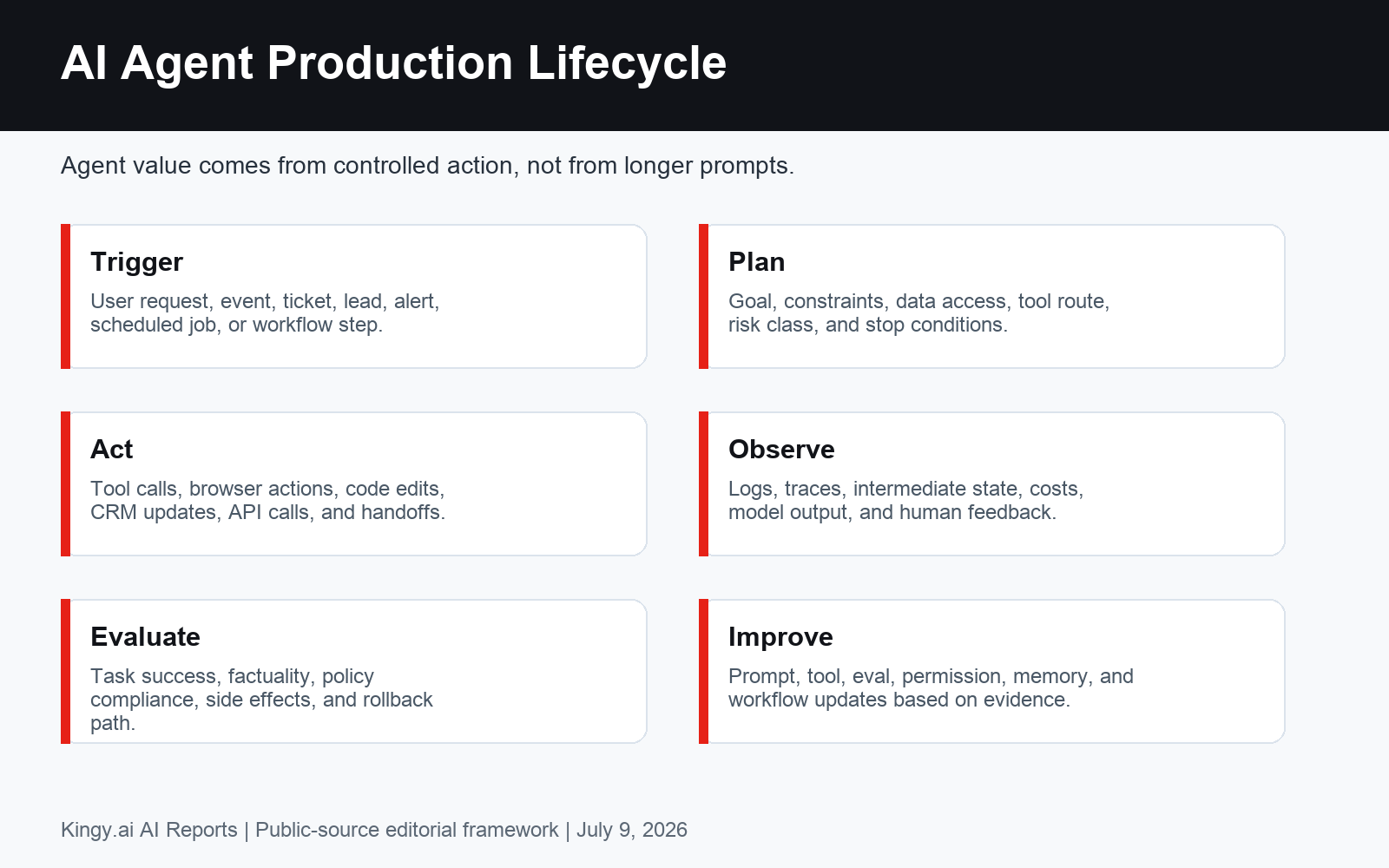
Kingy’s 2026 agent lifecycle has six layers:
| Layer | What it means | What to test |
|---|---|---|
| Trigger | The event or request that starts the agent. | Is the task specific enough to automate safely? |
| Plan | The model selects steps, tools, constraints, and stop conditions. | Does it ask for missing context or overconfidently act? |
| Act | The agent uses tools, APIs, browsers, files, code, or apps. | Are actions allowlisted, logged, and reversible where needed? |
| Observe | The system records state, traces, tool results, cost, and failures. | Can a human reconstruct the work? |
| Evaluate | The workflow checks success, policy, factuality, and side effects. | Are evals tied to business outcomes, not just model vibes? |
| Improve | Prompts, tools, permissions, evals, and workflows are updated. | Does the system learn from failures without hiding them? |
For founders, this is the real question: which layer are you selling? A developer framework sells control over the lifecycle. An enterprise agent sells a packaged workflow. A connector layer sells access to tools and context. A vertical agent sells a repeatable job. A browser agent sells operation across messy web surfaces. These are different businesses.
Market Landscape
The AI agent market in 2026 has at least six useful lanes.
Developer foundations. OpenAI Agents SDK, LangGraph, CrewAI, AutoGen, Vercel AI SDK, and similar frameworks help builders create agentic applications. These products win when teams need control: tool calls, routing, state, streaming, human-in-the-loop flows, observability, and app integration. LangGraph is especially important because it treats agents as stateful workflows, not just one-shot prompts.
Enterprise agent platforms. Copilot Studio, Google Agentspace, AWS Bedrock Agents, Salesforce Agentforce, IBM watsonx Orchestrate, ServiceNow AI Agents, and similar platforms are aimed at organizations that already have identity, permissions, process ownership, and systems of record. These products win when the buyer wants business users and admins to create or manage agents without building every primitive from scratch.
CRM and customer-operation agents. Salesforce Agentforce is the cleanest example in this report because CRM workflows are agent-friendly when data quality is high. A sales or service agent can summarize records, draft replies, route work, update fields, and recommend next actions. The demo looks great. The workflow still needs proof: data permissions, approval rules, customer-facing risk, and measurable time saved.
Automation agents. Zapier Agents represents the SaaS automation lane. These agents are attractive because they connect to apps people already use. The boring part matters: action scopes, account permissions, task boundaries, failure handling, and whether non-technical users understand what the agent is allowed to do.
Interoperability layers. MCP matters because the agent ecosystem needs safer, more standard ways to expose tools and context. The agent that cannot connect to anything is a chatbot. The agent that can connect to everything without governance is an incident waiting to happen.
Observability and eval layers. LangSmith and OpenTelemetry are included in the source list because serious agents need traces, logs, metrics, and evaluation loops. An agent that acts without a trace is hard to debug. An agent that acts without evals is hard to trust.
Platform and Framework Comparison
| Platform / framework | Lane | Best fit | Public proof used | Main caution | Kingy score | Source |
|---|---|---|---|---|---|---|
| OpenAI Agents SDK / Responses API | agent runtime and tool-calling foundation | Teams building custom agents with tool calls, handoffs, tracing, guardrails, and production application logic. | Official SDK and tools docs describe agents, tools, handoffs, guardrails, tracing, and hosted tool patterns. | This is a developer foundation, not a finished no-code business agent. Production quality depends on the app around it. | 9.1/10 | Source |
| LangGraph | stateful agent orchestration | Long-running workflows, multi-step state, human review, retry paths, graph control, and explicit agent loops. | Official docs position LangGraph around stateful agents, controllable workflows, and durable execution. | It rewards teams that can design flows. It is not a magic wrapper for unclear processes. | 8.9/10 | Source |
| Google ADK / Agentspace | enterprise and Google-cloud agent stack | Google Cloud teams building agents over enterprise search, apps, data, and governed workplace workflows. | Google’s ADK and Agentspace pages support agent development and enterprise agent/productivity positioning. | Buyers should separate developer toolkit value from enterprise workspace procurement and integration costs. | 8.7/10 | Source |
| Microsoft Copilot Studio | business copilots and low-code agents | Microsoft 365, Power Platform, Dynamics, and internal business workflows where admins need governed agent creation. | Microsoft docs describe Copilot Studio as a platform for creating, managing, and publishing copilots/agents. | It is strongest where Microsoft identity, data, and process ownership are already in place. | 8.4/10 | Source |
| AWS Bedrock Agents | cloud-native enterprise agents | AWS teams that need agents connected to Lambda, knowledge bases, enterprise data, and cloud governance. | AWS docs describe Bedrock Agents as a way to orchestrate tasks and invoke APIs across enterprise systems. | Cloud-native does not mean plug-and-play. IAM, data boundaries, and evals still decide production risk. | 8.2/10 | Source |
| Salesforce Agentforce | CRM and customer-operation agents | Sales, service, marketing, and commerce workflows where CRM data and business process context matter. | Salesforce positions Agentforce as a digital labor platform for building and deploying AI agents. | The buyer question is not agent novelty. It is data quality, process ownership, and handoff design. | 8.1/10 | Source |
| CrewAI | multi-agent workflow framework | Role-based agent teams, task delegation patterns, and developers experimenting with agent crews. | Official docs describe crews, agents, tasks, flows, tools, memory, and process patterns. | Multi-agent design can add complexity fast. Use it where role separation creates real control. | 7.9/10 | Source |
| Vercel AI SDK Agents | web-app agent UX and streaming | Product teams building web-native agents, chat interfaces, tool calls, streaming UX, and frontend-integrated AI flows. | Official AI SDK docs include an agents section plus tool calling and UI patterns for application builders. | It is best read as an application layer, not a complete enterprise agent operating system by itself. | 7.8/10 | Source |
| AutoGen | research-to-developer multi-agent framework | Teams prototyping conversational multi-agent patterns, distributed agents, and research-oriented designs. | The official Microsoft GitHub repository documents AutoGen as an open-source framework for multi-agent AI applications. | Check current API/version status before standardizing. Agent frameworks have moved quickly. | 7.5/10 | Source |
| Zapier Agents | automation and app-action agents | Non-engineering teams that want agents connected to SaaS apps and repeatable automations. | Zapier’s product page positions agents around actions, app connections, and automation workflows. | Good for workflow glue. Less suitable for deeply custom reasoning systems without engineering support. | 7.4/10 | Source |
| IBM watsonx Orchestrate | enterprise assistant and workflow orchestration | Large organizations evaluating governed assistants, HR/procurement-style workflows, and enterprise automation. | IBM positions watsonx Orchestrate around AI assistants, skills, agents, and business automation. | Enterprise fit depends heavily on integration scope, change management, and measurable workflow outcomes. | 7.3/10 | Source |
| MCP ecosystem | agent-tool interoperability layer | Teams standardizing how models and agents connect to tools, files, apps, APIs, and context providers. | The official Model Context Protocol docs describe an open protocol for connecting AI applications to external systems. | MCP is infrastructure. It does not remove the need for permissions, audit trails, and tool-risk controls. | 8.0/10 | Source |
Pricing is intentionally not treated as a ranking factor here unless a vendor clearly publishes stable plan details on the linked page. Agent pricing is especially hard to compare because real cost can include model tokens, seats, workflow runs, connector access, cloud resources, observability, storage, enterprise support, and implementation labor. If pricing is not clearly listed, buyers should treat it as not publicly confirmed and ask for a written estimate tied to a real workflow.
Kingy Agent Readiness Score
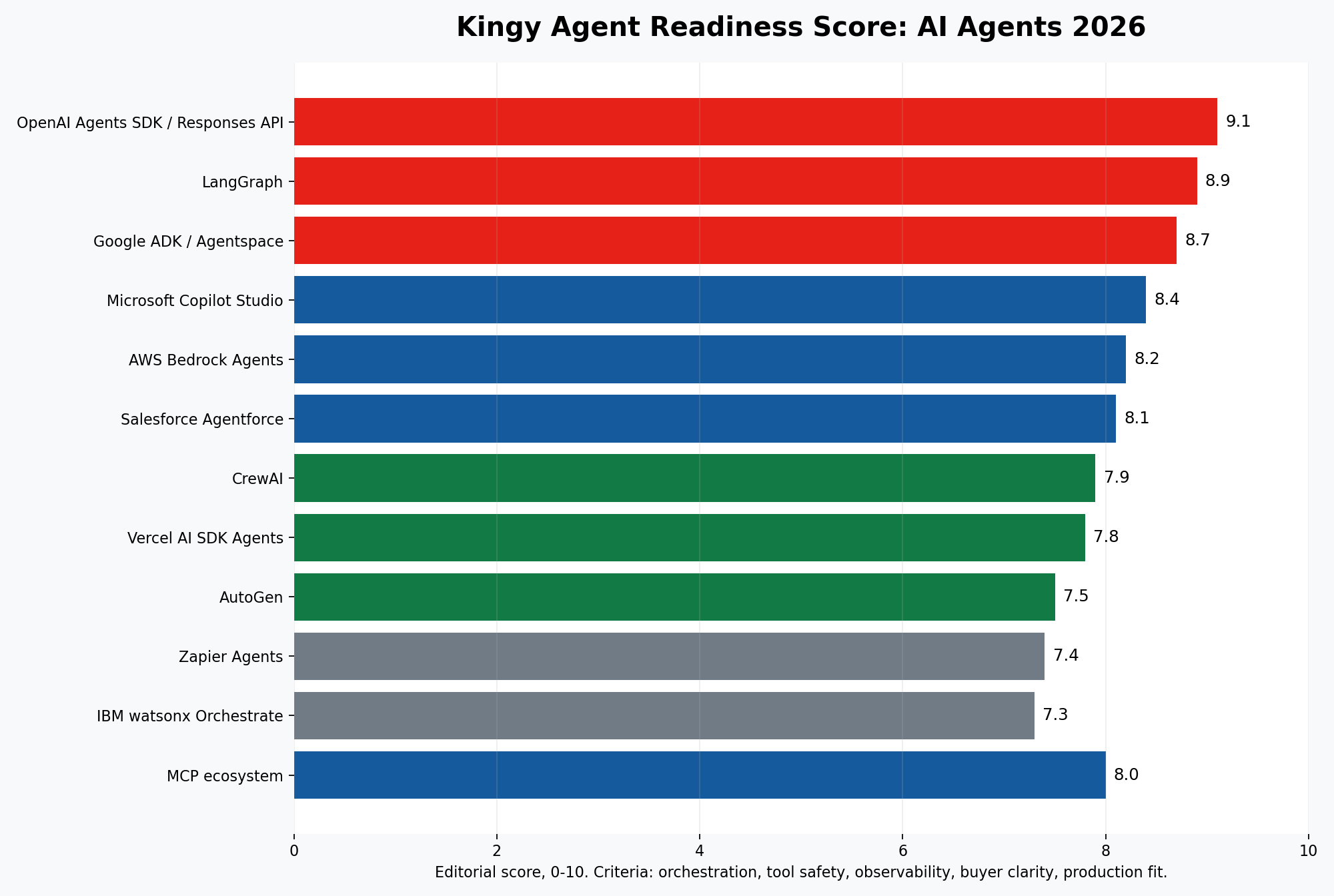
This score is an editorial framework, not an external benchmark. Kingy scored each platform from 0 to 10 using five criteria:
| Criterion | Weight | Why it matters |
|---|---|---|
| Orchestration depth | 25% | Agents need state, routing, retries, handoffs, and multi-step control. |
| Tool safety | 25% | The more an agent can do, the more permissions and guardrails matter. |
| Observability | 20% | Buyers need logs, traces, evals, and reviewable work. |
| Buyer clarity | 15% | The product should make its lane, use case, and limits clear. |
| Production fit | 15% | The system should map to real deployment, governance, and maintenance work. |
| Platform / framework | Score | Interpretation | Lane |
|---|---|---|---|
| OpenAI Agents SDK / Responses API | 9.1 | Strong production foundation | agent runtime and tool-calling foundation |
| LangGraph | 8.9 | Strong production foundation | stateful agent orchestration |
| Google ADK / Agentspace | 8.7 | Strong production foundation | enterprise and Google-cloud agent stack |
| Microsoft Copilot Studio | 8.4 | Strong fit in its lane | business copilots and low-code agents |
| AWS Bedrock Agents | 8.2 | Strong fit in its lane | cloud-native enterprise agents |
| Salesforce Agentforce | 8.1 | Strong fit in its lane | CRM and customer-operation agents |
| CrewAI | 7.9 | Useful but scope-sensitive | multi-agent workflow framework |
| Vercel AI SDK Agents | 7.8 | Useful but scope-sensitive | web-app agent UX and streaming |
| AutoGen | 7.5 | Useful but scope-sensitive | research-to-developer multi-agent framework |
| Zapier Agents | 7.4 | Watchlist / integration-dependent | automation and app-action agents |
| IBM watsonx Orchestrate | 7.3 | Watchlist / integration-dependent | enterprise assistant and workflow orchestration |
| MCP ecosystem | 8.0 | Strong fit in its lane | agent-tool interoperability layer |
Scores are deliberately conservative. A framework can score high without being a complete business product if it provides strong production primitives. An enterprise product can score high in its lane while still requiring heavy integration. A flashy demo can score lower if the public docs do not prove enough about controls, traces, or workflow safety.
Why Tool Calling Changes the Category
Tool calling is the difference between “the model said something” and “the system did something.” That is why the category is so valuable and so dangerous.
With tools, an agent can search a knowledge base, read a file, query a database, open a ticket, send a message, update a CRM record, create a pull request, generate a report, schedule a meeting, run a cloud function, or call a billing API. The value is obvious. So is the blast radius.
The strongest agent companies will make tool access feel boring in the best way: explicit permissions, narrowly scoped actions, clear logs, review steps, test modes, rollback plans, rate limits, spend limits, and human escalation. The weakest agent companies will hide risky behavior behind friendly chat UI.
This is why MCP, OpenAI tools, Bedrock integrations, Copilot Studio connectors, Zapier app actions, and Vercel AI SDK tool calls all matter. They are not merely technical details. They define what the agent can touch.
Enterprise Agents Versus Developer Agents
Enterprise agents and developer agents are often discussed as if they are the same market. They are not.
Developer agents are bought by builders who want control over application behavior. They care about SDK quality, streaming, state, tool APIs, tracing, evals, testability, deployment, and customization. They ask questions like: can we inspect the tool call? Can we retry only this step? Can we hand off to a human? Can we run evals in CI? Can we change the model? Can we keep customer data inside our boundary?
Enterprise agents are bought by organizations that want workflows improved without rebuilding every primitive. They care about admin controls, identity, connectors, system-of-record integration, compliance posture, audit logs, deployment paths, templates, business-user configuration, support, and vendor accountability. They ask questions like: who can create an agent? Which data can it see? What can it change? Who approves external actions? How do we measure value?
The overlap is growing. A startup might build a vertical sales-support agent using OpenAI Agents SDK, LangGraph, Vercel AI SDK, and CRM APIs. A large company might use Copilot Studio or Agentforce for internal workflows and still build custom agents for edge cases. The market will not consolidate into one winner quickly because the jobs are too different.
The Agent Risk Matrix
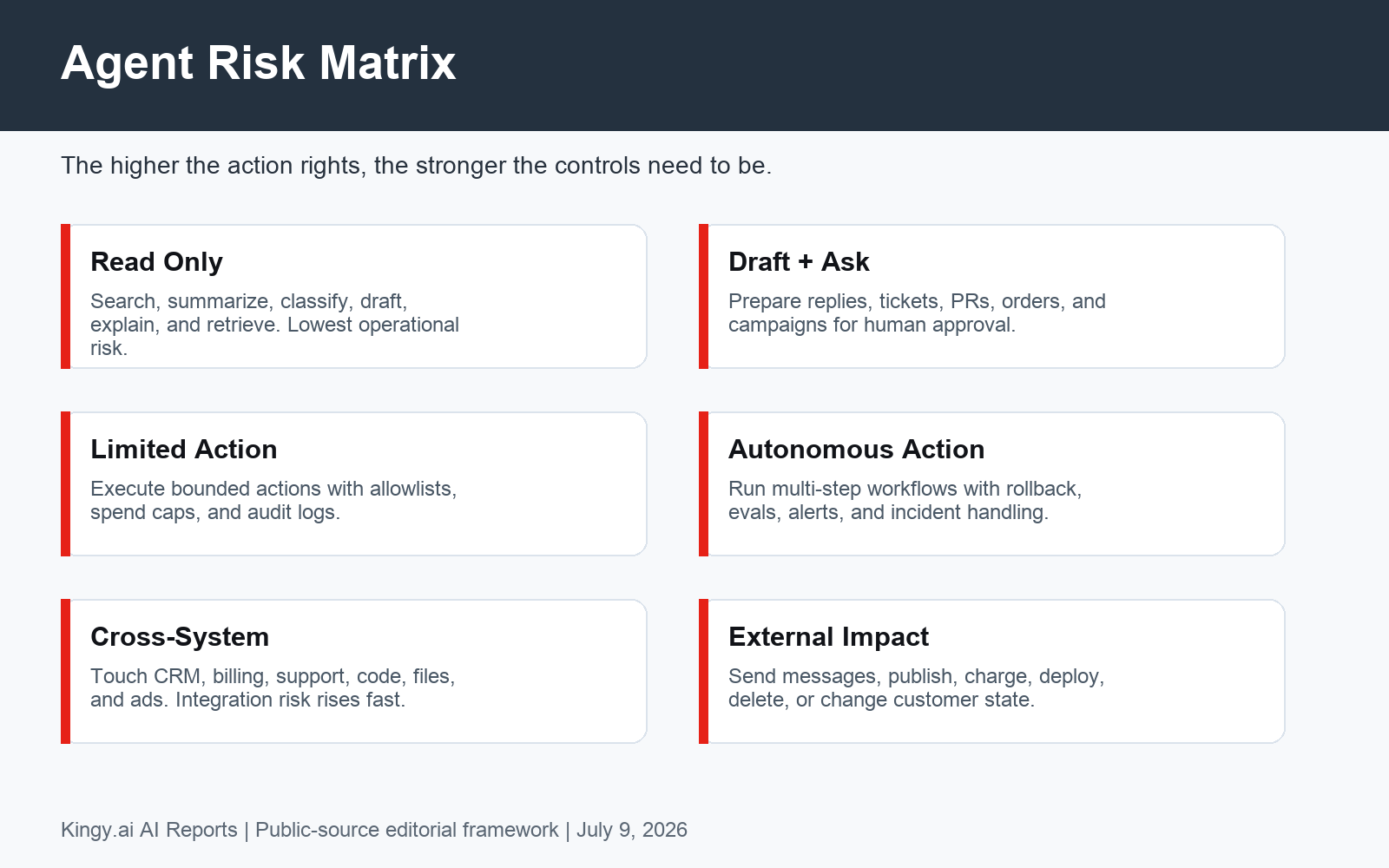
The simplest agent risk rule is this: risk increases with action rights.
| Risk level | Agent capability | Required controls |
|---|---|---|
| Read only | Search, summarize, classify, draft, explain. | Source links, confidence labels, retrieval logs, user review. |
| Draft and ask | Prepare an email, ticket, PR, order, post, or workflow step. | Human approval, diff view, edit history, policy checks. |
| Limited action | Execute bounded actions in known systems. | Allowlists, rate limits, spend caps, audit logs, rollback. |
| Autonomous action | Run multi-step tasks with limited supervision. | Evals, traces, alerts, incident handling, escalation paths. |
| Cross-system action | Touch multiple business systems. | Identity mapping, data boundaries, permission inheritance, monitoring. |
| External impact | Send, publish, deploy, charge, delete, or change customer state. | Strong human gates, legal/compliance review, full audit trail. |
This is not anti-agent. It is pro-useful-agent. The fastest way to kill trust in agents is to let them act before the organization knows how to inspect and reverse the work.
Buyer Methodology
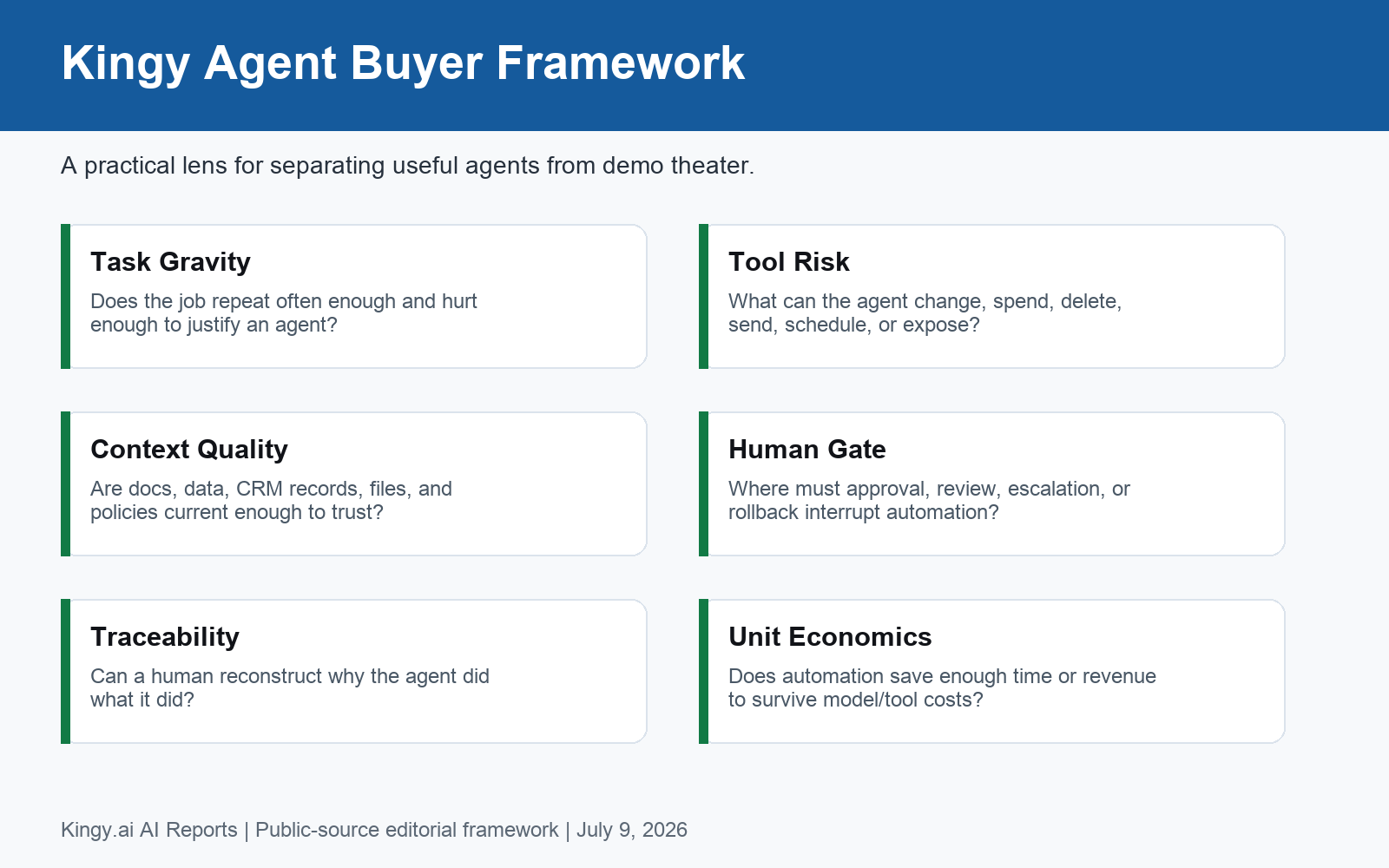
Use this six-part test before buying or building an agent:
- Task gravity. Does the workflow repeat often enough and hurt enough? If the job happens twice a month, an agent may be theater.
- Tool risk. What can the agent change, send, delete, spend, publish, or expose?
- Context quality. Are the docs, records, files, policies, and APIs reliable enough to use?
- Human gate. Where must a person approve, review, escalate, or stop the workflow?
- Traceability. Can a reviewer reconstruct the plan, tool calls, intermediate state, outputs, and costs?
- Unit economics. Does the saved time, increased revenue, faster response, or improved quality justify model cost, implementation, and monitoring?
For AI companies, the CTA is straightforward: do not sell “agents” as magic. Sell a painfully specific workflow. Show the before/after. Show what the agent is allowed to do. Show what it refuses to do. Show the logs. Show the human gate. Show the ROI model. Then submit launches and category updates through Submit an AI Launch, review Editorial Sponsorship Standards, and use Sponsor Kingy AI or the Media Kit if the product has a credible launch story.
Winners, Watchlist, and What to Test
Strongest developer foundations to study: OpenAI Agents SDK, LangGraph, Vercel AI SDK, CrewAI, AutoGen, and MCP. The reason is not that every buyer should use all of them. The reason is that they expose the primitives that matter: tools, state, orchestration, handoffs, traces, and app integration.
Strongest enterprise lanes to watch: Copilot Studio, Agentforce, Google Agentspace, AWS Bedrock Agents, ServiceNow AI Agents, and IBM watsonx Orchestrate. These products have the distribution advantage of living near enterprise systems and administrators. The risk is that broad platforms can feel powerful in demos but slow in messy process redesign.
Most important ecosystem layer: interoperability and observability. Tool standards, connector governance, traces, logs, evals, and monitoring may be less exciting than agent personas, but they are what turn agents into production systems.
Best first test for a buyer: pick one workflow where the agent can draft, classify, retrieve, or prepare work, but cannot create external impact without approval. Measure cycle time, quality, error rate, human intervention, cost per completed task, and failure modes for two to four weeks. If it wins there, expand action rights slowly.
Source-Backed Company Notes
- OpenAI: official docs support Agents SDK and tool-use patterns. This report does not claim private adoption, revenue, or undisclosed roadmap.
- Anthropic/MCP: official MCP docs support the protocol framing. This report treats MCP as infrastructure, not a standalone agent product.
- Google: official ADK and Agentspace pages support developer and enterprise-agent positioning. Pricing and customer claims are not inferred.
- Microsoft: official Copilot Studio docs support creating and managing copilots/agents. Exact customer outcomes are not inferred.
- AWS: official Bedrock Agents docs support cloud-agent orchestration and API integration. Actual implementation effort varies by account and workflow.
- Salesforce: official Agentforce page supports CRM/workflow positioning. This report does not claim a specific buyer ROI.
- Zapier, IBM, ServiceNow: official product pages support the agent/workflow positioning. Public pricing, traction, or customer outcomes are not assumed unless clearly listed by the vendor.
FAQ
What is an AI agent in 2026?
In this report, an AI agent is software that can use models, tools, context, memory, state, and workflow rules to pursue a task with some degree of autonomy. A chatbot answers. An agent does work or prepares work through connected tools.
Are AI agents ready for full autonomy?
Some bounded internal workflows are ready for limited action. Full autonomy across high-impact business systems is still risky without strong gates. The more an agent can change the world, the more it needs approvals, traces, evals, rollback, and monitoring.
What is the difference between an agent framework and an agent product?
An agent framework gives developers primitives for building agentic applications. An agent product packages a workflow for a buyer. Frameworks need engineering. Products need operational fit. Both can be valuable.
Should startups call everything an agent?
No. If the product mostly answers questions, call it an assistant or copilot. If it uses tools and takes bounded action through a repeatable workflow, “agent” is more defensible. Buyers are getting better at spotting agent-washing.
What should buyers test first?
Test a workflow with clear inputs, measurable outcomes, safe tool access, and a human approval step. Avoid beginning with a workflow where the agent can publish, charge, delete, deploy, or message customers without review.
Sources
- OpenAI Agents SDK
- OpenAI tools guide
- Model Context Protocol
- Anthropic computer use
- Google Agent Development Kit
- Google Agentspace
- Microsoft Copilot Studio
- Microsoft AutoGen
- LangGraph
- CrewAI
- Vercel AI SDK Agents
- AWS Bedrock Agents
- Salesforce Agentforce
- IBM watsonx Orchestrate
- Zapier Agents
- ServiceNow AI Agents
- LangSmith observability
- OpenTelemetry
Downloadable Assets
- Download the visual PDF packet: state-ai-agents-2026-visual-report.pdf
The Kingy Brief
Get The Kingy Brief.
AI changes, original tests and one practical thing to try. Fridays at 09:00 Vancouver time.
Free · Double opt-in · Unsubscribe anytime
Sign up for The Kingy Brief on Beehiiv.
Signup help and newsletter schedule
Signup form provided by Beehiiv. After submitting, check your inbox for "Confirm your subscription to The Kingy Brief" and open its confirmation link. Check Spam or Promotions if you cannot find it.
Fridays at 09:00 Vancouver time: source-checked AI changes, original tests and one practical thing to try. The weekly restart begins October 9, 2026. We skip a week when there is not enough verified material. Free. Unsubscribe anytime.