
The AI Startup Distribution Report is about the question founders avoid until the launch spike fades:
How does anyone keep discovering the product after the first announcement?
AI startups have never been easier to start. They have also never been easier to ignore. A founder can ship a convincing demo with a small team, a model API, a code agent, a polished landing page, and a few clips. That creates a crowded market where “we use AI” is no longer a distribution advantage. It is table stakes.
The startups that win distribution in 2026 are not just louder. They are easier to understand, easier to trust, easier to try, easier to compare, and easier for other people to explain. They turn launches into proof, proof into search visibility, search visibility into AI-answer visibility, AI-answer visibility into trials, trials into workflows, and workflows into stories creators and customers can repeat.
That is the real distribution loop.
This report maps the channels that matter now: Product Hunt-style launch surfaces, developer ecosystems like GitHub and Hugging Face, search and AI-answer visibility, creator-led distribution, marketplaces, and proof surfaces like Y Combinator and CB Insights AI 100. For the broader series, start with the Kingy AI Reports hub, State of AI Coding Tools 2026, State of AI Video Tools 2026, State of AI Agents 2026, and State of Open-Weight AI Models.
Executive Summary
- AI startup distribution is shifting from one launch day to a compounding proof system.
- The best channel depends on the buyer. Developer tools need technical proof. Creative tools need visual demos. Enterprise AI needs trust, security, and workflow proof. Consumer AI needs habit and repeated utility.
- Product Hunt can still create useful attention, but only when the product has a prepared audience, clear goal, strong assets, and follow-up path.
- GitHub, Hugging Face, docs, model cards, examples, Spaces, SDKs, and open repos create durable trust for technical AI products.
- Search visibility now includes AI-answer visibility. G2’s 2026 buyer research says many B2B buyers are starting research with AI chatbots more often than Google.
- Creator distribution works best when the product has a visible workflow and a real buyer problem. Weak products can buy attention but cannot keep it.
- Marketplaces and integration directories matter when the product attaches to an existing workflow, not when the listing is just a static badge.
- Investor and accelerator recognition helps with trust, hiring, fundraising, and sales credibility, but it is not a substitute for activation.
- This report uses public sources only. It does not include private Kingy.ai client data, unverifiable revenue, customer, funding, sponsor-spend, benchmark, or traction claims.
Table of Contents
- What changed in AI startup distribution
- The distribution loop
- Channel map and scoring
- Launch surfaces
- Developer and model ecosystems
- Search and AI-answer visibility
- Creator and community distribution
- Marketplaces and integration directories
- Analyst, investor, and accelerator proof
- Operating cadence, FAQ, sources, and update note
What Changed in AI Startup Distribution
AI made product creation cheaper, but it also compressed attention. The old playbook was simple: announce the product, get a few launch posts, hope for press, collect signups, and celebrate the graph. That still happens, but the half-life is brutal. A product that looks novel on Monday can feel copied by Friday.
Here is where this gets interesting. The distribution advantage is moving from access to production toward proof of usefulness. Buyers want to know whether the product solves a repeated workflow, whether the demo survives real input, whether pricing is understandable, whether data handling is credible, whether the founder can explain the category, and whether the company will keep shipping after the launch.
The boring part matters. Documentation, changelogs, templates, pricing pages, security pages, comparison pages, integrations, demo data, model cards, public examples, and credible source links all become distribution assets. They are not just support material. They are how search engines, AI answer engines, creators, investors, developers, and buyers understand the product.
This is especially true for AI startups because the product itself often needs explanation. “AI agent for sales” is not enough. Sales leaders want to know which system it touches, what it writes, what it approves, how it handles bad data, what happens when it is wrong, how a human reviews it, and how long it takes to show value. Developers want to know the API, repo, docs, evals, model behavior, examples, and failure modes. Creators want a workflow people can see in seconds. Investors want evidence that the company has a channel, not just a model wrapper.
The Distribution Loop
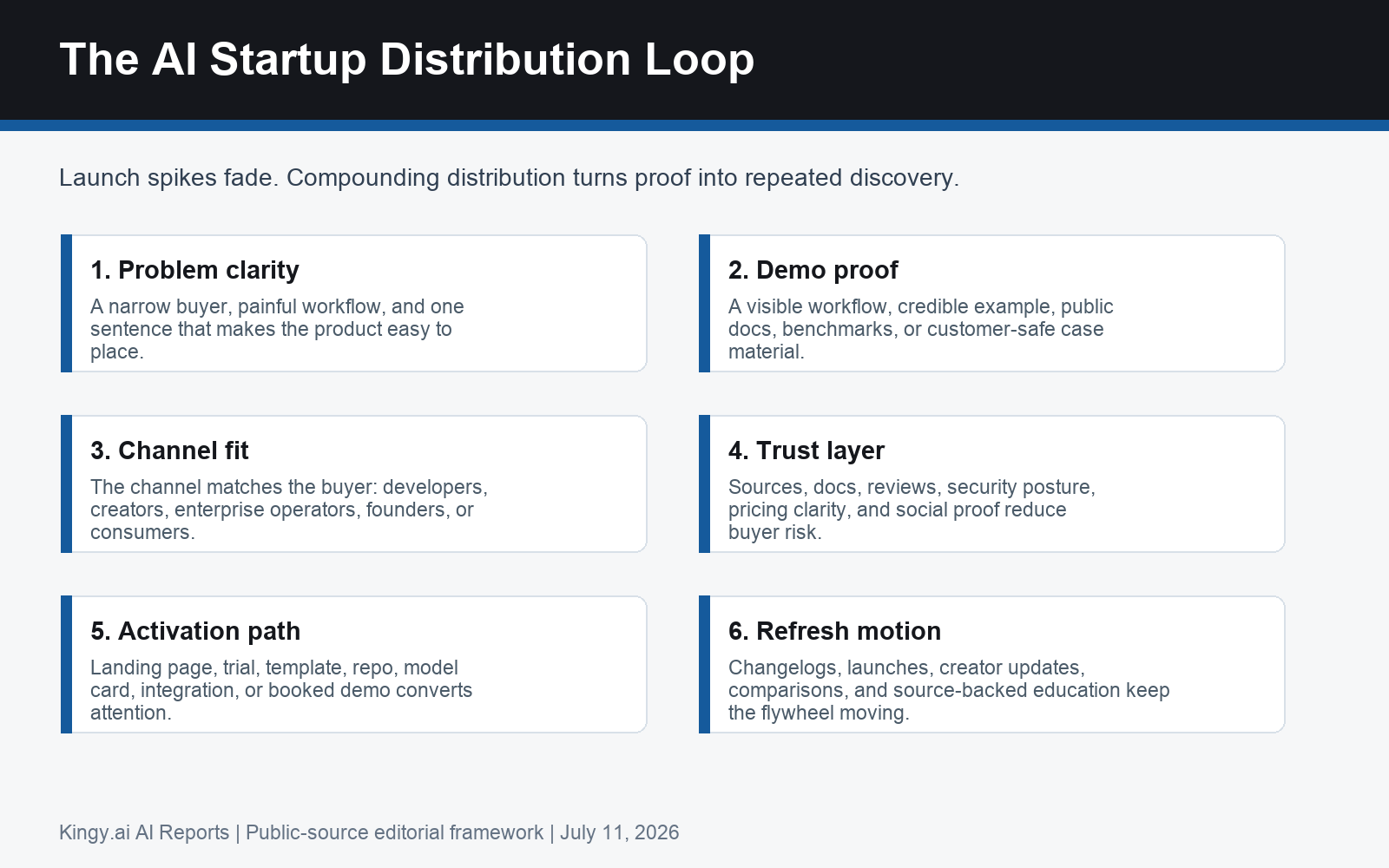
The strongest AI startups build a repeatable loop:
| Stage | What it means | Distribution asset |
|---|---|---|
| Problem clarity | The startup owns a specific buyer pain, not a vague AI category. | Positioning, landing page, use-case page, comparison page. |
| Demo proof | The product shows a workflow people can understand. | Video, GIF, live demo, notebook, repo, Space, template, case-safe example. |
| Channel fit | The startup chooses channels where the buyer already searches or trusts. | Product Hunt, GitHub, Hugging Face, creators, G2, marketplaces, newsletters. |
| Trust layer | The startup reduces perceived risk. | Docs, pricing, security, eval notes, model cards, terms, public source links. |
| Activation path | Attention turns into a next step. | Trial, demo booking, install, template, repo star, API key, waitlist, newsletter. |
| Refresh motion | The story keeps moving after launch week. | Changelog, integration, benchmark update, creator demo, comparison update. |
Most weak launches skip the middle. They go from “we built this” to “please sign up.” Strong distribution says why the product matters, who it is for, what proof exists, what to try first, and what happens next.
Kingy AI Startup Distribution Score
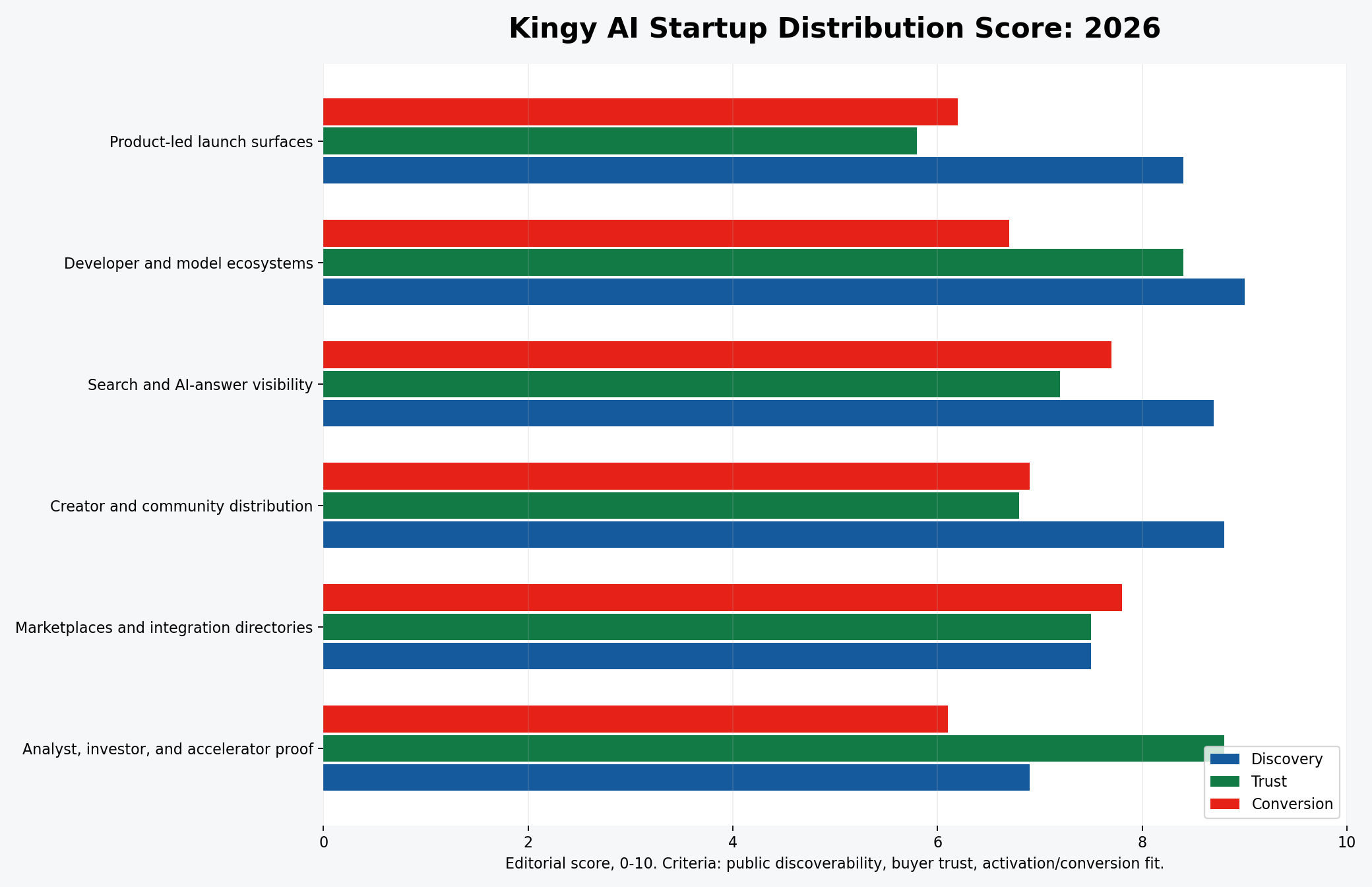
This score is an editorial framework, not a private analytics dataset. Kingy scores each channel from 0 to 10 on three public-signal dimensions:
| Dimension | What it rewards |
|---|---|
| Discovery | How well the channel helps the right audience find a product. |
| Trust | How well the channel makes the product feel credible enough to inspect. |
| Conversion | How well the channel can move attention into usage, signup, demo, install, or purchase. |
| Channel | Discovery | Trust | Conversion | Interpretation |
|---|---|---|---|---|
| Product-led launch surfaces | 8.4 | 5.8 | 6.2 | Useful as supporting proof |
| Developer and model ecosystems | 9.0 | 8.4 | 6.7 | Core distribution lane |
| Search and AI-answer visibility | 8.7 | 7.2 | 7.7 | Strong with the right product |
| Creator and community distribution | 8.8 | 6.8 | 6.9 | Strong with the right product |
| Marketplaces and integration directories | 7.5 | 7.5 | 7.8 | Strong with the right product |
| Analyst, investor, and accelerator proof | 6.9 | 8.8 | 6.1 | Strong with the right product |
The score does not claim that every startup should chase every channel. It is a planning tool. A consumer AI app with a visual before/after may need creators, app stores, short-form video, and a retention loop. A developer API may need docs, GitHub, SDK examples, benchmarks, and technical SEO. An enterprise agent startup may need security proof, integrations, partner marketplaces, executive education, webinars, and account-based selling.
Channel Map
| Channel | Examples | Best fit | Main risk | Source |
|---|---|---|---|---|
| Product-led launch surfaces | Product Hunt, launch directories, changelog posts, launch newsletters | Sharp launches with a clear before/after, fast demo, credible founder story, and launch-day follow-up. | A one-day spike that does not convert into signups, trials, demos, or backlinks. | Source |
| Developer and model ecosystems | GitHub, Hugging Face Hub, Spaces, docs, SDK repos, examples | Open models, agent frameworks, coding tools, APIs, infrastructure, eval tooling, and technical products. | Stars, demos, and forks look good but may not equal active usage or revenue. | Source |
| Search and AI-answer visibility | Google, Perplexity, ChatGPT, AI Overviews, comparison pages, documentation SEO | Products that solve recurring research queries: best tool, how to, pricing, alternatives, integration, benchmark, tutorial. | Answer engines summarize proof. Thin pages, unclear claims, and missing docs disappear quickly. | Source |
| Creator and community distribution | YouTube demos, X threads, Reddit, Discord, LinkedIn, newsletters, podcasts, webinars | Tools with visual workflows, dramatic demos, founder credibility, and clear use cases that creators can explain honestly. | Paid attention can look like traction; weak products produce fast churn after the demo. | Source |
| Marketplaces and integration directories | GPTs, Zapier, AWS Marketplace, app stores, extension stores, partner catalogs | Tools that attach to existing workflows and gain trust from where the buyer already works. | Marketplace listing without activation, onboarding, support, and proof becomes shelfware. | Source |
| Analyst, investor, and accelerator proof | YC, CB Insights AI 100, investor maps, analyst lists, partner case studies | Enterprise AI, infrastructure, vertical AI, security, and startups needing legitimacy with buyers, talent, or investors. | Recognition helps open doors, but buyers still need proof, references, security posture, and ROI. | Source |
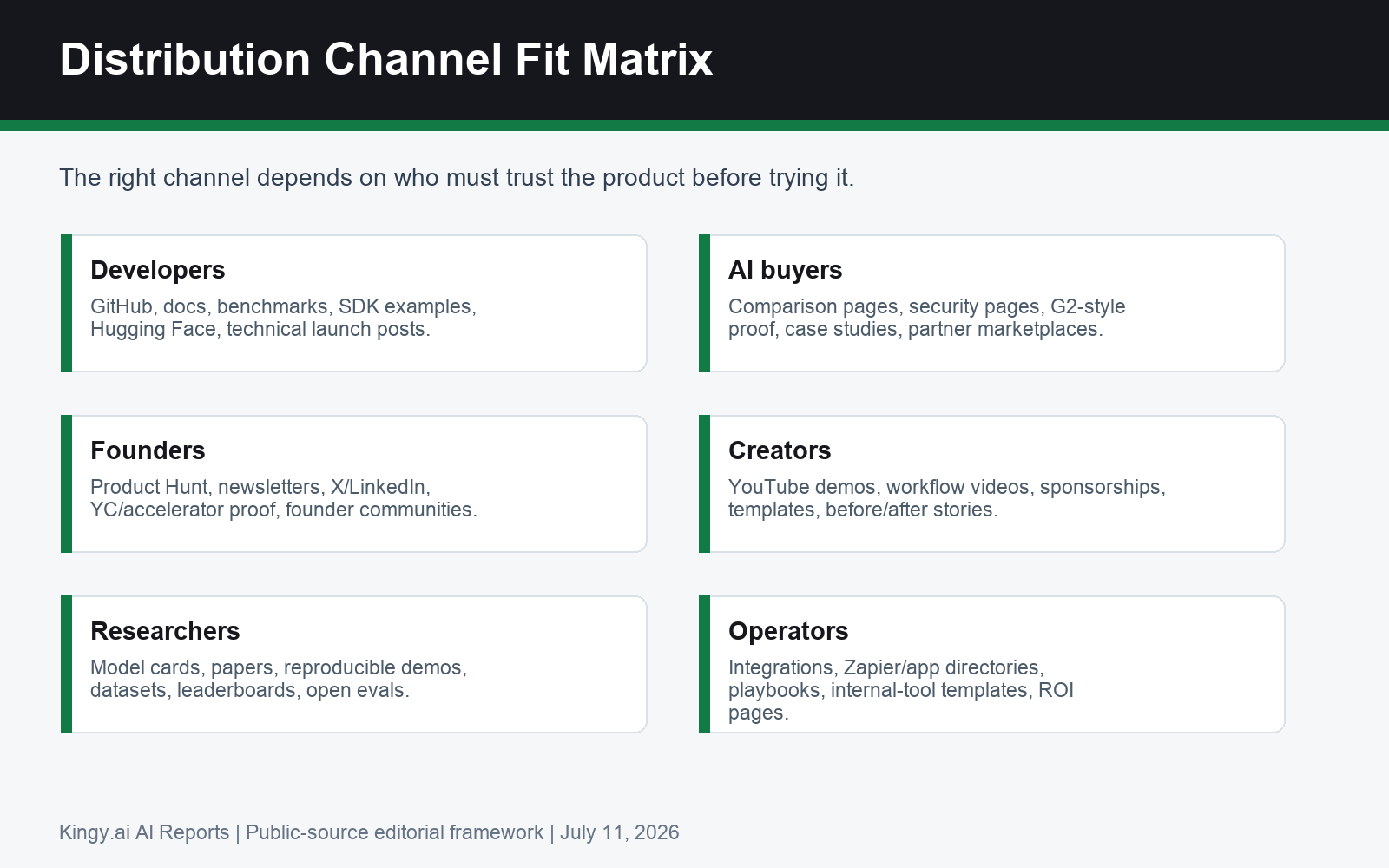
This table is intentionally practical. Distribution is not a vibes category. It is a buyer-match category.
If the buyer is a developer, the channel must support inspection. That means docs, examples, code, issues, model cards, benchmarks, APIs, install paths, and real constraints. If the buyer is a marketer, creator, or founder, the product must become explainable in a short workflow demo. If the buyer is an enterprise operator, the product must earn trust before it earns usage. If the buyer is a consumer, the product must become a habit before the novelty wears off.
The tools that win will not just be flashy. They will be sticky.
Launch Surfaces: Useful Spike, Weak Moat
Product Hunt remains useful because it concentrates founder, maker, investor, early adopter, and tech-media attention into a visible launch moment. The official Product Hunt launch guide frames launch preparation around goals, community familiarity, content, and best practices. That matters because the launch is not the product. The launch is a stress test of positioning.
For an AI startup, a strong launch surface needs four things:
- A clear promise. The buyer understands the category in one sentence.
- A visible demo. The workflow is concrete, not just a prompt box and a vague output.
- A conversion path. The page turns attention into signup, install, waitlist, template, repo, or demo.
- A follow-up sequence. The founder has changelog, customer-safe proof, tutorial, creator, newsletter, and sales follow-up ready.
The catch is that launch rankings can become vanity metrics. Being noticed for a day is not the same as being adopted for a month. The better question is not “Did we rank?” It is “What asset did the launch create?” Useful answers include newsletter subscribers, demos booked, repo stars from relevant developers, creator interest, benchmark feedback, search demand, backlinks, investor conversations, and product objections worth fixing.
For founders preparing launch coverage, Kingy.ai’s Submit an AI Launch path is built for credible AI launches with clear source material. The AI Launch Tracker and AI Launch Intelligence exist because good launch data should be easier to inspect after the hype cycle moves on.
Developer and Model Ecosystems: Proof Beats Polish
Developer products distribute differently. Developers do not just want a claim. They want the repo, docs, examples, API, pricing, model behavior, failure modes, and issue history.
GitHub’s Octoverse work is useful context because GitHub remains one of the central public places where developers discover, inspect, fork, watch, and evaluate technical projects. GitHub’s Octoverse article reported massive public development activity in 2025, including high repository creation and pull request volume. For AI startups, that means public technical proof is still a distribution channel.
Hugging Face is similarly important for AI-native distribution. Its Hub documentation describes the Hub as a reference AI platform for open ML, with models, datasets, and Spaces used for hosting, discovery, and collaboration. Its Spring 2026 open-source report described rapid growth across users, public models, and datasets. For model startups, eval tools, open-weight projects, ML infrastructure, and demo-heavy AI apps, Hugging Face can be both product surface and distribution surface.
The practical lesson: technical buyers reward substance. A beautiful landing page helps, but a useful example repo, model card, Space, notebook, benchmark note, changelog, or integration guide can create more durable trust than a launch announcement.
For products in the coding, model, and agent lanes, this report connects directly to State of AI Coding Tools 2026, State of AI Agents 2026, and State of Open-Weight AI Models.
Search and AI-Answer Visibility
Search is no longer only search. Buyers ask Google, but they also ask ChatGPT, Perplexity, Claude, Gemini, copilots, internal knowledge tools, LinkedIn, Reddit, YouTube, comparison sites, and category pages. G2’s 2026 AI chatbot buyer research says half of B2B software buyers now start software research with an AI chatbot more often than Google, and that many rely on AI chatbots during research.
That changes startup distribution in a concrete way.
AI answer engines compress sources. They reward products that can be summarized cleanly from public, structured, credible material. If pricing is unclear, docs are thin, use cases are vague, examples are missing, claims are unsupported, and category pages do not explain the product, the startup becomes hard to recommend. If the public record is clean, specific, and source-backed, the product has a better chance of appearing in answer-style research.
For AI startups, the minimum answer-engine package should include:
- A clear homepage with one primary buyer and one primary job.
- A pricing page or pricing explanation, even if enterprise pricing is custom.
- Use-case pages for the real workflows.
- Docs or setup instructions when the product is technical.
- Comparison pages that avoid fake competitor claims.
- Source-backed claims, model cards, changelogs, security pages, and update notes.
- Founder or company pages that help buyers understand who is behind the product.
- Fresh launch and product updates that show active momentum.
The demo looks great. The workflow still needs proof.
Creator and Community Distribution
Creator-led distribution is powerful because many AI products are easier to understand by watching than reading. AI video tools, design tools, coding agents, browser agents, voice tools, research tools, and workflow automations often need a visible before/after. A creator can compress the buyer’s first 10 minutes of curiosity into a 90-second workflow.
a16z’s consumer AI reporting is useful here because it shows AI usage and app discovery are fragmented across categories and ecosystems. The consumer AI market is not one monolithic leaderboard. Creative tools, agents, assistants, productivity products, education tools, and region-specific ecosystems all have different distribution dynamics.
The practical creator test is simple:
| Question | Why it matters |
|---|---|
| Can a creator show the core value in under two minutes? | If not, the product may need a better demo path. |
| Does the workflow survive messy input? | Polished examples can create backlash when users try real work. |
| Is the promise safe to repeat? | Unsupported claims put both the startup and creator at risk. |
| Is there a next step? | Templates, trials, prompt packs, examples, and docs convert views into use. |
| Can the story refresh? | One demo is a spike. A series of workflows becomes a channel. |
For creator-market fit, use State of AI Video Tools 2026, Sponsor Kingy AI, the Media Kit, and the AI Sponsored Video ROI Calculator. If a campaign claims performance, it needs tracked assumptions and honest limitations. The next report in this series will handle sponsorship benchmarks separately.
Marketplaces and Integration Directories
Marketplaces are not magic. They work when the product attaches to a workflow the buyer already trusts.
OpenAI’s GPT discovery surface, Zapier’s app directory, AWS Marketplace, app stores, extension stores, and partner catalogs all create distribution possibilities. But a listing is not a strategy. A buyer still needs onboarding, proof, support, clear pricing, permissions, integration docs, and a reason to keep using the product.
Marketplaces are strongest when they reduce friction:
- The buyer is already using the platform.
- The product extends a known workflow.
- Security and permissions are understandable.
- Setup is short.
- Reviews, usage, or partner trust are visible.
- The product’s activation event happens inside the marketplace-connected workflow.
They are weakest when founders treat them as badges. A listing that does not convert, update, or support users becomes shelfware.
Analyst, Investor, and Accelerator Proof
Recognition is not distribution by itself, but it changes trust. A YC batch, a CB Insights list, an investor map, a strong analyst mention, or a reputable category report can help startups with hiring, fundraising, sales credibility, partner conversations, and media filtering.
YC’s public startup directory and Requests for Startups create a visible market signal around what kinds of companies the accelerator is funding or wants to see. CB Insights’ AI 100 surfaces private AI companies through its own research methodology and predictive signals. These lists should not be treated as customer adoption proof. They are trust accelerants.
For enterprise AI startups, that matters. Buyers may not buy because of an award, but recognition can help them decide the company is worth a first meeting. After that, the real proof stack takes over: security, ROI, integration depth, references where public, procurement fit, and the ability to show the workflow without exaggerating.
The Proof Stack
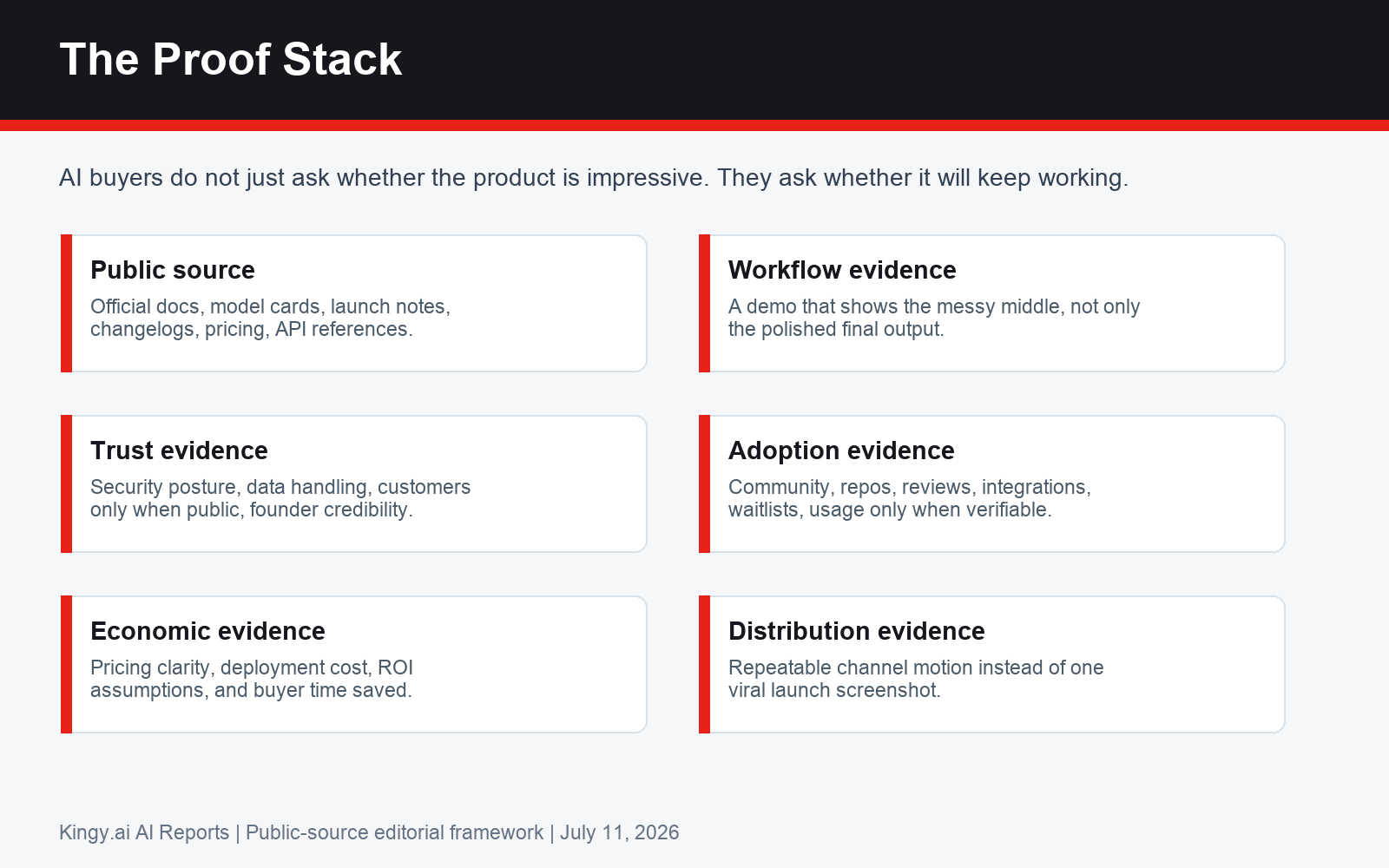
AI distribution increasingly depends on proof density. The more concrete public proof a startup has, the easier it is for every channel to work.
| Proof type | Examples | Why it helps distribution |
|---|---|---|
| Public source proof | Docs, model cards, changelogs, pricing, API references. | Lets buyers and answer engines verify claims. |
| Workflow proof | Demo videos, templates, notebooks, product tours, Spaces. | Makes the product understandable and shareable. |
| Trust proof | Security page, data policy, terms, founders, public customers where confirmed. | Reduces buyer risk. |
| Adoption proof | Reviews, integrations, repo activity, community, case studies where public. | Shows the product is not isolated. |
| Economic proof | Pricing clarity, ROI model, time saved, deployment cost. | Helps buyers defend the purchase. |
| Distribution proof | Repeatable launches, creator demos, SEO, newsletters, partnerships. | Shows growth is a system, not a lucky spike. |
Do not fake this. If a claim is not publicly confirmed, say so. If pricing is not clearly listed, say so. If a customer is private, do not imply it. If a benchmark is from a vendor, label it. If a creator campaign was sponsored, disclose it. Honest proof compounds. Inflated proof decays.
Operating Cadence
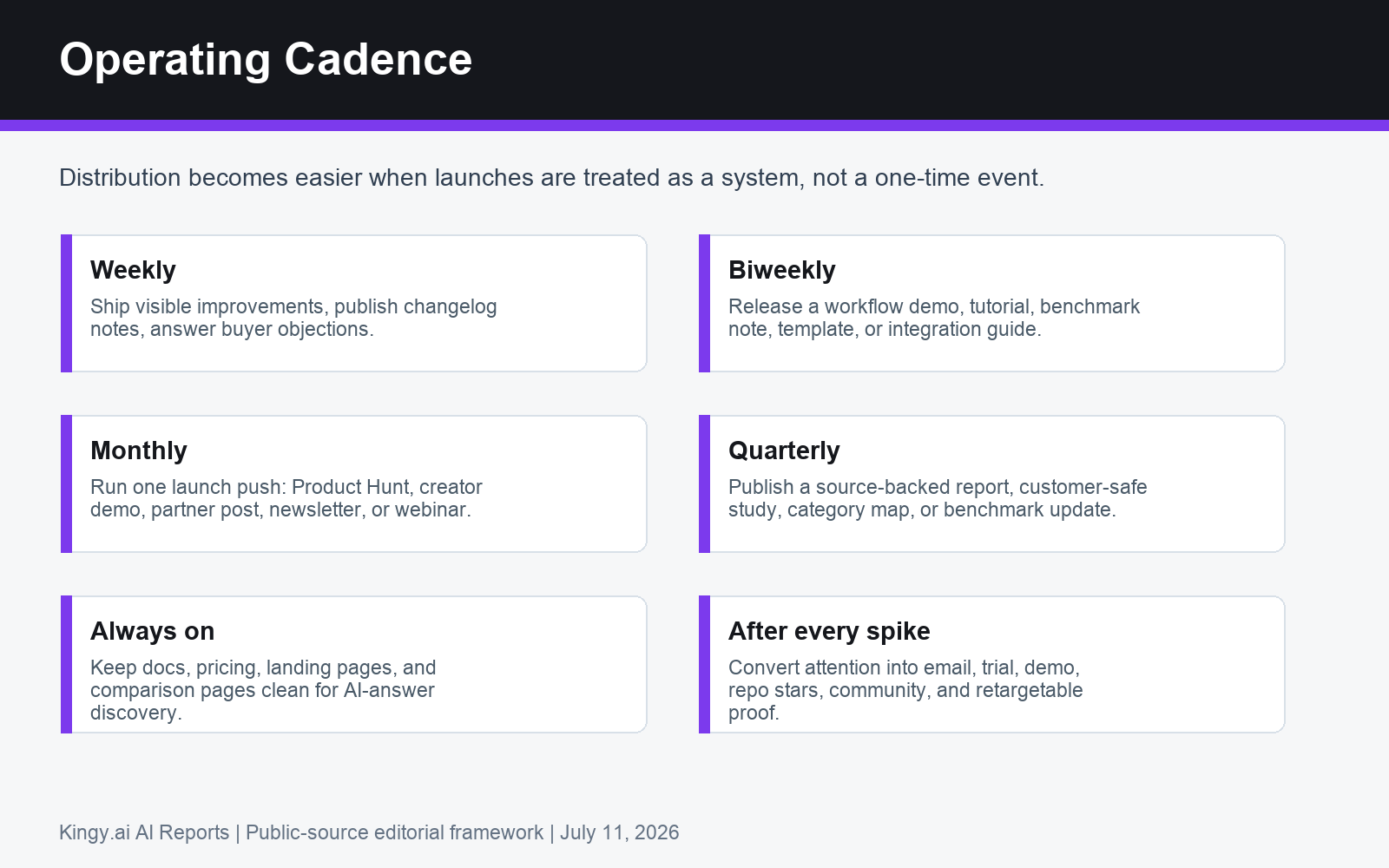
The best distribution teams treat content, launch, docs, and proof as one operating system.
| Cadence | What to ship | Why it matters |
|---|---|---|
| Weekly | Changelog, short demo, buyer objection answer, docs update. | Shows active momentum and feeds search/answer surfaces. |
| Biweekly | Tutorial, workflow video, integration guide, template, benchmark note. | Turns product capability into reusable proof. |
| Monthly | Launch push, creator collaboration, webinar, newsletter, Product Hunt-style campaign. | Creates focused attention without relying on random virality. |
| Quarterly | Category report, benchmark update, customer-safe study, comparison refresh. | Builds authority and link-worthy assets. |
| Always on | Pricing clarity, docs hygiene, security posture, source links, internal linking. | Keeps discovery and trust surfaces clean. |
For AI companies, the immediate next steps are practical: publish source-backed updates through Submit an AI Launch, review Editorial Sponsorship Standards, use For AI companies to understand fit, and route sponsorship conversations through Sponsor Kingy AI. For ongoing category research, browse AI Tools, AI Category Maps, AI News, and Clients.
Methodology
This report combines public-source research with Kingy.ai editorial scoring. The channel scores are based on:
- Public discoverability: how likely the channel is to expose a startup to relevant users or buyers.
- Trust creation: how well the channel supports verification, inspection, reputation, or technical proof.
- Conversion path: how naturally the channel can lead to signup, demo, install, API use, trial, marketplace action, or sales conversation.
- AI-category fit: whether the channel fits AI products specifically, including model, agent, creative, developer, enterprise, and consumer use cases.
- Risk: whether the channel can create misleading vanity metrics or unsupported hype.
The scores are not private traffic data, revenue estimates, conversion benchmarks, or sponsored-spend claims. They are a structured editorial framework for founders deciding where to focus.
FAQ
What is AI startup distribution?
AI startup distribution is the repeatable system a startup uses to get discovered, trusted, tried, adopted, and shared by the right users or buyers. It includes launch platforms, search, AI-answer visibility, developer ecosystems, creators, marketplaces, communities, partnerships, and proof assets.
What is the best distribution channel for AI startups?
There is no universal best channel. Developer tools often need GitHub, docs, Hugging Face, SDK examples, benchmarks, and technical proof. Visual tools often need creator demos. Enterprise tools need trust, security, ROI, integrations, and buyer education. Consumer AI apps need habit, shareability, and retention.
Should an AI startup launch on Product Hunt?
Yes, if the startup has clear positioning, demo assets, a launch audience, conversion path, and follow-up plan. No, if Product Hunt is being used as a substitute for product clarity, onboarding, retention, or trust.
How should startups prepare for AI-answer discovery?
Publish clear, source-backed, structured public material: homepage, docs, pricing, use cases, comparisons, changelogs, security notes, model cards where relevant, and updated source links. Answer engines need credible public context to recommend a product.
Are creator sponsorships good for AI distribution?
They can be strong when the product has a visible workflow, honest claims, good activation path, and audience fit. They are weak when the startup buys impressions for a product people cannot understand or keep using.
Source List
- Product Hunt Launch Guide
- Product Hunt before-launch guide
- Hugging Face Hub documentation
- Hugging Face Spaces
- Hugging Face state of open source Spring 2026
- GitHub Octoverse 2025
- GitHub Octoverse article
- Stack Overflow Developer Survey 2025
- Stack Overflow AI survey section
- a16z Top 100 Gen AI Consumer Apps, 6th edition
- a16z State of Consumer AI 2025
- G2 2025 Buyer Behavior Report
- G2 AI chatbot buyer research
- Y Combinator Requests for Startups
- Y Combinator Startup Directory
- CB Insights AI 100 2026
- CB Insights AI 100 tracker
- OpenAI GPTs
- Zapier App Directory
- AWS Marketplace AI Agents and Tools
Downloadable Report Assets
- Download the visual PDF packet: ai-startup-distribution-report-visual-report.pdf
The Kingy Brief
Get The Kingy Brief.
AI changes, original tests and one practical thing to try. Fridays at 09:00 Vancouver time.
Free · Double opt-in · Unsubscribe anytime
Sign up for The Kingy Brief on Beehiiv.
Signup help and newsletter schedule
Signup form provided by Beehiiv. After submitting, check your inbox for "Confirm your subscription to The Kingy Brief" and open its confirmation link. Check Spam or Promotions if you cannot find it.
Fridays at 09:00 Vancouver time: source-checked AI changes, original tests and one practical thing to try. The weekly restart begins October 9, 2026. We skip a week when there is not enough verified material. Free. Unsubscribe anytime.