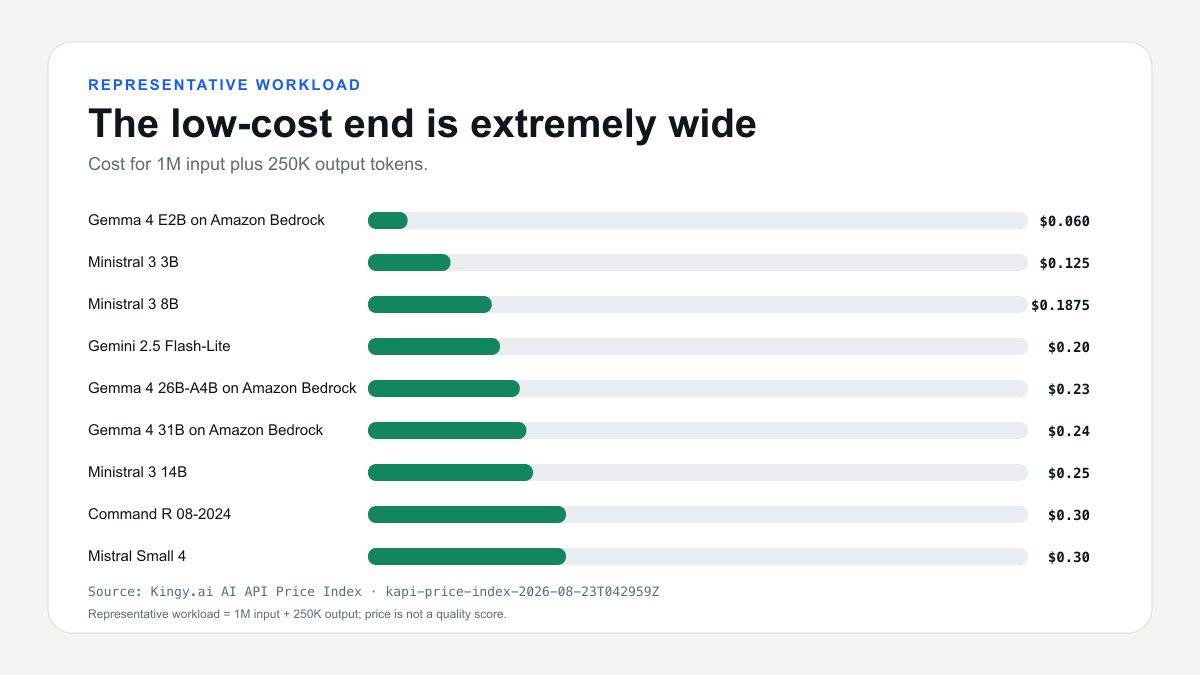
The cheapest accepted row in the first Kingy.ai AI API Price Index costs six cents for a representative token workload. That does not make it the best model. It does show how wide the API market has become.
The workload here is one million input tokens plus 250,000 output tokens. Prices come from exact official API identities in release kapi-price-index-2026-08-23T042959Z.
| Rank | Exact offering | Access route | Workload cost |
|---|---|---|---|
| 1 | Gemma 4 E2B on Amazon Bedrock | managed cloud | $0.06 |
| 2 | Ministral 3 3B | first-party Mistral | $0.125 |
| 3 | Ministral 3 8B | first-party Mistral | $0.1875 |
| 4 | Gemini 2.5 Flash-Lite | first-party Google | $0.20 |
| 5 | Gemma 4 26B-A4B on Amazon Bedrock | managed cloud | $0.23 |
| 6 | Gemma 4 31B on Amazon Bedrock | managed cloud | $0.24 |
| 7 | Ministral 3 14B | first-party Mistral | $0.25 |
| 8 | Command R 08-2024 | first-party Cohere | $0.30 |
| 9 | Mistral Small 4 | first-party Mistral | $0.30 |
| 10 | NVIDIA Nemotron 3 Super 120B on Amazon Bedrock | managed cloud | $0.3125 |
Why the route column matters
Four of the ten cheapest accepted offerings use Amazon Bedrock. They are not interchangeable with a first-party model that shares a family name. The seller, endpoint, region, model ID and billing route are part of the product you are buying.
If your organization already standardizes on AWS, that route may reduce operational work. If not, account setup, permissions, quotas and regional constraints can outweigh a small token-price difference.
Cheap models fit narrow jobs first
Low-cost models are strongest candidates for high-volume, well-specified work: classification, routing, extraction, rewriting, metadata and constrained retrieval steps. They should earn their place with an evaluation set.
Do not route a complex agent or high-stakes decision to the top row merely because its token bill is tiny. Measure task success, retries, tool failures and human correction. The real unit is cost per successful task.
Cache can reorder the list
Several accepted first-party models document read-cache prices 90% below standard input. A repetitive prompt architecture may therefore favor a model whose uncached row is not the cheapest. Cache eligibility, writes and retention vary, so the calculator input must match the actual request pattern.
Output length can reorder it again
The representative workload includes one output token for every four input tokens. Extraction workloads may emit much less. Generative agents may emit more. Because output is often the expensive component, your own ratio can change the ranking.
Download the canonical CSV and replace the workload formula with your observed mix. Or use the interactive comparison to inspect exact IDs, endpoints, tiers and sources.
The useful shortlist is not “ten cheap models.” It is “the cheapest exact offerings that pass my task, route and operational constraints.”
The Kingy Brief
Get The Kingy Brief.
AI changes, original tests and one practical thing to try. Fridays at 09:00 Vancouver time.
Free · Double opt-in · Unsubscribe anytime
Signup help and newsletter schedule
Signup form provided by Beehiiv. After submitting, check your inbox for "Confirm your subscription to The Kingy Brief" and open its confirmation link. Check Spam or Promotions if you cannot find it.
Fridays at 09:00 Vancouver time: source-checked AI changes, original tests and one practical thing to try. The weekly restart begins October 9, 2026. We skip a week when there is not enough verified material. Free. Unsubscribe anytime.