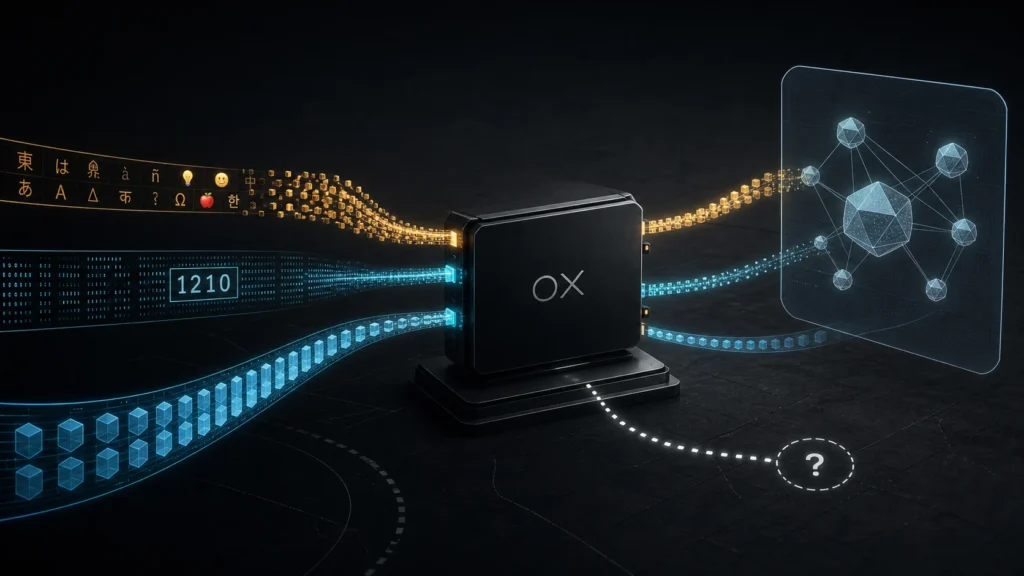
OpenRouter’s free mystery model looks increasingly like a member of Z.ai’s GLM-5 family. The tokenizer and API fingerprints are meaningful. The more specific claim that it is an upcoming model officially named “GLM-5.3 Flash” remains unconfirmed.
Reporting status — August 21, 2026
Source review cutoff: August 21, 2026, 11:22 a.m. PDT
Current identity: Unconfirmed; OpenRouter still labels the developer an anonymous third party
Kingy.ai assessment: High confidence that Ox Alpha is GLM-5.x-family or GLM-derived; moderate-to-high confidence that it is closely related to GLM-5.3; low confidence in the exact “GLM-5.3 Flash” name
Evidence class: Public-source analysis; no Kingy.ai hands-on model testing
What could change this: An OpenRouter card update, a Z.ai statement, provider metadata, released model files, or a reproducible independent fingerprint package
Direct answer: is Ox Alpha GLM-5.3 Flash?
Probably not enough is known to call it that—not yet.
The strongest public evidence points toward the GLM-5 model family. Multiple community testers report that Ox Alpha uses GLM-like tokenization, including fixed-offset token counts across unusual multilingual and Unicode strings. More importantly, testers say invalid reasoning settings trigger the same 1210 error and the same low/high/max reasoning contract that Z.ai officially documents for GLM-5.3.
That is a stronger case than “the answers feel similar.” It is still not proof of the exact model.
Z.ai says GLM-5.3 uses the same base model as GLM-5.2, with its gains coming from post-training. A shared tokenizer therefore cannot distinguish GLM-5.2, GLM-5.3 and an unreleased derivative by itself. Ox Alpha also accepts image and video input, while Z.ai’s public GLM-5.3 announcement does not present it as the company’s native multimodal model; Z.ai separately documents GLM-5V-Turbo for that role. And, as of the source cutoff, Z.ai’s official model and pricing pages contain no model called GLM-5.3 Flash.
The defensible verdict is narrower: Ox Alpha is likely a GLM-5.x-family model and plausibly an unreleased multimodal or efficiency-focused derivative of GLM-5.3. “GLM-5.3 Flash” is a credible rumor, not an established product identity.
What is confirmed—and what is not
What is established
- OpenRouter lists Ox Alpha as
stealth/ox-alpha, released August 20, 2026. - It is free on the listing, with a 1,048,576-token context window and up to 131,072 completion tokens.
- It accepts text, images and video, returns text, and supports tool calling and JSON output without JSON-schema enforcement.
- OpenRouter says it only routes requests. The model is developed and operated by an anonymous third-party provider.
- Z.ai released GLM-5.3 on August 14 for coding and long-horizon agent work.
- Z.ai documents three GLM-5.3 reasoning levels—low, high and max—and says thinking cannot be disabled.
- Z.ai’s current pricing page lists GLM-5.3 at $1.40 per million input tokens and $4.40 per million output tokens.
- OpenRouter’s Pony Alpha archive now says that earlier stealth model was an early testing version of GLM-5.
What is not established
- The identity of Ox Alpha’s developer.
- Whether Ox Alpha is a public GLM-5.3 checkpoint, a GLM-5.3 derivative, a GLM vision model, or a later GLM checkpoint.
- Whether “Flash” is its intended launch name.
- Its parameter count, active parameter count, training recipe, license, eventual price or release date.
- Whether eye-catching community benchmark results will survive controlled reproduction.
Ox Alpha versus the public GLM-5.3 record
| Property | Ox Alpha | Public GLM-5.3 | Rumored “GLM-5.3 Flash” |
|---|---|---|---|
| Identity | Anonymous stealth model | Official Z.ai model | Unconfirmed name |
| Developer | Undisclosed third party | Z.ai | Alleged to be Z.ai |
| First public date | August 20, 2026 | August 14, 2026 | Unknown |
| Context | 1,048,576 tokens | Z.ai reports 1M-context evaluations | Unknown; alleged match |
| Maximum output | 131,072 tokens | Up to 128K in published evaluation settings | Unknown |
| Native inputs | Text, image, video | Launch materials focus on text coding and agent work; no native image/video claim | Alleged multimodal variant |
| Reasoning controls | Community reports low/high/max and no disabled mode | Low/high/max; thinking cannot be disabled | Alleged match |
| Access | Free preview through OpenRouter and other gateways | GLM Coding Plan and ZCode; Z.ai now lists API pricing; weights remained scheduled at the cutoff | Unknown |
| Price | Free on the current card | $1.40/M input and $4.40/M output on Z.ai’s current pricing page | Unknown |
| Evidence status | Platform-confirmed specifications; identity unknown | Official product | Rumor |
The shapes are similar enough to investigate, but specifications are not fingerprints on their own. A 1M context window, long output and coding focus are increasingly common among frontier agent models.
The evidence case, weighted
| Clue | Observation | Source class | What it supports | What it does not prove | Weight |
|---|---|---|---|---|---|
| Tokenizer counts | Testers report exact GLM-family counts across unusual strings, sometimes with a constant 75-token offset | Community black-box testing | Shared tokenizer or close GLM lineage | Exact checkpoint, size or product name | Strong for family; weak for version |
| Reasoning error | Ox reportedly returns GLM-5.3’s 1210 error when thinking is disabled or an invalid effort is sent |
Community API observation checked against official Z.ai behavior | Closely matching API/backend contract | That the underlying weights are identical | Strong |
| Reasoning levels | Low, high and max; no disabled mode | Official for GLM-5.3; community-reported for Ox | GLM-5.3-era behavior | Ownership on its own | Moderate |
| 1M/128K shape | Both support approximately 1M context and very long output | Platform and vendor records | Product-family compatibility | Identity; several rivals have similar limits | Weak-to-moderate |
| Multimodal inputs | Ox accepts images and video; Z.ai already operates a multimodal coding line | Official platform/vendor records | Possible unreleased GLM multimodal derivative | “Flash” rather than V, Turbo, Air or another name | Moderate |
| Pony Alpha precedent | An earlier OpenRouter Alpha became GLM-5 | Official OpenRouter archive | Z.ai has used this testing pattern before | That Z.ai owns Ox Alpha | Weak-to-moderate |
| Output style/self-ID | Similar formatting, wording or GLM self-identification | Anecdotal model outputs | A lead for further testing | Model identity | Weak |
| Claimed coding wins | Small community runs report strong results | Unreviewed third-party testing | Ox Alpha deserves serious evaluation | General superiority or model origin | Weak for identity |
The tokenizer clue is real—but narrower than it sounds
The clearest public fingerprint comes from user-run token-count comparisons. In one documented six-prompt test, English, German, Chinese, code and emoji inputs reportedly produced the same counts as GLM-5.3 plus a fixed 75-token offset. The tester interpreted the offset as an Ox-specific hidden system wrapper. Counts reportedly matched through both OpenRouter and OpenCode while Kimi, Qwen, MiMo and MiniMax comparisons diverged.
Other users posted larger comparisons. One OpenCode discussion includes examples in which emoji, Korean text, full-width Latin characters, mathematics and Cyrillic text matched the GLM tokenizer while MiMo differed. A LocalLLaMA thread reports a 60-string comparison pointing in the same direction.
The convergence matters. Different tokenizers split unusual characters differently, so varied multilingual strings make a better fingerprint than ordinary English words.
But the conclusion stops at lineage. Z.ai explicitly says GLM-5.3 uses the same base model as GLM-5.2. A tokenizer match cannot tell us which post-training run is behind an endpoint. It also cannot distinguish an official Z.ai derivative from a third party using released GLM-family components—although the unreleased status of GLM-5.3’s weights at the time of testing makes that second route less straightforward.
Error 1210 is the strongest version-specific clue
The more discriminating evidence is the API contract.
Z.ai’s GLM-5.3 launch documentation says the model always thinks, accepts only low, high and max reasoning effort, and rejects requests that attempt to disable thinking. Community testers report that Ox Alpha behaves the same way and returns a Z.ai-style error:
[1210] This model always engages in thinking and cannot be disabled; please use low, high, or max
An exact error code, wording and parameter contract are harder to dismiss than similar prose. They suggest either a shared Z.ai backend, a closely related implementation, or a compatibility layer deliberately reproducing it.
That last possibility keeps the claim below certainty. Gateways can normalize parameters and errors. The public tests are first-person community reports, not an independently archived network trace with code, raw responses and timestamps. The finding deserves a high evidentiary weight, but it still does not reveal the launch label.
The multimodal difference is both a clue and a problem
Ox Alpha natively accepts images and video. Z.ai’s GLM-5.3 announcement focuses on coding, long-horizon agents and cyber capability; it does not announce GLM-5.3 as the company’s native multimodal coding product. Z.ai separately describes GLM-5V-Turbo as a model for image, video, text and file input.
That creates two reasonable readings.
The pro-GLM reading is that Ox Alpha is exactly what a stealth preview should be: a GLM-5.3-era backbone joined to Z.ai’s multimodal stack before a public launch. The skeptical reading is that calling it “GLM-5.3” is too specific when the public model lacks the defining modality shown by Ox.
Either way, the difference makes the Flash suffix even less secure. Z.ai has used Flash, FlashX, Air, AirX, Turbo and V names elsewhere. Its current pricing page lists GLM-4.7-Flash, GLM-4.5-Flash and GLM-4.6V-Flash, but no GLM-5.3 Flash. Naming precedent makes the rumor plausible; it does not make the name real.
What about MiMo, Hy4 or another lab?
Xiaomi’s MiMo family was an early candidate because Xiaomi has tested stealth models before, offers a 1M-context coding model, and operates multimodal systems. Hy4, MiniMax and a larger unreleased GLM checkpoint have also been proposed.
Those alternatives should not be erased merely because the GLM theory is popular. The endpoint is anonymous, and black-box identification is probabilistic. Still, the reported tokenizer mismatches and the GLM-specific reasoning error give the Z.ai hypothesis more direct technical support than the alternatives currently have.
The original Synthwave rumor asserts that Ox Alpha is the upcoming GLM-5.3 Flash while discussing another anonymous Arena model, Kerrine, as a likely Kimi successor. Prior success spotting a stealth model can make a source worth listening to. It cannot substitute for evidence on a new claim.
Strong coding results do not identify the model
Ox Alpha appears capable enough to have triggered immediate benchmark hunting. A widely shared DeepSWE comparison was only a ten-task sample. Another tester later reported 48 of 50 resolved tasks on SWE-bench Verified Mini using a mini-swe-agent scaffold—and then explicitly warned that the result looked too good to trust as a frontier comparison.
The caveats are material: the mini set covers only Django and Sphinx, its issues are old enough to raise contamination concerns, the run used an anonymous free endpoint, and most cited rival scores came from the full 500-task set or different scaffolds. The tester offered to share trajectories and reports, but the public post is not a completed independent reproduction.
The proper conclusion is that Ox Alpha merits controlled testing. It is not that the model has already beaten Claude, GPT or GLM-5.3. Intelligence scores would not reveal ownership anyway: distillation, shared training data, different agent scaffolds and task selection can all create misleading resemblance.
Free does not mean private
OpenRouter’s product card says Ox Alpha’s provider retains prompts and completions but does not use them for training. That is not zero retention.
There is also a policy mismatch readers should see. The linked Stealth Program EULA, updated July 6, says Stealth Model content may be collected, shared with providers and licensed for model training and improvement. The supplemental-terms page displays no Ox-specific exception. The product card’s specific no-training statement may be intended to narrow the general program terms, but the public documents do not explain the relationship clearly.
Kingy.ai is not offering a legal interpretation. The practical advice is simpler: assume an anonymous provider can receive and retain what you send. Do not submit private repositories, credentials, personal information, client data, unreleased products or regulated material. Free access is useful for disposable tests, not a reason to relax data discipline.
What would settle the identity?
Any one of these could materially change the assessment:
- OpenRouter replaces the stealth label with a named provider and model.
- Z.ai claims Ox Alpha or publishes a GLM-5.3 Flash model card.
- Provider or API metadata exposes an authenticated model identifier.
- Released weights, tokenizer files and configuration reproduce Ox Alpha’s behavior.
- Independent testers publish scripts, raw request/response logs, hashes and comparisons that distinguish GLM-5.2, GLM-5.3, GLM-5V-Turbo and other candidates.
- A technical report explains the multimodal stack and launch naming.
Until then, “GLM-family” is a stronger conclusion than “GLM-5.3 Flash.”
Bottom line
Ox Alpha probably comes from the GLM branch of the model family tree. The tokenizer evidence points there. The GLM-5.3 reasoning contract points there more sharply. Z.ai’s prior Pony Alpha test provides relevant precedent.
But the last step in the rumor is doing too much work. No official source has named the developer. No Z.ai page lists GLM-5.3 Flash. Tokenizers are shared, errors can be wrapped, and Ox Alpha’s multimodal inputs distinguish it from the public GLM-5.3 story as much as they connect it to Z.ai’s broader stack.
Kingy.ai verdict: likely GLM-5.x; plausibly GLM-5.3-derived; not yet defensible as confirmed “GLM-5.3 Flash.”
FAQ
Who made Ox Alpha?
The developer remains anonymous. OpenRouter says it routes requests to a third-party provider and is not the model’s developer, owner or provider.
Is Ox Alpha GLM-5.3?
It may be closely related. Tokenizer and API fingerprints strongly support GLM-family lineage, but public evidence does not prove it is the same checkpoint as the released GLM-5.3.
Has GLM-5.3 Flash been officially announced?
No official Z.ai model page or announcement for GLM-5.3 Flash was found by the August 21, 2026 source cutoff.
Is Ox Alpha free?
Yes on OpenRouter’s current listing. Stealth previews are time-limited and can be changed or removed without notice.
Is Ox Alpha safe for private code?
Do not treat it as a private-code endpoint. The anonymous provider retains prompts and completions, and OpenRouter’s product copy and general Stealth Program EULA leave a policy ambiguity around training rights.
How strong is the identification evidence?
Strong for the GLM family, moderately strong for a GLM-5.3-era derivative, and weak for the exact Flash name.
What other identities have been proposed?
Community theories have included Xiaomi MiMo, Hy4, MiniMax, GLM-5.3V, GLM-5.3 Air and a later GLM checkpoint. None has been officially confirmed.
Editorial methodology and limitations
This article was researched on August 21, 2026. Kingy.ai prioritized current OpenRouter and Z.ai pages, then examined first-person community fingerprinting and benchmark reports. Platform specifications are labeled as platform claims; Z.ai performance figures are vendor claims; community tests are not presented as Kingy.ai observations.
Kingy.ai did not run Ox Alpha, spend money on API access, inspect private telemetry or contact OpenRouter, Z.ai or the community testers during this reporting pass. No model self-identification was treated as authoritative. The central limitation is the absence of a named provider, released model files and a reproducible third-party forensic package.
The article should be rechecked when the stealth preview ends or whenever OpenRouter, Z.ai or another lab claims the model.
Selected sources
Official and platform records
- OpenRouter: Ox Alpha model listing
- OpenRouter: Stealth Program EULA
- OpenRouter: Stealth Program supplemental terms
- OpenRouter: Pony Alpha archive
- Z.ai: GLM-5.3 launch
- Z.ai: GLM-5V-Turbo documentation
- Z.ai: current model pricing and names
Original rumor and community technical evidence
- Synthwave: Ox Alpha / GLM-5.3 Flash claim
- Six-prompt tokenizer, error and output comparison
- GLM/MiMo token-count and API-contract discussion
- Wider candidate and tokenizer discussion
- SWE-bench Verified Mini community run