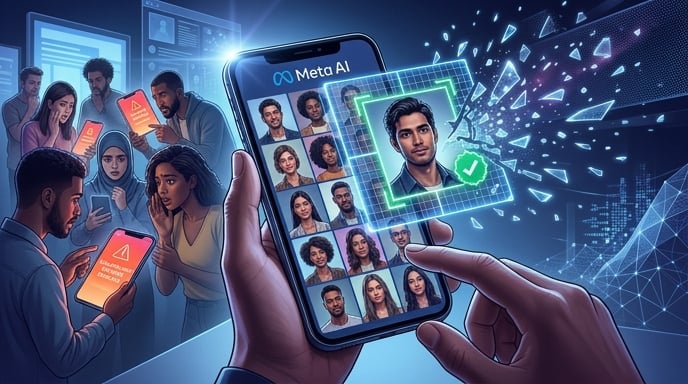
Meta entered July with an ambitious plan for AI-generated media. It introduced a new image model, offered users a clever way to create pictures involving Instagram accounts, and previewed a tool designed to identify content made by its own artificial intelligence.
On paper, the pieces fit together nicely.
Meta would make AI images easier to create. It would embed invisible watermarks into those images. Then it would provide a detector capable of finding those watermarks later.
Generate, label, detect. Simple.
Reality proved considerably messier.
Within days, Meta withdrew one of the most controversial features connected to its new image generator after users, privacy advocates and performers raised alarms over consent. At almost the same time, testing indicated that the company’s new AI-detection tool could lose track of Meta-generated images after something as ordinary as cropping.
The result was an awkward double launch. Meta faced questions about whether people had enough control over how their public images were used, while also confronting doubts about whether its technical safeguards could reliably follow AI content after it left the generator.
Welcome to the modern AI product cycle: launch boldly, receive several thousand angry posts, and discover that the watermark dislikes scissors.
Meta Introduces Muse Image
At the center of the story is Muse Image, the first image generator released by Meta’s Superintelligence Labs.
Meta positioned the model as a creative companion that could transform written ideas into polished visuals. Users could generate images, download them and share them through feeds, stories or private conversations.
The model also represented a broader upgrade to Meta’s generative-media strategy. Instead of treating AI images as an isolated novelty, the company aimed to connect image creation more deeply with the social information already available across its platforms.
That connection soon caused trouble.
One feature allowed people to reference public Instagram accounts when generating images. A user could mention an account, and Meta AI could use content associated with that public profile as a visual reference.
For creators, marketers and friends experimenting with harmless memes, the feature may have sounded entertaining. However, it also opened the door to creating synthetic representations of people who had never actively agreed to participate.
According to Gizmodo, Meta launched the feature on July 7, 2026. By the end of that week, the company had already pulled it.
That is not a product cycle. That is a long weekend.
A Public Profile Is Not a Permission Slip
The backlash centered on a basic question: Does posting a public photograph mean someone has consented to having that photograph used as a reference for AI-generated content?
Meta’s initial implementation leaned heavily on the distinction between public and private accounts. Content from a public Instagram profile was already viewable by anyone. Therefore, the company appeared to treat that material as suitable for its image-reference feature unless the account holder changed the relevant control.
Critics viewed the matter differently.
A public photograph is normally posted for people to view, share or discuss within a social-media environment. Using that image to produce a synthetic scene, altered appearance or digital replica changes the nature of the interaction.
The person in the photograph may not know that the generated image exists. They may never see it. They may also have little control over the surrounding context.
A commentary published by DEV Community argued that default participation can weaken meaningful user control. It noted that people may share content with human audiences without expecting it to become an input for AI systems or synthetic-media tools.
That distinction matters. “Publicly visible” and “available for every imaginable technological reuse” are not automatically the same thing.
Opt-Out Controls Meet the Consent Problem
Meta reportedly provided controls that allowed users to prevent their public content from being referenced by the feature. The problem was that users had to find and activate those controls.
That is an opt-out approach.
Under an opt-out system, participation begins automatically. Anyone who objects must locate the setting, understand what it does and switch it off.
An opt-in system reverses the arrangement. Nothing happens until the account holder actively grants permission.
The difference sounds small when written in a settings menu. In practice, it can affect millions of people.
Many users never inspect newly added privacy options. Others may not understand how a vaguely worded setting connects to AI image generation. Some will not hear about the feature until someone creates an unwanted picture involving their likeness.
The DEV Community analysis argued that opt-out mechanisms place the burden on individuals, particularly when controls are difficult to discover or interpret. It also warned that even a modest percentage of unaware users can represent an enormous volume of content on a platform operating at Instagram’s scale.
Consent buried in a menu is technically a control. Whether it feels like genuine permission is another question entirely.
The public response gave Meta a fairly clear answer.
Performers Raise the Alarm
SAG-AFTRA, the union representing performers and media professionals, strongly criticized the feature.
Actors, voice artists and other performers have particular reasons to worry about synthetic media. Their faces, voices and movements form part of their professional value. AI tools can imitate those traits, sometimes convincingly, without requiring the original performer to appear on camera or enter a studio.
The union argued that anything short of a clear opt-in process was unacceptable for tools involving people’s images.
Its concern extended beyond celebrity accounts. The same underlying technology can affect influencers, photographers, small creators and ordinary users. A person does not need a Hollywood contract to object to an AI-generated replica.
Synthetic images can place someone in a setting they never visited, wearing something they never wore or appearing to endorse something they have never used. Most results may be harmless jokes. Some will not be.
The feature therefore collided with a lesson that the AI industry keeps relearning: the ability to generate a person’s likeness does not settle whether doing so is appropriate.
Gizmodo reported that SAG-AFTRA welcomed Meta’s decision to discontinue the feature and described the withdrawal as the responsible action.
Meta had built an impressively powerful creative shortcut. Unfortunately, the shortcut appeared to run directly across the lawn marked “consent.”
Meta Pulls the Feature After Three Days
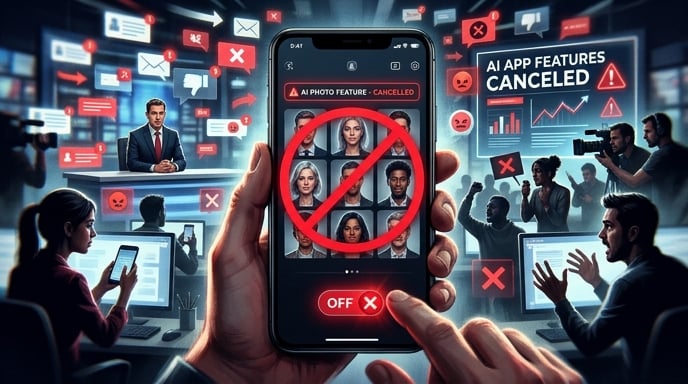
Meta responded quickly.
The company updated its announcement and acknowledged that the public-account referencing feature had failed to land as intended. Meta said it had wanted to provide a useful creative capability while giving users control over whether their public content could be referenced.
It then delivered the crucial sentence: the feature was no longer available.
The turnaround took only a little more than three days, according to Gizmodo’s timeline. Muse Image itself remained available, but the ability to generate images by mentioning public Instagram accounts disappeared.
The speed of the reversal suggests Meta recognized that minor interface changes would not calm the controversy. Adding another explanation screen or hiding the option behind an extra button would not resolve the central issue.
The dispute concerned the default.
Users and critics were not merely asking for better instructions. They were questioning why participation began without an explicit yes.
Meta deserves some credit for reacting instead of stubbornly defending the feature for several months while issuing increasingly philosophical blog posts about innovation. Still, the episode raises an obvious question: Why did such a predictable consent problem make it through internal review?
Generative AI can move quickly. Human expectations tend to move at normal human speed.
Product teams still have to account for both.
Meanwhile, Meta Launches an AI Detector
While the privacy controversy unfolded, Meta was also promoting a safeguard for its new generation tools.
The company previewed a web-based detector that could inspect an image and determine whether Muse Image had generated or edited it.
The detector did not rely solely on visual clues. Instead, it searched for an invisible watermark called Content Seal.
Meta embeds the Content Seal signal into images processed by Muse Image. Because the watermark is invisible, it avoids the cosmetic problem created by visible AI labels or logos. Users can share a clean image without a badge sitting in the corner.
Meta claimed that the watermark could survive common transformations, including compression, resizing, screenshots and cropping.
Early testing looked promising.
An Engadget reporter found that the detector correctly identified fully generated images, AI-edited pictures and screenshots of Meta AI creations.
The idea was sensible. Instead of asking a general-purpose classifier to guess whether an image “looked artificial,” Meta could search for a signal intentionally placed there during generation.
That works beautifully—provided the signal survives.
Cropping Gives Content Seal a Bad Day
A later analysis found that cropping could significantly weaken the detector.
As summarized by The Quint, Reuters tested original images produced with Meta’s model and cropped versions of those same files.
The detector reportedly identified all the unmodified originals. However, after the images were cropped to approximately one-third or one-half of their original dimensions, it failed to verify 55 percent of them.
That is a substantial drop.
Cropping is not an advanced attack requiring specialist software, hidden code or a shadowy figure wearing a hoodie in an aggressively dark room. It is one of the most basic editing actions available on a smartphone.
People crop images constantly. They remove blank space. They change a landscape photo into a square. They isolate a face. They prepare graphics for social platforms with different aspect ratios.
If an invisible watermark disappears when a large part of the image is removed, the detector may fail precisely when verification becomes most valuable. A deceptive user can alter the composition while preserving the central subject.
Meta acknowledged that its detector remained a preview and that the technology had limitations. The company said it planned to keep improving the system.
That qualification is important. The tool was not presented as a finished universal truth machine. Nevertheless, the cropping results expose a major weakness in the claim that the watermark can endure ordinary edits.
The Detector Only Knows Meta’s Newest Work
Content Seal also has a narrower job than the term “AI detector” might suggest.
The tool does not reliably determine whether any random online image was generated by artificial intelligence. It searches for Meta’s proprietary watermark in material created or edited using specific Meta AI systems.
A positive result can indicate that Meta AI processed the file.
A negative result cannot prove that the image is authentic. It may have been produced by another company’s model. It may come from an older Meta generator. It may have been altered enough to damage the watermark. Or it may simply lack a readable Content Seal signal.
Engadget found that the preview tool could not identify images created in older Meta AI conversations. It was also incompatible with other established provenance systems, including Google’s SynthID and C2PA Content Credentials.
The detector even imposed a daily limit after several checks during Engadget’s testing.
That combination makes it more of a product-specific verification utility than a general AI-image detective.
This distinction matters because users may interpret a negative result too confidently. “No Meta watermark found” does not mean “photograph confirmed as real.”
It only means the tool did not find the particular signal it expected.
That is useful information. It just is not the whole answer.
Watermarks Help, but They Are Not Magic Dust
Invisible watermarking remains one of the more practical approaches to synthetic-media provenance.
A company that controls the generator can insert a hidden signal directly into every output. Detection then becomes a search for known evidence rather than a speculative judgment based on pixels.
However, watermarking involves trade-offs.
The signal must be strong enough to survive normal editing. At the same time, it must remain invisible and avoid damaging image quality. If it occupies only limited portions of the picture, cropping may remove it. If it spreads across the entire file, compression or aggressive manipulation may weaken it.
Attackers can also experiment repeatedly. They can resize, crop, blur, compress, recolor or screenshot an image until the detector stops responding.
Meta’s experience shows why no single safeguard can carry the full burden of online authenticity.
Effective verification will likely require several layers: embedded watermarks, cryptographic content credentials, platform labels, metadata, forensic analysis and clear information about where a file first appeared.
Even then, certainty may remain elusive.
A detector can provide evidence. It cannot restore the lost context surrounding every copied, edited and reposted image on the internet.
That is the uncomfortable part. The industry is building image generators faster than it is building a shared system for proving where their outputs came from.
Privacy and Detection Are the Same Trust Problem
The withdrawn Instagram feature and the struggling watermark detector may appear to be separate stories.
One concerns consent. The other concerns technical reliability.
Together, however, they reveal the same underlying challenge: trust.
Users want to know that companies will not use their images in unexpected ways. They also want to know whether the content appearing in their feeds came from a camera, an editing tool or an AI model.
Meta attempted to address both sides.
Its generation feature included a user-control mechanism, but critics argued that the default exposed people before they had meaningfully agreed. Its detector included an invisible watermark, but testing showed that routine editing could make that watermark difficult to find.
In both cases, the safeguard existed.
In both cases, the safeguard proved weaker than the headline promise.
That does not make Muse Image useless. It does not mean Content Seal has no value. Nor does it prove that Meta cannot improve either its consent systems or its watermarking technology.
It does show that shipping a protection is not the same as solving a problem.
A privacy toggle does not guarantee informed consent. A watermark does not guarantee permanent traceability. A detector does not guarantee truth.
AI companies increasingly market safeguards alongside powerful new models. Users should judge those safeguards by how they behave under real-world pressure, not by how neatly they appear in an announcement.
Meta’s Bigger Lesson: Ask First, Verify Better

Meta’s turbulent week offers two fairly straightforward lessons.
First, tools that generate representations of real people should begin with explicit permission. Opt-in consent may reduce immediate usage, but it also reduces confusion, resentment and emergency feature withdrawals.
Second, provenance systems must survive ordinary behavior, not merely laboratory demonstrations. If cropping can erase a watermark, developers should disclose that weakness clearly and avoid presenting detection as definitive.
Meta can still turn Content Seal into a useful piece of a wider authenticity system. The company already describes the detector as an early preview, and early previews are supposed to reveal problems. Finding flaws now is better than discovering them during an election, emergency or viral misinformation campaign.
The privacy backlash may also influence how Meta designs future social AI features. The company now has fresh evidence that users distinguish between publicly sharing an image and volunteering that image for synthetic reuse.
That difference should not surprise anyone. Yet here we are.
The broader AI industry should pay attention. Generative tools will become more capable, more personal and more tightly connected to social platforms. That combination can produce delightful experiences. It can also create convincing replicas at enormous scale.
Innovation needs brakes, labels and steering.
Preferably before the car leaves the showroom.
Sources
- The Quint — Meta AI Image Detector Struggles to Identify Its Own AI-Cropped Images: Analysis
- Gizmodo — The Public Got So Mad at Meta’s New AI Photo Tool That It’s Scrapped Already
- Engadget — Meta Built an AI Detection Tool to ID Images and Video Created With Its New Models
- DEV Community — Meta’s AI Image Generator: Default Opt-In Raises Data Privacy Concerns for Instagram Users
The Kingy Brief
Get The Kingy Brief.
AI changes, original tests and one practical thing to try. Fridays at 09:00 Vancouver time.
Free · Double opt-in · Unsubscribe anytime
Sign up for The Kingy Brief on Beehiiv.
Signup help and newsletter schedule
Signup form provided by Beehiiv. After submitting, check your inbox for "Confirm your subscription to The Kingy Brief" and open its confirmation link. Check Spam or Promotions if you cannot find it.
Fridays at 09:00 Vancouver time: source-checked AI changes, original tests and one practical thing to try. The weekly restart begins October 9, 2026. We skip a week when there is not enough verified material. Free. Unsubscribe anytime.