Last updated: 2026-07-11
Last verified: 2026-07-11
TL;DR: Meta’s official pages reviewed on October 10, 2026 still describe Muse Video as an early preview or in development. Its July 7 announcement says the model shares a pretraining base with Muse Image, supports native audio, and placed third in a first-party snapshot of the Text-to-Video Arena. Meta also names unfinished work on audio-video synchronization and physically accurate fast motion. The reviewed official pages do not list a public Muse Video launch date, API, price, or production specification. Muse Image launched in July; Muse Video remains a product signal to monitor rather than a tool to buy or build around.
The important distinction: Muse Image launched; Meta still describes Muse Video as a preview
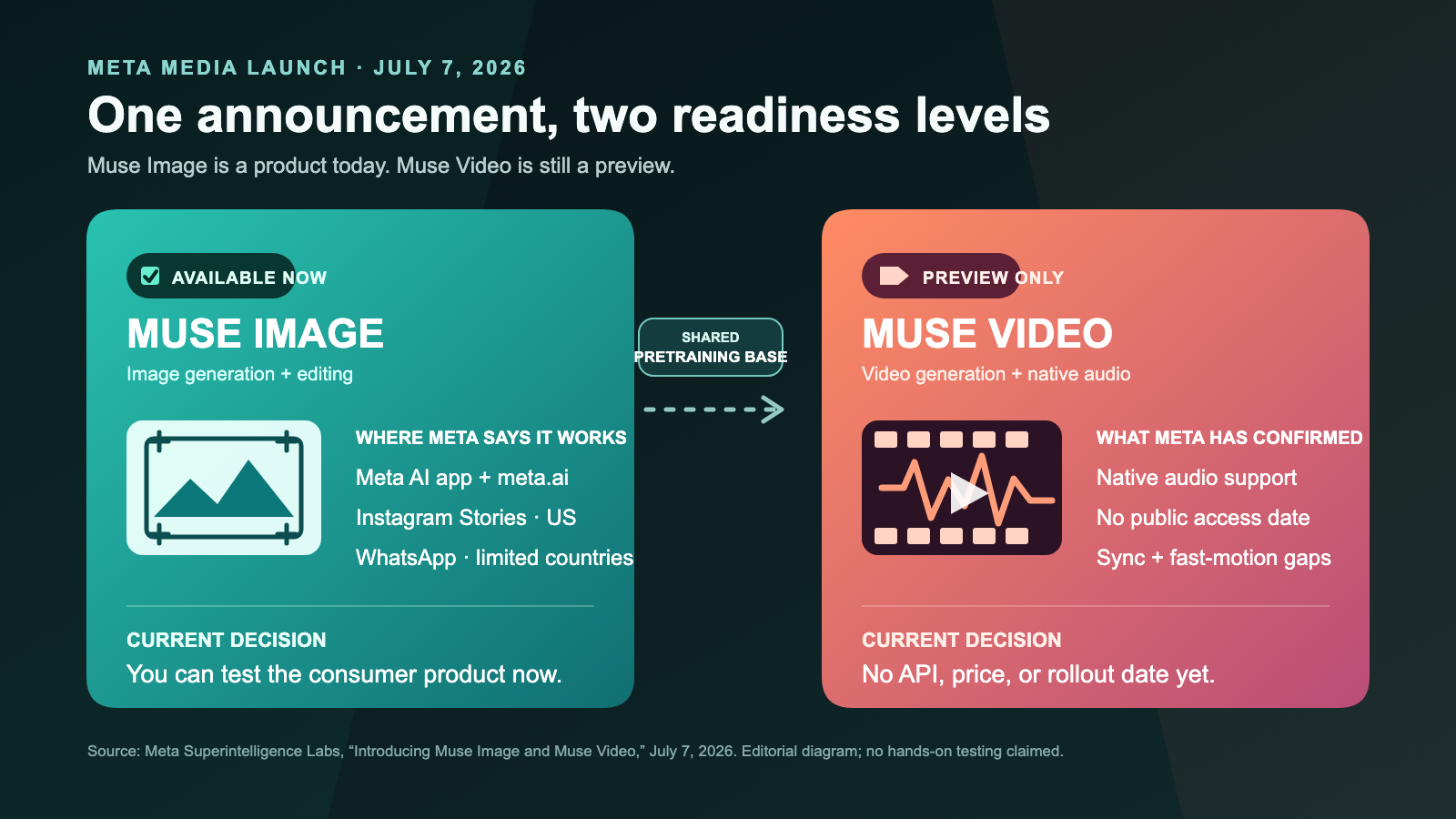
Meta announced the two models together in July, but their release states were different. Muse Image launched in the Meta AI app and on meta.ai, in Instagram Stories in the United States, and in WhatsApp in limited countries. The technical page, reviewed again on October 10, still describes Muse Video as an early preview “coming soon” to creators and Meta AI; Meta’s consumer page describes it as in development. Those reviewed pages do not list a Muse Video sign-up path, launch date, API, or commercial terms.
That boundary matters because a preview can reveal technical direction without creating a usable product. Kingy AI already has a separate analysis of the live Muse Image product, including its social distribution and editing features. This article focuses on the narrower question that remains: what does the Muse Video preview establish, and what is still unknown?
What Meta actually confirmed about Muse Video
Meta’s technical announcement makes five concrete points about Muse Video:
- It is an early preview. Meta’s technical page still uses that label, while its consumer page describes Muse Video as in development.
- It shares a pretraining base with Muse Image. Meta presents the models as related parts of its first media-generation family from Meta Superintelligence Labs.
- Native audio is part of the model’s positioning. The announcement says Muse Video supports native audio rather than treating sound as a separate afterthought.
- Meta claims competitive prompt adherence, visual fidelity, and temporal consistency. Those are vendor claims from a launch post, not results from independent Kingy AI testing.
- Important gaps remain. Meta specifically calls out audio-video synchronization and physically accurate fast motion as areas still receiving investment.
That is enough to understand the direction, but not enough to evaluate a production workflow. The reviewed official pages do not state supported durations, output resolutions, frame rates, aspect ratios, editing controls, reference-image behavior, export formats, safety settings, regional availability, or usage limits.
The Arena result is a signal, not a launch
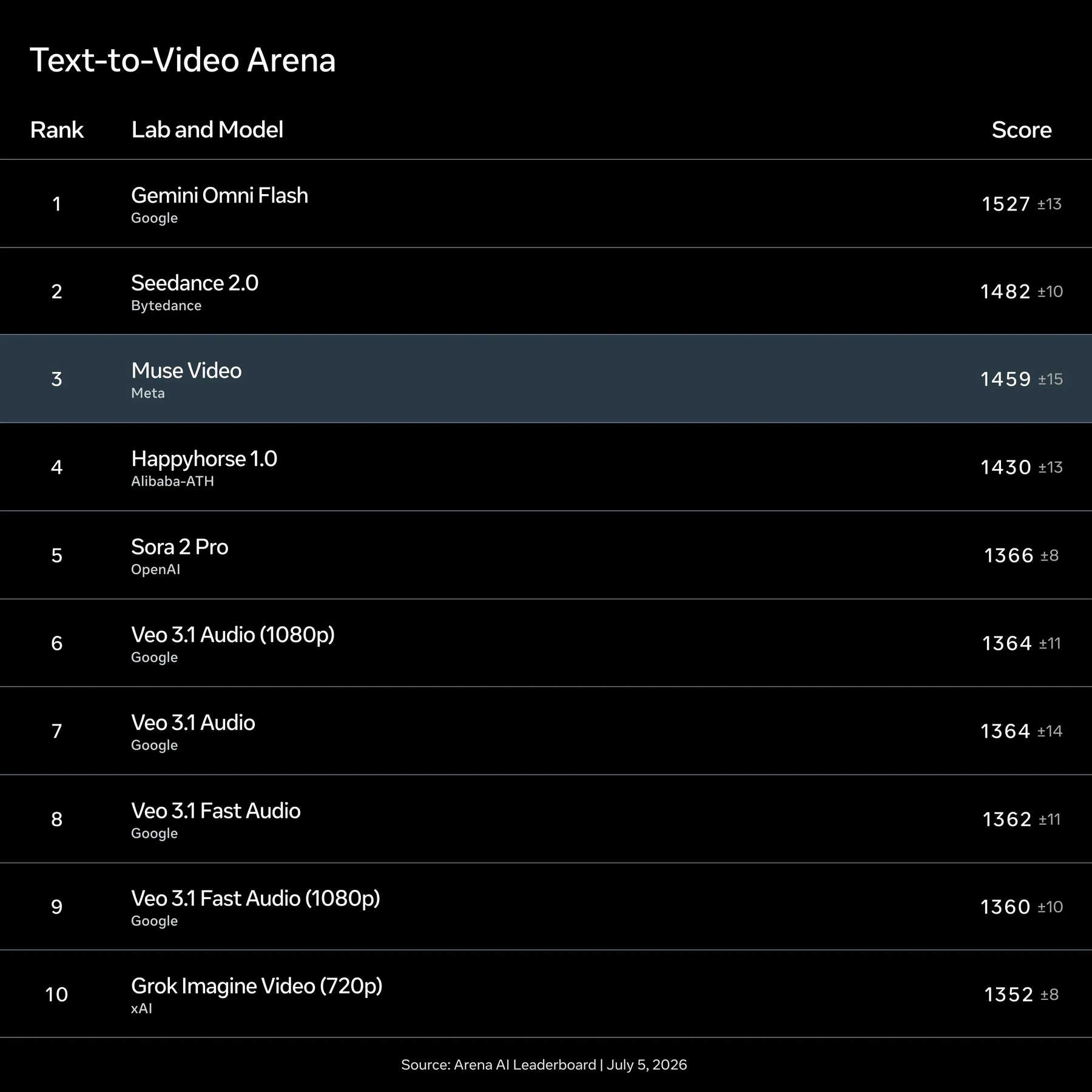
Meta says Muse Video ranked third in human-preference Elo on the Text-to-Video Arena as of July 5, 2026. The official chart places it behind Gemini Omni Flash and Seedance 2.0 in that snapshot. The ranking suggests that Meta had a competitive model to preview, but it does not answer whether the public product will preserve that quality, how long generations take, what controls users receive, or what the service will cost.
The date is also important. Leaderboards move, and this image captures one point in time. Treat the table as first-party launch evidence, not a permanent market ranking or an independent benchmark conducted by Kingy AI.
Why the shared pretraining base matters
A shared pretraining base gives Meta a coherent way to present image and video generation as one media family. Muse Image already handles generation, editing, multiple visual references, search, code-assisted visual tasks, and self-refinement. Muse Video extends the family into motion and audio. That relationship is strategically useful because Meta’s main consumer surfaces already move between static images, Stories, Reels, messages, and ads.
There is a limit to what can be inferred, however. “Shared pretraining base” does not prove that an image created in Muse Image can become a controllable first frame in Muse Video, that edits will carry across modalities, or that characters and products will stay consistent through a clip. Meta has not documented those workflows. They are reasonable evaluation questions for a future release, not features readers should assume today.
What the combined announcement says about Meta’s product direction
The useful part of pairing Muse Image with Muse Video is not simply that Meta has two generators. The July announcement shows a path from the launched image product toward a broader media layer inside Meta AI. In that rollout, Muse Image connected generation with places where people create and share. A video model in the same family could eventually serve creators and social formats without requiring a separate standalone app.
That last point is an inference from Meta’s stated product surfaces, not a confirmed release plan. The reviewed technical page says Muse Video is coming to creators and Meta AI. The reviewed official pages do not promise availability in Reels, Stories, WhatsApp, Advantage+ creative, or any particular developer product. Readers should wait for a named surface and an official access path before treating those possibilities as features.
Known facts versus open questions
| Area | What Meta states in the reviewed official pages | Not specified there |
|---|---|---|
| Release state | Early preview; coming soon to creators and Meta AI | Public date, countries, waitlist, and eligible plans |
| Media | Video generation with native audio support | Duration, resolution, frame rate, aspect ratios, and export formats |
| Quality evidence | Meta-reported No. 3 Arena position on July 5 | Public reliability, latency, consistency, and independent evaluations |
| Known gaps | Audio-video synchronization and physically accurate fast motion | How often those failures occur and what controls can correct them |
| Commercial access | The reviewed pages do not list a Muse Video offer | Price, quotas, subscriptions, API access, and usage rights |
Pricing and access
The reviewed official pages do not list a Muse Video price or commercial offer. Meta’s consumer announcement says everyday creation with Muse Image in Meta AI is free and that people who want to create more can receive additional use through Meta subscription plans where available. That wording applies to Muse Image; it should not be carried over to Muse Video.
The same caution applies to developer access. The July 7 media-model announcement does not introduce a public Muse Image API or Muse Video API. A creator-facing preview inside Meta AI would not automatically provide the controls, terms, throughput, or data handling required for a production integration.
A practical evaluation plan for the eventual release
If Meta opens broader access, creators and teams can evaluate Muse Video with a small, repeatable set of scenes rather than relying on a highlight reel:
- Prompt adherence: use prompts with explicit subject, camera movement, environment, and action constraints, then record which details survive.
- Temporal consistency: watch faces, hands, clothing, product geometry, lighting, and backgrounds across the full clip rather than judging a single frame.
- Audio synchronization: test speech, impacts, footsteps, and environmental sound, especially because Meta identifies synchronization as unfinished work.
- Fast motion: include running, thrown objects, quick camera pans, and collisions to probe the physical-accuracy gap Meta names.
- Revision control: check whether a user can preserve a good shot while changing only the failed action, sound, or region.
- Rights and provenance: confirm output terms, reference-media permissions, disclosure tools, and whether Meta extends Content Seal to released video as planned.
This is an evaluation framework, not a claim that Kingy AI has accessed Muse Video. No hands-on testing is possible from the public announcement alone.
Who should pay attention now?
Creators should watch for supported surfaces and whether Meta provides usable controls for sound, continuity, and revisions. Teams should not reorganize a production pipeline until Meta publishes access and export details.
Social and marketing teams should separate the Muse Image product Meta launched in July from the future Muse Video possibility. Video campaign planning should remain vendor-neutral until Meta publishes formats, rights, brand controls, and pricing.
AI builders should monitor whether Meta exposes an API or keeps Muse Video inside consumer products. The difference determines whether this becomes an integration option or primarily a feature of Meta’s own distribution network.
Risks to keep visible
Native audio raises the value of a video model, but it also raises the review burden. Incorrect speech, mismatched sound, identity misuse, copyrighted reference material, and convincing but false scenes can create harm even when a clip looks polished. Fast generation inside a social product can shorten the distance between an output and a public post, making provenance and human approval more important.
Meta says images created by Muse Image in the Meta AI app and on meta.ai carry its invisible Content Seal signal, and it plans to extend Content Seal to video. A plan is not the same as a shipped safeguard. The released video product should be judged on the actual provenance behavior users receive.
Kingy verdict
Muse Video is worth tracking because Meta has shown a competitive first-party ranking, native-audio ambition, and a direct relationship to Muse Image. In the official pages reviewed on October 10, Meta still describes Muse Video as an early preview or in development. Teams should not treat it as a purchasable or integration-ready product without a named access path, terms, and production details.
FAQ
How does Meta currently describe Muse Video access?
In the official pages reviewed on October 10, Meta still describes Muse Video as an early preview or in development. The July technical announcement says it is coming soon to creators and Meta AI; the reviewed pages do not list a sign-up path.
Does Muse Video generate audio?
Meta says the model supports native audio. The company also identifies audio-video synchronization as an area that still needs work.
How does Muse Video compare with Muse Image?
Meta launched Muse Image as an image-generation and editing product in selected surfaces. Its reviewed official pages describe Muse Video as a previewed model built on the same pretraining base and do not list production specifications or commercial terms.
Is there a Muse Video API or price?
The reviewed Meta announcement does not provide a public API or price for Muse Video.
What should I watch for next?
Look for a named launch date, eligible plans and regions, supported durations and resolutions, editing and reference controls, output rights, provenance behavior, and any developer-access documentation.
Official sources
- Meta Superintelligence Labs: Introducing Muse Image and Muse Video
- About Meta: Introducing Muse Image
- Meta AI product page
Related Kingy AI coverage
The Kingy Brief
Get The Kingy Brief.
AI changes, original tests and one practical thing to try. Fridays at 09:00 Vancouver time.
Free · Double opt-in · Unsubscribe anytime
Sign up for The Kingy Brief on Beehiiv.
Signup help and newsletter schedule
Signup form provided by Beehiiv. After submitting, check your inbox for "Confirm your subscription to The Kingy Brief" and open its confirmation link. Check Spam or Promotions if you cannot find it.
Fridays at 09:00 Vancouver time: source-checked AI changes, original tests and one practical thing to try. The weekly restart begins October 9, 2026. We skip a week when there is not enough verified material. Free. Unsubscribe anytime.