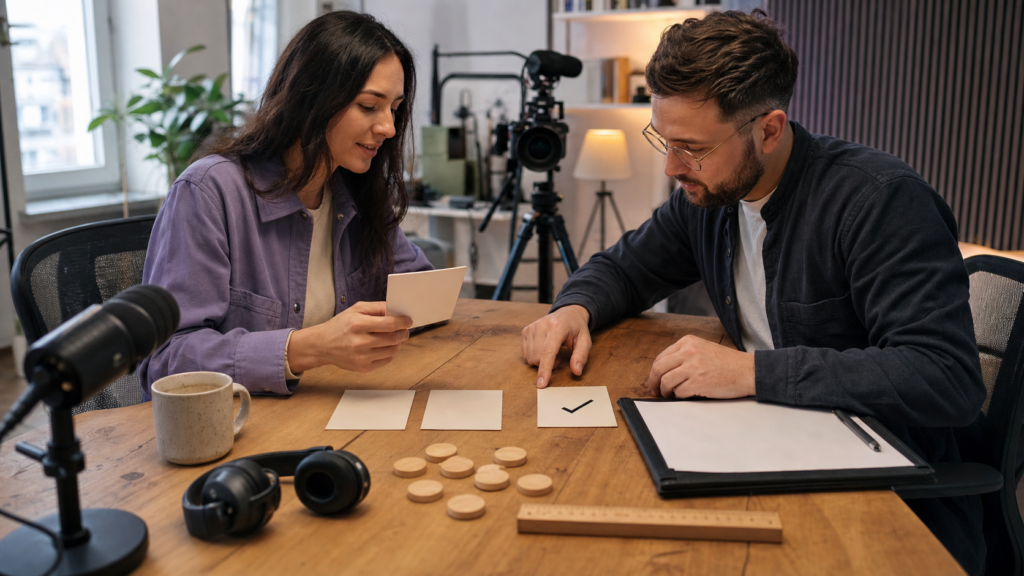
The AI Sponsorship Benchmarks Report is for AI companies that are trying to buy creator attention without buying a credibility problem.
Creator sponsorships are now a real media channel, not a novelty line item. IAB’s 2025 Creator Economy Ad Spend & Strategy Report projected U.S. creator ad spend at $37 billion in 2025, up 26% year over year. IAB’s creator-economy discussion frames the channel as nearing $40 billion in U.S. ad spend. CreatorIQ’s 2025-2026 creator marketing report points to measurement, AI, speed, and brand safety as core operating issues, while FTC endorsement guidance and platform policies make disclosure a non-negotiable part of the campaign system.
For AI companies, this is not just a media-buying story. AI tools are unusually demonstration-dependent. The buyer often needs to see the messy middle: the prompt, the input, the failure mode, the edit, the output, the integration, the review step, and the moment where the tool either saves time or creates more work. That is why sponsorship benchmarks for AI need more than CPM math.
The better question is: what job should the creator campaign perform?
This report maps practical planning bands, sponsorship formats, risk controls, attribution design, disclosure hygiene, and the measurement stack AI companies should have before paying creators. It connects directly to the broader Kingy AI Reports hub, including State of AI Video Tools 2026, State of AI Agents 2026, AI Startup Distribution Report, and State of AI Coding Tools 2026.
Executive Summary
- Creator sponsorship has become a core media channel, but AI companies should treat it as a proof and education channel before treating it as pure performance spend.
- The most useful benchmark is not a universal creator rate. It is a format-specific planning range tied to deliverables, audience fit, rights, exclusivity, disclosure, attribution, and product activation.
- AI products generally need workflow proof. Dedicated YouTube demos, newsletter integrations, podcasts, LinkedIn creators, and short-form clips each solve different buyer questions.
- The biggest mistake is paying for reach before the landing page, offer, trial, demo, or attribution path is ready.
- The second biggest mistake is asking creators to repeat claims the company cannot source. No unverified benchmark, customer, funding, savings, security, accuracy, or deployment claim belongs in a paid creator script.
- FTC guidance and platform policies from YouTube, TikTok, and Meta make disclosure central to the campaign, not a footnote.
- Kingy’s planning bands are editorial planning ranges. They are not private deal data, guaranteed rates, or instructions to pay a specific creator a specific amount.
- A good campaign postmortem should answer four questions: who watched, who acted, who retained, and what did the creator reveal about buyer objections?
Table of Contents
- Why AI sponsorship benchmarks are different
- Budget planning bands
- The Kingy sponsorship readiness score
- Format-by-format benchmarks
- Measurement stack
- Disclosure and claims controls
- Channel fit for AI products
- Operating model
- Methodology, FAQ, sources, and update note
Why AI Sponsorship Benchmarks Are Different
A normal consumer product can sometimes win with a creator saying, in effect, “I use this, here is why I like it, here is the offer.” AI products usually need more context. A coding agent has to be shown inside a real development loop. An AI video tool has to show creative control, not just a glossy output. An AI research tool has to reveal source handling. An enterprise agent has to make risk, review, and human handoff visible.
That changes the economics. The useful sponsorship is not only the media placement. It is the creator’s ability to translate a complex product into a workflow the audience trusts.
The catch is that creator reach can hide product weakness. A beautiful demo can create a view spike while the trial leaks users. A high-profile integration can create brand legitimacy while attribution shows weak qualified demand. A paid newsletter slot can drive clicks from the wrong buyer. A short-form clip can produce cheap attention and zero serious adoption.
For founders, this is the real question: are you buying awareness, explanation, proof, activation, or trust?
The answer determines the format, the budget, the brief, and the measurement plan. AI creator campaigns should be judged by the job they perform. A launch-week creator read may be a smart way to make a small product visible. A dedicated workflow video may be the right tool for a technical buyer who needs to watch the product handle a real task. A podcast or newsletter integration may be the better fit when the buyer needs category education. A multi-creator category package may be useful only after the message, landing page, and measurement path have survived smaller tests.
Budget Planning Bands
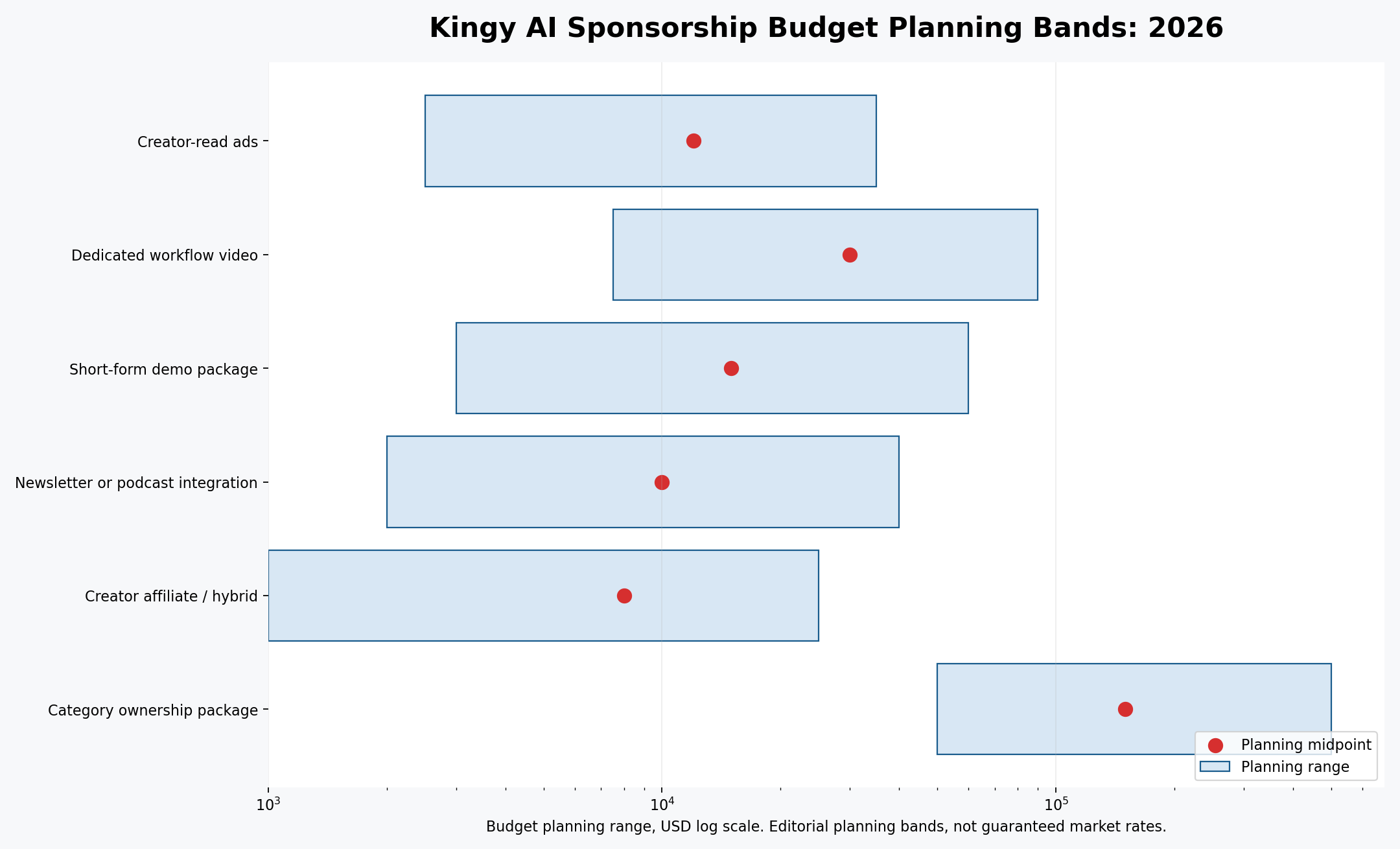
These are Kingy editorial planning bands for AI sponsorship packages. They are designed to help teams scope campaigns before negotiation. They are not universal market averages and they do not replace creator-specific pricing, agent negotiation, platform audience data, usage-rights terms, exclusivity terms, or current campaign demand.
| Sponsorship lane | Planning range | Planning midpoint | Best for | Proof required |
|---|---|---|---|---|
| Creator-read ads | $2,500-$35,000 | $12,000 | Founder-led tools, AI utilities, developer products with one clear job | Verbal integration, pinned link, disclosure, coupon/UTM, usage rights if repurposed. |
| Dedicated workflow video | $7,500-$90,000 | $30,000 | AI video, coding, design, agent, research, and productivity tools that need a visible demo | Brief, creator testing window, claims review, disclosure, edit notes, attribution links. |
| Short-form demo package | $3,000-$60,000 | $15,000 | Visual AI tools, consumer apps, template products, prompt packs, and lightweight SaaS launches | Usage rights, platform-native edits, comment monitoring, landing page and retargeting path. |
| Newsletter or podcast integration | $2,000-$40,000 | $10,000 | B2B AI, infrastructure, developer tools, AI education, analyst-style products | Audience fit, sponsor placement, disclosure language, landing page, source-backed claims. |
| Creator affiliate / hybrid | $1,000-$25,000 | $8,000 | Self-serve tools with clear activation, templates, trials, or API credits | Rev-share terms, coupon code, payout window, refund rules, attribution limits. |
| Category ownership package | $50,000-$500,000 | $150,000 | Well-funded AI companies trying to own a workflow narrative across multiple trusted creators | Multi-creator brief, exclusivity terms, content rights, brand safety, disclosure audit, incrementality read. |
The boring part matters. Two sponsorships with the same sticker price can have completely different value. A $12,000 read in a trusted developer newsletter can outperform a $60,000 general creator integration if the audience is tighter, the offer is clearer, and the activation path is ready. A $40,000 YouTube workflow demo can be cheap if the company has rights to reuse clips, a strong landing page, and product-qualified lead tracking. It can be expensive if the creator never used the tool, the demo is scripted, and the audience is wrong.
Kingy evaluates sponsorship cost through five levers:
| Lever | What changes the price | Why it matters |
|---|---|---|
| Audience fit | Buyer density, trust, niche, region, decision-maker mix. | AI tools need the right workflow audience, not just large reach. |
| Production depth | Ad read, tutorial, workflow demo, live build, benchmark-style walkthrough. | More proof requires more creator time and more review risk. |
| Rights and reuse | Organic only, paid whitelisting, clip rights, sales use, landing page use. | Reuse can turn one sponsorship into a campaign asset library. |
| Exclusivity | Category lockout, competitor restrictions, duration, platform scope. | AI categories are crowded; exclusivity can become expensive quickly. |
| Measurement burden | UTMs, codes, CRM fields, lift study, affiliate payout, postmortem. | Better attribution usually requires more planning before launch. |
The planning ranges are intentionally broad because creator pricing is not a menu. A niche technical creator with a small audience can command a high rate if the audience includes the exact buyers, developers, or founders the AI company needs. A large creator can be inefficient if the product sits outside the audience’s real workflow. A creator with low reach but deep trust may be useful for enterprise education. A creator with massive reach but weak relevance may be a poor fit for anything beyond broad awareness.
The Kingy Sponsorship Readiness Score
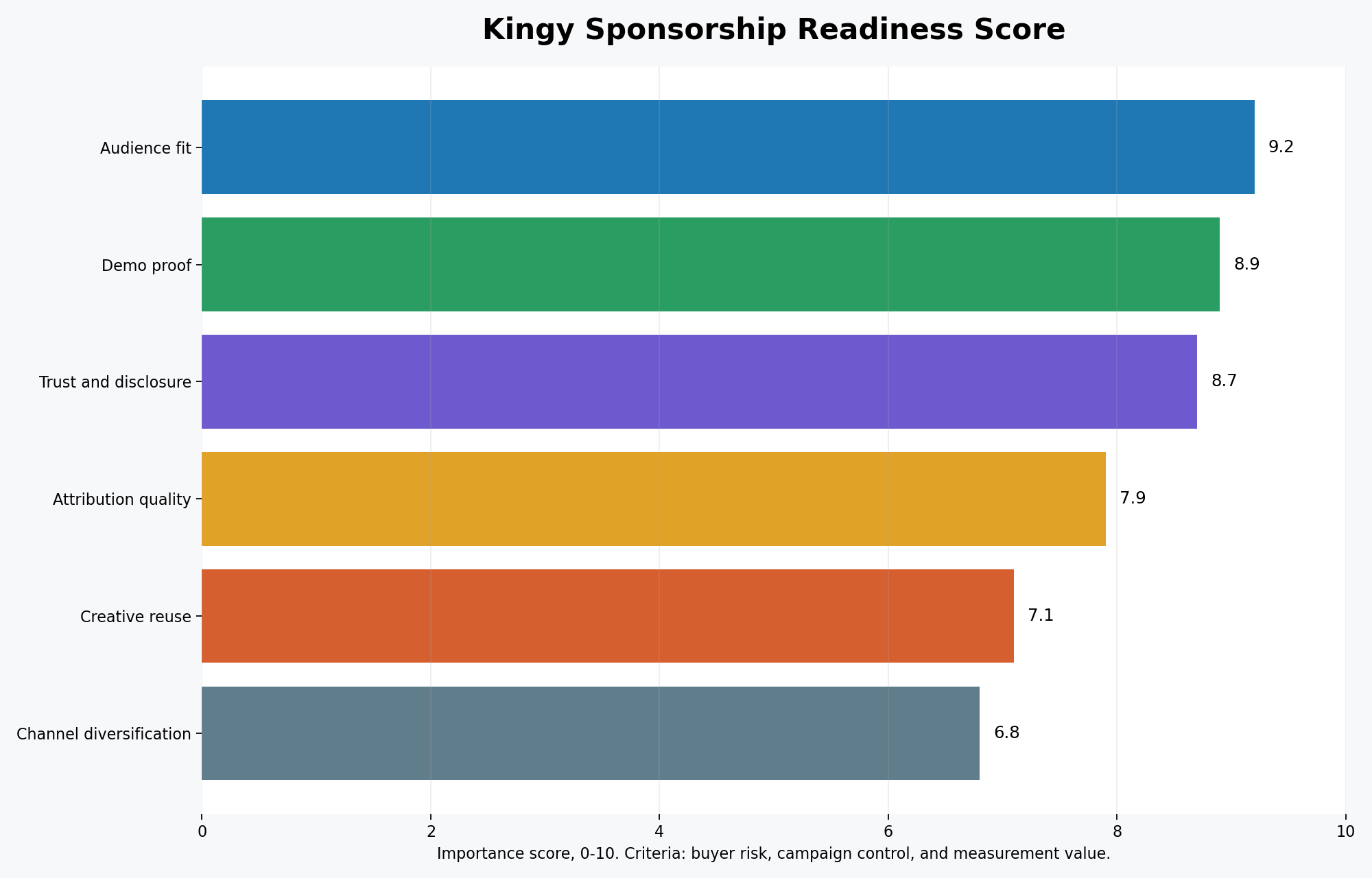
The readiness score is not a creator ranking. It is a campaign-preparation framework for AI companies deciding whether a sponsorship is ready to buy.
| Criterion | Importance | Definition |
|---|---|---|
| Audience fit | 9.2 | Does the creator already teach, review, or use the buyer workflow? |
| Demo proof | 8.9 | Can the product be shown honestly with messy input and a real activation path? |
| Trust and disclosure | 8.7 | Are sponsorship, claims, usage rights, and review rules clear? |
| Attribution quality | 7.9 | Are UTMs, coupon codes, trials, holdouts, and CRM fields prepared? |
| Creative reuse | 7.1 | Can clips, quotes, and learnings be reused legally and practically? |
| Channel diversification | 6.8 | Does the campaign avoid betting the whole launch on one creator? |
The score reveals a simple truth: the campaign can fail before the creator ever records. If the audience is wrong, the demo is soft, the disclosure is vague, the landing page is generic, or the claims are unsupported, higher spend just scales confusion.
For AI companies, sponsorship readiness usually means having these assets in place:
- A creator-safe product brief with sourced claims and prohibited claims.
- A demo path that works with realistic input, not only founder-selected examples.
- A landing page matched to the creator’s audience and video promise.
- A trial, template, signup, API key, booked-demo, or waitlist action that is easy to complete.
- UTM links, coupon codes, source fields, and CRM notes prepared before publication.
- Disclosure language agreed in the contract and visible in the final content.
- Usage rights and paid amplification terms documented before clips are repurposed.
This is where AI companies often underinvest. They negotiate the placement, then rush the brief, then discover that the creator has basic product questions the landing page does not answer. The company may also discover that the strongest video hook relies on a claim the legal or product team cannot support. That problem should be found before the creator records, not after the campaign is live.
Format-by-Format Benchmarks
Creator-Read Ads
Creator-read ads are useful when the audience already understands the category and the tool has a simple promise. They work for founder tools, AI utilities, developer products, note-taking, productivity, research, browser assistants, lightweight design tools, and products with a clear first action.
A good creator-read spot should not sound like a generic SaaS paragraph. It should connect the creator’s actual workflow to the product. The best version says: here is the problem I had, here is what the tool does, here is where it fits, here is what I would try first, and here is the disclosed offer.
The risk is shallow proof. If the creator has not used the product, a read becomes rented trust. For AI companies, the minimum proof is a real account, a tested workflow, and a claim list the creator can defend.
Dedicated Workflow Videos
Dedicated workflow videos are the most important sponsorship format for many AI tools because they show process. This matters for AI video tools, AI agents, coding tools, research tools, design tools, and B2B workflow products.
The demo looks great. The workflow still needs proof.
A dedicated video should show setup, input, iteration, output, limitations, pricing caveats where appropriate, and the buyer’s next step. For a coding agent, that may mean opening an issue, editing files, running tests, and showing review. For an AI video product, it may mean prompt, storyboard, edit controls, export quality, watermark or rights notes, and production time. For an agent product, it may mean permissions, logs, human review, and rollback.
Dedicated videos justify higher budgets only when the creator can make the product easier to trust. A polished but unrealistic demo is not a benchmark. It is a liability.
Short-Form Demo Packages
Short-form packages are good for hooks, retargeting, and visual workflows. They are weaker for complex buyer education. For AI companies, short-form works best when the product has one visible before/after, a template, a fast setup, or a consumer-friendly result.
Short-form also creates useful creative testing. The company can learn which pain point gets attention, which demo is understood, which phrase people repeat, and which objection appears in comments. But it should not be the only format for serious B2B or developer products. Short clips rarely carry enough context for security, integration, pricing, or procurement.
Newsletters and Podcasts
Newsletters and podcasts work when trust and context matter more than spectacle. A founder, investor, developer, marketer, operator, or AI-buyer audience can be more valuable than a broad creator audience. The offer must be specific, though. “Try our AI platform” is weak. “Use this agent workflow to turn customer tickets into draft fixes with human approval” is stronger.
Podcast integrations are especially useful for category education and founder credibility. They are less useful when the product cannot be explained verbally or when the call to action is vague.
Affiliate and Hybrid Sponsorships
Affiliate or hybrid structures can reduce upfront risk, but they only work when attribution and economics are honest. AI tools with self-serve signup, free trials, API credits, templates, or usage-based plans can sometimes support affiliate economics. Enterprise tools with long sales cycles usually need a different model.
Do not use affiliate math to pressure creators into carrying all risk if the product is unproven. Creators understand audience trust. The good ones will not turn their channel into a coupon farm for a product that may disappoint users.
Category Ownership Packages
Category ownership packages are multi-creator, multi-format campaigns. They can include YouTube demos, newsletter placements, podcasts, short clips, webinars, LinkedIn posts, creator events, and paid amplification. They are for companies trying to own a category narrative: AI coding, AI video, AI sales agents, AI research, AI support, AI data work, or AI creative operations.
This is where budgets can climb quickly. The justification is not reach alone. The justification is repeated, credible exposure across the places the buyer already trusts. The risk is overbuying before the message is proven.
Measurement Stack
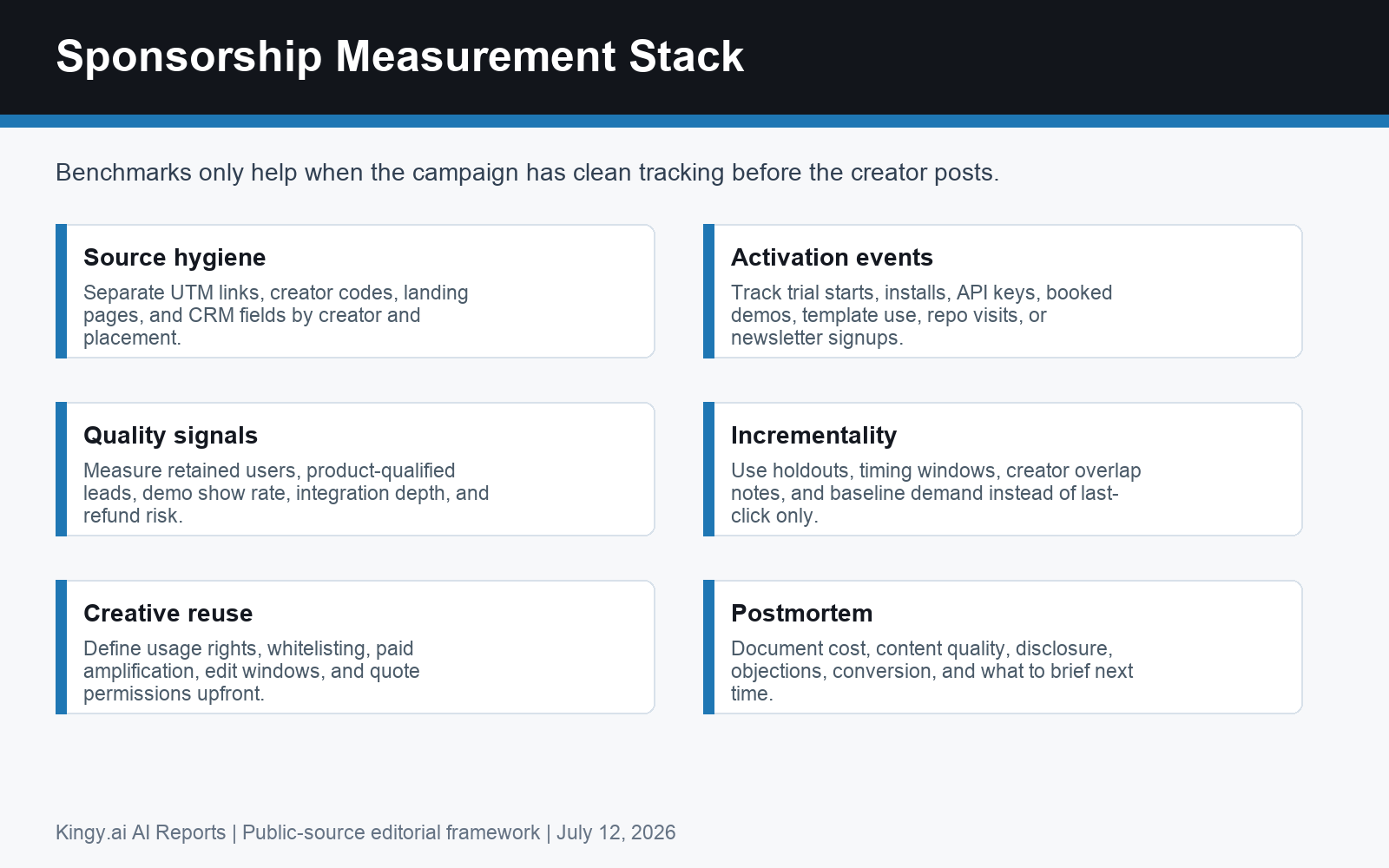
Sponsorship measurement should start before the contract is signed. If the campaign launches with one generic homepage URL, the company has already limited what it can learn.
| Layer | What to set up | What it answers |
|---|---|---|
| Link hygiene | UTM per creator, placement, format, and date. | Which placement drove traffic? |
| Offer tracking | Coupon, trial code, creator-specific landing page, template, or API credit. | Which audience took action? |
| Activation event | Signup, install, API key, template use, booked demo, repo visit, or workspace creation. | Did attention become product motion? |
| Quality filter | PQL, MQL, retained user, demo show, integration, paid conversion, churn/refund. | Was the audience useful? |
| Sales handoff | CRM source field, creator note, first-touch and assisted-touch policy. | Did sales know where demand came from? |
| Creative analysis | Hook, objection, comment themes, clips, retention, creator feedback. | What did the market teach us? |
Last-click attribution is not enough. A creator may influence a buyer who returns through search, a comparison page, a retargeting ad, a teammate’s link, or an AI answer. The postmortem should include assisted influence and qualitative evidence, not just coupon redemptions.
For practical campaign math, use the AI Sponsored Video ROI Calculator and sanity-check assumptions against the Media Kit, Sponsor Kingy AI, and Editorial Sponsorship Standards.
Disclosure and Claims Controls
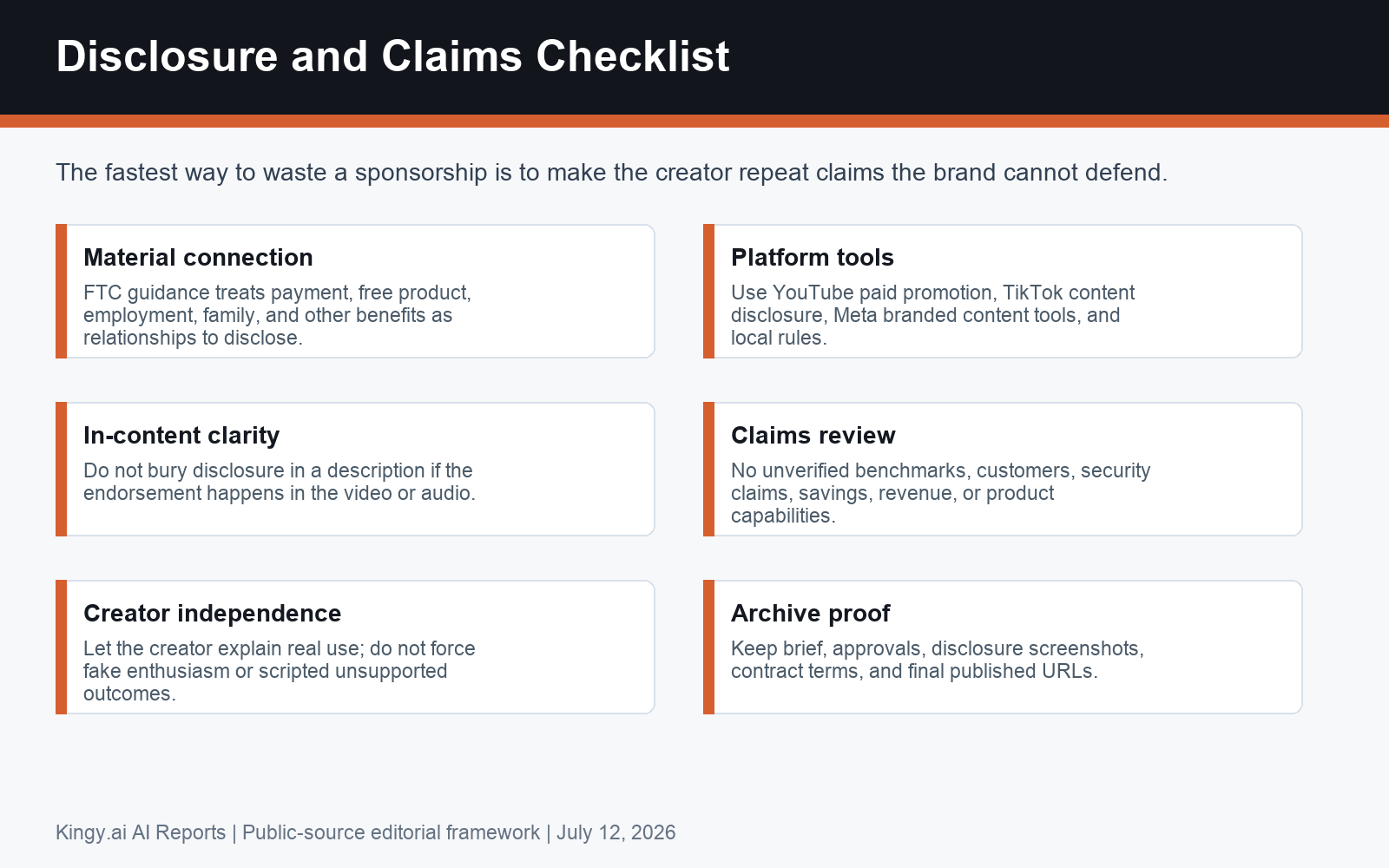
FTC guidance and platform policies are clear enough for an operating rule: if there is a material connection, disclose it clearly. The FTC’s endorsement guidance covers truthful advertising and material relationships. Its Disclosures 101 guidance explains that creators recommending brands need to disclose relationships. YouTube, TikTok, and Meta all provide platform-level branded content or paid promotion guidance.
AI companies should treat disclosure as trust infrastructure. It should appear in the brief, contract, creator instructions, platform settings, caption/description, and final QA. Do not outsource compliance to vibes.
Claims control is just as important. Sponsorships often fail when the brand wants creator authenticity but also demands aggressive claims. That tension is dangerous in AI because performance claims age quickly and can depend on prompts, inputs, models, settings, regions, and workflow constraints.
Do not include these unless they are publicly sourced and current:
- Exact customer names.
- Revenue, funding, user count, retention, or growth claims.
- Benchmark superiority.
- Security or compliance claims.
- Guaranteed productivity savings.
- Pricing claims that are not clearly listed.
- Model capability claims that changed after a release.
- Unsupported “best” or “number one” language.
A better script says what the creator actually did and what the audience can verify. The creator can say they used the tool to generate a rough cut, draft a pull request, summarize a document, test an agent workflow, or plan a campaign if that is what happened. The brand should not turn that into a sweeping market claim.
Creator Channel Fit for AI Products
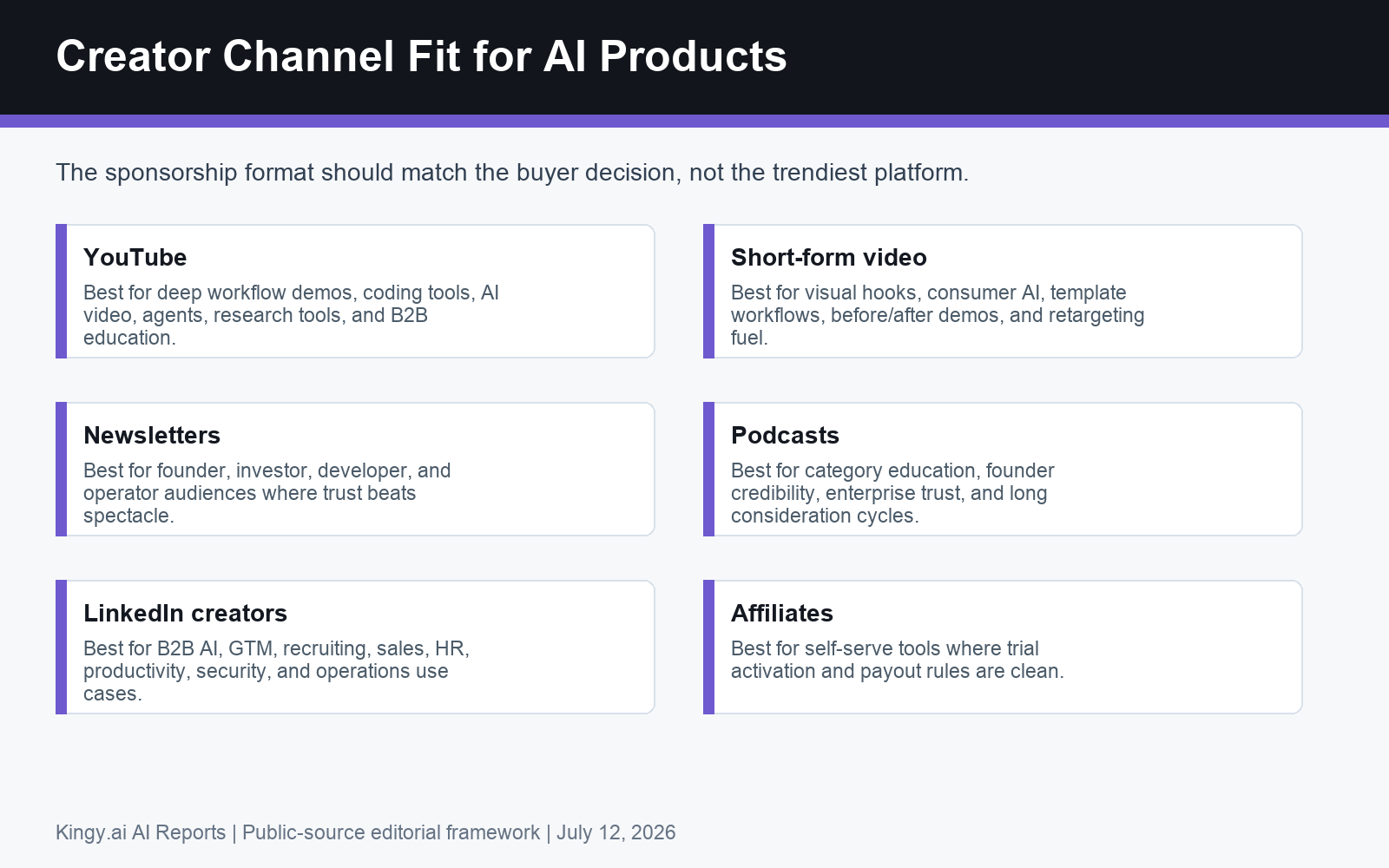
The format should match the buyer’s decision.
| AI product type | Strong sponsorship fit | Weak fit to watch |
|---|---|---|
| AI coding tools | YouTube workflow demos, developer newsletters, podcasts, GitHub/tutorial creators. | Broad tech lifestyle placements with no code proof. |
| AI video tools | YouTube demos, short-form clips, creator production channels, visual comparison pages. | Static ad reads that do not show controls or outputs. |
| AI agents | Long-form workflow demos, B2B newsletters, operator creators, webinars. | Quick clips that hide permissions, review, logs, and failure modes. |
| Open-weight/model tools | Developer channels, Hugging Face/GitHub content, technical newsletters. | General AI hype channels without deployment context. |
| AI startup distribution tools | Founder newsletters, GTM podcasts, LinkedIn creators, operator communities. | Broad consumer audiences with low buyer density. |
| Enterprise AI platforms | Analyst-style creators, podcasts, webinars, LinkedIn, partner content. | Creator formats that cannot discuss trust, data, and procurement. |
The tools that win will not just be flashy. They will be sticky.
Operating Model
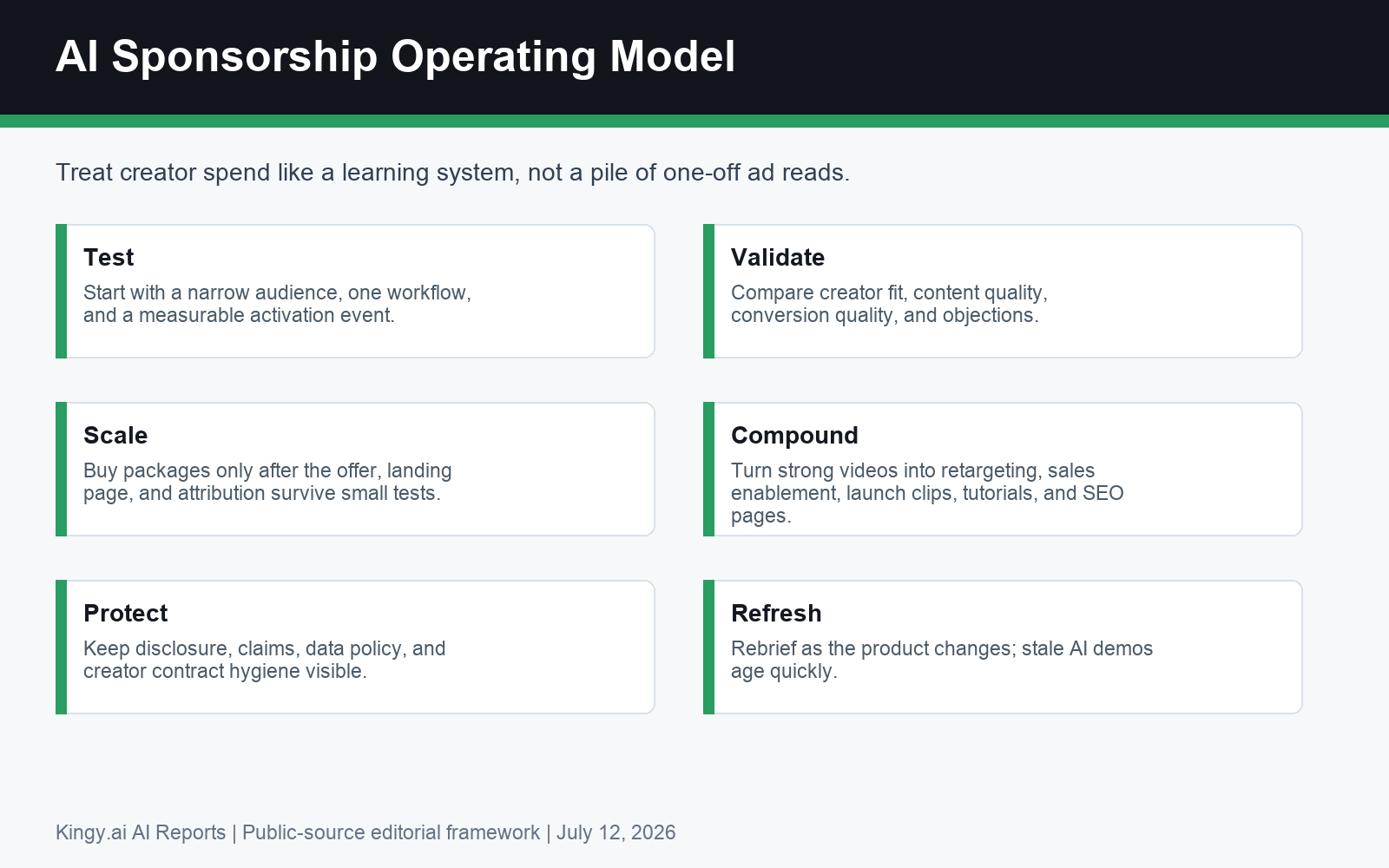
A strong sponsorship program has a cadence.
| Stage | What to do | Gate before scaling |
|---|---|---|
| Test | Buy one narrow creator placement around one workflow and one activation event. | Audience quality and first-action conversion are credible. |
| Validate | Compare creator fit, objections, content quality, trial quality, and sales notes. | The company can explain why performance happened. |
| Scale | Add creators, formats, paid amplification, newsletter, podcast, and retargeting. | Landing page, attribution, and support can handle demand. |
| Compound | Reuse clips, build comparison pages, answer objections, brief sales, update docs. | Rights and claims are documented. |
| Refresh | Update creative after product changes, pricing changes, model changes, or market shifts. | Old demos do not misrepresent the product. |
For Kingy.ai readers, this report sits between AI Startup Distribution Report and the upcoming creator-spend watchlist. Distribution asks where attention comes from. Sponsorship benchmarks ask what attention should cost, what it should teach, and how it should be governed.
Methodology
This report uses public-source research, platform policy references, and Kingy.ai editorial scoring. The planning bands are based on sponsorship format complexity, AI-product proof burden, measurement requirements, rights/exclusivity considerations, and current public industry evidence that creator marketing spend and measurement scrutiny are rising.
The bands are not based on private Kingy.ai client data. They are not guaranteed creator rates. They are not sponsor spend estimates for any named AI company. They are a planning framework for AI founders, marketers, and operators preparing campaigns.
Quality limits:
- Creator rates vary widely by niche, platform, audience quality, country, timing, demand, deliverables, usage rights, exclusivity, agent representation, and negotiation.
- Published industry reports often use survey data, platform data, or modeled estimates. Treat them as directional, not as exact price sheets.
- AI-company sponsorship spend is often private. This report avoids unsourced claims about who spent what.
- Campaign performance depends on product-market fit, activation quality, pricing, landing page clarity, sales follow-up, and retention.
FAQ
How much should an AI company budget for creator sponsorships?
Start from the campaign job, not a universal rate. A small test can begin with a creator-read ad, newsletter placement, affiliate hybrid, or short-form demo. A serious workflow proof campaign usually needs a dedicated video or multi-format package. Category ownership requires multiple creators and repeated placements.
Are these exact market rates?
No. They are Kingy editorial planning bands. Use them to scope campaigns, then validate against creator audience data, deliverables, rights, exclusivity, agent terms, platform mix, and current demand.
What should AI companies measure?
Measure activation quality: trials, installs, API keys, booked demos, template use, retained users, PQLs, MQLs, sales conversations, and objections. Views matter, but they are not the whole result.
Do sponsorships need disclosure?
Yes. FTC guidance and platform policies require clear disclosure when there is a material connection. YouTube, TikTok, and Meta have platform-specific branded content or paid promotion tools and guidance.
Should AI companies use affiliates?
Only when the product has a clear self-serve activation path and fair payout rules. Affiliate structures are weaker for enterprise AI products with long sales cycles unless assisted attribution is handled carefully.
Source List
- IAB 2025 Creator Economy Ad Spend & Strategy Report
- IAB creator ad spend release
- IAB State of Creator Economy Advertising
- IAB/PwC Internet Advertising Revenue Report 2025
- FTC Advertisement Endorsements
- FTC Disclosures 101 for Social Media Influencers
- FTC Endorsement Guides FAQ
- Federal Register FTC Endorsement Guides
- YouTube Paid Product Placements and Endorsements help
- TikTok promoting a brand product or service
- Meta branded content policies
- CreatorIQ State of Creator Marketing 2025-2026
- CreatorIQ influencer marketing trends 2026
- CreatorIQ budget planning guidance
- Influencer Marketing Hub Benchmark Report 2026
- Aspire influencer marketing stats 2026
- Impact influencer cost guide
- Notion creator program
- Perplexity for Startups
- OpenAI for Startups
Downloadable Report Assets
- Download the visual PDF packet: ai-sponsorship-benchmarks-report-visual-report.pdf
The Kingy Brief
Get The Kingy Brief.
AI changes, original tests and one practical thing to try. Fridays at 09:00 Vancouver time.
Free · Double opt-in · Unsubscribe anytime
Sign up for The Kingy Brief on Beehiiv.
Signup help and newsletter schedule
Signup form provided by Beehiiv. After submitting, check your inbox for "Confirm your subscription to The Kingy Brief" and open its confirmation link. Check Spam or Promotions if you cannot find it.
Fridays at 09:00 Vancouver time: source-checked AI changes, original tests and one practical thing to try. We skip a week when there is not enough verified material. Free. Unsubscribe anytime.