AI Model Profile
Kling Video 3.0
Kling Video 3.0 is Kuaishou’s February 2026 short-form video model for text-, image- and reference-guided generation, with multi-shot control, element consistency, native multilingual audio and flexible 3–15 second output.
- Family
- Kling Video
- Release date
- 2026-02-05
- Status
- Current
- Context window
- Not applicable to video generation
- Output limit
- Web guide: 3–15 seconds at 720p or 1080p; Open Platform separately advertises native-4K Video 3.0 API output.
- API
- yes
- Open weights
- no
- Local/self-hosted
- no
- Pricing
- Credit metering by second; web-guide rates vary by resolution and native-audio mode, while API resource packages are billed separately.
- Evidence state
- Recheck due
Benchmark Caveat
Provider demonstrations show selected outputs. Continuity, dialogue attribution, text retention, motion quality, latency and cost should be measured on a fixed prompt-and-reference set before comparing Video 3.0 with other generators.
No standardized independent quality benchmark is supplied in the official Video 3.0 guide. The documentation supports a capability comparison against Video 2.6, not a universal quality ranking.
Best for
Short narrative sequences, campaign concepts and previsualization where a creator needs recurring subjects, planned shot changes and generated dialogue or sound in one model workflow.
Skip if
Skip if you need local weights, long-form generation beyond 15 seconds in one web render, independently verified quality benchmarks, or predictable spend without first measuring retry rates.
Strengths
The documented control set is unusually production-oriented: custom shot descriptions, element binding from image or video references, multi-speaker dialogue assignment, multilingual native audio and flexible short-form duration.
Weaknesses
The model is proprietary and cloud-only. Kuaishou publishes feature demonstrations rather than a standardized independent benchmark, and real cost depends on resolution, audio mode, duration and how many generations survive editorial review.
Kingy AI take
Video 3.0 belongs on a serious AI-video shortlist when continuity, shot planning and native dialogue matter. The buying decision should follow a controlled footage test and a credit-per-usable-second calculation, not a highlight reel.
Verification & Sources
- Evidence state
- Recheck due
- Source links
- 6
- Freshness
- Needs recheck: checked July 27, 2026
- Last updated
- July 27, 2026
What this evidence state means
- Definition
- The claim was previously checked, but its review window expired or a material change may have invalidated it.
- Required provenance
- The prior evidence and check date are retained, together with the expiry or change signal that triggered recheck.
- Owner
- Kingy freshness queue owner and assigned editorial reviewer
- Freshness rule
- This is already outside its freshness rule. It must not be presented as current until reviewed against current evidence.
- Disputes and corrections
- Use “Suggest a correction” on the record. Kingy editorial reviews the cited evidence, records material corrections, and changes or removes the state when it is not supported.
Key source checks
Suggest a correction
Full Model Notes
Testing limit: Kingy reviewed the provider’s release material, current guide and API documentation for this profile. We did not run a controlled generation suite, so provider claims about realism, consistency and prompt adherence remain claims to verify on representative footage.
What Video 3.0 is
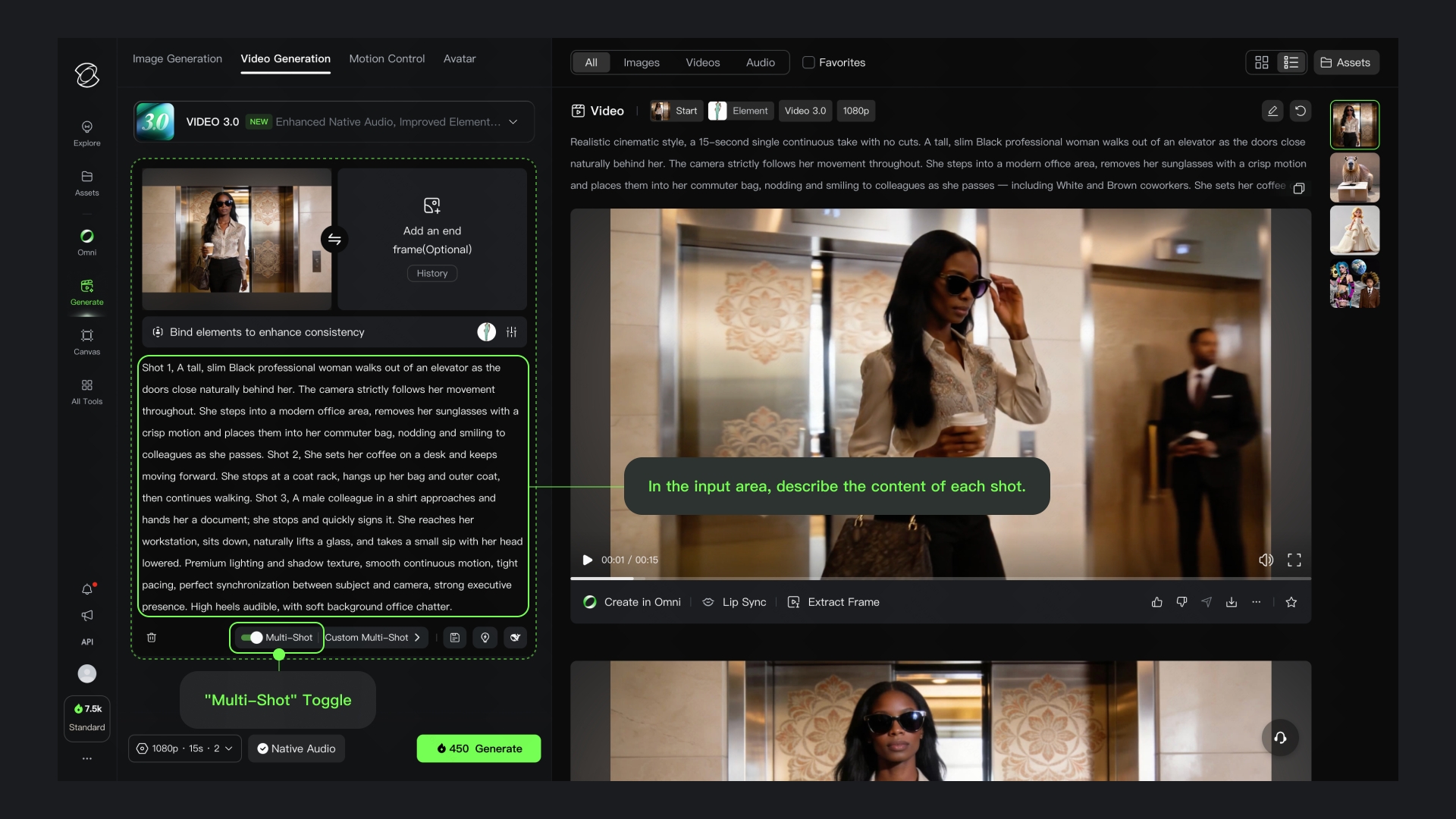
Kuaishou launched the Kling 3.0 family globally on February 5, 2026. Video 3.0 is the direct successor to Video 2.6; Video 3.0 Omni is the separate successor to Video O1. The standard Video 3.0 model supports text-to-video, image-to-video, start/end-frame guidance, native audio and multi-shot generation. Kling’s guide also adds an element-binding workflow for keeping a referenced subject visually and vocally consistent.
Controls that matter
Multi-Shot mode lets the model plan scene transitions and framing from a prompt. Custom Multi-Shot exposes shot-by-shot descriptions and duration, which is the more useful mode when a creator already has a sequence in mind. Element references can be built from two to four images or a video; character elements may include a bound voice. The official guide lists Chinese, English, Japanese, Korean and Spanish dialogue, mixed-language output, several accents and Chinese dialects.
Duration, resolution and credits
The web guide documents 3–15 second output. Its published Video 3.0 table lists native-audio generation at 12 credits per second for 1080p and 9 for 720p; no-native-audio generation is listed at 8 and 6 credits per second respectively, with voice control adding 2 credits per second. These are provider-published credit rates, not currency prices, and they can change. Kling’s current Open Platform overview separately advertises a native-4K Video 3.0 API option, so web and API capabilities should not be assumed identical.
Practical evaluation
Use a repeatable test pack: the same subject in three camera setups, two speakers with assigned dialogue, one visible text element and one 15-second action. Score continuity, speaking attribution, audio artifacts, instruction following and the number of paid generations needed to obtain an editable result. Also confirm commercial terms, regional availability and the exact API model identifier before integrating it into production.
What the documentation does not establish
The published materials do not establish deterministic repeatability, a guaranteed generation time, a fixed retry rate or a rights outcome for every input. They also do not make web-plan credits interchangeable with API resource packages. Buyers should record the model mode, resolution, audio setting and reference assets used in each test, then preserve accepted outputs and invoices alongside the project brief. That creates a defensible production record without treating a provider feature list as a service-level agreement.
Primary sources
- Kuaishou launch announcement
- Kling Video 3.0 model guide and web credit table
- Kling Video 3.0 release notes
- Kling Open Platform overview
- Kling Open Platform resource packages
The Kingy Brief
Get The Kingy Brief.
AI changes, original tests and one practical thing to try. Fridays at 09:00 Vancouver time.
Free · Double opt-in · Unsubscribe anytime
Signup help and newsletter schedule
Signup form provided by Beehiiv. After submitting, check your inbox for "Confirm your subscription to The Kingy Brief" and open its confirmation link. Check Spam or Promotions if you cannot find it.
Fridays at 09:00 Vancouver time: source-checked AI changes, original tests and one practical thing to try. The weekly restart begins October 9, 2026. We skip a week when there is not enough verified material. Free. Unsubscribe anytime.
Creative notes
Test Custom Multi-Shot and element binding together; they are the clearest documented differentiators for maintaining a subject across a planned sequence.
API pricing notes
Verified July 27, 2026: the web Video 3.0 guide lists native audio at 12 credits/s (1080p) or 9 (720p), no native audio at 8 or 6 credits/s, and voice control at an additional 2 credits/s. Confirm live API package pricing separately.
License notes
Proprietary hosted service. Review Kling’s current paid-service, API and commercial-use terms for the account and region used in production.
Hardware requirements
Cloud service; Kling does not provide downloadable Video 3.0 weights or a documented self-hosted runtime.
Official Model Links
Model Intelligence Research Map
Use these internal paths to move from this model profile into provider pages, static comparison pages, related Kingy records, and the broader AI launch graph. These are research paths, not rankings.