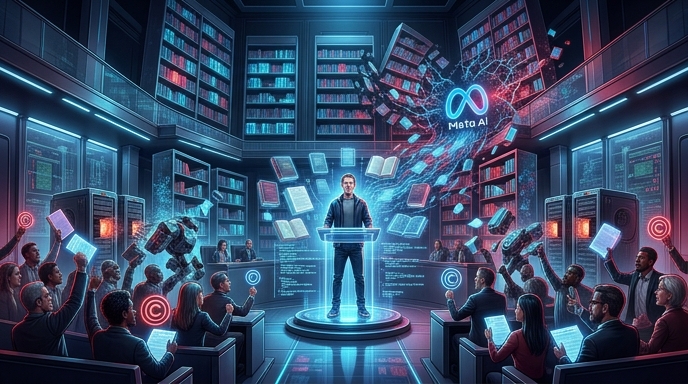
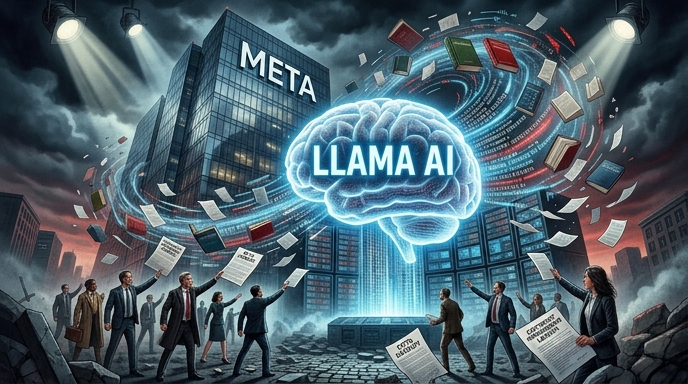
The artificial intelligence gold rush has officially wandered into a courtroom carrying a duffel bag full of pirated books.
This week, a coalition of major publishers filed a sweeping lawsuit against Meta and CEO Mark Zuckerberg, accusing the company of illegally copying millions of copyrighted books and journal articles to train its Llama AI models. The complaint does not tiptoe around the issue. It calls Meta’s conduct “one of the most massive infringements of copyrighted materials in history.” (The Verge)
That is not ordinary legal language. That is the legal equivalent of flipping a conference table over.
The plaintiffs include publishing heavyweights like Macmillan, Hachette Book Group, McGraw Hill, Elsevier, and Cengage, along with bestselling author Scott Turow. Together, they are trying to drag one of the world’s richest tech companies into a brutal fight over what AI companies are actually allowed to consume in order to build their models.
And underneath the legal jargon sits a much bigger question:
Did Silicon Valley build the AI boom on industrial-scale theft?
That question is no longer hypothetical. It is rapidly becoming the defining legal battle of the AI era.
The Core Allegation: Meta Didn’t Just Scrape the Internet — It Allegedly Looted Pirate Libraries
The lawsuit claims Meta trained its Llama models using material pulled from notorious piracy databases including LibGen, Anna’s Archive, Sci-Hub, and Sci-Mag.
Those names matter.
LibGen and Sci-Hub are not obscure corners of the internet where confused undergraduates accidentally wander after midnight. They are among the most infamous repositories of pirated books and academic papers in the world. Publishers and authors have spent years trying to shut them down.
According to the complaint, Meta allegedly dipped directly into those databases anyway.
That changes the optics dramatically.
There is an enormous difference between arguing that AI systems learned from publicly available internet material and arguing that a company knowingly vacuumed up pirated books from black-market libraries. One argument sounds like technological ambiguity. The other sounds like a digital warehouse robbery conducted with GPUs.
The publishers also allege Meta used data from Common Crawl, a massive archive of web data that reportedly contains unauthorized copies of copyrighted works.
The complaint goes even further. It claims Meta stripped copyright management information from works during training. In plain English, the lawsuit suggests Meta not only copied the books but also removed identifying information that would reveal where the content came from.
That accusation is radioactive because courts often view the removal of copyright metadata as evidence of deliberate infringement rather than accidental misuse.
And then there is the output problem.
The plaintiffs claim Llama can generate “verbatim” or “near-verbatim” reproductions of copyrighted material.
That matters because the strongest defense AI companies usually rely on is transformation. The argument goes like this: the model does not store books; it learns statistical relationships from them and creates something new.
But if a model can spit passages back out nearly word-for-word, the “transformative use” defense starts looking shaky.
Very shaky.
This Lawsuit Is About More Than Books
The case looks like a publishing dispute on the surface. It is not.
This is really a fight over the economic foundation of generative AI.
Most large language models depend on absurd quantities of text. Not millions of words. Trillions. Human civilization’s written output became raw fuel for machine learning systems almost overnight.
The dirty secret of the AI industry is that licensing all that material legally would cost astronomical amounts of money.
The lawsuit claims Meta briefly explored licensing deals with publishers between January and April 2023 and even discussed boosting its licensing budget from $17 million to $200 million.
Then, according to the plaintiffs, the company effectively decided: why pay if you can scrape?
That accusation cuts directly into the economics of AI development.
If courts eventually decide AI companies must pay licensing fees for copyrighted training data, the entire business model changes. Suddenly, building frontier models becomes much more expensive. Barriers to entry rise. Open-source AI becomes harder to sustain. Smaller startups get crushed first.
In other words, this lawsuit is not just about whether Meta copied books.
It is about whether the current AI industry structure survives intact.
Meta’s Defense Will Sound Familiar: “Fair Use”
Meta has already indicated it plans to fight aggressively and maintain that AI training can qualify as fair use.
That defense sits at the center of nearly every major AI copyright case right now.
Fair use is the legal doctrine that allows limited use of copyrighted material without permission under certain circumstances. Courts analyze several factors, including whether the use is transformative and whether it harms the market for the original work.
Tech companies argue AI training is transformative because models do not simply redistribute books. Instead, they allegedly learn patterns about language, reasoning, and structure.
Critics respond with a fairly devastating counterpoint:
If your billion-dollar AI product competes against writers while being trained on those writers’ unpaid labor, how exactly is that not market harm?
That issue has become central in court battles involving OpenAI, Anthropic, Google, and Meta.
Federal Judge Vince Chhabria already expressed skepticism in earlier litigation involving Meta. During hearings in 2025, he questioned how AI companies could claim fair use while potentially “obliterating” markets for original works.
That quote landed like a grenade inside Silicon Valley.
Because it exposed the core tension that tech executives often glide past: generative AI does not merely analyze creative work. It increasingly competes with it.
A search engine points users toward a website. A chatbot increasingly replaces the website entirely.
Publishers understand this perfectly well. That is why they are panicking.
The Publishing Industry Waited Years to Fight Back — Now It’s Coordinated
For a while, publishers looked strangely passive during the AI explosion.
Individual authors sued first. Artists sued. News organizations sued. Musicians sued. Meanwhile, many publishers moved cautiously, almost nervously.
That caution is gone.
This lawsuit represents something different: institutional coordination.
Big publishers now appear convinced that AI firms crossed a line. More importantly, they seem to believe courts may finally agree.
The complaint argues Meta’s alleged piracy is damaging ongoing efforts to create legitimate licensing markets between publishers and AI firms.
That detail is crucial.
Publishers are not necessarily trying to destroy AI. They want payment systems. Licensing systems. Control. They want AI companies to negotiate instead of strip-mining libraries like digital oil fields.
The irony here is brutal.
For two decades, Silicon Valley conditioned users to believe “information wants to be free.” Now AI companies need enormous quantities of information to survive, and suddenly the people who create information are demanding invoices.
Turns out the internet’s free-content era may have produced the biggest copyright backlash in modern history.
The Anthropic Disaster Changed Everything
One reason this Meta lawsuit feels more dangerous than earlier AI copyright cases is timing.
The industry just watched Anthropic get hammered by copyright litigation involving pirated books. Anthropic eventually agreed to a massive $1.5 billion settlement tied to allegations that it used unauthorized books to train its systems. (Vox)
That number terrified the AI sector.
Not because every case will end in billion-dollar settlements. They will not.
But because it shattered the illusion that these lawsuits were merely nuisance litigation from angry creatives.
They are existential threats.
Even more alarming for AI companies, researchers have increasingly studied “memorization” inside large language models — the tendency for models to reproduce copyrighted text. Some findings suggest larger models become more prone to verbatim recall under certain prompting techniques.
That matters enormously in court.
If plaintiffs can show models reproduce copyrighted passages rather than merely learning abstract patterns, the legal exposure multiplies.
Suddenly AI firms are not defending abstract machine learning concepts anymore. They are defending specific outputs that look suspiciously like copying.
And juries understand copying.
You do not need a PhD in neural networks to recognize a duplicated paragraph.
Mark Zuckerberg’s Presence in the Lawsuit Is Not Accidental
The lawsuit does something especially aggressive: it names Mark Zuckerberg personally.
That is strategic.
When plaintiffs target a CEO directly, they are trying to frame the alleged misconduct as executive-level decision-making rather than operational confusion buried deep inside engineering teams.
The complaint reportedly argues Zuckerberg personally authorized the conduct.
That creates reputational risk far beyond ordinary copyright litigation.
Meta already carries years of baggage involving privacy scandals, content moderation controversies, and accusations that it prioritized growth over safeguards. The company’s old “move fast and break things” culture now looks less like a startup slogan and more like evidence prosecutors might quote in court.
And the optics are ugly.
An ultra-wealthy tech giant allegedly downloading pirated books while authors struggle to earn royalties is not exactly a sympathetic narrative.
The publishing industry understands narrative warfare very well. They publish narratives for a living.
AI Companies Keep Saying This Is Innovation. Critics Call It Extraction.
There is a philosophical divide underneath all these lawsuits.
AI companies frame training as learning. Critics frame it as extraction.
That distinction changes everything.
If AI systems “learn” from copyrighted material the way humans do, then training may ultimately look legitimate. Humans read books constantly and later produce original work inspired by them.
But critics argue LLMs are fundamentally different because they ingest works at industrial scale, retain statistical representations of them, and generate outputs that directly compete against the original creators.
That turns the relationship economic rather than inspirational.
Several legal scholars now argue existing copyright doctrine may not fully address generative AI. Some researchers propose new frameworks specifically tailored to AI-era market competition.
And honestly, they may have a point.
Traditional copyright law evolved in a world where copying required effort. AI obliterates that assumption.
Once a model absorbs enough creative work, it can generate infinite approximations at near-zero cost.
That capability changes the scale of potential market disruption so radically that older legal frameworks may strain under the pressure.
The courts are essentially trying to regulate nuclear technology using rules designed for photocopiers.
The Real Fear: AI Could Hollow Out Creative Industries
The publishing industry’s terror is not really about isolated copyright violations.
It is about replacement.
The lawsuit argues AI-generated outputs threaten the livelihoods of authors and publishers.
That fear is not irrational.
If AI systems summarize books, imitate writing styles, generate educational content, and answer factual questions without sending users back to original sources, publishers face a brutal possibility: their content becomes raw material for machines that eventually compete against them.
This fear extends far beyond books.
News organizations have already sued AI companies. Music publishers are suing over lyrics. Visual artists claim their styles were absorbed without consent.
Everybody sees the same pattern.
The AI economy appears to depend heavily on ingesting copyrighted human work first and figuring out legal permission later.
That strategy worked during the industry’s rapid-growth phase because regulators moved slowly and courts lacked precedent.
Now the lawsuits are piling up faster than companies can settle them.
Silicon Valley May Have Miscalculated the Political Optics
Tech companies often assume public opinion naturally favors innovation.
That assumption may fail here.
Most people understand plagiarism instinctively. Most people also know giant tech firms are extremely powerful. When publishers describe AI companies as pirating libraries of books without permission, the accusation feels emotionally legible in a way that abstract data-scraping debates never did.
And unlike social media controversies, this issue directly affects elite professional classes: authors, journalists, academics, lawyers, professors, and publishers.
Those groups shape public discourse.
That matters politically.
Washington is already circling AI regulation. Europe is even more aggressive. Copyright disputes may become the pressure point where governments finally decide Silicon Valley cannot simply self-regulate frontier AI systems.
Ironically, the industry’s obsession with speed may have created its biggest vulnerability.
AI companies raced to scale models before establishing stable licensing frameworks because they feared losing competitive advantage. Now they face a legal avalanche precisely because they moved too quickly.
Classic Silicon Valley move, really.
Sprint first. Hire litigators later.
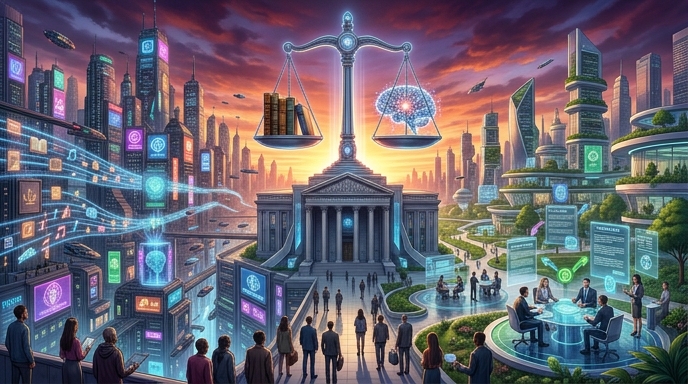
What Happens Next Could Reshape the Entire AI Economy
No matter who eventually wins this case, the consequences will spread far beyond Meta.
If publishers win major damages or secure licensing mandates, AI development costs rise dramatically.
If Meta wins decisively under fair use, creative industries may lose enormous leverage and face a future where AI systems freely absorb copyrighted work with minimal compensation.
Neither outcome is clean.
A world where every training dataset requires expensive licensing could consolidate AI power inside a few mega-corporations that can afford it.
A world where AI companies freely consume copyrighted work could devastate creative incentives over time.
And courts may end up splitting the difference anyway.
Some judges already appear willing to distinguish between legally acquired books and pirated datasets. That distinction could become the new battleground. (Wikipedia)
In other words, future AI companies may still train on copyrighted material — but only after paying for lawful access.
That would not end AI development.
It would simply end the fantasy that copyrighted creative work is a free natural resource waiting to be harvested.
Sources
- The Verge — “Book publishers sue Meta over AI’s ‘word-for-word’ copying”
- Publishers Weekly — “Publishers File Lawsuit Against Meta, Mark Zuckerberg”
- Reuters coverage of the lawsuit
- Associated Press coverage
- Financial Times coverage
The Kingy Brief
Get future Kingy Brief editions.
Source-checked AI changes, original tests and one practical thing to try.
Free · Choose your subjects · Double opt-in · Unsubscribe anytime
Regular sending is paused; no restart date is set.