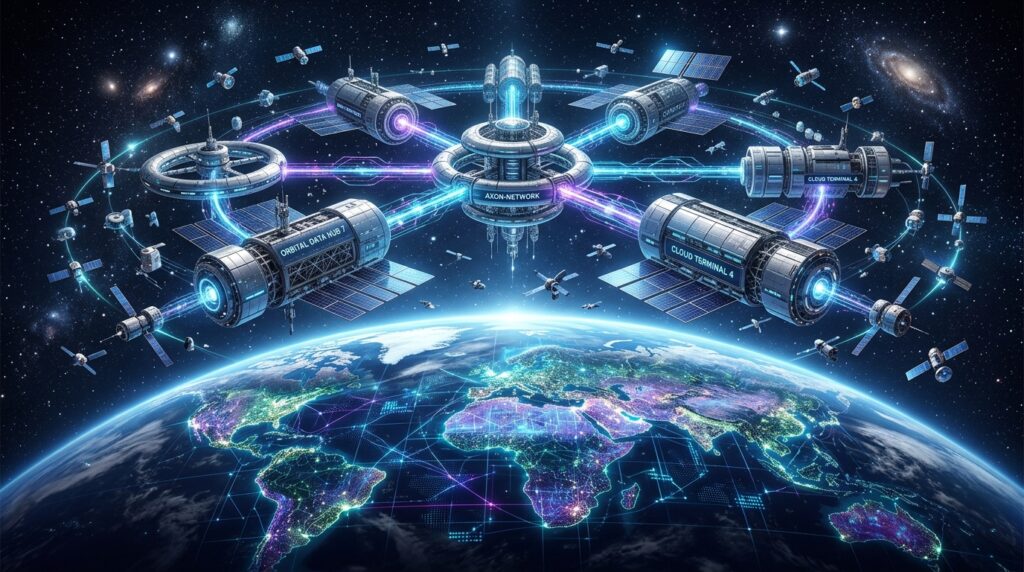
The man who keeps the internet running just looked up at the sky and said, “Yeah, let’s build up there.”
Wait, Did He Just Say Space?

Let’s be real. When you think of Cisco, you probably think of that blinking router in your office closet. You don’t think of rocket ships. But Chuck Robbins, the CEO of one of the most powerful networking companies on the planet, just told the world that data centers in space aren’t just a wild idea. They’re coming. And Cisco is already preparing for it.
In a candid, wide-ranging interview on The Verge’s Decoder podcast, Robbins dropped a bombshell. When asked point-blank whether we should build data centers in space, he didn’t hesitate. “Absolutely,” he said. “And we will.”
That’s not a maybe That’s not a “we’re exploring options.” That’s a CEO of an 85,000-person company saying the future of AI infrastructure might literally be orbiting Earth. And honestly? The more you dig into why he said it, the more it starts to make sense.
The Problem With Building on Earth
Here’s the thing nobody wants to talk about at the dinner table: data centers are terrible neighbors.
They’re loud. They’re ugly. They guzzle electricity like it’s going out of style. And communities across the United States, from red states to blue states, are pushing back hard. We’re talking bipartisan opposition to new builds. An Alabama state senator even tried to block solar projects just to discourage data centers from moving in. That’s how bad it’s gotten.
Robbins gets it. “People don’t want these things in their backyards, and I get that,” he said. Sam Altman, OpenAI’s CEO, agrees, he’s said data centers shouldn’t be in people’s backyards either. But Altman also called orbital data centers a “pipe dream.”
Robbins? He’s not buying it. When asked who he believes, Altman or Elon Musk, he was blunt: “I wouldn’t bet against Elon.”
Bold words. But Robbins has a point. Space offers something Earth simply can’t right now: unlimited, unimpeded solar power. No utility bills No angry town hall meetings. No zoning fights. Just pure, clean energy beaming down from the sun 24/7.
Cisco Is Already Doing the Homework
This isn’t just talk. Robbins revealed that his head of product came to him about two to three months ago and said, “We really have to be prepared for data centers in space.” His first reaction? He looked at him like he was crazy.
But then he listened. And now Cisco’s teams are actively working through what it would take to adapt their networking equipment for orbital conditions, extreme temperatures, no atmosphere, no traditional cooling systems. It’s early. Very early. But the work has started.
“We’re in the early stages of just making sure the atmospheric issues, the temperatures, all of those things are taken into consideration,” Robbins explained. The good news? Networking equipment in space might actually be simpler in some ways. No cooling loads means less weight. Less weight means cheaper launches. It’s not a solved problem, but it’s a solvable one.
Robbins even joked that he’d rather be on the “leading edge” than the “bleeding edge.” Smart man.
The Silicon Secret That Changed Everything

Before we get too far into the stars, let’s talk about how Cisco got here on Earth. Because the story is genuinely fascinating, and it all comes down to a lucky phone call in 2016.
That year, one of Cisco’s hardware engineers walked into Robbins’ office and said there was a chip company in Israel worth buying. The company was called Leaba. Cisco bought it. And that single acquisition quietly turned Cisco into one of only three companies in the world that can build the networking silicon needed to connect GPUs inside AI data centers.
Think about that. Three companies. In the entire world.
“If we didn’t have that silicon today, we would not be participating in this phase,” Robbins admitted. “Otherwise I’d be buying merchant silicon like all my competitors, and I’d be just like everybody else.”
That chip bet is why Cisco went from nearly zero hyperscaler revenue five years ago to doing billions this year. Amazon, Microsoft, Google, they’re all buying Cisco gear to build out their AI infrastructure. The company that was once just “the router people” is now a cornerstone of the AI revolution.
Cisco vs. Nvidia: The Friendly Rivalry
Of course, Cisco isn’t the only player at the table. Nvidia’s networking business hit $31 billion last fiscal year. Cisco’s was around $20 billion. That’s a gap. And Nvidia isn’t slowing down.
But Robbins isn’t sweating it. He calls the relationship “coopetition.” Hyperscalers like to mix and match vendors, they want options, not lock-in. And in the enterprise world, Cisco has 40 years of embedded trust, processes, and institutional knowledge that Nvidia simply doesn’t have.
More importantly, Cisco has something nobody else does: a massive security business sitting right next to its networking business. As AI agents start running loose across corporate networks, someone has to validate their identities, monitor their behavior, and, if needed, shut them down. Robbins argues that has to happen at the network layer, where latency is lowest and visibility is highest.
He even floated the idea of partnering with Okta, whose CEO recently pitched “kill switches” for AI agents, saying the actual kill switch might live in Cisco’s network. “We may see something happening that it won’t see at the upper layers,” he said. A deal might be forming in real time.
Yes, He Called It a Bubble
Here’s where Robbins really surprised people. He didn’t dodge the question. He didn’t spin it. When asked directly if AI infrastructure spending is a bubble, he said yes.
“Did the dot-com bust or did the winners emerge, the losers failed, and now we have what we have?” he said. He’s seen this before. During the dot-com era, Cisco was briefly the most valuable company in the world, for about a day, he laughed. Then the bubble popped. Companies died. Capital evaporated.
But the internet didn’t go away. The winners survived. And the infrastructure they built became the foundation for everything that came after.
Robbins sees AI the same way. “There are certainly going to be companies that will cease to exist,” he said plainly. “They’re going to go away.” The difference this time? The data centers being built today are running at full capacity from day one. This isn’t dark fiber sitting unused for 20 years. The demand is real, right now.
Still, the consumer application problem looms large. Enterprise use cases like AI-assisted coding and customer service are clear. But the killer consumer app, the one that makes regular people want AI the way they wanted smartphones, doesn’t exist yet. And without it, convincing communities to accept data centers in their backyards gets harder every day.
70% of Cisco’s Code Will Be Written by AI Next Year
Let that sink in for a second. Robbins revealed that next year, roughly 70% of Cisco’s code will be AI-generated. Five or six products are already 100% AI-written today.
That’s wild for any company. But for Cisco, whose networking equipment literally keeps the internet running, it raises serious questions. Robbins knows it. “Our stuff has to work,” he said, contrasting Cisco’s reliability requirements with OpenAI’s philosophy of shipping products that work “10 percent of the time just to get to use them.”
The company is even using AI to convert decades-old C++ code into modern languages. Robbins’ immediate reaction when he heard about it? “You better test that like crazy before you put it in a customer environment.” Exactly right. The upside is real, AI can find bugs faster, spot security vulnerabilities, and accelerate development cycles. But the downside of a Cisco failure isn’t a crashed app. It’s the internet going dark.
A Fragmented Internet Is Coming
The geopolitical picture adds another layer of complexity. Countries around the world are demanding data sovereignty. They want their data stored locally. They want control over the technology they use. And critically, they don’t want any foreign government holding a kill switch over their infrastructure.
This is forcing Cisco to completely rethink how it builds products. The old model was simple: build global cloud instances, partition them, sell access. The new model? Build systems that can run entirely within a single country’s borders, completely isolated if needed.
“The internet in California looks different than the internet in Texas today,” Robbins observed. The future internet will be more fragmented, not broken, but divided by borders, regulations, and sovereignty requirements in ways we’ve never seen before. As 4sysops noted, Cisco’s long-term objective is building a “fragmented but secure global internet that respects regional data sovereignty.”
It’s a far cry from the borderless, open internet that Chuck Robbins grew up watching transform the world.
The Bottom Line: Cisco Is Betting on the Stars

Chuck Robbins grew up on a farm in Georgia. He never imagined he’d be talking about data centers in space. But here we are.
The pressures are real. Communities don’t want data centers. Power grids are strained. Memory shortages are squeezing margins. Geopolitical fragmentation is reshaping the internet. And a bubble may be forming that could wipe out a generation of AI companies.
But Robbins isn’t flinching. He’s moving faster, He’s betting on proprietary silicon, network-layer security, and, yes orbital infrastructure. He’s preparing Cisco for a world where the answer to “where do we put the data center?” might be “400 miles above your head.”
Is it crazy? Maybe. But then again, so was buying a chip company in Israel in 2016. And that turned out pretty well.
As TechBuzz.ai reported, Robbins is making billion-dollar bets in a moment of extraordinary uncertainty. Whether those bets pay off will define his legacy, and possibly the future of the internet itself.
For now, the man who keeps the world connected is looking up. And he’s not blinking.
Sources
- The Verge — Cisco CEO Chuck Robbins wants data centers in space (Decoder Podcast)
- TechBuzz.ai — Cisco CEO: We’re Building Data Centers in Space
- 4sysops — Cisco CEO Chuck Robbins’ plan for the AI era
- Tom’s Hardware — Sam Altman fires back at Elon Musk’s space data center proposal
- Heatmap News — Data Center Cancellations 2025