
Wait — Did Microsoft Just Call Its Own AI a Toy?

Picture this. You’re paying $30 a month for a productivity tool. You use it to draft reports, summarize meetings, and crunch data. Then someone points you to the fine print — and you find out the company that sold it to you quietly labeled it “for entertainment purposes only.”
That’s not a joke. That’s Microsoft.
The tech giant’s Copilot Terms of Use — updated in October 2025 and still live as of this writing — contains three sentences that have sent the internet into a full-blown meltdown:
“Copilot is for entertainment purposes only. It can make mistakes, and it may not work as intended. Don’t rely on Copilot for important advice. Use Copilot at your own risk.”
Read that again. Slowly. Let it sink in.
This is the same Copilot that Microsoft has been aggressively pushing into Windows 11, Microsoft 365, and every corner of its product ecosystem. The same AI that the company markets as a “productivity multiplier.” The same tool that enterprises pay millions of dollars a year to use.
And Microsoft’s own legal team called it entertainment.
The Fine Print Nobody Was Supposed to Read
The disclaimer didn’t just pop up overnight. According to TechCrunch, the terms were last updated on October 24, 2025. That’s six months of enterprise sales pitches, corporate deployments, and billion-dollar revenue projections — all while the legal page quietly said “don’t rely on this for important advice.”
It gets better. Microsoft also disclaims all warranties about Copilot. The company states it “cannot promise that Copilot’s responses won’t infringe someone else’s rights” — including copyrights, trademarks, or rights of privacy. And if you publish anything Copilot generates? You’re “solely responsible.”
So let’s recap. Microsoft sells you the tool. Microsoft markets it as transformative. And then Microsoft’s lawyers say: if anything goes wrong, that’s on you.
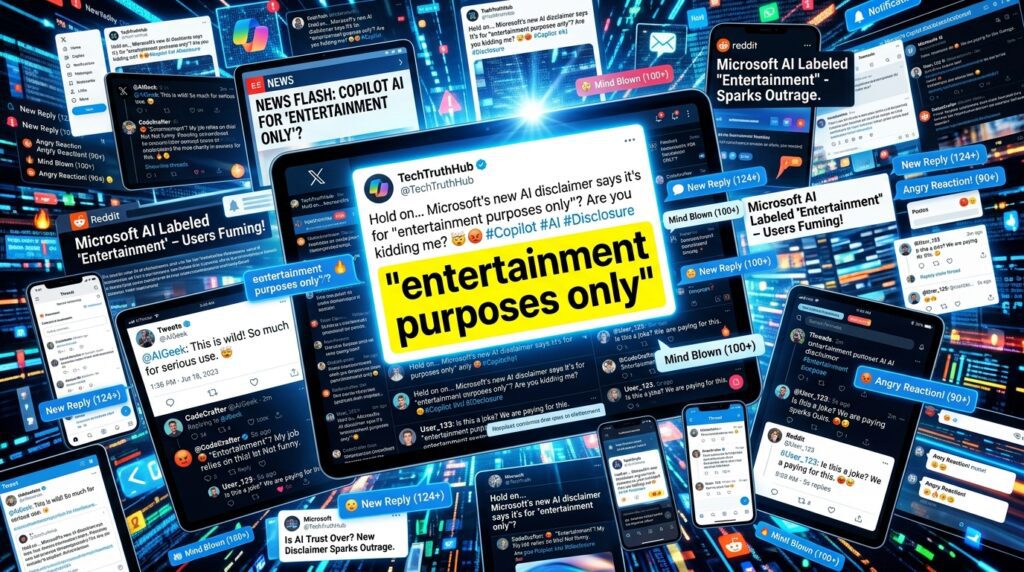
The disclaimer went viral after The Register picked it up on April 2, followed quickly by TechCrunch and Hacker News. Social media exploded. One user put it perfectly: “Call me crazy but Microsoft declaring its flagship AI product is ‘for entertainment purposes only’ should be a huge story.”
Another person was less diplomatic: “So, entertainment is now tied to productivity tools? They have an army of lawyers, and this is the best they can come up with?”
$30 a Month for a Carnival Ride
Here’s where the story gets genuinely wild. Microsoft 365 Copilot costs $30 per user per month for enterprise customers — on top of existing Microsoft 365 licensing fees. Do the math:
- 1,000 employees = $360,000 per year
- 10,000 employees = $3.6 million per year
Analysts project between $5 billion and $16 billion in annual Copilot revenue, based on adoption across Microsoft’s 300 million Office 365 seats.
That’s a lot of money for something legally classified as entertainment.
Microsoft’s enterprise Copilot page uses phrases like “transform productivity,” “reimagine the way you work,” and “AI-powered assistant for every task.” The sales team promises Copilot can summarize meetings, draft contracts, analyze data, and generate board-level reports.
The legal page says don’t rely on it for important advice.
For regulated industries — finance, healthcare, legal — this isn’t just awkward. It’s a genuine compliance risk. If a financial analyst uses Copilot to help prepare a client report, and the terms say “entertainment only,” that’s a footnote auditors and regulators will absolutely notice.
Microsoft’s Defense: “It’s Just Old Language”
When the story blew up, Microsoft sent a spokesperson to PCMag with a response. The company called it “legacy language” that is “no longer reflective of how Copilot is used today” and promised it “will be altered with our next update.”
No timeline. No explanation. Just vibes.
Skila AI’s analysis punched holes in that defense immediately. Three big problems stand out.
First, the terms were updated in October 2025. That’s not ancient history. Microsoft had every opportunity to remove “entertainment purposes only” during that update. They chose not to — or their legal team decided it should stay.
Second, “will be altered with our next update” comes with zero timeline. For a company that has invested over $13 billion in OpenAI and is betting its entire product future on AI, Microsoft apparently can’t fast-track a terms-of-service revision.
Third, calling it “legacy language” implies it was appropriate at some point. When? When Copilot launched to enterprise customers at $30/month in November 2023? Was it entertainment then, too?
The “legacy language” defense doesn’t hold up. And the internet knows it.
Microsoft Was Already Pulling Back on Copilot
Here’s the thing — this disclaimer didn’t come out of nowhere. Microsoft had already been showing signs of Copilot fatigue before the terms-of-service firestorm.
Just last month, Windows VP Pavan Davuluri admitted the company had gone too far in pushing AI on users who were increasingly frustrated. In a blog post, he wrote: “As part of this, we are reducing unnecessary Copilot entry points, starting with apps like Snipping Tool, Photos, Widgets and Notepad.”
That’s a significant retreat. Microsoft spent years baking Copilot into every nook and cranny of Windows 11. Now it’s walking some of that back. According to NDTV, the company has been pushing hard for its massive Windows 11 user base to adopt Copilot — while the fine print quietly told users not to trust it.
The timing of the entertainment disclaimer going viral couldn’t be worse. It surfaced the same week Microsoft launched three new AI models: MAI-Transcribe-1, MAI-Voice-1, and MAI-Image-2. The company is expanding its AI portfolio while its legal team hedges against the existing flagship product.
CEO Satya Nadella has called AI “the most transformative technology of our generation.” The legal page says entertainment only.
It’s Not Just Microsoft — But Microsoft Said It Loudest
To be fair, Microsoft isn’t the only AI company playing this game. Every major AI player uses aggressive disclaimers to limit liability while marketing their products for professional use.
Tom’s Hardware noted that xAI warns users that its AI may produce “hallucinations,” be “offensive,” or “not accurately reflect real people, places or facts.” OpenAI cautions users not to rely on its output as “a sole source of truth or factual information.” Google’s Gemini restricts reliance on outputs for critical decisions.
The pattern is consistent: marketing sells enterprise capability, legal departments protect against enterprise liability.
But here’s what makes Microsoft’s case uniquely damaging — the bluntness. Other companies use vague legal language that requires a lawyer to parse. Microsoft used words a fifth-grader understands. “Entertainment purposes only.” Five words. Crystal clear. Impossible to spin.
That clarity is what made it go viral. And it’s what makes it hardest to walk back.
The Automation Bias Problem Nobody Talks About
There’s a deeper issue here that goes beyond legal disclaimers and PR disasters. It’s about how humans actually use AI — and why disclaimers may not be enough.
Tom’s Hardware raised a critical point: even people who know AI makes mistakes are vulnerable to automation bias — the tendency to favor results that machines produce and ignore data that might contradict them.
We’ve already seen this play out in the real world. Amazon reportedly experienced AWS outages caused by an AI coding bot after engineers let it solve an issue without oversight. The Amazon website itself suffered “high blast radius” incidents linked to “Gen-AI assisted changes,” forcing senior engineers into emergency meetings.
AI can generate results that look plausible — even true — with a cursory glance. That’s the danger. It’s not that people are stupid. It’s that AI is convincingly wrong in ways that are hard to catch.
One Copilot user on Tom’s Hardware forums described the experience perfectly: “Its responses are insistent about their correctness with absolute certainty, yet nine times out of ten require repeated follow-up to find the actual correct answer.”
That’s not entertainment. That’s exhausting.
What Happens Next?
Microsoft will change the language. That much is certain. The PR damage is too visible to ignore.
But the real question is: what do they replace it with?
If they add a real warranty for business use they accept liability for Copilot’s mistakes. If they use softer disclaimer language, they gain PR cover but keep the same legal protection If they create separate consumer and enterprise terms, they implicitly admit the current terms were never appropriate for business users.
Every option has trade-offs. And Microsoft’s legal team has been sitting with these trade-offs since at least October 2025 — when they chose to keep “entertainment purposes only” in an updated terms page.
The entertainment disclaimer is embarrassing. But it’s a symptom of a larger industry problem. Every AI company is selling professional tools with amateur legal backing. Microsoft just got caught saying the quiet part loud.
One social media user summed up the whole situation with brutal accuracy: “AI companies in public: AI will take over everything, very scary, oooh. AI companies in private: This thing can output complete and utter nonsense if you rely on it for serious work, it’s on you and not on us.”
That’s the AI industry in 2026. In a nutshell.
The Bottom Line

Microsoft built a billion-dollar AI product. Pushed it into every product it makes. Charged enterprises $30 a month for it. And then quietly told everyone not to rely on it for anything important.
That’s not a bug. That’s a business model.
If you’re using Copilot at work, read your contract. Ask your Microsoft rep — in writing — whether Copilot is warranted for business use. Brief your legal team. And maybe, just maybe, double-check whatever Copilot tells you before you put it in a board report.
Because according to Microsoft’s own terms of service, you’re on your own.
Sources
- TechCrunch — “Copilot is ‘for entertainment purposes only,’ according to Microsoft’s terms of use”
- NDTV — “Microsoft Warns Copilot AI Is For ‘Entertainment Purposes’ Only: ‘Use At Your Own Risk'”
- Tom’s Hardware — “Microsoft says Copilot is for entertainment purposes only, not serious use”
- Skila AI — “Microsoft Charges $30/Month for Copilot. Its Own Legal Team Calls It ‘Entertainment Only.'”
- Microsoft Copilot Terms of Use
The Kingy Brief
Get The Kingy Brief.
AI changes, original tests and one practical thing to try. Fridays at 09:00 Vancouver time.
Free · Double opt-in · Unsubscribe anytime
Signup help and newsletter schedule
Signup form provided by Beehiiv. After submitting, check your inbox for "Confirm your subscription to The Kingy Brief" and open its confirmation link. Check Spam or Promotions if you cannot find it.
Fridays at 09:00 Vancouver time: source-checked AI changes, original tests and one practical thing to try. The weekly restart begins October 9, 2026. We skip a week when there is not enough verified material. Free. Unsubscribe anytime.