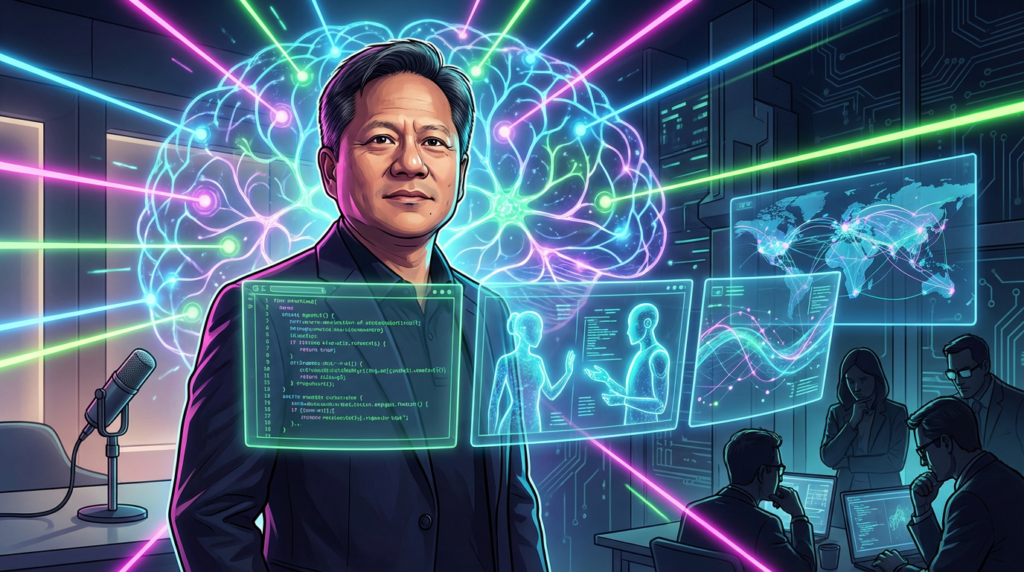
The Nvidia CEO dropped a bombshell on the Lex Fridman Podcast. Here’s what he actually said, what he meant, and why it matters.
The Statement That Broke the Internet

Picture this. It’s a Monday. You’re sipping your morning coffee, scrolling through your feed, and suddenly — boom — the CEO of one of the most powerful tech companies on the planet casually drops the phrase “I think we’ve achieved AGI.”
That’s exactly what happened when Jensen Huang, the leather-jacket-wearing, GPU-selling, AI-hype-fueling CEO of Nvidia, sat down with podcaster Lex Fridman. In one short sentence, Huang lit up every AI forum, tech subreddit, and LinkedIn comment section on the planet.
Was he serious? Was it a marketing play? Is AGI actually here?
Buckle up. We’re breaking it all down.
Who Is Jensen Huang, and Why Should You Care?
Let’s set the stage. Jensen Huang isn’t just some random tech executive throwing buzzwords around. He runs Nvidia, a company currently valued at roughly $4 trillion. Yes, trillion with a “T.”
Nvidia makes the GPUs that power virtually every major AI system you’ve heard of. OpenAI’s GPT models? Nvidia chips. Google’s Gemini? Nvidia chips. The AI that writes your emails, generates your images, and summarizes your meetings? You guessed it Nvidia chips.
When Jensen Huang talks about AI, the entire industry listens. His words move markets. His statements shape narratives. So when he says “we’ve achieved AGI,” it’s not just a throwaway comment. It’s a headline. It’s a moment.
And it happened on the Lex Fridman Podcast, one of the most-watched tech interview shows in the world.
What Did He Actually Say?
Here’s where it gets interesting. Fridman asked Huang a pretty direct question: when does he think AGI will arrive? Is it five years away? Ten? Twenty?
Huang didn’t hesitate. He said, “I think it’s now. I think we’ve achieved AGI.”
Fridman’s reaction was priceless. He told Huang, “You’re gonna get a lot of people excited with that statement.”
No kidding, Lex.
But Huang didn’t stop there. He went on to talk about OpenClaw, the open-source AI agent platform that’s been making waves, He described how people are using individual AI agents to do all kinds of things, building apps, creating digital influencers, launching social products. He even compared it to a Tamagotchi. Remember those? Huang suggested that one of these AI-built apps could blow up overnight and become a massive hit.
It was a vivid, exciting picture. AI agents hustling in the digital economy, building things, making money, going viral.
Wait — But Then He Walked It Back?
Here’s the twist. Almost as quickly as he made the bold claim, Huang pumped the brakes.
He acknowledged that most of these AI-built projects fizzle out. People try them for a couple of months, then move on. The novelty wears off. And then came the most revealing line of the entire interview.
“The odds of 100,000 of those agents building Nvidia is zero percent.”
Let that sink in. The man who just said AGI is here also admitted that no collection of AI agents could build the company he runs. That’s not a small caveat. That’s a massive one.
So what’s going on? Is AGI here or not? The answer, it turns out, depends entirely on how you define the term.
The AGI Definition Problem Is Real
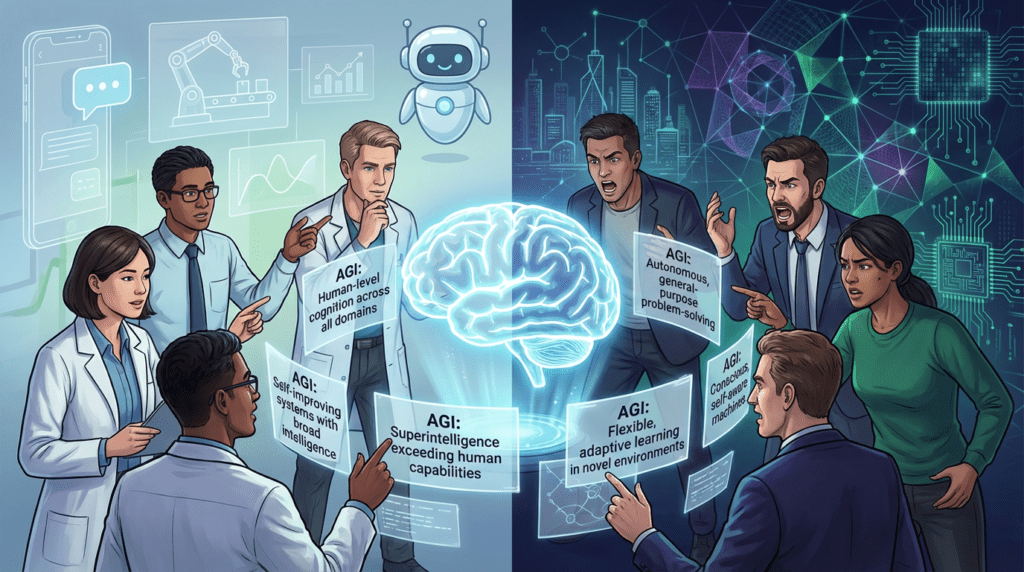
This is where the conversation gets genuinely fascinating, and a little messy.
AGI, or Artificial General Intelligence, doesn’t have a single agreed-upon definition. Ask ten AI researchers what AGI means, and you’ll get ten different answers. Some point to specific benchmarks. Others describe it as a qualitative threshold of reasoning ability. It’s one of the most debated terms in all of tech.
Fridman, for his part, offered his own definition during the interview. He described AGI as an AI system capable of essentially doing your job, specifically, one that could start, grow, and run a successful tech company worth more than $1 billion.
Huang’s definition? Much narrower. Back at the 2023 New York Times DealBook Summit, he laid it out clearly: software that can pass tests reflecting normal human intelligence at competitive levels. He predicted AI would hit that bar within five years. Now, apparently, he thinks it already has.
Under Huang’s framework, an AI that builds a simple app, goes viral, and generates a billion dollars in revenue qualifies as AGI. He even compared it to the dot-com era, suggesting many of those early websites could have been built by an AI.
That’s a very different bar than “build the next Nvidia.”
As El-Balad reported, Huang’s interpretation “does not require that an AI sustain any business over time.” It just needs to generate the revenue. Once. That’s it.
The Business Case Behind the Bold Claim
Let’s be real for a second. Jensen Huang is a brilliant businessman. He didn’t build a $4 trillion company by accident. And when you look at his AGI declaration through a business lens, it starts to make a lot more sense.
Gentic News put it bluntly: “Huang’s AGI declaration is less a technical assessment and more a strategic market signal.”
Think about it. Nvidia doesn’t sell AGI. It sells the hardware and software that companies use to build AGI-like applications. GPUs, networking infrastructure, AI Enterprise software, that’s the product. And if Huang can convince the market that the AGI era has arrived, every enterprise on the planet suddenly feels urgent pressure to invest in Nvidia’s full stack.
It’s a masterclass in narrative control. By declaring AGI “achieved,” Huang effectively tells every CEO, every investor, every policymaker: “The foundational technology is here. Stop waiting. Start building.”
And who do they build with? Nvidia.
The timing isn’t random either. Nvidia’s data center revenue now eclipses its traditional gaming revenue. Competitors like AMD are gaining ground. Custom silicon efforts from Google and Amazon are eating into Nvidia’s dominance. Huang needs to keep the momentum going. Declaring AGI “achieved” creates urgency. It keeps Nvidia at the center of the story.
What Do AI Researchers Actually Think?
Here’s where the tech community pushes back, hard.
Most AI researchers would raise an eyebrow at Huang’s claim. Large language models are genuinely impressive. They write code, analyze data, generate creative content, and hold surprisingly coherent conversations. But they still struggle with consistent reasoning. They hallucinate facts, They fail in unfamiliar situations. They lack the kind of robust, flexible understanding that most researchers associate with true general intelligence.
The AI community largely views Huang’s statement as a market signal, not a technical milestone. There’s no benchmark he cited. No specific model he pointed to. No peer-reviewed paper backing the claim. Just a confident declaration on a podcast.
That ambiguity, as Gentic News noted, “serves Nvidia’s interests: it generates discussion while avoiding commitment to any particular technical standard that might later prove embarrassing if unmet.”
Clever? Absolutely. Technically rigorous? Not so much.
The “Can AI Run a Company?” Question
One of the most fascinating moments in the interview came when Fridman asked a follow-up question: “Do you think you could have a company run by an AI system like this?”
Huang’s answer was a single word: “Possible.”
That one word sparked its own wave of debate. Is Huang suggesting AI could replace CEOs? That entire organizations could be automated? That human leadership is on the way out?
Probably not, at least not in the near term. What Huang is likely pointing to is the growing reality of AI automating business processes, customer service, operational decision-making, and routine management tasks. Nvidia’s own platforms already do this for enterprise clients.
The vision isn’t a robot CEO sitting in a boardroom. It’s AI systems coordinating workflows, making data-driven decisions, and handling the operational grunt work that currently requires armies of human workers. That’s already happening. And it’s accelerating fast.
Still, the idea that a company could be run by AI, even partially, is a genuinely radical concept. It raises enormous questions about accountability, ethics, and what human work even means in an AI-saturated economy.
Why This Moment Matters Beyond the Hype
Strip away the marketing spin. Ignore the definitional gymnastics. Look past the podcast theatrics. What’s left is something genuinely significant.
The CEO of the company that builds the hardware powering modern AI just said, on one of the world’s most-watched tech podcasts, that AGI is here. That’s a cultural moment. It shifts the conversation, It changes how enterprises think about AI investment, It influences how policymakers approach regulation. It shapes how the public perceives the technology.
Words from people like Jensen Huang don’t just describe reality. They help create it.
And whether you agree with his definition of AGI or not, the underlying trend is undeniable. AI systems are getting more capable, faster than almost anyone predicted. They’re handling tasks that seemed impossible just three years ago, They’re generating real economic value. They’re reshaping industries.
The debate over whether we’ve “achieved” AGI might be semantic. But the transformation happening around us is very, very real.
The Bottom Line

Jensen Huang said something bold. He walked part of it back. He left the rest deliberately vague. And in doing so, he sparked exactly the kind of conversation that keeps Nvidia at the center of the AI universe.
Is AGI here? Depends on who you ask, and how they define the term.
What’s not debatable is this: AI is more powerful than ever. It’s moving faster than ever. And the people building it, and profiting from it, are making bigger and bolder claims than ever before.
Whether that’s exciting or terrifying probably depends on your job description.
One thing’s for sure: the AGI conversation isn’t going away anytime soon. And Jensen Huang just made sure of that.
Sources
- The Verge — Nvidia CEO Jensen Huang says ‘I think we’ve achieved AGI’ — Hayden Field
- El-Balad — NVIDIA CEO Jensen Huang Reveals Insightful AGI Definition — Bassyonni,
- Gentic News — NVIDIA CEO Jensen Huang Claims ‘We’ve Achieved AGI’ in Lex Fridman Podcast Interview — Gentic.news Editorial
The Kingy Brief
Get future Kingy Brief editions.
Source-checked AI changes, original tests and one practical thing to try.
Free · Choose your subjects · Double opt-in · Unsubscribe anytime
Regular sending is paused; no restart date is set.