When a Near-Miss Becomes a Wake-Up Call
It happens in an instant. A car cuts you off, there’s a bang, and you’re left on the shoulder of a highway wondering: did I get the plate? You pull up your dashcam footage only to find a blurry smear where the license number should be. For many drivers, that moment — replayed in countless dash cam forums and Reddit threads — is what finally forces the upgrade.
That’s exactly the scenario that opens a recent video review of the DDPAI Z90 Master, and it’s a far more compelling pitch than any spec sheet. The Z90 Master isn’t just a dashcam. It’s DDPAI’s answer to a growing frustration with the industry: why, in 2025 and 2026, are so many three-channel systems still pairing a flagship front lens with a bargain-bin rear camera and a barely-functional interior unit?
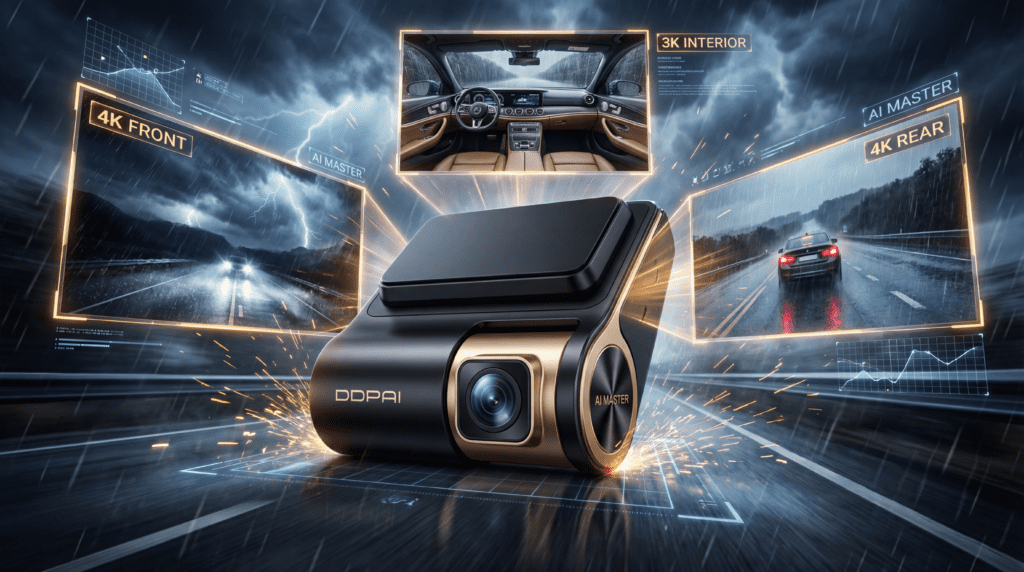
The DDPAI Z90 Master challenges that compromise head-on. It offers genuine 4K recording on both the front and rear cameras simultaneously, a 3K cabin camera with infrared night vision and AI portrait processing, dual-storage redundancy, optional 4G LTE cloud connectivity, and a suite of AI-driven safety alerts that go well beyond the standard “beep when you drift.” It’s a bold, premium system — and one that deserves a serious, honest look before you hand over your credit card.
This is that review.
What Is the DDPAI Z90 Master?
DDPAI, a Chinese dashcam manufacturer with a growing North American presence, launched the Z90 series in late 2025. The Z90 Master is the flagship of that lineup — sitting above the Z90 Pro and the base Z90 in terms of resolution, sensors, and features.
The core proposition is what DDPAI calls “Flagship Triple Vision, Full Digital Clarity.” That means:
- Front: 4K UHD (3840×2160) @ 30fps, with an optional 3K @ 60fps mode
- Rear: 4K UHD (3840×2160) @ 30fps
- Cabin/Interior: 3K (approximately 2880×1620) @ 30fps with IR and AI portrait processing
That’s genuinely rare. As the video review correctly points out, most triple-channel dashcam systems on the market pair a strong 4K front unit with a significantly weaker 1080p or 1440p rear, then throw in an interior camera that barely qualifies as functional. Matching 4K on both the front and rear — while adding a high-resolution interior unit — is a meaningful differentiator.
The Z90 Master is available in several configurations on Amazon and on DDPAI’s official store: as a 2-channel unit (front + rear), a 3-channel unit (adding the cabin camera), and bundled with or without the optional 4G LTE Cloud Box for remote connectivity.
Hardware Deep Dive: What’s Actually Inside
The Sony STARVIS 2 IMX678: The Sensor That Changes Everything
The Z90 Master’s front and rear cameras both use the Sony STARVIS 2 IMX678 sensor — a 1/1.8-inch, 8-megapixel chip that has become the benchmark for premium dashcam image quality. The STARVIS 2 family is Sony’s second-generation back-illuminated CMOS sensor line, specifically engineered for low-light performance in automotive and security applications.
What does that mean practically? The IMX678 captures significantly more light per pixel than older CMOS sensors, which translates directly into reduced noise, better color accuracy, and sharper detail in challenging lighting conditions — exactly what you need when trying to read a license plate in the rain at 11pm.
For the front camera, DDPAI specifies an F1.75 aperture with a 135° field of view. The rear camera runs at F1.7 with a 126° FOV. Both are wide enough to capture adjacent lanes without distorting proportions. The cabin camera, meanwhile, operates at F1.5 — the most light-hungry aperture of the three — combined with a 148° field of view wide enough to see through the vehicle’s side windows, capturing angles that front and rear cameras fundamentally cannot reach.
Triple HDR: What It Actually Means in Practice
DDPAI describes the Z90 Master’s image processing as “Triple HDR” — meaning all three camera channels apply High Dynamic Range processing simultaneously. In practical terms, HDR helps the camera manage scenes where there’s a large contrast between bright and dark areas: think of driving into a tunnel from a sunny highway, or capturing a vehicle in front of you with the sun blazing directly behind it.
Standard dashcams often blow out bright areas (overexpose the sky) or crush dark areas (underexpose the shadowed road). HDR processing blends multiple exposures to retain detail across the full brightness range. The Z90 Master pairs this with what DDPAI calls “NightVIS 2.0 with AI ISP,” which applies artificial intelligence-based image signal processing to further refine low-light footage. One verified Amazon purchaser noted that “low-light performance is better than I expected” after hardwiring the unit — real-world confirmation that the spec sheet claims translate to actual footage.
The Cabin Camera: The Feature That Sets This Apart
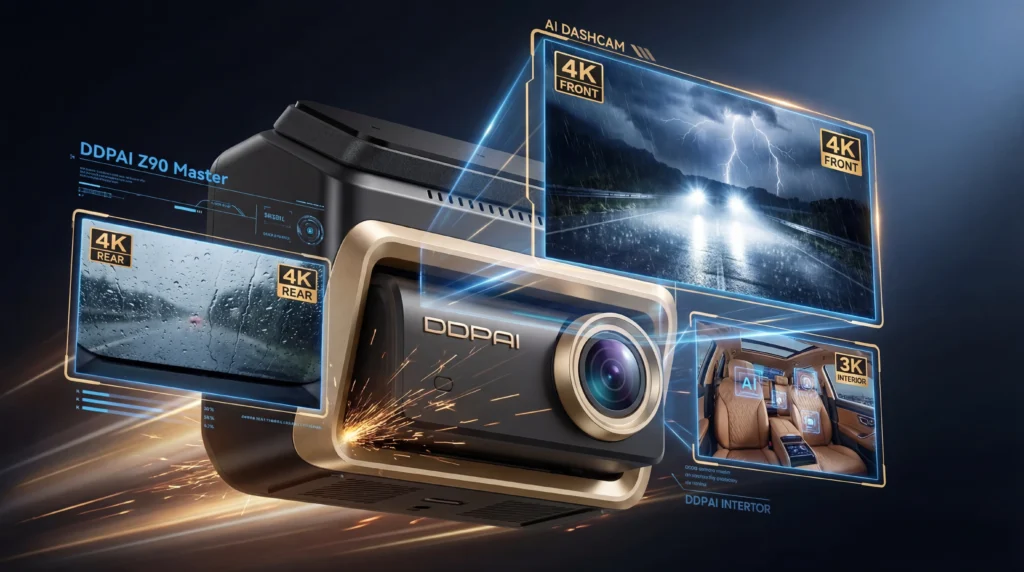
Most people shopping for a triple-channel dashcam are focused on front and rear. The interior camera tends to be an afterthought. DDPAI has done something genuinely interesting with the Z90 Master’s cabin unit.
The interior camera uses dual infrared LEDs combined with a “ColorSense Night Mode” that DDPAI contrasts directly against traditional binary IR (which renders everything in flat, ghostly black and white). The result, according to both the product page and the video review, is full-color interior recording in very low light conditions — not the washed-out green-tint look of older IR systems.
Beyond the IR performance, DDPAI has added “AI Portrait” processing specifically for the interior channel. This AI tuning is designed to render skin tones more naturally, balancing interior and exterior lighting so that subjects inside the car don’t appear blown-out when the exterior is bright. For rideshare and taxi drivers, this is more than a nice-to-have — it’s a material differentiator that can mean the difference between usable and useless footage in a dispute.
Speaking of rideshare: if you’re planning to use the Z90 Master in a commercial capacity, the DDPAI Z90 Master Review explicitly flags the need to check local privacy laws before recording passengers. This is an important caveat — interior recording regulations vary by jurisdiction, and it’s your responsibility to comply.
Build Quality: Supercapacitor, CPL Filter, and Physical Design
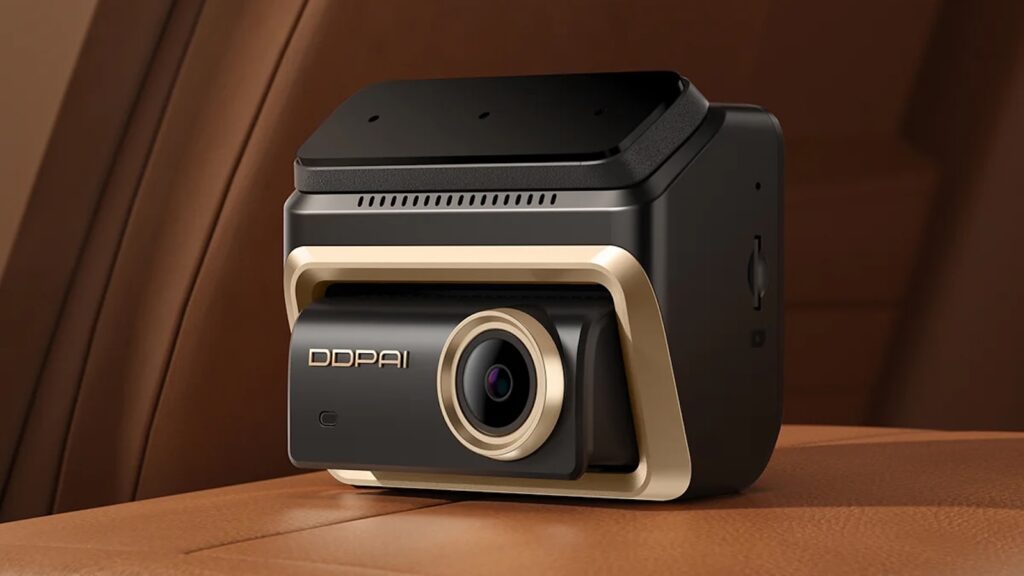
The Z90 Master measures 83.0 × 67.5 × 46.3mm and weighs 204.5g — not a small unit, but not unreasonable for what it’s doing. The 3-inch IPS LCD screen (640×360 resolution) is non-touch; all interaction beyond viewing happens via three physical buttons (Menu, OK, and Power) or through the DDPAI smartphone app.
Rather than a lithium-ion battery — which degrades in extreme heat and cold, a chronic problem for dashcams mounted on sun-exposed windshields — the Z90 Master uses a supercapacitor. Supercapacitors don’t degrade the same way batteries do, handle a much wider temperature range (-20°C to 70°C operating, -40°C to 85°C storage), and provide reliable short-term power for error-free recording shutdown in case of a sudden power loss. This is a premium choice that reflects the Z90 Master’s flagship positioning.
Every package also includes a Circular Polarizer (CPL) filter, which reduces reflections from the windshield, dashboard, and other glass/metal surfaces. This is the dashcam equivalent of putting a UV filter on a camera lens — it’s a small accessory that makes a real difference in footage quality, particularly in bright conditions, and the fact that it’s included rather than sold separately is appreciated.
Installation: Three Cameras, One System
Getting a triple-channel dashcam set up is inherently more involved than a single-lens unit, and the Z90 Master is no exception. The main unit mounts to the windshield via an electrostatic sticker and 3M adhesive bracket. The rear camera (“D-CAM”) connects to the main unit’s Type-C port via a 6-meter extension cable, which you’ll route through the headliner and down the C-pillar. The cabin camera (MINI3X, sold as an add-on for the 3-channel configuration) connects wirelessly via DDPAI’s “πLink” technology — no additional wire run required.
For power, you have three options:
- Cigarette lighter / 12V adapter: Quickest to install, no parking mode, cable clutter
- Intelligent Hardwire Kit: Connects to the fuse box, enables 24/7 parking monitoring, cleanest finish — but requires routing wires and basic electrical knowledge
- OBD Power Cable: Plugs into the OBD-II port, a middle ground between the two
One verified Amazon reviewer spent considerable time hardwiring their Z90 Master and found the process “not hard, but getting everything hidden and looking clean takes time” due to routing three separate camera units. A local car audio shop installation is a reasonable option if a factory-clean finish is your standard.
Once powered on, the initial setup involves pairing the device via the DDPAI app, formatting the microSD card, calibrating the ADAS sensors, and configuring time zone and recording preferences. The πLink wireless pairing for the interior camera requires a few extra steps in the app to bring all three channels under one management interface — the DashCamTalk community has noted this can require some patience on first setup, but once connected, the system syncs automatically on every subsequent start.
The DDPAI App: Your Actual Control Center
The Z90 Master’s three physical buttons give you basic recording control and status monitoring, but the device’s full feature set lives inside the DDPAI app (available for Android and iOS). Connectivity is handled through Bluetooth 5.1 for quick pairing, then 5GHz Wi-Fi (802.11ac) for data transfer — meaning you can pull high-resolution footage to your phone quickly rather than waiting for a slow 2.4GHz connection.
Within the app, you can:
- Live preview all three camera channels simultaneously
- Browse, download, and share video clips (5GHz speeds make this practical even for large 4K files)
- Adjust ADAS calibration by aligning the horizon line in live view
- Configure parking mode parameters, including sensitivity thresholds for the G-sensor and motion detection
- Access “SR Mode” (DDPAI’s “Sense Reality” overlay), which adds GPS telemetry, speed data, and heading information visually overlaid on your footage
- Receive push notifications for parking events, geofence triggers, and CabinCare alerts (requires 4G module)
- Initiate firmware updates over the air
One of the more practical app features worth calling out: when the optional 4G LTE Cloud Box is installed, you gain the ability to remotely wake the camera, view a live stream from any of the three channels, receive real-time location tracking, and have emergency clips automatically uploaded to cloud storage. This isn’t just remote viewing for curiosity — it’s a genuine security feature that could be decisive in a theft, vandalism, or hit-and-run scenario.
Video Quality: Day, Night, and Everywhere In Between
Daytime Performance
With dual Sony STARVIS 2 IMX678 sensors and 4K resolution on both the front and rear, daytime performance is where the Z90 Master most obviously delivers on its premium positioning. License plates — the practical benchmark every driver actually cares about — are clearly legible. One verified Amazon purchaser specifically tested this: “I was able to clearly read license plates from about 13 to 16 feet away, and the image was very sharp. That was something I specifically tested.” In high-resolution 4K, text and detail that would be a pixelated guess on a 1080p camera become unambiguous evidence.
The CPL filter’s contribution to daytime quality is also meaningful. Dashboard reflections and windshield glare — two of the most common reasons dashcam footage becomes inadmissible or useless — are substantially reduced. Even with front-window tinting, the same reviewer found the camera “still handled reflections well and kept the image clean.”
The optional 3K@60fps mode for the front camera is worth noting for drivers particularly concerned about fast-moving objects or highway driving. The higher frame rate reduces motion blur, which can make a difference when trying to freeze a frame of a vehicle that’s already passed. You trade some resolution for the extra frames, but it’s a useful mode to have available.
Night Vision and NightVIS 2.0
Night performance is where the combination of the IMX678 sensor, F1.75 front aperture, and DDPAI’s NightVIS 2.0 with AI ISP technology comes into its own. The AI ISP layer doesn’t just brighten dark footage — it applies algorithmic noise reduction and detail enhancement that legacy image signal processing can’t match. The result is footage that retains color fidelity and sharpness in city streets, not the washed-out greenish monochrome of older low-light systems.
Challenging lighting scenarios — entering a lit intersection from a dark road, managing oncoming headlight glare, transitioning between a lit expressway and an unlit side street — are where triple HDR processing proves its value. By managing the extreme dynamic range of night driving environments, the Z90 Master avoids the overexposed headlight halos and crushed shadow detail that plague less capable systems.
Interior IR: A Class of Its Own
The Z90 Master’s cabin camera switches between AI-enhanced full-color mode during the day and an infrared-assisted “ColorSense Night Mode” at night. This is a meaningful step beyond the binary on/off IR systems on most interior cameras. Traditional IR cameras in dashcams often render subjects with an unnatural color cast and poor skin tone rendering — fine for identifying that someone was present, less useful for any evidentiary or identification purpose.
DDPAI’s approach — pairing dual IR LEDs with AI portrait processing — produces interior footage where faces remain identifiable even in complete darkness within the cabin. The video review demonstrates this: even in still shots taken in a dark cabin using the voice command “Take Photo,” the AI portrait optimization captures usable face detail. For rideshare drivers who need to document passenger interactions or for parents monitoring children in the back seat, this is a meaningful capability.
AI Features in Practice: ADAS, CabinCare, and Smart Alerts
ADAS 2.0: Active Driver Assistance
The Z90 Master includes ADAS 2.0 — Advanced Driver Assistance System — which is DDPAI’s umbrella term for camera-based driver safety features. The implemented alerts include:
- Forward Vehicle Start Alert: Notifies the driver when the vehicle ahead begins moving (useful at stop lights when you’re distracted)
- Driver Fatigue Alert: Triggers after extended driving periods to prompt the driver to take a break
These alerts require the ADAS to be properly calibrated through the app — a step that involves positioning the horizon line correctly in the live preview interface. Skipping this step will produce inaccurate or missed alerts, so it’s worth taking the time during initial setup.
It’s worth being honest about what ADAS 2.0 is and isn’t: this is a camera-based system, not radar or lidar. It’s meaningful as a supplementary alert layer, but it’s not a replacement for the active collision avoidance systems in modern vehicles. Lane Departure Warning and Forward Collision Warning are included in the feature set, though real-world performance depends on road conditions, visibility, and proper calibration.
CabinCare: The Post-Exit Intelligence Feature
One of the Z90 Master’s most genuinely novel features is what DDPAI calls “CabinCare.” Using the interior camera and onboard AI, CabinCare can detect — after the driver exits the vehicle — whether:
- A child or pet has been left behind in the cabin
- Windows or the sunroof have been left open
If any of these conditions are detected, the system sends a push notification to the driver’s smartphone via the DDPAI app. This requires the 4G LTE module for remote delivery, but even on local Wi-Fi, the alert logic runs on-device.
The left-behind child and pet detection is particularly significant. Heat-related deaths in vehicles are a genuine public safety issue, and having a camera system that actively monitors for this scenario — rather than requiring a separate accessory or manual check — is a feature that’s hard to put a dollar value on. It’s the kind of AI application that justifies the “smart dashcam” label in a way that most products using that term don’t.
Smart Voice Control
A smaller but practically useful AI feature is the voice command system. Saying “Take Photo” triggers the camera to save a 10-second video clip — five seconds before the command and five seconds after — across all active channels. This works in the dark, in motion, and with passengers present. No hands. No fumbling with the app.
For capturing a moment that isn’t necessarily a collision (a scenic view, a suspicious vehicle idling nearby, a minor interaction worth documenting), this is a genuinely ergonomic addition. The video review highlights this as one of the daily-use convenience features that makes the Z90 Master a pleasure to live with, not just a security appliance you forget is there.
D²save 2.0: The Case for Dual Storage
Dashcam storage is a topic that rarely gets the attention it deserves — until the moment you need footage and discover your microSD card failed silently three weeks ago. DDPAI’s answer to this is “D²save 2.0“: a dual-storage architecture that combines a built-in 128GB eMMC chip with a microSD slot expandable up to 512GB.
In practice, this means the camera records to both storage mediums simultaneously. If the microSD card fails, corrupts, or is physically removed, the eMMC continues recording without interruption. If the eMMC fills up, the microSD provides overflow capacity. The system is designed to be self-managing — no manual intervention required.
In terms of capacity, DDPAI’s own lab data shows the following approximate recording durations at 4K (front + rear dual-channel):
| Storage Configuration | Recording Duration (approx.) |
|---|---|
| 128GB eMMC only | ~3.5 hours |
| 128GB eMMC + 64GB microSD | ~5.25 hours |
| 128GB eMMC + 128GB microSD | ~7 hours |
| 128GB eMMC + 256GB microSD | ~10.5 hours |
| 128GB eMMC + 512GB microSD | ~17.5 hours |
One Amazon reviewer — who opted for a SanDisk 512GB High Endurance card to supplement the built-in eMMC — noted an additional ~$65 cost for maximum storage. For a system recording three channels at these resolutions, that’s a reasonable and worthwhile investment. DDPAI recommends UHS-3 class cards for reliable write speeds at 4K.
For file organization, the system tags footage from each channel separately (front, rear, cabin), places G-sensor triggered events in a dedicated “event” folder, and stores voice command photos with their own timestamp. GPS telemetry is embedded in the files and viewable on a map within the DDPAI app.
Connectivity: 5GHz Wi-Fi, BLE 5.1, and the Optional 4G Module
The Z90 Master’s wireless stack is built around 5GHz Wi-Fi (802.11ac) for data transfer and Bluetooth 5.1 for initial pairing. The BLE 5.1 connection allows password-free, one-touch Wi-Fi pairing from the app — removing the friction that makes many dashcam apps feel clunky. Once paired, the 5GHz Wi-Fi connection enables fast video downloads that make pulling recent footage onto your phone a practical, sub-minute operation rather than the multi-minute wait that 2.4GHz systems impose.
For GPS, the Z90 Master supports five positioning systems: GPS, GLONASS, BDS (BeiDou), Galileo, and QZSS. Multi-system GPS provides faster lock and more reliable positioning, particularly in urban canyons or areas with limited sky visibility.
The optional 4G Cloud Box — sold separately — adds an entirely different dimension to the system. With a 4G module installed, the Z90 Master becomes a genuinely always-on connected device:
- Remote live view: Stream from any of the three cameras from anywhere
- Cloud backup: Emergency clips and snapshots are automatically uploaded
- Geofencing: Receive alerts when the vehicle enters or leaves a defined geographic area
- Remote two-way voice: Talk directly into the cabin via the main unit’s built-in speaker and microphone
- Real-time GPS tracking: Monitor the vehicle’s location in real time
This is particularly relevant for fleet operators, parents with young drivers, or anyone who parks their vehicle in areas where theft or vandalism is a concern.
Parking Mode: 24/7 Three-Channel Surveillance
With the Intelligent Hardwire Kit installed, the Z90 Master supports three parking monitoring modes:
- Time-Lapse Recording: Continuous recording at 5 frames per second, capturing everything over long parking periods at dramatically reduced storage consumption. AI ISP Night Vision applies to front/rear in this mode.
- Collision Detection Mode: High-definition recording triggered automatically by the G-sensor upon detecting any impact — a door ding, a parking lot collision, or a vehicle strike.
- IPS Power Management: The camera continuously monitors the vehicle battery voltage across 6 configurable levels, automatically shutting down the system before the car battery drains to the point where the vehicle won’t start.
This combination — smart power management plus triple-channel coverage including interior — makes the Z90 Master genuinely viable as a 24-hour vehicle surveillance system, not just a driving recorder. For fleet managers, rideshare operators, or anyone whose vehicle is regularly parked in public spaces overnight, this feature set is significant.
How It Compares: The Triple-Channel 4K Landscape
The Z90 Master sits at the premium end of the dashcam market, but it isn’t competing in isolation. Here’s how it stacks up against key alternatives:
| Model | Front | Rear | Interior | Built-in Storage | Key Connectivity | Price |
|---|---|---|---|---|---|---|
| DDPAI Z90 Master | 4K@30fps (IMX678) | 4K@30fps (IMX678) | 3K@30fps (IR + AI) | 128GB eMMC | 5GHz Wi-Fi, BLE 5.1, GPS, Optional 4G | $389.99 (3CH) |
| BlackVue DR900X-3CH | 4K@30fps | 2K@30fps | 1080p@30fps (IR) | None | Dual-band Wi-Fi, GPS, Optional LTE | ~$600+ |
| Vantrue OnDash N4 | 4K@25fps | 1080p@30fps | 1080p@30fps (IR) | None | No Wi-Fi | ~$260 |
| Thinkware U1000 | 4K@30fps | 2K@30fps | N/A | None | Wi-Fi, GPS, Optional LTE | ~$400 |
| VIOFO A229 Pro 2CH | 4K@30fps | 2K@30fps | N/A | None | 5GHz Wi-Fi, GPS | ~$260 |
The Z90 Master’s most significant competitive advantage is the 4K+4K+3K triple-channel specification — no direct competitor at this price point matches it on rear and interior resolution simultaneously. The BlackVue DR900X-3CH is a respected system with strong cloud capabilities, but it retails for significantly more without the built-in storage advantage. The Vantrue N4 undercuts on price but makes meaningful resolution sacrifices on the rear and interior, and lacks Wi-Fi entirely.
The 128GB built-in eMMC is a genuine differentiator that doesn’t show up clearly in spec comparison tables but matters enormously in practice: you get reliable, always-on storage regardless of microSD card health, right out of the box.
Pricing and Value: What You’re Actually Paying For
On Amazon, the Z90 Master 3-channel unit retails at $389.99, with occasional coupon discounts bringing it closer to $329. Bundled with the hardwire kit, the package runs approximately $319.99. Adding the 4G LTE module brings the total to approximately $369.99 as a bundle (prices vary and are subject to change — always verify at time of purchase). On DDPAI’s official store, the Z90 series starts at $219.00 for base configurations.
Budget for a high-endurance 256GB or 512GB microSD card (approximately $35–$65 for a quality card like the Samsung Pro Endurance or SanDisk High Endurance) to complement the built-in eMMC. If you want parking mode, budget for the hardwire kit. If you want remote 4G features, budget for the Cloud Box and a SIM card (DDPAI notes a free SIM is available in selected regions — confirm availability before purchase).
The total cost of a fully equipped 3-channel setup with hardwire and 4G can approach $450–$500. That’s not inexpensive. But compare it to the BlackVue DR900X-3CH at $600+ for a system with lower interior resolution and no built-in storage, and the Z90 Master’s value proposition becomes clearer. You’re getting more camera for less money — the trade-off is that DDPAI is a newer name in the North American market, and long-term reliability data across a large install base is still being established.
Real User Experiences: What Owners Are Saying
The Z90 Master is a relatively new product — it first became available on Amazon in late December 2025 — so the user review base is still building. That said, early verified purchasers have shared a consistent pattern of observations.
The positive: video quality consistently exceeds expectations. Multiple buyers have highlighted plate legibility at real-world distances as a standout result. One reviewer tested it specifically and confirmed clear reads from 13–16 feet. Audio quality has also drawn praise — the internal microphone captures cabin audio clearly without distortion or excessive ambient noise.
The critical: installation complexity is real. Three separate camera units, wire routing from front to rear, and the πLink pairing process for the interior camera require time and patience. One reviewer flagged intermittent recording gaps in their footage — segments where recording apparently paused and resumed, leaving a time jump in the clip timeline. This is worth monitoring; the issue may be firmware-related and potentially addressable via OTA update, which DDPAI provides. Another early buyer received a unit that appeared to have been returned and repackaged — a fulfillment issue rather than a product defect, but worth noting as a reason to purchase from DDPAI’s official Amazon storefront (sold by “DDPAI Globe”) and inspect packaging carefully on arrival.
DDPAI’s customer support received specific positive mention: one buyer contacted them during installation and found the response “quick with clear instructions” — a good sign for a brand building its North American reputation.
Who Is This For?
The DDPAI Z90 Master is a purpose-built system for a specific type of driver. It excels in the hands of:
- Rideshare and taxi operators who need legally defensible footage of every trip, including the interior
- Fleet managers tracking company vehicles and driver behavior
- Security-conscious commuters who regularly park in urban environments or want remote monitoring capability
- Tech-forward drivers who want the latest sensor technology and aren’t put off by an app-dependent ecosystem
- Parents who want to monitor young drivers from afar, including the cabin interior
- Luxury vehicle owners willing to invest in a premium protection system commensurate with the vehicle
It is not the right choice for drivers who want a set-it-and-forget-it dashcam, are uncomfortable with a multi-step installation, prefer a hidden or discreet mount, or are unwilling to rely on a smartphone app for configuration and file access. For those users, simpler 2-channel systems from DDPAI’s own lineup — like the Z60 Pro or Z90 Pro — or competitors like the VIOFO A229 Pro may be better-suited.
The Verdict: A Genuinely Ambitious Dashcam That Earns Its Price
The DDPAI Z90 Master is one of the most capable dashcam systems available in early 2026. On the spec sheet, it does things that no triple-channel competitor at its price point can match: true 4K on both front and rear simultaneously, a 3K interior camera with AI portrait processing and ColorSense IR night vision, 128GB of built-in eMMC storage as a safety net, and a connectivity suite that includes 5GHz Wi-Fi, BLE 5.1, multi-constellation GPS, and optional 4G LTE cloud features.
More importantly, those specs translate to real-world performance that justified buyers’ confidence. License plates are legible. Night footage is clean. The interior camera does more than most people expect a cabin unit to do. The CabinCare AI and Post-Exit alerts represent a genuine evolution of what a dashcam can monitor — not just the road ahead, but the environment inside and around the vehicle after you walk away.
The Z90 Master is not a beginners’ dashcam. Installation demands time, patience, and ideally some comfort with vehicle electrical systems — or a budget for professional installation. The app-dependent interface means your smartphone is part of the required ecosystem. And at $389.99 for the 3-channel unit, plus potential additional costs for a large microSD card, hardwire kit, and 4G module, the total investment can reach $450–$500 for a fully configured system.
But for drivers who want the most complete, high-resolution, AI-enhanced vehicle coverage available today — particularly rideshare operators, fleet managers, and security-conscious owners — the Z90 Master delivers. It’s the right answer to the wrong moment: the one where you pull up your dashcam footage and can finally, clearly, read the plate.
The Kingy Brief
Get future Kingy Brief editions.
Source-checked AI changes, original tests and one practical thing to try.
Free · Choose your subjects · Double opt-in · Unsubscribe anytime
Regular sending is paused; no restart date is set.