The AI Assistant That Now Knows You
Google just made a big move. And it affects every single one of its users in the United States.
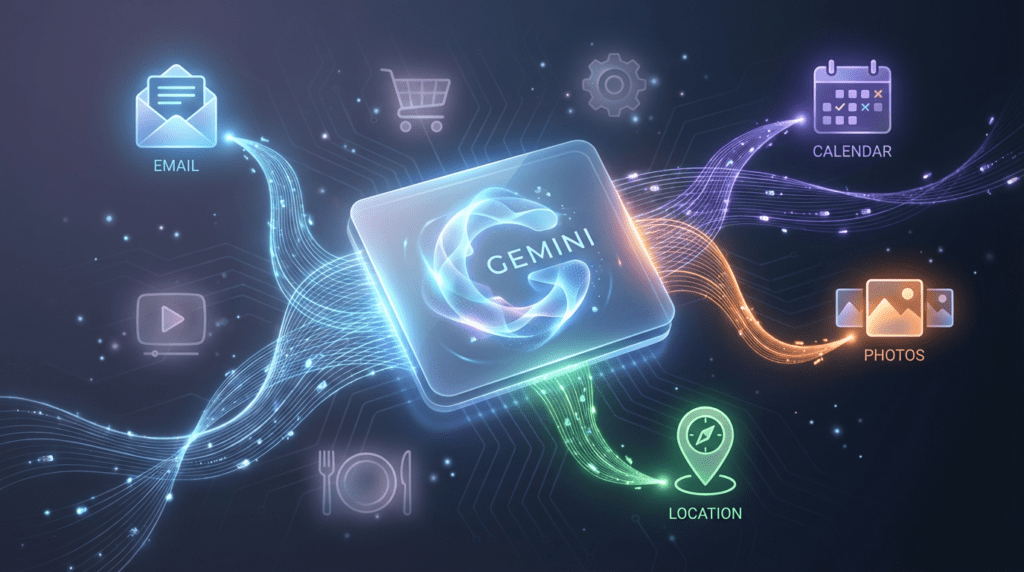
On March 17, 2026, Google announced that its Personal Intelligence feature, previously locked behind a paid subscription, is now available to all free-tier users in the US. That’s a massive shift. It means millions of everyday people can now connect their Gmail, Google Photos, YouTube, and other Google apps directly to Gemini.
The result? An AI assistant that doesn’t just answer questions. It answers your questions, with context it already knows about you.
Think about what that looks like in practice. You ask Gemini for a restaurant recommendation. It already knows your neighborhood from your Google Maps history. You ask it to help plan a trip. It pulls your upcoming calendar events. You ask about a product. It remembers what you’ve already bought.
This is not your average chatbot. This is something far more intimate.
And that intimacy is exactly what’s making people nervous.
What Is Personal Intelligence, Exactly?
Let’s break it down simply. Personal Intelligence is a Gemini feature that connects to your existing Google apps to give the AI more context when it responds to you.
It’s opt-in. You choose to turn it on. You can also disconnect apps at any time.
Google has been clear about one thing: Gemini does not train directly on your Gmail inbox or Google Photos library. Instead, it uses limited information, like specific prompts you’ve typed and the model’s responses, to improve personalization.
When The Verge‘s Allison Johnson tested the feature earlier this year, she noted that “Gemini can analyze my interests and make some pretty good guesses about what I’d be interested in; it’s the details where AI gets lost.”
So it’s impressive. But it’s not perfect.
Still, the expansion of Personal Intelligence to free users is a significant step. Before this announcement, only Google AI Pro and AI Ultra subscribers had access. Now, free-tier users can use it through AI Mode in Search, Gemini in Chrome, and the Gemini app itself, though only on personal Google accounts, not business, enterprise, or education accounts.
Google is clearly betting that personalization is the future of search. And based on what its executives are saying, that bet is only getting bigger.
750 Million Users and Counting
Here’s a number that should stop you in your tracks: 750 million.
That’s how many monthly active users Gemini now has, according to Alphabet’s Q4 2025 earnings report. Just one year ago, in March 2025, that number was 350 million. Gemini more than doubled its user base in twelve months.
For context, OpenAI doesn’t release monthly active user numbers. But its weekly active user count sits at around 900 million, a figure that includes ChatGPT’s massive global footprint.
The growth race between these two AI giants is real. And it’s accelerating fast.
Google’s rapid expansion gives it enormous leverage. Advertisers want to reach audiences. And right now, hundreds of millions of people are shifting from traditional search to conversational AI. That’s a seismic change in how people find information, and how companies can reach them.
Google knows this. And it’s starting to act on it.
The Ad Question Nobody Can Ignore
Here’s where things get complicated.
For months, Google executives insisted that ads in Gemini were not on the table. In January 2026, Google DeepMind CEO Demis Hassabis told reporters at Davos that the company had no “any plans” to put ads in Gemini. That seemed definitive.
Then came the WIRED interview with Nick Fox.
Fox is Google’s Senior Vice President of Knowledge and Information. He’s one of the most powerful people shaping how Google’s AI products evolve. And in a candid conversation with WIRED, he said something that turned heads across the tech industry.
“We’re not ruling them out,” Fox said, referring to ads in Gemini.
That’s a direct contradiction of what Hassabis said just weeks earlier. And it signals a clear shift in Google’s internal thinking about how to monetize its fastest-growing AI product.
Fox was careful to frame it as a long-term consideration, not an immediate plan. But the direction is unmistakable. Ads are coming to Gemini. The only question is when, and how.
AI Mode: Google’s Testing Ground
Google isn’t jumping straight into Gemini ads. It’s being strategic. Smart, even.
Right now, Google is testing ads inside AI Mode, its Gemini-powered Search product. Think of AI Mode as a sandbox. A lower-stakes environment where Google can experiment with ad formats before rolling them into the standalone Gemini app.
“We have an environment with AI Mode where we can experiment [with ads],” Fox told WIRED.
The rules Google is following in AI Mode are straightforward. Ads stay separate from organic results. They’re clearly labeled. If no ad is relevant to a query, Google doesn’t show one. The company is drawing on over 20 years of Search advertising experience to guide every decision.
Fox also pointed out that Google’s business is in excellent shape. In 2025, Alphabet crossed $400 billion in annual revenue, almost entirely from advertising. That financial strength gives Google the luxury of patience. It doesn’t need to rush Gemini monetization the way a startup might.
“The general philosophy we have is to build a great consumer product, then figure out monetization,” Fox said. “Because the business is so strong and healthy, that’s a luxury we have.”
That’s a very different position from OpenAI, which reportedly aims to more than double its $30 billion revenue in 2026 and is already testing ads in ChatGPT’s free tier in the United States.
The Industry Is Divided
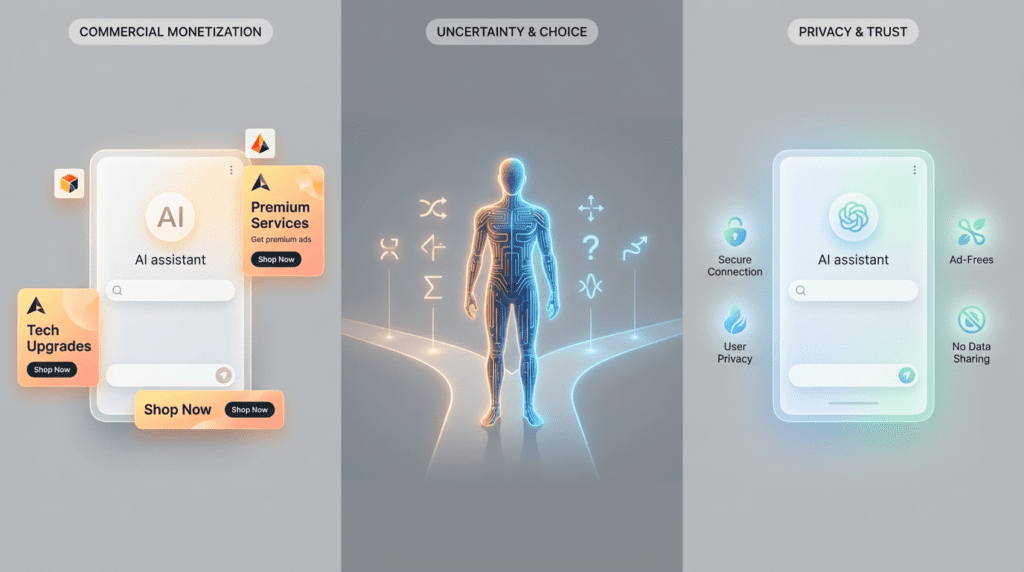
Google isn’t the only company wrestling with this question. The entire AI industry is fracturing over advertising.
OpenAI moved first. In January 2026, it announced it would start testing ads in ChatGPT’s free tier. CEO Sam Altman framed it as a matter of access, a way to bring AI to billions of people who can’t afford subscriptions.
Anthropic took the opposite stance. The company ran a Super Bowl commercial that directly warned against ads in AI. It was a bold, public statement. Anthropic is betting that trust, not ad revenue, is the real currency of the AI era.
Perplexity went even further. In February 2026, the AI search startup announced it would stop experimenting with ads entirely, citing concerns about user trust. That’s a significant reversal for a company that once predicted advertising would be a massive business.
Emarketer analyst Jeremy Goldman has warned that ad placements risk driving users away from AI products altogether. The concern is real. Users come to AI assistants for clean, helpful, unbiased answers. Ads, even well-targeted ones, can feel like a betrayal of that promise.
But Google occupies a unique position in this debate. It’s the only major AI company approaching chatbot ads from a position of advertising dominance. It has two decades of ad-targeting infrastructure. It has the data and It has the scale. And now, with Personal Intelligence, it has something even more powerful: deep personal context.
When Personal Data Meets Advertising
This is the part that deserves the most attention.
Personal Intelligence connects Gemini to your Gmail, Google Photos, YouTube, and Calendar. It knows what you’ve bought, where you’ve been, and it knows what you’ve searched for, what videos you’ve watched, and what emails you’ve received.
Now imagine ads layered on top of that.
Fox acknowledged this tension directly in his WIRED interview. He called the intersection of Personal Intelligence and advertising “TBD” to be determined. But he didn’t dismiss it. He said Google would need to figure out “how the targeting of the ads can be consistent with the organic response.”
He also offered a telling example. While skiing, Fox asked AI Mode a vague question about goggle lenses. The AI pulled his resort location from his email, checked the weather forecast, and even found a receipt his wife had forwarded him for a spare lens. It knew exactly what he needed.
“It’s like subtle magic,” Fox said.
Now imagine that same interaction, but with a sponsored goggle brand appearing in the response. That’s the future Google is quietly building toward.
Fox was quick to add that Google does not sell user data to advertisers. “We’ll make sure that your private information remains private and isn’t shared with advertisers,” he said. But the line between using personal data to target ads and sharing that data with advertisers is one that users may find difficult to distinguish in practice.
Privacy advocates are already paying close attention. The combination of intimate personal data and AI-powered ad targeting represents a fundamentally different dynamic than traditional Search advertising, which only targets the intent expressed in a single query. Personal Intelligence goes much deeper. It targets patterns drawn from a user’s entire digital life.
What Google Says About User Trust
Fox doesn’t dismiss the challenge. He actually leans into it.
“It’s an odd thing to say, but our research shows that users actually like ads within the context of Search,” he told WIRED. “Over time, we’ll figure out what makes sense in the Gemini app.”
That’s a measured, careful statement. Google isn’t rushing. It’s watching. It’s learning from AI Mode. And it’s building toward a version of Gemini advertising that it believes users will accept, or even appreciate.
The company also emphasized that Personal Intelligence remains opt-in. Users choose to connect their apps. They can disconnect at any time. Google says it won’t surprise users with changes to how their data is used.
“This is not something that’s being done to users,” Fox said. “This is something that users are choosing to invoke.”
That framing matters. Google is trying to position Personal Intelligence, and any future advertising tied to it, as a user-driven experience, not a corporate extraction of personal data.
Whether users buy that framing remains to be seen.
The Bigger Picture: AI Is Rewriting Everything

Step back for a moment. Look at the full picture.
Google just opened its most personal AI feature to hundreds of millions of free users. Its AI chatbot has surpassed 750 million monthly active users. Its top executive just confirmed that ads in Gemini are not off the table. And the company is actively testing ad formats in its AI-powered Search product right now.
This is not a company standing still. This is a company in the middle of the most significant transformation in its history.
Search, the product that built Google’s empire, is changing. It’s becoming conversational. It’s becoming personal. And it’s becoming the foundation for a new kind of advertising that knows you better than any ad platform ever has.
The stakes are enormous. For Google, advertisers and for users. And for the future of how we interact with information online.
The AI era isn’t coming. It’s already here. And Google is making sure it’s at the center of it.
Sources
- The Verge — “Now everyone in the US is getting Google’s personalized Gemini AI”
- WinBuzzer — “Google Not Ruling Out Ads in Gemini as Users Top 750M”
- WIRED — “Google Is Not Ruling Out Ads in Gemini”
- VMVirtualMachine — “Google Leaves Door Open to Ads in Gemini”
The Kingy Brief
Get the next Kingy Brief.
Source-checked AI changes, original tests and one practical thing to try.
Free · Choose your subjects · Double opt-in · Unsubscribe anytime