The Big Announcement Nobody Saw Coming (But Everyone Predicted)

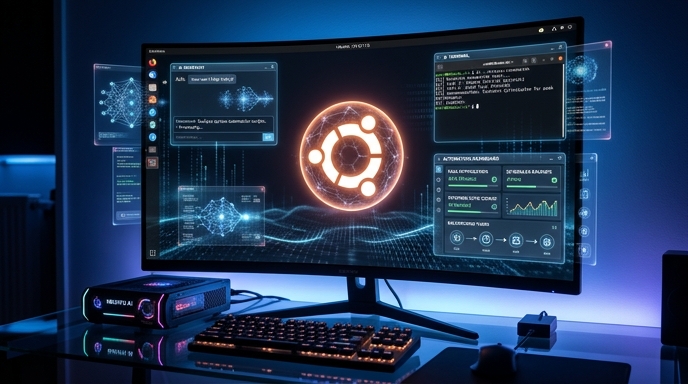
Let’s be honest. The moment AI started showing up in every app, every phone, and every toaster on the planet, it was only a matter of time before Linux got the treatment too. And now it’s official. Canonical, the company behind one of the world’s most popular Linux distributions, Ubuntu, just dropped a roadmap that’s going to change how millions of users interact with their operating system.
Jon Seager, VP of Engineering at Canonical, published a detailed blog post on Ubuntu Discourse laying out the plan. The headline? AI features are coming to Ubuntu “throughout 2026.” The fine print? Ubuntu is not becoming an AI product. That’s a quote, by the way, straight from Seager himself.
So what does that actually mean? Buckle up, because this story has layers.
Two Flavors of AI — Pick Your Poison
Seager’s roadmap splits Ubuntu’s AI future into two distinct categories. Think of it like a menu at a restaurant you didn’t know you were walking into.
First, there’s the “implicit” AI. This is the quiet stuff. AI models running in the background, making your system smarter without announcing themselves. Better speech-to-text. Smarter text-to-speech. System optimizations that learn your workflow. You won’t see a big “AI” badge slapped on these features. They’ll just… work. Or at least, that’s the plan.
Then there’s the “explicit” AI. This is where things get spicy. Seager calls these “AI native” features, opt-in tools for users who actually want them. We’re talking agentic AI workflows. Autonomous systems that can complete multi-step tasks with minimal hand-holding. Imagine telling your computer to troubleshoot a network issue and having it actually do it. That’s the vision.
As The Verge reported, these features range from accessibility tools to full-blown agentic automation. It’s ambitious. It’s exciting. And it’s making a lot of Linux users very, very nervous.
The “We’re Not Forcing This On You” Promise
Here’s where Canonical is trying to thread a very thin needle. The Linux community is not exactly known for embracing corporate AI initiatives with open arms. Open-source developers tend to be skeptical. Privacy-conscious users tend to be vocal. And Ubuntu’s own community has a long memory when it comes to features that felt forced.
Seager seems to know this. He’s been careful with his language. The roadmap emphasizes opt-in features, local inference by default, and a preference for open-weight models. He even addressed the internal culture at Canonical directly, saying he won’t be measuring engineers by how much AI they use, but by how well they deliver.
That’s a refreshing stance. Most tech companies right now are racing to slap AI on everything and call it innovation. Canonical is at least saying they want to be thoughtful about it.
But saying and doing are two very different things.
The Snap Connection — AI Delivered Safely?

One of the more interesting technical details in Seager’s post involves Snap packages. For those unfamiliar, Snap is Canonical’s containerized app format, a way to bundle software with all its dependencies so it runs consistently across different Linux systems.
Seager believes Snap will play a key role in delivering AI features safely and securely. The idea is that agentic AI workflows could be packaged and sandboxed through Snap, limiting what they can access and reducing security risks.
As GamingOnLinux reported, Canonical is developing a framework that separates implicit and explicit AI features. Implicit AI enhances what Ubuntu already does. Explicit AI introduces entirely new capabilities. Snap sits at the center of that delivery mechanism.
It’s a smart approach, in theory. Snap has had its own controversies in the Linux world, and some community members are already cracking jokes about “slop in slop.” But the security argument is solid. Containerized AI features are a lot less scary than AI with unrestricted system access.
What About Privacy? The Question Everyone’s Asking
Here’s the elephant in the room. AI features that run locally are great. AI features that phone home to cloud servers? That’s a different conversation entirely.
Seager’s post emphasizes a “bias toward local inference by default.” That’s encouraging. But the word “bias” is doing a lot of heavy lifting in that sentence. It doesn’t mean always local. It means preferably local. And that distinction matters enormously for privacy-conscious users and enterprises with strict data policies.
OSNews was blunt about this. Thom Holwerda called the entire post “deceptively vague, open-ended, and weasely.” He pointed out that adjectives like “focused,” “principled,” “thoughtful,” and “tasteful” don’t actually commit to anything. Words like “favour” and “where possible” leave the door wide open for cloud-based models and third-party AI providers to find their way into your default Ubuntu installation.
That’s a fair critique. Corporate communications about AI tend to be optimistic and light on specifics. Canonical’s post is no exception. The community deserves concrete answers about what runs locally, what doesn’t, and who controls the data.
The Accessibility Angle — A Genuine Win?
Let’s pump the brakes on the skepticism for a second. Because buried in all the corporate language is something genuinely exciting: accessibility.
Improved speech-to-text and text-to-speech capabilities could make Ubuntu significantly more usable for people with disabilities. That’s not a small thing. Linux has historically lagged behind Windows and macOS in accessibility features. If Canonical can close that gap using AI, that’s a real win for real people.
Seager also made an interesting point about the “famously fragmented” Linux desktop ecosystem. He suggested that LLMs could help new users navigate that complexity, demystifying the capabilities of a modern Linux workstation and bringing them to a much wider audience.
Think about that for a moment. Linux has always had a reputation for being powerful but intimidating. If AI can lower that barrier without dumbing down the experience, Ubuntu could reach users who never considered it before. That’s a compelling vision.
TechBuzz noted that companies building machine learning pipelines already favor Linux. Having AI tools baked into the OS itself eliminates friction. If Canonical delivers seamless integration with popular frameworks like PyTorch and TensorFlow, Ubuntu becomes an even more attractive platform for data science teams.
The Competition Is Already Moving
Let’s zoom out for a second. Canonical isn’t making this move in a vacuum. Microsoft shipped Copilot across Windows 11. Apple embedded Apple Intelligence into macOS. Google keeps pushing AI features into Chrome OS. The enterprise landscape is shifting fast.
AI capabilities are quickly becoming table stakes. If Ubuntu doesn’t evolve, it risks looking dated in a world where every major OS is getting smarter. Canonical’s move keeps Ubuntu competitive, at least on paper.
And here’s the kicker: Red Hat and SUSE haven’t announced comparable AI initiatives yet. That gives Canonical a real window to differentiate Ubuntu in a crowded market. If the execution matches the ambition, this could shift enterprise Linux preferences in a meaningful way.
The rollout timeline spans the next year, which gives Canonical room to iterate. That’s smart. The AI landscape shifts constantly. What works in Q2 2026 might be obsolete by Q4. Building flexibility into the roadmap makes sense.
The Community Reacts — And It’s Complicated
The Linux community’s response has been… predictably mixed. Some users are cautiously optimistic. Others are furious. And a few are already planning their migration to other distributions.
On GamingOnLinux, one user wrote: “I didn’t leave Windows for more AI in my operating system!” Another called Canonical “the Microsoft of Linux.” A third simply said: “Nope.”
But not everyone is doom-scrolling. Some community members pointed out that local inference, opt-in features, and open-weight models are actually the right way to do AI integration. One commenter on OSNews put it well: “AI that’s designed to advance FOSS interests and local user control checks the right boxes. However, talk is cheap, it’s going to come down to what they actually deliver.”
That’s the crux of it. The Linux Mint team is already watching closely. Some users predict Mint will strip out whatever AI features Canonical adds, just as they’ve done with other Ubuntu additions in the past. A full switch to a Debian base for Mint might be getting closer.
The open-source community has a long history of forking, remixing, and rejecting features they don’t want. Canonical knows this. The question is whether they can deliver AI integration that feels native and useful, not bolted on and intrusive.
What Canonical Is Doing Internally
It’s not just about the product. Canonical is also changing how its own engineers work.
Seager’s post describes a deliberate internal push toward AI education and competence. Rather than forcing a single AI stack on everyone, Canonical is encouraging different teams to experiment with different tools. The goal is to learn as an organization, to figure out where AI actually adds value before committing to a specific approach.
As Noise/LWN reported, Canonical is “not setting shallow metrics on token usage, or percentages of code written with AI.” Instead, they’re incentivizing engineers to experiment and understand. That’s a mature approach. It acknowledges that AI tools can be genuinely useful and genuinely harmful, depending on how they’re used.
Seager also flagged a real concern: AI-generated “slop” pull requests flooding open-source projects. He’s aware that LLMs can hinder learning if people use them as a crutch. His position is nuanced, LLMs are excellent learning tools, but you still need to be skeptical and not blindly trust the output.
That kind of self-awareness is rare in corporate AI announcements. It doesn’t guarantee good outcomes, but it’s a better starting point than blind enthusiasm.
The Verdict — Exciting, Vague, and Worth Watching

So where does this leave us? Ubuntu is getting AI. That much is certain. The details are still fuzzy. The timeline is broad. The privacy questions are unanswered. And the community is divided.
But here’s the thing: this is actually the most interesting moment in Ubuntu’s history in years. Canonical is making a bet that AI can make Linux more accessible, more powerful, and more competitive, without betraying the open-source values that built the platform.
That’s a hard balance to strike. Apple and Microsoft have the resources to throw at AI integration and iterate until it works. Canonical is working with a smaller team, a more demanding community, and a much higher bar for transparency.
The next 12 months will tell us everything. Will the AI features feel native and useful, Will local inference actually be the default? Will the open-source community embrace or reject what Canonical builds?
We’re watching. And honestly? We’re kind of rooting for them to pull it off.
Sources
- The Verge — Canonical lays out a plan for AI in Ubuntu Linux
- TechBuzz — Canonical lays out a plan for AI in Ubuntu Linux
- GamingOnLinux — Canonical developer lays out some AI plans for Ubuntu Linux
- OSNews — Ubuntu is going to integrate AI, but Canonical remains vague about the how and why
- Noise/LWN — The future of AI in Ubuntu
- Jon Seager’s original post — Ubuntu Discourse
Related Guides
Compare
Recent Launches
- Firefox Takes a Stand: Browser Introduces Comprehensive AI Kill Switch in Response to User Concerns
- Microsoft Revolutionizes Windows 11 with Game-Changing AI Features
- Microsoft Copilot on Windows 11: A New Era of PC Computing
Latest News
The Kingy Brief
Get future Kingy Brief editions.
Source-checked AI changes, original tests and one practical thing to try.
Free · Choose your subjects · Double opt-in · Unsubscribe anytime
Regular sending is paused; no restart date is set.