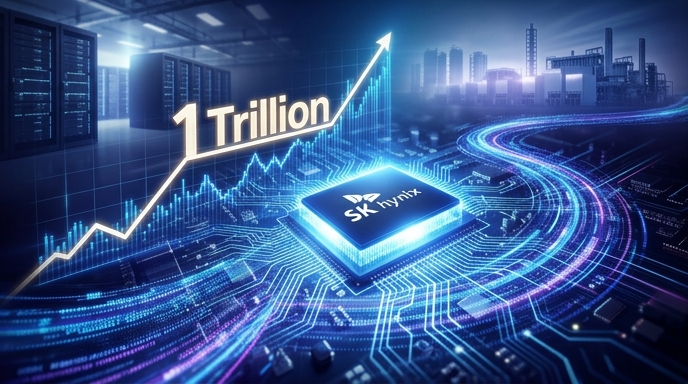
The Newest Member of the Trillion-Dollar Club
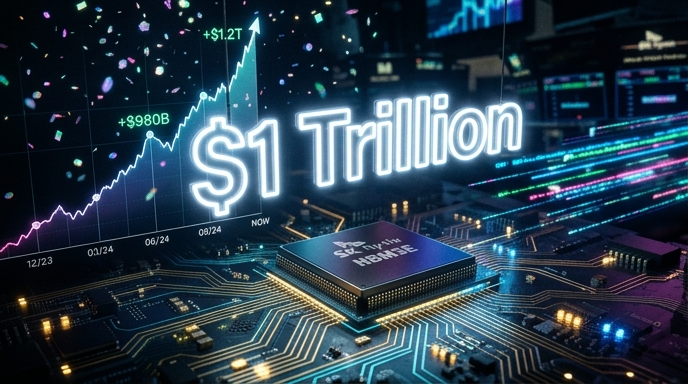
SK Hynix has done it. The South Korean memory-chip giant has joined the $1 trillion club, and it did not tiptoe through the door. It kicked it open with a stock rally powered by artificial intelligence, soaring demand for memory chips, and a market that suddenly treats semiconductor suppliers like rock stars with fabs.
On Wednesday, May 27, 2026, SK Hynix crossed the trillion-dollar market-cap line after a huge jump in its share price. Business Insider reported that the company’s shares closed up more than 9% at 2,243,000 Korean won, or about $1,500 per share. That pushed the company’s value above $1 trillion, or roughly 1,500 trillion Korean won.
That is not a small flex. That is a skyscraper-sized signal.
For years, investors obsessed over the glamorous names in tech. Apple had the iPhone. Microsoft had software and cloud. Alphabet had search. Amazon had everything from cardboard boxes to cloud servers. Nvidia had the AI chip crown.
Now SK Hynix has entered the room with memory chips. Not flashy, Not cute. Not something you brag about at brunch.
But absolutely essential.
And in the AI economy, essential is the new sexy.
Why Memory Chips Are Suddenly Hot
Memory chips used to live in a less glamorous neighborhood of the semiconductor market. Investors respected them, sure, but they also treated them as cyclical beasts. Prices rose. Prices fell. Supply tightened. Supply flooded back. Margins boomed. Margins got whacked.
Then AI changed the script.
Modern AI systems do not just need powerful processors. They need vast amounts of fast memory to move data quickly. That is where high-bandwidth memory, or HBM, comes in. HBM helps AI servers handle enormous workloads without choking on their own hunger for data.
SK Hynix has become a major player in this crucial layer of the AI buildout. It supplies memory chips used in AI systems, including chips tied to the broader server and accelerator ecosystem. Investors have noticed. Actually, “noticed” is too polite. Investors have stampeded.
Business Insider reported that SK Hynix’s share price had risen more than 230% in 2026 by the time it hit the milestone. It also said the stock was about 1,000% higher than at the same point in 2025.
That is not a rally. That is a moonshot with a balance sheet.
The old view said memory was boring and cyclical. The new view says memory is a chokepoint in the AI economy.
Markets love chokepoints. They smell pricing power.
South Korea Gets Its Semiconductor Moment
SK Hynix’s trillion-dollar moment is not just a company story. It is also a South Korea story.
BusinessKorea described the milestone as a new chapter for South Korea’s semiconductor industry. It noted that SK Hynix became the second domestic company to enter the global $1 trillion club after Samsung Electronics. That matters because it shows that South Korea is not merely participating in the AI boom. It is sitting near the center of the machinery.
Samsung crossed the trillion-dollar mark earlier in May, according to Business Insider. SK Hynix followed soon after. That gave South Korea two trillion-dollar corporate champions in the same broad chip universe.
That is rare air.
The Kospi has also surged. Business Insider reported that South Korea’s main stock index had more than tripled since the start of 2025, helped by market reforms and the global AI rally. This matters because investors used to treat South Korea’s market with a discount. It was often seen as cheap, complicated, and under-loved.
Now the mood has flipped.
AI has turned Korean chip stocks into global market celebrities. The phrase “Korea discount” suddenly sounds like an artifact from another age, like a fax machine or a sincere corporate mission statement.
SK Hynix did not rise alone. It rose with a national market behind it.
The Numbers Behind the Surge
BusinessKorea reported that SK Hynix traded at 2,258,000 won, about $1,505, at 9:43 a.m. on May 27, up 10.04% from the previous trading day. It also said the stock rose as high as 2,279,000 won during intraday trading.
Business Insider later reported that shares closed up more than 9% at 2,243,000 won.
Those figures differ slightly because they capture different points in the trading day. That is normal. Stocks move. Markets twitch. Traders drink too much coffee.
BusinessKorea also cited CompaniesMarketCap as recording SK Hynix’s market capitalization at $1.05 trillion that day. The article said the company climbed three spots in global rankings to 12th place, surpassing Berkshire Hathaway, while Samsung Electronics remained ahead with a market cap of $1.378 trillion.
The details tell a clear story: investors were not gently warming to SK Hynix. They were chasing it.
BusinessKorea also pointed to improved supply-demand dynamics, expectations for a global semiconductor recovery, and rising memory-chip demand. It said Mirae Asset Securities raised its target price for SK Hynix from 3,200,000 won to 3,800,000 won, an 18.8% increase.
The message from analysts was blunt: this rally may already look wild, but some still see more upside.
Markets can get overexcited. They can also identify real bottlenecks before everyone else does.
The AI Trade Moves Beyond Nvidia
Nvidia remains the obvious winner of the AI boom. It designs the accelerators that power much of today’s AI infrastructure, It became the poster child for the trade. It earned that crown.
But the AI market is no longer just asking, “Who makes the smartest chip?”
It now asks, “Who supplies the whole machine?”
That question changes everything.
TipRanks argued that the $1 trillion club is starting to look less like a list of consumer-tech empires and more like a map of the AI supply chain. That is the key point. Apple, Amazon, Microsoft, and Alphabet built huge businesses around users, software, devices, search, advertising, and cloud. The new entrants show investors rewarding the invisible plumbing behind AI.
Memory matters. Manufacturing capacity matters. Networking matters. Chip equipment matters. Cloud infrastructure matters.
TipRanks highlighted SK Hynix and Micron as signs that investors now reward the memory-chip layer of the AI boom, not just Nvidia and the big platform companies. It also named Taiwan Semiconductor Manufacturing Company and Broadcom as central players in the broader AI infrastructure story.
This is the more interesting phase of the AI rally. The first phase celebrated the star quarterback. The second phase pays the offensive line.
And without the line, the quarterback gets flattened.
Micron Joins the Same Conversation
SK Hynix was not alone in crossing the trillion-dollar threshold. Micron also hit the milestone around the same period, according to Business Insider and TipRanks.
That timing matters. It suggests investors were not merely betting on one South Korean champion. They were re-pricing the memory-chip sector itself.
TipRanks reported that Micron reached the milestone after a sharp rally and another 19.29% jump on Tuesday, tied to strong demand for AI memory chips. Business Insider said Micron’s rise was helped by UBS tripling its price target and by public praise from President Donald Trump, who said at a rally that Micron was “great” and investing hundreds of billions.
The politics may grab headlines. The deeper story sits in the demand curve.
AI data centers need mountains of memory. Companies building AI systems keep spending. Cloud giants keep adding capacity. Every new model, server cluster, and data-center expansion increases the pressure on the supply chain.
Memory companies used to suffer because supply could swamp demand. Now investors are betting that AI demand may stay strong enough to change the old rhythm.
That bet may prove right. It may prove overheated. But it is not random.
The market has found a new favorite corner of the AI trade, and it has a very specific address: memory.
Why This Milestone Matters
A $1 trillion valuation is not just a number with dramatic zeroes. It changes how investors, governments, suppliers, and competitors view a company.
SK Hynix now sits in a club that once felt almost reserved for American tech giants and a few global outliers. Business Insider reported that 14 companies worldwide were worth more than $1 trillion at the time of SK Hynix’s move: 10 based in the United States, two in South Korea, one in Taiwan, and one in Saudi Arabia.
That distribution says plenty.
The U.S. still dominates the trillion-dollar club. But Asia’s chip powers now hold serious weight. Taiwan has TSMC. South Korea has Samsung and SK Hynix. These companies do not just make products. They anchor the infrastructure behind modern computing.
BusinessKorea quoted a financial investment industry representative saying SK Hynix’s role in the global AI semiconductor supply chain had been “proven in numbers.” That is corporate-speak, yes, but the point lands.
AI has turned memory into strategic infrastructure.
Governments care about that. So do investors, So do cloud providers. So do every company’s AI team quietly begging for more compute capacity.
SK Hynix’s valuation tells the world that memory chips are no longer background music. They are part of the main act.
The nerds have taken the stage. Again.
What Could Go Wrong?
The bullish case is powerful. But it is not bulletproof.
Memory remains a cyclical business. TipRanks noted that memory-chip stocks still carry cyclical risk, and today’s AI pricing power may not last forever. That warning deserves attention. Markets love to extrapolate. Give investors three quarters of strong demand and they start drawing hockey-stick charts like caffeinated architects.
Supply can expand. Demand can cool. Customers can delay orders. Competitors can catch up. AI spending can wobble if investors start demanding profits instead of promises.
There is also valuation risk. A trillion-dollar market cap sets a brutal standard. Once a company trades like a permanent winner, even a small disappointment can hit hard.
BusinessKorea reported aggressive analyst forecasts for future operating profit and DRAM average selling price growth. Those projections may support the bull case, but they also raise the stakes. When expectations climb that high, “good” results may not be good enough.
That is the cruel little joke of market success.
SK Hynix now has prestige, momentum, and strategic importance. It also has a target on its back.
The company must keep executing. It must defend its memory leadership. It must ride the AI wave without getting crushed by the next supply cycle.
Easy? No. Possible? Clearly.
The Bigger Picture: AI Picks Its Suppliers
The SK Hynix rally shows how the AI boom keeps widening.
At first, investors chased the companies building AI models and selling AI dreams. Then they chased Nvidia, because Nvidia sold the shovels in the gold rush. Now they are chasing the companies that make the shovel factory work.
That is a more mature market story.
AI needs chips. Chips need memory. Memory needs fabs. Fabs need tools. Tools need supply chains. Supply chains need capital. Capital needs confidence. And confidence, in 2026, seems to be wearing an AI hoodie and sprinting through the semiconductor sector.
TipRanks argued that the next trillion-dollar candidates may come from several industries, including retail, healthcare, banking, semiconductors, and cloud infrastructure. But it also said semiconductors remain the industry to watch.
That seems right.
Walmart, Eli Lilly, and JPMorgan may all hover near the club’s velvet rope. But the most electric story remains AI infrastructure. AMD, ASML, Oracle, Broadcom, TSMC, Micron, Samsung, and SK Hynix all represent different pieces of the same puzzle.
The market now values not just who sells AI products, but who makes AI possible.
That is the real shift.
SK Hynix did not become a trillion-dollar company because memory suddenly became charming. It became one because AI made memory indispensable.
Charm is nice. Indispensable pays better.
Sources
- CNN — SK Hynix trillion-dollar club video
- Business Insider — South Korean chipmaker SK Hynix joins the market’s rapidly growing $1 trillion club
- BusinessKorea — SK Hynix Tops $1 Trillion Market Cap
- TipRanks — Beyond Nvidia: Micron, SK Hynix and the AI Stocks Reshaping the $1 Trillion Club
The Kingy Brief
Get The Kingy Brief.
AI changes, original tests and one practical thing to try. Fridays at 09:00 Vancouver time.
Free · Double opt-in · Unsubscribe anytime
Signup help and newsletter schedule
Signup form provided by Beehiiv. After submitting, check your inbox for "Confirm your subscription to The Kingy Brief" and open its confirmation link. Check Spam or Promotions if you cannot find it.
Fridays at 09:00 Vancouver time: source-checked AI changes, original tests and one practical thing to try. The weekly restart begins October 9, 2026. We skip a week when there is not enough verified material. Free. Unsubscribe anytime.