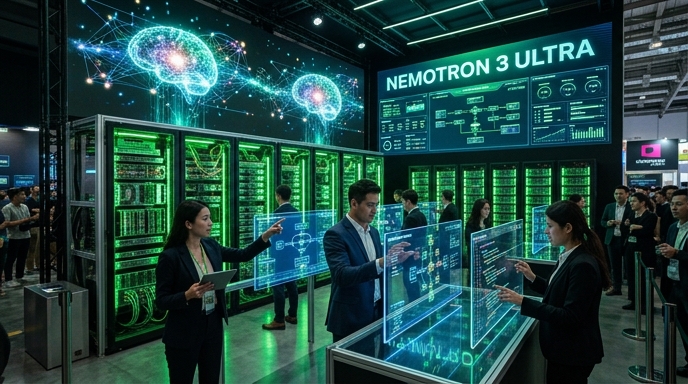
A Leather Jacket, a Giant Model, and a Very Loud Message
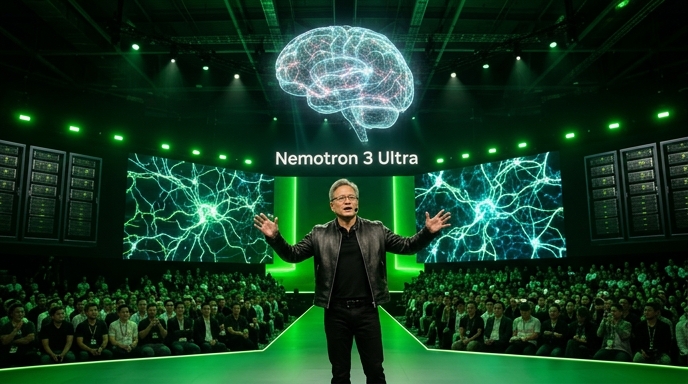
NVIDIA did not tiptoe into Computex 2026. It walked in wearing the corporate equivalent of a leather jacket and dropped a monster.
At the Taipei Music Center on June 1, CEO Jensen Huang introduced Nemotron 3 Ultra, the biggest and most powerful model in NVIDIA’s open AI family so far. The announcement landed with a clear message: NVIDIA does not want to be known only as the company selling the shovels in the AI gold rush. It wants to dig, too.
Nemotron 3 Ultra is a huge open-weight AI model built for serious reasoning, planning, coding, and agent-style work. It sits above Nemotron 3 Nano and Nemotron 3 Super in NVIDIA’s three-tier model lineup.
That matters because the AI race is no longer just about who has the biggest chatbot. It is about who controls the full stack: chips, software, models, cloud tools, deployment systems, and developer mindshare.
NVIDIA already dominates the hardware conversation. Nemotron 3 Ultra shows it wants a much bigger role in the intelligence layer as well.
What NVIDIA Actually Announced
NVIDIA’s current model listing identifies Nemotron 3 Ultra as a 550-billion-parameter model with 55 billion active parameters. Parameters are the internal values a model uses to process language and generate answers. The total count and the active count describe different aspects of its mixture-of-experts design.
But the more interesting detail is not just the total size. It is how the model uses that size.
Nemotron 3 Ultra uses a mixture-of-experts architecture. Instead of activating the whole giant network for every prompt, it activates only the parts it needs. Decrypt reported that the model has around 550 billion total parameters but uses about 55 billion active parameters at a time.
That is the trick. Big brain, selective effort.
Imagine a hospital. You do not summon every doctor, surgeon, nurse, pharmacist, and radiologist because someone has a sprained ankle. You call the right specialist. Mixture-of-experts works in a similar spirit. It routes work to relevant “experts” inside the model.
The result should be faster responses and lower operating costs than a dense model of similar headline size.
Why “Open-Weight” Matters
Nemotron 3 Ultra is not just another private model sitting behind a corporate wall. NVIDIA is positioning it as an open-weight model.
That does not automatically mean “free-for-all with no rules.” It means developers can access the model weights and build with them in ways that are harder or impossible with fully closed systems. NVIDIA’s Nemotron materials also emphasize open weights, training data, and recipes for specialized AI agents.
That is a serious strategic move.
Closed AI models from companies like OpenAI, Anthropic, and Google can be powerful, polished, and convenient. But they also create dependency. Developers send prompts into someone else’s black box and hope the terms, prices, and access rules stay friendly.
Open-weight models change the mood. Companies can inspect, customize, deploy, and fine-tune models with more control. For regulated industries, privacy-heavy workloads, or infrastructure teams that hate vendor lock-in with the fire of a thousand server racks, that is a big deal.
NVIDIA is not doing this out of charity. Open models also sell GPUs, cloud services, NIM microservices, and enterprise infrastructure. Generosity and business strategy are shaking hands here.
Built for Agents, Not Just Chat
Nemotron 3 Ultra is aimed at “agentic” workflows. That word gets tossed around so often in AI circles that it is starting to sound like seasoning. Still, it means something important.
An AI agent does not merely answer a question. It plans, takes actions, checks results, revises the plan, and continues working. A useful coding agent might inspect a repository, identify a bug, edit files, run tests, and explain the fix. A business agent might search documents, update a dashboard, draft a report, and flag anomalies.
That kind of work needs more than smooth prose. It needs reasoning, tool use, long context, and speed.
Nemotron 3 Ultra was built for advanced reasoning and planning. CryptoBriefing reported that the model targets complex reasoning and agentic workflows, while NVIDIA’s own Nemotron materials describe the family as designed for specialized AI agents.
This is why the model’s architecture matters. Agent workflows can involve many steps. If every step is slow or expensive, the agent becomes less like a digital worker and more like a dramatic intern with a stopwatch problem.
The Speed Story Is the Fun Part
The most eye-catching claim around Nemotron 3 Ultra is not just that it is smart. It is that it is fast.
Decrypt reported that the model served more than 300 output tokens per second on a pre-release DeepInfra endpoint. That is quick. Very quick. Tokens are pieces of words used by AI systems, so higher token output means faster generation.
Speed sounds boring until you watch a slow AI agent crawl through a task. Then it becomes everything.
A chatbot taking five extra seconds is annoying. An autonomous agent taking five extra seconds on every step across 80 steps is a productivity tax wearing a fake mustache.
NVIDIA claims major throughput gains, and CryptoBriefing reported up to 5x higher throughput compared with previous versions. If those gains hold up in real-world deployments, enterprises may care a lot.
Why? Because inference cost is one of AI’s biggest headaches. Training gets the headlines. Inference gets the bills. A faster model can mean lower latency, better user experience, and less money burned per task.
The Architecture: Hybrid, Sparse, and Very NVIDIA
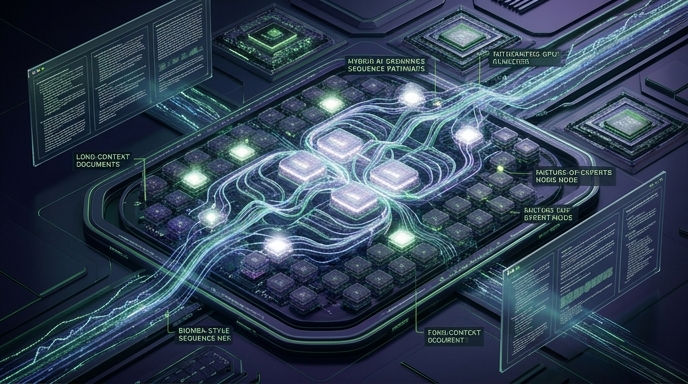
Nemotron 3 is not built like a plain old transformer model. NVIDIA’s research materials describe the family as using a hybrid Mamba-Transformer mixture-of-experts architecture.
That is a mouthful. Let’s unpack it without making anyone run screaming into a spreadsheet.
Transformers are the dominant architecture behind modern large language models. They are powerful, but they can become expensive when dealing with very long sequences. Mamba-style components are designed to process long context more efficiently. Mixture-of-experts adds another efficiency layer by activating only selected parts of the model.
NVIDIA also highlights features such as LatentMoE, multi-token prediction, NVFP4 training for larger models, and support for context lengths up to 1 million tokens.
That 1 million-token context window is a major claim. In practical terms, it means the model can potentially work across huge codebases, long documents, sprawling chat histories, and thick research files without losing the plot after page three.
For enterprise users, that is catnip. Boring catnip, maybe. But powerful.
Nano, Super, Ultra: NVIDIA’s Three-Size Strategy
Nemotron 3 Ultra is the flagship, but it is not alone. NVIDIA built the Nemotron 3 family in three tiers: Nano, Super, and Ultra.
Nano is the lightweight option. It is meant for smaller, cheaper, more efficient deployments.
Super is the middle child, though not exactly neglected. It launched earlier in 2026 as a 120-billion-parameter model designed for mid-range enterprise tasks. CryptoBriefing described it as targeting applications such as collaborative agents and enterprise workflows.
Ultra is the big beast. It is the datacenter-grade model for complex reasoning workloads.
This tiered strategy makes sense. Not every company needs a 550-billion-parameter model to summarize support tickets. That would be like using a space telescope to find your car keys. Impressive, but silly.
By offering multiple sizes, NVIDIA can reach developers working at different scales. Edge devices, single-GPU systems, cloud endpoints, and enterprise datacenters can all fit somewhere in the lineup.
That is classic platform thinking. Give builders a ladder, not just a throne.
The China Problem NVIDIA Cannot Ignore
Decrypt’s June 1, 2026 report described Nemotron 3 Ultra as the leading U.S. open-weight model in a pre-release assessment, while reporting a higher score for Kimi K2.6. That comparison describes the launch period.
Decrypt reported that Artificial Analysis scored Nemotron 3 Ultra at 48 on its Intelligence Index. That put it well ahead of other U.S. open-weight models listed in the report, including Google’s Gemma 4 31B, Nemotron 3 Super, and OpenAI’s gpt-oss-120b.
But Moonshot AI’s Kimi K2.6 reportedly scored higher at 54.
That is not a rounding error. It is a meaningful gap.
Chinese AI labs have become extremely aggressive in open-model releases. They are pushing strong systems into the open ecosystem while many leading American AI labs keep their best models locked behind APIs.
The June 1 report presented Nemotron 3 Ultra as a stronger U.S. open-weight contender, with Kimi K2.6 still ahead in that reported assessment. These dated scores do not establish the current leader.
That is the spicy bit. NVIDIA brought fireworks. China still brought a bigger scoreboard.
Why Enterprises Should Pay Attention
Enterprises will not adopt Nemotron 3 Ultra because it makes fun demo videos. They will care if it solves three problems: cost, control, and capability.
The cost angle is clear. Higher throughput can lower cost per inference. That matters when companies run millions of requests.
The control angle may matter even more. Open-weight models can be customized and deployed in ways closed models cannot. Companies can adapt models for private data, internal workflows, compliance rules, and specialized environments.
Capability is the third leg. Nemotron 3 Ultra targets reasoning, planning, coding, tool use, and long-context tasks. Those are the workflows where companies hope AI can move beyond chat and into actual operations.
Think software maintenance. Think cybersecurity triage. Think customer support automation. Think research analysis. Think internal knowledge systems that do not collapse when handed a 200-page policy document.
None of this means Nemotron 3 Ultra will magically fix enterprise AI. Enterprise AI has a world-class talent for turning promising demos into procurement mud wrestling. Still, the model gives NVIDIA a more credible role in the software side of the stack.
What Investors Should Watch
For investors, Nemotron 3 Ultra is less about one model and more about NVIDIA’s widening moat.
The company already sells the hardware many AI labs need. By developing open models, deployment tools, and AI infrastructure software, NVIDIA can pull customers deeper into its ecosystem.
CryptoBriefing reported that the broader Nemotron 3 family had more than 50 million downloads in the year leading up to April 2026. That suggests real developer interest, though downloads do not always equal production adoption.
The important metric is what comes next.
Do developers keep using Nemotron models after the launch buzz fades? Do enterprises build production agents on NVIDIA’s stack? Do cloud providers and inference platforms make Nemotron 3 Ultra easy to access? Does NVIDIA’s open-model strategy help it compete not only with chip rivals, but also with software-first AI labs?
Those are the questions that matter.
A flashy keynote can move attention. Sustained adoption moves markets.
NVIDIA knows this. The company is not just selling a model. It is selling the idea that the AI factory should run on NVIDIA from floor to ceiling.
What This Means for Developers
For developers, Nemotron 3 Ultra adds another serious option to the open AI toolbox.
That does not mean everyone should download it and try to run it under a desk next to a dusty router. A model this large belongs in datacenter territory. But developers may access it through APIs, cloud providers, inference platforms, or NVIDIA’s own deployment systems.
The open approach also makes the surrounding ecosystem more interesting. NVIDIA’s Nemotron pages mention compatibility with frameworks such as vLLM, SGLang, Ollama, llama.cpp, and NVIDIA NIM microservices, depending on the model and deployment scenario.
That matters because developers hate fragile demos. They want models they can actually deploy, monitor, scale, and customize.
If Nemotron 3 Ultra delivers strong reasoning at high speed, it could become a popular foundation for serious agent systems. Not toy agents. Not “book my vacation and accidentally email my dentist” agents. Real workflow agents.
The catch is simple: benchmarks are not production. Teams will still need to test reliability, hallucination rates, tool-use behavior, latency, privacy, and cost under real workloads.
The model opens a door. It does not carry the furniture in by itself.
The Bottom Line
Nemotron 3 Ultra is NVIDIA’s loudest open-model statement yet.
It gives the company a powerful flagship for reasoning-heavy, agentic AI. It strengthens the U.S. open-weight model scene. It pushes NVIDIA further beyond chips and deeper into full-stack AI infrastructure. It also gives developers and enterprises another serious alternative to closed frontier models.
But it does not settle the open AI race.
In Decrypt’s June 1, 2026 report, the pre-release Artificial Analysis scores put Nemotron 3 Ultra ahead of the listed U.S. open-weight models and behind Kimi K2.6. That is a launch-period comparison, not a current leaderboard ranking or a Kingy benchmark.
Still, the direction is obvious. NVIDIA wants to own more of the AI pipeline. Not just the GPU. Not just the server rack. Not just the cloud plumbing. The model layer, too.
That should make competitors sweat a little.
Computex 2026 gave NVIDIA a stage. Nemotron 3 Ultra gave it a sharper weapon. Now the market gets to find out whether developers treat it like a breakthrough, a benchmark trophy, or another very expensive dragon guarding the datacenter.
Either way, the open AI race just got louder.
Sources
- Decrypt: “Nvidia Releases Its Best Open AI Model Yet—But Still Lags Behind China”
- CryptoBriefing: “Nvidia CEO Jensen Huang launches Nemotron 3 Ultra AI model at Computex 2026”
- BitcoinEthereumNews: “Nvidia launches Nemotron 3 Ultra AI model at Computex 2026”
- 4sysops: “Nvidia Nemotron 3 Ultra sets new performance benchmarks for open US AI models”
- NVIDIA Developer: Nemotron
- NVIDIA Research: Nemotron 3 Family of Models
The Kingy Brief
Get The Kingy Brief.
AI changes, original tests and one practical thing to try. Fridays at 09:00 Vancouver time.
Free · Double opt-in · Unsubscribe anytime
Sign up for The Kingy Brief on Beehiiv.
Signup help and newsletter schedule
Signup form provided by Beehiiv. After submitting, check your inbox for "Confirm your subscription to The Kingy Brief" and open its confirmation link. Check Spam or Promotions if you cannot find it.
Fridays at 09:00 Vancouver time: source-checked AI changes, original tests and one practical thing to try. We skip a week when there is not enough verified material. Free. Unsubscribe anytime.