
Why Google Says GEO, AEO, and “AI Optimization” Are Mostly Repackaged SEO
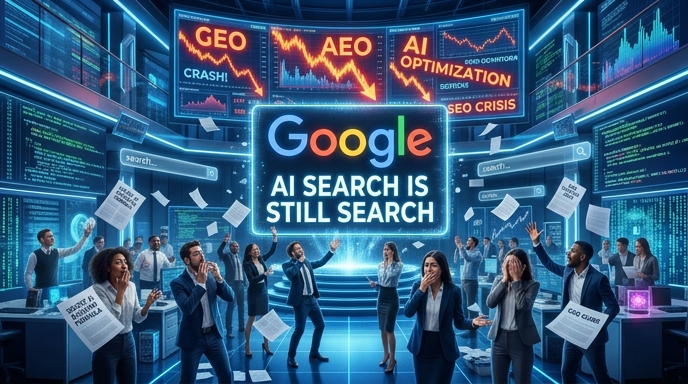
For the last two years, the SEO industry has behaved like a medieval village reacting to an eclipse. Panic. Superstition. Strange rituals. Consultants selling miracle cures. And somewhere in the middle of the chaos, a growing crowd of marketers started insisting that traditional SEO was dead.
Apparently, the future belonged to GEO. Or maybe AEO, or maybe LLM optimization. Or “Generative Engine Optimization.” Pick your acronym. The industry certainly did.
Then Google showed up and essentially said: calm down. Most of this stuff is nonsense.
In May 2026, Google released new guidance explaining how websites should approach optimization for AI-powered search experiences. The reaction was immediate because Google did not merely offer technical recommendations. It detonated several profitable myths in one move.
The company’s core message was brutally simple: AI search is still search.
Not a new universe, Not a replacement for SEO, Not some mystical chatbot dimension requiring entirely new rules. According to Google, the same fundamentals that helped pages rank in traditional search still matter in AI Overviews and other AI-driven results.
That statement alone threatens an entire cottage industry built around fear.
And yes, some people are furious about it.
The Great GEO Gold Rush
Over the past year, “GEO experts” have multiplied at astonishing speed. LinkedIn became saturated with self-appointed AI search prophets promising secret frameworks for ranking inside large language models.
The pitch usually sounded something like this:
“Traditional SEO is obsolete. You need AI-native optimization strategies.”
That sounds sophisticated. It also sounds expensive. Conveniently.
Marketers were told they needed:
- LLM.txt files
- AI chunk optimization
- vector-friendly content structures
- semantic passage engineering
- conversational query sculpting
Some of these concepts contain partial truths. Many were inflated beyond recognition.
Google’s new documentation effectively punctured the balloon.
According to Google, site owners do not need special optimization tricks specifically for AI search. The company explicitly stated that standard SEO best practices remain the primary path to visibility in AI-generated search experiences.
That directly contradicts months of aggressive marketing from optimization vendors claiming the opposite.
The message landed like a brick through a window.
The article from The Verge highlighted Google’s increasingly aggressive stance against AI-generated spam while emphasizing that quality content still matters more than gimmicks.
Meanwhile, reporting from The Decoder summarized Google’s position even more bluntly: GEO and AEO are largely myths.
That is not subtle language.
Google’s Actual Argument
Here is the central misunderstanding driving the panic.
Many marketers assumed AI search systems worked fundamentally differently from traditional search engines. They imagined a completely separate ranking environment with entirely different rules.
Google disagrees.
The company argues that AI-generated responses still depend heavily on the same underlying signals:
- crawlability
- structured information
- page quality
- authority
- relevance
- helpfulness
- user experience
In other words, AI systems still need trustworthy source material.
That sounds obvious when stated plainly. Yet the industry spent months pretending otherwise.
Google’s official blog post, published on Google Search Central, explains that creators should focus on “people-first” content and technical accessibility rather than chasing speculative AI-specific hacks.
That matters because it re-centers the conversation around fundamentals instead of pseudoscience.
And frankly, the industry needed that correction.
The LLM.txt Fantasy
One of the strangest trends in recent months involved the sudden obsession with LLM.txt files.
If that sounds vaguely familiar, it is because people tried to position it as the AI-era equivalent of robots.txt.
The theory was simple:
websites could create special files to help AI models interpret content more effectively.
Sounds plausible. Except Google effectively said it is unnecessary.
The breakdown from Dev.to outlined several myths Google debunked directly, including the idea that LLM.txt implementation is required for AI visibility.
Google also dismissed exaggerated claims around “chunking optimization,” where marketers began restructuring content specifically for AI retrieval systems.
This is where the industry started drifting into techno-mysticism.
Yes, AI systems process chunks of text internally. That does not mean writers should butcher readability to satisfy speculative retrieval theories.
Good structure matters. Clear headings matter. Logical organization matters.
But that has always been true.
SEO veterans recognized the pattern immediately. Every technological shift creates a temporary market for snake oil.
This time, the snake oil came wrapped in AI terminology.
AI Spam Is Becoming Google’s Bigger Problem

While marketers obsessed over optimization tactics, Google had another concern entirely: AI-generated garbage flooding the web.
And the scale of the problem is staggering.
Generative AI has dramatically lowered the cost of producing low-quality content. Entire websites can now be mass-produced in hours. Thousands of articles. Zero expertise. Minimal editing.
The result is a growing sludge layer across the internet.
Google knows this threatens search quality directly.
That is why the company has started emphasizing spam policies more aggressively in the AI era. The Verge reporting noted that Google is sharpening enforcement against scaled content abuse and manipulative AI-generated pages.
This distinction matters.
Google is not anti-AI content.
Google is anti-worthless content.
There is a difference.
The company repeatedly states that content quality matters more than whether humans or machines helped produce it. If AI assists an expert in creating useful material, fine. If AI generates thousands of hollow pages designed solely to manipulate rankings, Google considers that spam.
Again, this is not actually new.
It is the same war Google has fought for decades:
signal versus noise.
Only now the noise machine operates at industrial scale.
SEO Experts Are Quietly Admitting Google Is Right
An awkward thing is happening across the SEO world right now.
Privately, many experienced professionals admit Google’s guidance makes sense.
Publicly, however, some continue promoting AI optimization frameworks because there is enormous financial incentive to do so.
Fear sells.
“Your old SEO strategy still works” is not nearly as profitable as:
“Everything changed overnight and you need my proprietary AI framework.”
That is the uncomfortable reality underneath this entire debate.
The analysis from Search Engine Journal captured this tension perfectly. Google’s new guidance effectively reframes AEO and GEO as extensions of standard SEO practices rather than replacements for them.
That sounds far less revolutionary.
Because it is.
Most successful SEO principles remain astonishingly durable:
- answer real questions
- demonstrate expertise
- build authority
- structure content clearly
- improve site performance
- earn trust
AI did not invalidate these principles.
If anything, AI systems may depend on them even more heavily because language models need reliable source material.
The Real Shift Nobody Wants to Discuss
Here is the part many marketers are avoiding.
AI search may not destroy SEO. But it absolutely threatens traffic models.
That is the real story.
Google’s AI Overviews increasingly answer user questions directly inside search results. Users often get what they need without clicking through to websites.
This creates a brutal paradox.
Publishers may still rank successfully.
They simply might not receive the same traffic.
That distinction changes everything.
Many SEO debates currently fixate on optimization mechanics while ignoring the larger economic disruption underneath the surface.
If AI-generated summaries satisfy user intent immediately, entire business models built on informational search traffic become vulnerable.
Recipe blogs.
Affiliate sites.
Basic explainer publishers.
Low-depth informational media.
Some will survive. Many will struggle.
This explains why emotions around AI search have become so intense. The stakes are not merely technical. They are existential.
Google’s reassurance that “SEO still matters” is true.
But it does not fully address publisher anxiety.
Because traffic erosion remains a legitimate concern.
AI Search Still Needs Human Authority
Ironically, the AI era may increase the importance of genuine expertise.
Large language models are fundamentally remix engines. They synthesize information from existing material. They do not possess lived experience, original reporting instincts, or human judgment.
That creates an opportunity.
As AI-generated sludge expands, authentic expertise becomes more valuable, not less.
Original reporting matters.
First-hand analysis matters.
Unique perspectives matter.
AI can imitate style remarkably well. But imitation is not authority.
Google appears increasingly focused on surfacing trustworthy, experience-driven content precisely because AI spam has become so pervasive.
The DemandSphere analysis, published at DemandSphere, emphasized this point directly: AI search systems still rely on the foundational principles of relevance, authority, and usefulness.
Again, not revolutionary.
Just easy to forget during hype cycles.
The Industry’s Favorite Mistake
The technology world repeatedly commits the same intellectual error.
People assume new interfaces erase old systems completely.
They rarely do.
Television did not eliminate radio.
Streaming did not eliminate television.
Ebooks did not eliminate printed books.
AI search will not eliminate SEO.
Instead, technologies layer on top of each other.
That is what appears to be happening now.
AI search changes user behavior. It changes interfaces. It changes traffic patterns. But underneath the surface, discovery systems still need organization, trust signals, relevance scoring, and quality evaluation.
Search still requires search infrastructure.
Google’s recent guidance is basically an attempt to drag the industry back to reality after months of AI hysteria.
And honestly, the correction was overdue.
What Smart Publishers Should Actually Do

The practical takeaway is surprisingly unglamorous.
Stop chasing magical AI hacks.
Focus on:
- authoritative writing
- clear site architecture
- fast performance
- strong sourcing
- factual accuracy
- original insights
- audience trust
That advice lacks the sexy futurism of “Generative Engine Optimization.”
Too bad. It is probably correct.
The marketers most vulnerable right now are the ones addicted to shortcuts. AI has made low-quality mass production easier than ever, which means differentiation matters more than ever too.
The future likely belongs to creators who combine:
- human expertise
- strong editorial standards
- AI-assisted efficiency
- technical SEO competence
Not people stuffing pages with synthetic fluff and hoping vector embeddings save them.
Google’s latest statements amount to a public warning:
stop trying to game imaginary AI ranking systems and build genuinely useful websites instead.
A surprisingly old-fashioned conclusion for the AI age.
Sources
- The Verge — Google cracks down on AI search spam
- The Decoder — Google says GEO and AEO are a myth
- Search Engine Journal — Google’s new AI search guide still points to SEO fundamentals
- Dev.to — Google debunks GEO myths
- DemandSphere — AI search is still search
- Google Search Central — A new resource for optimizing for AI experiences
GEO and AI Search
- from SEO to GEO in AI-powered search
- GEO versus SEO software budgets in 2026
- SERP-to-LLM customer journey in GEO
AI Search and SEO Strategy
The Kingy Brief
Get future Kingy Brief editions.
Source-checked AI changes, original tests and one practical thing to try.
Free · Choose your subjects · Double opt-in · Unsubscribe anytime
Regular sending is paused; no restart date is set.