The Box That Changed the World Is Changing Again
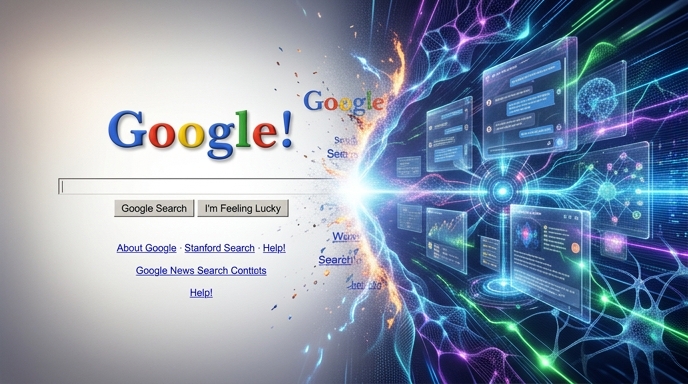
Picture this. It’s 1998. You open a browser. A clean white page loads. There’s a simple text box in the middle. You type a few words. You hit Enter. A list of blue links appears.
That was Google Search. Simple. Fast. Brilliant.
For 25 years, that little white rectangle barely changed. Sure, Google added autocomplete. It added image search, maps, and shopping tabs. But the core experience? Type a few keywords. Get a list of links. Click. Done.
That era is officially over.
At Google I/O 2026, Google dropped what it calls “the biggest upgrade to our iconic search box since its debut over 25 years ago.” And honestly? That’s not hype. This is a genuine, ground-shaking transformation of the most-used interface in the history of the internet.
So buckle up. We’re breaking down exactly what changed, why it matters, and what it means for you, whether you’re a casual searcher, a content creator, a marketer, or just someone who Googles “how to boil an egg” at 11pm.
Goodbye, Keyword Box. Hello, Conversation Starter.
Let’s start with the obvious: the search box itself.
VentureBeat reports that Google’s Liz Reid, VP and Head of Search, called this “the biggest upgrade to our iconic search box since its debut over 25 years ago.” That’s a bold claim. But when you look at what the new box actually does, it’s hard to argue.
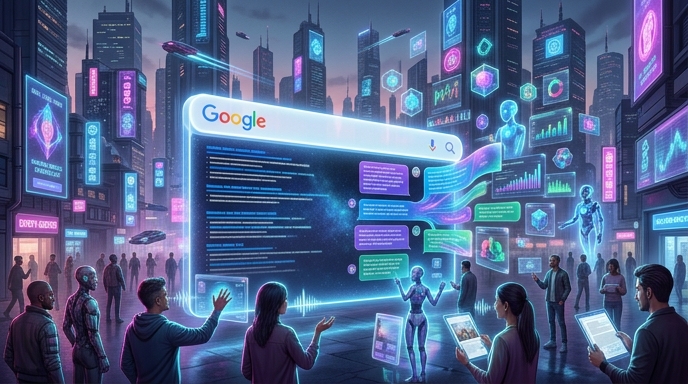
The new search box dynamically expands as you type. No more cramming your question into a tiny field. You can now write full sentences. Paragraphs, even. The box grows with you.
But that’s just the beginning. The new box accepts multimodal inputs, meaning you can drop in images, PDFs, videos, and even open Chrome tabs directly into your search. Previously, some of these features existed in AI Mode, but they were buried behind extra steps. Now they live right at the front door.
Google is also rolling out an AI-powered query suggestion system that goes way beyond autocomplete. Instead of just predicting your next word, it actively coaches you toward better, more detailed questions. Think of it less like a search engine and more like a research assistant who helps you figure out what you actually want to ask.
GadgetGuy notes that the new box is built on Gemini 3.5 Flash, Google’s newest and fastest AI model. This thing is reportedly four times faster than comparable frontier models. Speed matters enormously here, a slow AI search experience would be dead on arrival for a product that handles billions of queries every single day.
AI Mode and AI Overviews Just Got Married
Here’s where things get really interesting.
For the past year or so, Google has been running two parallel AI experiences: AI Overviews (those AI-generated summaries that appear above search results) and AI Mode (a more immersive, conversational search experience). They were separate. You had to choose between them.
Not anymore.
Google just merged them into one seamless flow. You type a question. You get an AI Overview alongside traditional results. Then, without navigating anywhere, you can keep asking follow-up questions directly in AI Mode. It’s one continuous conversation.
Reid explained the thinking clearly: “For most users, they don’t actually want to have to think about, do they want more of a traditional page or an AI-forward search experience.” So Google made the decision for them. You just search. The system figures out the best experience for your query.
The numbers back up why Google made this move. VentureBeat reports that AI Mode has surpassed one billion monthly users in its first year. AI Overviews now reach 2.5 billion monthly users. And overall search query volume hit an all-time high last quarter.
Google CEO Sundar Pichai put it this way: “When people use our AI-powered features in search, they use search more.” He added that he loves “how search has become less about individual queries and feels more like an ongoing conversation.”
That’s not just a product update. That’s a philosophical shift.
Search Results That Build Themselves in Real Time
Okay, this part is genuinely wild.
Google is introducing something called Generative UI, the ability for search to dynamically build custom widgets, interactive visualizations, and even mini applications on the fly, tailored specifically to your question.
Here’s a concrete example. You ask: “How do black holes affect spacetime?” Instead of getting a list of links to physics articles, Google builds you an interactive visual right inside the search results. You ask a follow-up question. A brand-new visual generates in real time. No clicking. No loading new pages. Just a living, breathing answer that evolves with your curiosity.
TechCrunch reports that this system was built in partnership with the Google DeepMind team and runs on Gemini Flash 3.5. It will roll out to everyone, free of charge, this summer.
But Google goes even further. Users will be able to tap into Google Antigravity, the company’s agentic development platform, to build their own customizable “mini apps” directly in Search using natural language commands. No coding required. Just describe what you want.
Imagine building a meal-planning app that pulls from your own calendar. Or a fitness tracker tailored to your specific goals. All inside Google Search. All without writing a single line of code.
The Verge frames this perfectly: Google isn’t just showing you the location of information anymore. It’s answering questions for you — and increasingly, doing things for you.
Meet Your New AI Research Assistant: Information Agents

Remember Google Alerts? That handy little tool from 2003 that emailed you when new web results matched your search terms?
Information Agents are Google Alerts on steroids. Rocket-powered steroids.
Starting this summer, users will be able to create, customize, and manage AI-powered information agents directly within Google Search. These agents work in the background, 24/7, monitoring the web for specific conditions and delivering synthesized updates when those conditions are met.
TechCrunch explains the use cases well. You could set up an agent to track market movements in a specific sector with very precise parameters. The agent maps out a monitoring plan, taps into real-time finance data, and proactively notifies you when conditions are met, complete with links and context for further research.
Other use cases? Tracking sneaker drops. Monitoring apartment listings. Keeping tabs on a competitor’s pricing. Following a niche topic that mainstream news ignores.
Liz Reid described it this way: “The agent will map out a monitoring plan for you, including the tools and the data it needs to access, like our real-time finance data. And it will then keep track of those changes and let you know when the conditions are met, and provide a synthesized update with links and information you can dive into further.”
This is a massive shift. Searching the web will increasingly be performed by AI agents on your behalf. You’ll focus on acting on the information, not hunting for it.
Information Agents will launch first for Google AI Pro and Ultra subscribers this summer, with broader rollout to follow.
Gemini Is Everywhere Now, And It Knows Your Whole Life
The search box overhaul doesn’t exist in isolation. It’s part of a much bigger Google vision: one where Gemini becomes the connective tissue across your entire digital life.
The Verge highlights several major Gemini upgrades announced at I/O. There’s a Daily Brief feature that tells you about your day based on information pulled from Gmail, Google Calendar, and other apps. Gemini Spark, a 24/7 personal AI agent that runs on dedicated virtual machines in Google Cloud.
There’s also Personal Intelligence, a feature that pulls context from your Google apps to inform your Gemini responses. Your emails, Your calendar. Your search history. All feeding into a more personalized AI experience.
And for shopping? The new Universal Cart keeps track of things you want to buy across Search, Gemini, Gmail, and YouTube, letting you check out using Google’s payment infrastructure. One cart. Every Google surface.
The picture that emerges is striking. Google isn’t building separate AI features. It’s building one unified AI layer that sits across everything, and the search box is the primary entry point.
What Does This Mean for SEO? (Spoiler: Less Panic Than You Think)
If you’re a content creator, marketer, or website owner, you’ve probably been sweating about AI search for a while now. Terms like GEO (Generative Engine Optimization) and AEO (Answer Engine Optimization) have been floating around the industry, promising new frameworks for surviving the AI search era.
Google just called their bluff.
The Decoder reports that Google published new documentation with a clear, direct message: if your SEO is already solid, you barely need to change a thing for AI Overviews and AI Mode.
Here’s why. Google’s AI search uses two core techniques. The first is Retrieval-Augmented Generation (RAG) — the AI pulls relevant, up-to-date pages from the existing search index, then checks specific information on those pages to generate an answer. The second is Query Fan-out, the system fires off related queries in parallel to surface more relevant results.
Both techniques run through the same classic ranking systems. If you don’t rank in regular Google Search, you won’t show up in AI answers either.
Google’s documentation goes further, busting specific myths one by one:
- LLMS.txt files and special markup? Not needed.
- “Chunking” content into tiny pieces? Dead end.
- Rewriting content to cater to AI systems? Waste of effort.
- Farming fake “mentions” across other sites? Won’t move the needle.
- Obsessing over structured data for AI? Doesn’t factor in.
What does work? Genuine expertise. Real experience. Content that answers deep, nuanced questions in authoritative ways. Google draws a clear line between “commodity content” (generic “7 tips” articles) and “non-commodity content” (real stories rooted in actual experience).
The message is refreshingly simple: stop chasing technical hacks. Write great content. Be genuinely helpful. That’s it.
The Web’s Existential Question: Who Gets the Traffic?
Here’s where the conversation gets uncomfortable.
All of these AI features, the seamless AI Mode, the Generative UI, the information agents, share one common side effect: users spend less time clicking links to external websites.
TechCrunch puts it bluntly: “Combined, these changes will likely further decimate Google referrals to publishers, which have already been suffering from declining referrals due to AI Overviews. This has put some ad-dependent media operations out of business, and now things will likely get worse.”
The Verge raises the same concern from a different angle. If Google Search doesn’t send traffic to publishers who need visitors to make money, what will Search learn from? If YouTube’s AI Mode-like feature stops people from browsing videos, how will creators support themselves?
Google has consistently maintained that its AI features drive more traffic to publishers. Sundar Pichai repeated this claim at I/O. But the structural reality is hard to ignore: when users can get an AI-generated answer and ask multiple follow-up questions without ever leaving the search page, the incentive to click through to source material diminishes.
VentureBeat frames the advertiser question too. Conversational queries contain richer intent signals, which could make ad targeting more precise. But when a user is mid-conversation with AI Mode, where does an ad naturally fit? Google didn’t detail changes to its advertising model at I/O, but the structural shift will inevitably reshape how ads are surfaced and measured.
These are not small questions. They’re existential ones for the open web.
$190 Billion Says Google Is All-In
Let’s talk numbers for a second.
Google’s surfaces now process over 3.2 quadrillion tokens per month, up seven-fold from a year ago. The company expects capital expenditures of approximately $180 to $190 billion in 2026, roughly six times the $31 billion it spent four years ago, largely to support the infrastructure required for this AI transformation.
That’s not a company hedging its bets. That’s a company going all-in.
VentureBeat notes that when asked about the future of traditional search, Pichai was direct: “Search is the most used AI product in the world.”
Think about that framing. Not “Search is becoming an AI product.” Not “Search is integrating AI features.” Search is an AI product. Full stop.
The Bigger Picture: One Box to Rule Them All
Step back and look at everything Google announced at I/O 2026. The redesigned search box. The merged AI Mode and AI Overviews. The Generative UI. The information agents. The Universal Cart. Gemini Spark. Personal Intelligence. The Daily Brief.
See the pattern?
The Verge captures it perfectly: “It’s not hard to imagine a future where, someday, Google just makes everything happen in one universal search box. No more hopping between Google Search, YouTube, Gmail, Gemini — my gut is that Google’s current end state is that you just type anything you’re looking for into an Ask Google box, and Google finds a way to make it happen.”
One box. Every question, Every task, Every purchase. Every piece of information you’ll ever need.
That’s the vision. And Google is spending $190 billion to make it real.
Whether that future excites you or unsettles you probably depends on how much you trust Google with your data, your habits, and your digital life. The company is betting that most people will embrace the convenience. Critics worry about what gets lost, the serendipity of browsing, the traffic that sustains the open web, the privacy implications of an AI that knows everything about you.
Both concerns are valid. Both deserve serious attention.
What Should You Do Right Now?
Whether you’re a regular user, a content creator, or a business owner, here’s the practical takeaway:
For regular users: The new search box is rolling out now. Start using it. Type full questions. Upload images. Ask follow-ups. The more you use it conversationally, the more useful it becomes.
For content creators and publishers: Don’t panic about GEO or AEO. Focus on what Google has always rewarded — genuine expertise, real experience, and content that actually helps people. That’s your best defense in the AI search era.
For businesses: Pay attention to the Universal Cart, the Business Agent feature, and the emerging Universal Commerce Protocol. These are the new surfaces where customers will find and interact with your brand.
For everyone: Keep watching. This is moving fast. The search box that launched in 1998 took 25 years to get its first major redesign. The next redesign might come in 25 months.
The Blinking Cursor Just Got a Whole Lot Smarter
For 25 years, that blinking cursor in Google’s search box trained billions of people to think in keywords. Short. Fragmented. Compressed.
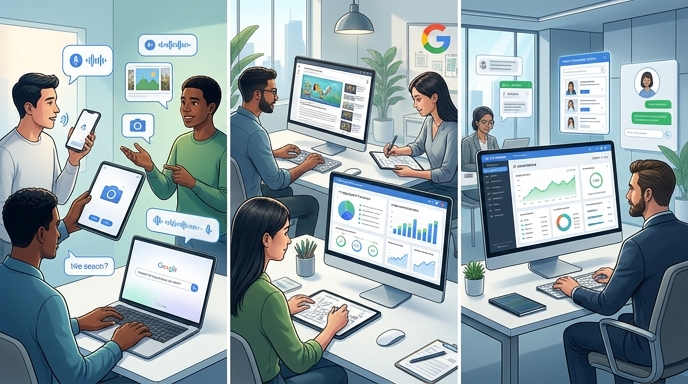
Now Google is asking us to think in sentences. To speak naturally, To upload what we’re looking at. To let an AI handle the compression.
It’s a profound shift, not just in technology, but in how we relate to information itself. The search box was always more than a product. It was a habit. A reflex. A cultural artifact used by essentially the entire internet-connected world.
That artifact just got its biggest upgrade ever.
The era of ten blue links is over. The era of AI-powered conversation has begun. And whether you’re ready or not, the next time you open Google, you’ll feel the difference.
Sources
- The Verge — “The future of Google is a search box that does everything”
- GadgetGuy — “Google search is about to look very different with more AI infusion”
- VentureBeat — “Google just redesigned the search box for the first time in 25 years”
- TechCrunch — “Google Search as you know it is over”
- The Decoder — “Google says GEO and AEO are a myth and traditional SEO is all you need for AI search”
Google AI Search and SEO
- Google AI rewriting headlines and SEO impact
- Google AI Mode search rollout
- AI search as the new SEO battlefield
- generative search disrupting Google Search and ads
- Google’s AI search button strategy
- Google AI Mode and SEO discovery rules
- Google AI overviews and search traffic impact
- Google AI Mode visual search and shopping
The Kingy Brief
Get future Kingy Brief editions.
Source-checked AI changes, original tests and one practical thing to try.
Free · Choose your subjects · Double opt-in · Unsubscribe anytime
Regular sending is paused; no restart date is set.