
OpenAI Just Quietly Rewrote the Enterprise AI Contract
Inside “Guaranteed Capacity” — the multi-year compute deal that turns a model vendor into infrastructure
There are two kinds of product announcements from OpenAI. The flashy ones — new models, new modalities, new agents — which fill timelines and dominate the cycle for a week. And then there are the structural ones, which barely trend but quietly change the math for every CIO, CTO, and platform team building on top of the company’s APIs.
The launch of Guaranteed Capacity, announced by OpenAI on X, is firmly in the second category. It is not a model. It is not a feature. It is a contract.

Specifically, it is a way for enterprises to reserve long-term access to OpenAI compute — one-year to three-year commitments, with discounts that scale with annual spend, redeemable across OpenAI’s model families and across supported cloud providers — for production systems, customer-facing apps, and the increasingly load-bearing population of AI agents now running inside large businesses. That summary comes directly from OpenAI’s own announcement and the first wire report on the offering from Investing.com.
It is a small product page. It is also, if you read it carefully, the moment OpenAI stopped behaving like a vendor and started behaving like infrastructure.
This piece is an attempt to explain what Guaranteed Capacity actually is, what it tells us about the state of the AI market in mid-2026, what it solves for buyers, what it deliberately does not solve, and how serious teams should evaluate it. No hype. No fake certainty. If something is unclear from the public record, it’s flagged that way.
What was actually announced
The product, in OpenAI’s framing:
“Introducing OpenAI Guaranteed Capacity: a new offering that enables customers to guarantee long-term access to OpenAI compute.”
The mechanics, as described in the launch post and confirmed in the Investing.com report:
- Commitment terms: one to three years.
- Discount structure: pricing improves with annual spend levels.
- Scope: dedicated capacity intended for production systems, customer-facing applications, and AI agents.
- Flexibility: the guaranteed spend can be drawn down across OpenAI’s portfolio of products and across supported cloud providers and model families.
- Service wrap: customers can work with an OpenAI team to model capacity against forecasted demand, product expansion, and multi-year AI adoption plans.
There is no public per-token pricing, no public list of qualifying products, no public floor for minimum spend. None of that is unusual for an enterprise capacity product. It’s also a sign that this isn’t being aimed at the self-serve developer signing up with a credit card. It’s aimed at the buyer whose AI bill is now a line item in the board pack.
The framing OpenAI itself uses is telling:
“We’ve made long-term investments in infrastructure, partnerships, and capacity planning to help customers scale reliably. Now, Guaranteed Capacity helps customers plan ahead for critical workloads in a compute-constrained world.”
That phrase — compute-constrained world — is the entire premise. The rest is plumbing.
Why “compute-constrained” is not marketing language
A reasonable read of the last twelve months is that OpenAI has been doing two things in parallel: shipping models, and frantically wiring together the largest commercial compute footprint in software history.
On April 29, 2026, OpenAI published a blog post confirming that Stargate — the program announced in January 2025 — had crossed 10 gigawatts of contracted U.S. AI infrastructure, a milestone it had originally targeted for 2029. More than 3 GW of that was added in just the prior 90 days. Bloomberg and Data Center Dynamics covered it the same week.
That 10 GW number deserves a careful caveat. As DCD pointed out, it is contracted capacity, not live capacity. CFO Sarah Friar has publicly stated OpenAI ended 2025 with roughly 1.9 GW of compute online. The flagship Stargate site in Abilene, Texas is operational on Oracle Cloud Infrastructure running NVIDIA GB200 systems; additional sites in Texas, New Mexico, Wisconsin, and Michigan are at various stages of development.
Underneath that headline number sits a stack of long-term supply deals that is genuinely without precedent in enterprise software:
- A $300 billion, five-year Oracle Cloud contract beginning in 2027, originally reported by the Wall Street Journal and confirmed in subsequent filings, covering roughly 4.5 GW per year.
- A seven-year, $38 billion AWS partnership, covered by Built In, giving OpenAI access to AWS UltraServer GPU clusters; bundled within OpenAI’s $122B round was a separate commitment to spend roughly $100 billion on AWS over eight years, as detailed by SaaStr.
- A NVIDIA letter of intent for at least 10 GW of systems, with NVIDIA committing to invest up to $100B progressively as each gigawatt is deployed, the first targeted for H2 2026 on the Vera Rubin platform.
- Within OpenAI’s Scaling AI for everyone post, confirmation of 3 GW of dedicated inference and 2 GW of training capacity on Vera Rubin systems as part of the NVIDIA arrangement.
- A 10 GW custom-silicon co-design with Broadcom, plus a 6 GW AMD agreement, plus existing CoreWeave and Google Cloud relationships.
Pull back and the picture is this: OpenAI is no longer “renting Azure.” It’s running a multi-vendor, multi-region, multi-architecture supply chain whose total commitments — across cloud, chips, and data centers — comfortably exceed one trillion dollars over the next decade, as Built In summarised in November 2025.
In that context, Guaranteed Capacity is not a separate idea. It’s the demand-side mirror of the supply-side buildout. OpenAI spent eighteen months locking in compute it doesn’t yet need. Now it’s offering enterprises a way to lock in their slice of it before someone else does.
For a longer running view of how AI infrastructure is reshaping enterprise software economics, the analysis archive at Kingy AI’s infrastructure coverage tracks the same trend line from a buyer’s perspective.

What “Guaranteed Capacity” actually solves
Strip away the marketing surface and the offering addresses four distinct problems that have been quietly compounding inside enterprises running serious workloads on OpenAI.
1. Headroom risk during demand spikes
This is the most obvious one. Every team that operationalised an OpenAI-backed product in 2024 and 2025 has, at some point, seen rate limits bite during a real production event — a campaign launch, a holiday weekend, a viral moment, an internal rollout. Sam Altman himself acknowledged that the GPT-4.5 launch in February 2025 had to be staggered because the company had “run out of GPUs,” as documented by Built In.
Guaranteed Capacity is, in effect, a reservation system: you trade a multi-year commitment for the right to not be throttled when your business needs the throughput most. The exact SLA terms aren’t public, but the framing — certainty of access to compute based on spend levels — is the contractual analogue of buying reserved instances on a hyperscaler.
2. Latency planning for agent workloads
Agents are different from chat. A chat response that arrives 800ms late is a minor annoyance. An autonomous agent making 40 tool calls in a workflow that fails halfway through because of a rate-limit response is a Sev-2.
OpenAI’s public 2026 product line — Codex, Frontier for enterprise AI coworkers, the agent SDK ecosystem — points firmly toward sustained, multi-step inference patterns. Those don’t tolerate noisy-neighbour behaviour. Dedicated capacity, sold as a multi-year commitment with predictable latency characteristics, is the natural commercial answer.
3. Procurement and finance alignment
Finance teams have struggled to model AI spend. Usage-based pricing with no floor and no ceiling, on a vendor whose unit economics shift with every model release, makes a CFO’s job nearly impossible. Multi-year contracts with tiered discounts and forecastable draw-downs convert AI from an erratic OPEX line into something that looks like the cloud spend models procurement already knows how to negotiate.
Whether this is good for the buyer over the term of the contract depends entirely on whether model pricing falls faster than your committed discount tier, or slower. That’s the classic reserved-instance bet. It is a real bet.
4. Strategic optionality across model families
The most interesting clause in the announcement is that customers can draw their commitment across OpenAI’s portfolio. That matters because the model landscape inside OpenAI alone now includes GPT-5, GPT-5.1, the codex variants, the realtime audio family, image and video models, and whatever sits behind the “Frontier” platform brand. Locking in capacity without locking in which model you use against it is a real concession from the vendor — and one that meaningfully reduces switching cost between OpenAI’s own products as new releases roll out.
It does not, of course, reduce switching cost away from OpenAI to Anthropic, Google, or open-weight alternatives. That is the trade.
The enterprise AI tell
There’s a particular signal buried in this announcement that’s worth naming clearly, because it changes how observers should read the next 24 months of enterprise AI.
Multi-year compute commitments are not signed by companies running pilots. They are signed by companies for whom losing access to a specific compute substrate would constitute a material operational risk. They are signed when the AI in question is too critical to lose access to.
Read against the rest of OpenAI’s recent commercial moves — the DeployCo joint venture with private equity firms to embed OpenAI tools across 1,200+ portfolio companies, the Dell partnership for hybrid and on-prem Codex deployments, the Malta agreement to bring ChatGPT Plus to all citizens — the picture is consistent. OpenAI is building the commercial plumbing of an infrastructure business, not a model business.
For buyers, this has a few practical implications worth taking seriously:
- Model quality is no longer the only axis of evaluation. A frontier model you cannot reliably access is worth less than a slightly weaker model with a deterministic SLA. Latency certainty, quota headroom, failure-mode documentation, and contractual receipts when capacity is short are now part of the procurement checklist.
- Compute is becoming part of the SLA, not a footnote to it. The conversation between buyer and vendor is shifting from “what can your model do?” to “what can your model do, at our peak, under contract, for the next three years?”
- The cost of switching is rising, asymmetrically. Multi-year commitments don’t just bind a customer to a vendor financially. They bind the customer’s roadmap to that vendor’s release cadence. That can be a tailwind if OpenAI keeps shipping. It can be a tax if it doesn’t.
We covered the procurement-side implications of multi-year AI commitments in a related piece at Kingy AI; the short version is that the diligence required to sign one of these contracts well is meaningfully more than the diligence most enterprises currently apply to their AI spend.
What the announcement does not say
It’s worth being precise about what is and isn’t in the public record, because a lot of the takes circulating online are extrapolating beyond it.
Not disclosed publicly:
- The minimum spend threshold to qualify.
- The exact discount curve.
- The specific SLA targets (latency percentiles, availability, throttling behaviour).
- Whether dedicated capacity means physically dedicated hardware, logically dedicated quota, or some hybrid.
- Penalty / break clauses if OpenAI fails to deliver the capacity.
- Penalty / break clauses if the customer underconsumes.
- Whether agreements are sovereign-region-bound or globally drawable.
These are exactly the details that decide whether Guaranteed Capacity is genuinely useful or commercially aggressive. Until they’re either published or surfaced through reporting, treat any blanket claim about the offering’s value with caution.
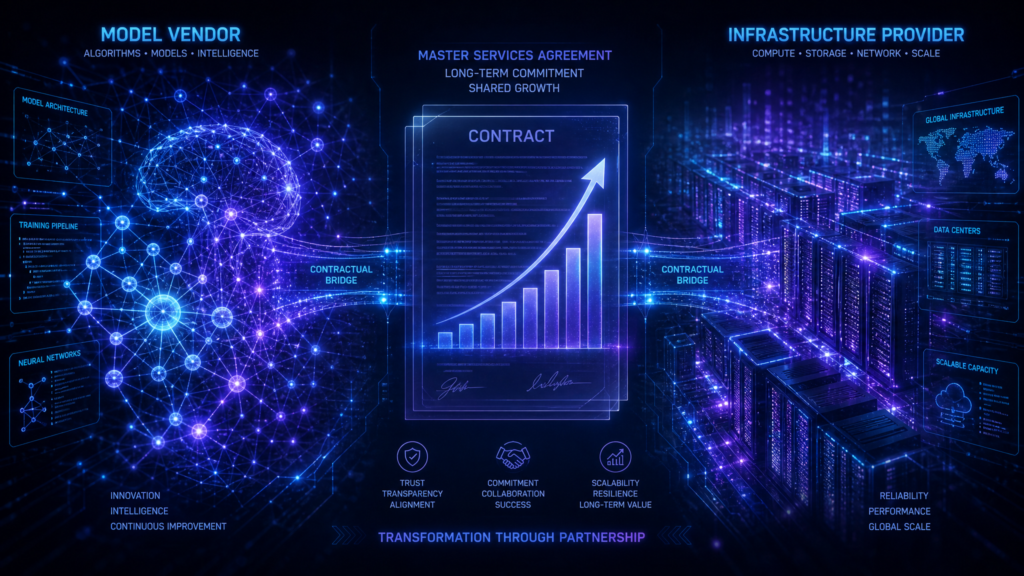
What is clear: OpenAI is signalling that its enterprise contract surface now includes capacity guarantees as a first-class product, on terms that resemble reserved-instance contracts in the hyperscaler market. That alone is a structural change.
Why this is happening now
Three forces converged in the spring of 2026.
First, demand kept compounding past every internal forecast. OpenAI’s own Scaling AI for everyone post cited 900M weekly ChatGPT users, 50M+ consumer subscribers, and 9M+ paying business users by February 2026 — with January and February on pace to be the largest subscriber months in the company’s history. The 3 GW of capacity added in the 90 days before the April infrastructure post is the supply-side mirror image of that demand.
Second, the compute supply chain is no longer abundant. Power, permitting, transmission, and skilled labour have all become binding constraints on data centre buildout, as OpenAI itself acknowledges in its infrastructure post. When supply is genuinely constrained, vendors with privileged access to it stop offering it on pure spot terms. They start offering it on contracts. That is how every commodity market eventually matures.
Third, enterprise buyers were already asking for it. Anthropic has been moving in similar directions with its own enterprise capacity arrangements. Microsoft’s Azure already offers Provisioned Throughput Units (PTUs) for latency-critical workloads — dedicated resources with guaranteed capacity and predictable latency, sold as a premium tier. Google Cloud has analogous offerings. The market expected OpenAI direct to land somewhere in this neighbourhood. Guaranteed Capacity formalises it.
What thoughtful buyers should actually do
If you’re a platform leader, head of AI, or CTO at an organisation with material OpenAI spend, here is a practical, non-hype-driven way to evaluate this.
1. Get honest about your forecasted draw.
Reserved capacity only pays off if your usage is high enough that the discount outweighs the optionality you’re giving up. If you can’t model your 12-month draw within ±25% confidence, you are not ready to sign a three-year commitment. Build the forecast first; talk to OpenAI second.
2. Ask for the failure modes in writing.
A guarantee is only as strong as the remedy when it’s broken. The most important sentence in any capacity agreement is the one that describes what happens when capacity isn’t delivered. Make sure that sentence exists.
3. Negotiate cross-model flexibility explicitly.
The headline says you can draw across model families. Verify, in the contract, that this includes future models released during the contract term, not only the ones available at signing. Otherwise you’re locking in to today’s model economics for three years.
4. Plan for a multi-vendor footprint regardless.
Even with Guaranteed Capacity, the prudent enterprise posture in 2026 is multi-model and multi-provider. The Microsoft–OpenAI exclusivity break that began in early 2025 went both ways: OpenAI is free to source compute anywhere, and customers should reserve the same right with respect to models. A commitment to OpenAI is not, and should not be, an exclusion of Anthropic, Google, or self-hosted open weights.
5. Separate “agent workloads” from “everything else” in your usage analysis.
The economics of agentic workloads — high tool-call volume, long-running contexts, sustained inference — are sufficiently different from chat that they deserve their own capacity planning. Guaranteed Capacity may be the right answer for agents and the wrong answer for everything else.
A practical framework for assessing AI vendor commitments under this kind of structure is available in the planning notes at Kingy AI, particularly for teams comparing dedicated capacity offerings across providers.
What this means for the broader market
Three things are likely to follow, in roughly this order.
Anthropic will respond. It is already pursuing structurally similar enterprise distribution arrangements with private equity firms, as Capacity Media reported. A formal capacity-guarantee product, branded or not, is the obvious next step. Expect it within months, not quarters.
Hyperscalers will lean harder into their existing PTU-equivalents. Azure’s PTU offering, AWS Bedrock’s provisioned throughput, and Google Vertex AI’s reserved capacity were already viable answers to this problem when the model was hosted on a hyperscaler. The OpenAI direct offering pulls some of that revenue back to OpenAI; the hyperscalers will counter by tightening their own capacity-tier pricing and adding cross-model guarantees of their own.
Open-weight providers will get a second look. The flip side of “compute is the SLA” is that owning your inference stack — whether through dedicated hosting on a neocloud, a private CoreWeave deployment, or an on-prem footprint — becomes more attractive when capacity itself is a contested resource. Expect a bifurcation: large enterprises will sign Guaranteed Capacity with OpenAI for some workloads, and run open-weight models on owned infrastructure for others.
The honest read
Guaranteed Capacity is a sensible, well-timed product. It addresses a real pain point — capacity uncertainty — for a real customer base — enterprises running OpenAI in production. It’s structured in a way that gives buyers some genuine flexibility (cross-model draw, cross-cloud portability) while binding them to the OpenAI ecosystem at a contractual level.
It is also a reminder of a less comfortable truth: the enterprise AI market is now a capacity market, not just a capability market. Frontier model quality matters, but it matters alongside who can deliver the inference, where, with what latency, under what contract, when demand spikes.
The companies that win the next 24 months will not be the ones with the smartest model in the room. They’ll be the ones whose AI bills are predictable, whose production systems don’t throttle during peak load, and whose vendor contracts include receipts for both quality and access.
OpenAI just made it easier — and more expensive — to be one of those companies.
For ongoing analysis of enterprise AI infrastructure, vendor contract structures, and the practical realities of running these systems in production, the team at Kingy AI is tracking each of these threads independently.
The Kingy Brief
Get future Kingy Brief editions.
Source-checked AI changes, original tests and one practical thing to try.
Free · Choose your subjects · Double opt-in · Unsubscribe anytime
Regular sending is paused; no restart date is set.