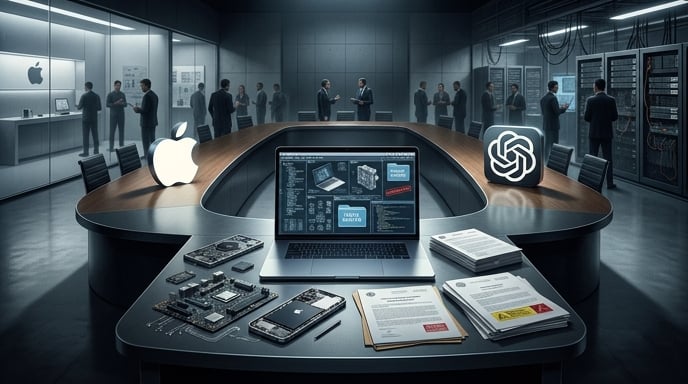
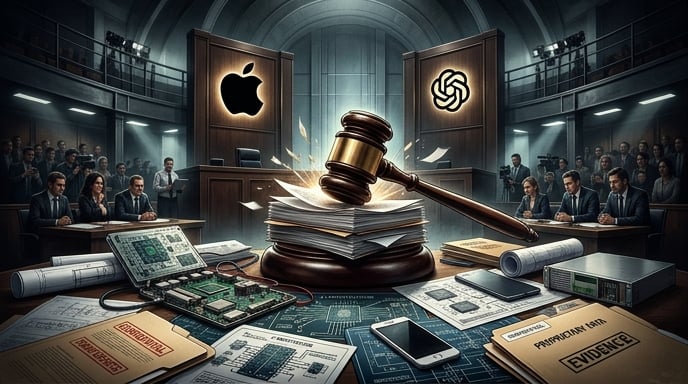
Apple and OpenAI have spent the past two years acting like friendly neighbors who occasionally borrow each other’s power tools. Apple integrated ChatGPT into its software. OpenAI gained access to hundreds of millions of potential users. Everyone smiled for the cameras.
Now Apple has marched across the lawn carrying a lawsuit.
The iPhone maker has sued OpenAI, its affiliated entities, its hardware subsidiary io Products, and two former Apple employees. Apple claims the defendants stole confidential information involving unreleased products, engineering methods, suppliers, manufacturing techniques, and hardware-development processes.
OpenAI denies the accusation.
The case lands at a delicate moment. OpenAI is preparing to move beyond apps and chat windows into consumer hardware. Apple, meanwhile, has built its empire by controlling every tiny detail of its devices—from chips and circuit boards to glass finishes and the satisfying little click of a button.
That makes this more than an ordinary corporate dispute. It is a fight over who gets to build the next major computing platform—and whether OpenAI took an unauthorized shortcut through Apple’s locked workshop.
Apple Drops a Legal Thunderbolt
Apple filed the lawsuit on July 10, 2026, in the US District Court for the Northern District of California. The complaint names OpenAI, OpenAI Foundation, OpenAI Group PBC, io Products, former Apple executive Tang Yew Tan, and former Apple engineer Chang Liu as defendants.
Apple alleges that OpenAI deliberately and systematically obtained confidential information from current and former Apple employees while building its consumer-hardware operation. The company describes the alleged conduct as a coordinated pattern rather than a couple of careless downloads.
According to the complaint, the information covers unreleased technologies, proprietary engineering processes, manufacturing methods, supplier relationships, technical specifications, product components, and internal project data. Apple argues that these materials could help OpenAI reduce the cost, time, and uncertainty involved in developing new hardware.
That is a serious accusation. Hardware development moves slowly, eats money, and punishes mistakes with almost theatrical enthusiasm. A small advantage in manufacturing knowledge or component design can save years of experimentation.
Apple says it contacted OpenAI in February after finding evidence that its information may have reached the AI company. According to Apple, OpenAI did not respond to its concerns. Apple then widened its internal investigation and says it uncovered a broader pattern involving former employees who later joined OpenAI.
The Engineer, the Laptop, and the Alleged Security Bug
One of the lawsuit’s most striking sections concerns Chang Liu, a former senior systems electrical engineer who worked at Apple for roughly eight years.
Apple claims Liu kept a company-issued laptop after leaving the business. More importantly, the laptop allegedly remained authenticated to Apple’s systems.
The complaint says Liu discovered an authentication vulnerability that allowed him to access Apple’s cloud-based or network file storage after his departure. In a message quoted by Axios, Liu allegedly told a former colleague that he had discovered he could still enter the storage system, adding that he found the situation funny.
Apple was not amused.
The company alleges that Liu accessed and downloaded dozens of confidential files while working on hardware for OpenAI. Those materials reportedly included engineering presentations, manufacturing documents, proprietary project information, details about unreleased products, and technical specifications concerning multilayer motherboards.
The complaint also accuses Liu of communicating with another Apple employee, Yu-Ting “Alyssa” Peng, about accessing company information. Peng later left Apple and joined OpenAI, although she is not currently named as a defendant.
These claims remain allegations. Liu has not yet had the opportunity to present his full defense in court. Still, the details give Apple’s complaint the flavor of a corporate-security thriller—except the glamorous spy gadget is apparently an old work laptop somebody forgot to return.
Tang Tan Sits at the Center of the Hardware Story
The other former employee named in the lawsuit is Tang Yew Tan, usually known as Tang Tan.
Tan spent 24 years at Apple and served as vice president of product design. His work reportedly touched major products including the iPhone, Apple Watch, and iPod. He later helped create io Products, the hardware company associated with former Apple design chief Jony Ive.
After OpenAI acquired io in a transaction valued at nearly $6.5 billion, Tan became OpenAI’s chief hardware officer.
Apple alleges that Tan began transferring confidential information before leaving the company. According to the complaint, he emailed himself materials related to suppliers and internal industry assessments.
The claims do not stop there.
Apple says Tan used internal product codenames while speaking with Apple employees who were interviewing for OpenAI positions. He allegedly asked candidates to bring physical components—including batteries, logic boards, shields, housings, and back-glass pieces—to interviews for technical discussions and “show and tell” demonstrations.
Apple further claims that Tan advised prospective hires not to disclose that they planned to join OpenAI and encouraged them to delay Apple’s formal departure procedures for as long as possible.
The company also alleges that Tan circulated an internal Apple offboarding document explaining security checks. Apple believes the document may have helped departing workers avoid scrutiny while taking company materials.
Again, OpenAI and Tan have not admitted wrongdoing. But Apple’s description is explosive: a senior hardware executive allegedly turning recruitment interviews into live product teardowns—just without the tiny screwdrivers and cheerful YouTube music.
Apple Says the Alleged Leaks Reached Its Suppliers
Apple’s competitive advantage does not come only from elegant industrial design. It also comes from a vast manufacturing network that can produce complicated devices at enormous scale.
That network is one of Apple’s crown jewels.
The lawsuit alleges that OpenAI approached some of Apple’s trusted manufacturing partners using confidential supplier information. In one example, Apple claims a partner demonstrated a proprietary metal-finishing technique after being led to believe that OpenAI had Apple’s permission.
If accurate, this part of the case could prove especially important.
A product idea can be sketched on a napkin. Producing millions of identical units with reliable tolerances, acceptable costs, low failure rates, and premium materials is another matter entirely. Apple has refined that process over decades.
OpenAI can hire brilliant engineers. It can spend billions. It can recruit famous designers. What it does not yet possess is Apple’s long history of turning delicate prototypes into products that arrive in stores by the truckload.
Apple therefore argues that the alleged theft was not simply about copying a drawing or memorizing a specification. It was about gaining access to an ecosystem of technical knowledge, supplier trust, and production experience that competitors cannot easily recreate.
OpenAI has publicly rejected the accusation, saying it has no interest in other companies’ trade secrets and remains focused on developing innovative technology. The formal legal responses from the individual defendants have yet to arrive.
More Than 400 Former Apple Employees Now Work at OpenAI
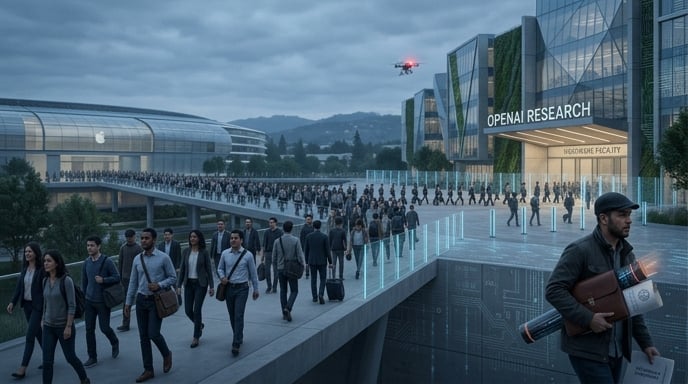
One number in the complaint instantly grabbed attention: more than 400 former Apple employees reportedly work at OpenAI.
That sounds dramatic, but the number requires context.
Hiring people from competitors is generally legal. Employees are allowed to change jobs, take their experience with them, and apply their general skills elsewhere. California also places significant limits on noncompete agreements, making worker mobility a deeply established part of Silicon Valley culture.
Apple cannot win merely by pointing at a crowd of former staff members wearing OpenAI badges.
Instead, it will need to identify specific trade secrets, demonstrate that it took reasonable steps to protect them, and provide evidence that the defendants improperly acquired, disclosed, or used those secrets.
That distinction will sit at the heart of the case.
An engineer cannot erase years of professional knowledge from their brain before joining a new employer. They also cannot walk out carrying confidential CAD files, prototype components, supplier lists, internal presentations, or instructions for evading security reviews.
Apple’s complaint attempts to draw that line sharply. It says this was not normal employee movement. It was an organized effort to transfer protected information into OpenAI’s hardware program.
OpenAI will almost certainly challenge that characterization. It may argue that its work emerged from independent development, legally acquired expertise, or information that does not qualify as a protected trade secret.
The presence of hundreds of former Apple workers creates plenty of smoke. The court must decide whether Apple can prove there was also a legally actionable fire.
Jony Ive Is Not Named, but His Shadow Is Everywhere
Jony Ive is not named as a defendant.
Nevertheless, it is difficult to discuss this lawsuit without mentioning him.
Ive spent decades shaping Apple’s visual identity. He helped design products that transformed the company from a struggling computer maker into one of the most valuable businesses on Earth. His influence can be seen in everything from the original iMac to the iPhone and Apple Watch.
After leaving Apple, Ive founded the design firm LoveFrom and later became involved with io Products. OpenAI acquired io in 2025, bringing Ive, Tan, and dozens of engineers into its hardware effort.
The goal is ambitious. OpenAI wants to create a new kind of personal AI device—something that does not merely shrink ChatGPT into another rectangular screen.
OpenAI has revealed few firm details about the product. Executives have discussed moving beyond traditional apps, screens, and interfaces. The resulting speculation has included everything from an intelligent wearable to an ambient assistant that observes its surroundings and communicates naturally.
Whatever the final shape, the device could compete with Apple for users’ attention, data, and daily habits.
That is the larger strategic tension behind the lawsuit. Apple currently helps distribute ChatGPT through its operating systems. At the same time, OpenAI is building hardware that could eventually reduce the importance of those operating systems.
Partners at breakfast. Potential platform rivals by lunch. Silicon Valley really knows how to keep relationships uncomplicated.
The Lawsuit Complicates an Already Awkward Partnership
Apple and OpenAI announced their high-profile partnership in 2024. Through that arrangement, Siri and Apple’s software can pass certain user requests to ChatGPT—with permission—when OpenAI’s model may produce a better response.
The partnership gave Apple access to advanced generative AI while its own systems developed. It gave OpenAI a valuable position inside Apple’s enormous device ecosystem.
But the relationship has grown more complicated.
OpenAI’s hardware plans could place the company in direct competition with Apple. Meanwhile, Apple has expanded its dealings with other AI developers, including Google, while working to improve Siri and its broader artificial-intelligence strategy.
Reports have also suggested that OpenAI considered taking legal action against Apple over contractual issues connected to their partnership. That means the companies were already circling each other before Apple filed its trade-secret case.
The new lawsuit raises several practical questions.
Can Apple continue presenting ChatGPT as a trusted option inside its products while accusing OpenAI of systematically taking confidential information? Could the legal fight change their commercial agreement? Will Apple reduce OpenAI’s role in future operating-system updates? Neither company has announced such changes.
For now, the partnership continues. Yet the relationship no longer resembles two companies happily filling gaps in each other’s technology.
It resembles two chess players sharing a table while quietly checking whether the other person has stolen a rook.
What Apple Wants From the Court
Apple is asking for more than a financial award.
The company wants an injunction preventing the defendants from possessing, using, or disclosing its alleged trade secrets. It also wants the preservation and return of Apple materials, compensation for losses, and other financial remedies that may include royalties connected to the use of its intellectual property.
An injunction could create major problems for OpenAI’s hardware timeline.
If Apple persuades the court that confidential material entered OpenAI’s development process, OpenAI may need to identify which teams saw it, which suppliers received it, and whether any designs or manufacturing decisions relied upon it.
That process can become messy very quickly.
Courts sometimes require companies to isolate employees, rebuild development records, surrender documents, or demonstrate that disputed technology originated independently. Even without an immediate injunction, legal discovery could expose internal messages, hiring practices, product plans, supplier communications, and technical-development histories.
Apple’s complaint openly signals that it wants discovery to reveal the full extent of the alleged conduct. The company says it currently lacks complete visibility into how its information may have been used.
OpenAI faces another complication. Its hardware project has already encountered separate litigation involving the startup iyO, which raised trademark and trade-secret claims connected to the io name and product development.
One lawsuit can be dismissed as a business hazard. Two starts to look like the legal department has its own product roadmap.
OpenAI’s Hardware Dream Now Carries Legal Baggage
OpenAI wants to prove that artificial intelligence can become a new computing platform rather than another feature trapped inside smartphones and laptops.
Hardware is essential to that vision.
A dedicated device could give OpenAI greater control over microphones, cameras, sensors, interfaces, subscriptions, and user interactions. It could also reduce the company’s dependence on Apple, Google, Microsoft, and the operating systems those companies control.
However, hardware is brutally difficult.
Software companies can update a faulty feature overnight. A badly designed physical device can sit in a warehouse, attract returns, overheat in somebody’s pocket, or become the subject of an extremely educational government recall.
OpenAI recruited Apple veterans because they understand those challenges. Their experience has immense value. Apple’s lawsuit argues that some of them brought more than experience.
The timing makes the dispute particularly dangerous. OpenAI executives have offered shifting indications about when the first device may arrive, with public comments pointing broadly toward 2026. Any legal restriction, internal investigation, supplier hesitation, or engineering review could slow that schedule.
Suppliers may also become cautious. Few manufacturers want to find themselves trapped between Apple—one of the world’s most important hardware customers—and an ambitious newcomer accused of using Apple’s confidential production methods.
OpenAI has the money and talent to continue. But this lawsuit adds friction at precisely the stage when the company needs speed, secrecy, and dependable industrial partners.
The Case Could Redefine Silicon Valley’s Talent Wars
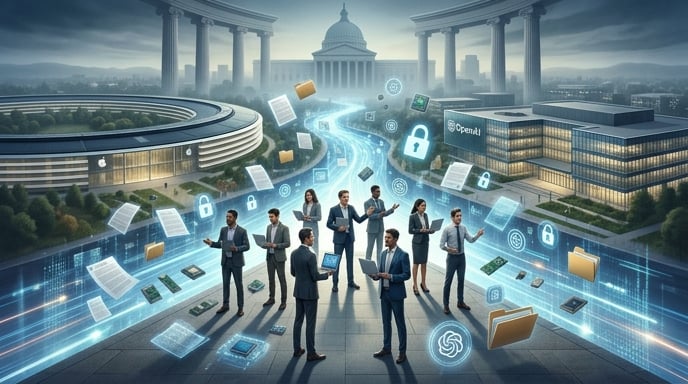
The Apple–OpenAI lawsuit will matter far beyond these two companies.
The AI boom has created one of the fiercest talent wars in technology history. Companies routinely offer enormous compensation packages to recruit engineers, researchers, designers, and product leaders from competitors.
The knowledge inside those employees’ heads often provides the main reason for hiring them.
That creates a difficult boundary. Businesses must protect genuine trade secrets without treating their employees as corporate property. Workers must remain free to move between jobs, but they cannot take protected files or physical components with them.
Apple’s complaint presents an extreme version of that tension. It alleges unauthorized system access, copied documents, retained equipment, physical parts brought to interviews, and supplier information used outside the company.
OpenAI denies wanting anyone else’s trade secrets. Whether that denial survives discovery will depend on evidence that the public has not yet seen.
For now, Apple has supplied the allegations. OpenAI has supplied a brief rejection. The defendants have not filed their full answers, and no court has determined that misconduct occurred.
That point matters. A complaint tells one side’s story in its strongest possible language. It is not a verdict.
Still, the lawsuit has already changed the atmosphere around OpenAI’s hardware ambitions. What once looked like a glamorous alliance between Sam Altman and Jony Ive now comes with allegations of network access, secret files, suspicious interviews, and supplier intrigue.
The future of computing may still be ambient, intelligent, and screen-free.
First, however, everyone may need to spend a few months in a courtroom arguing about motherboards.
Sources
- PetaPixel — Apple Sues OpenAI, Alleging Former Employees Stole Confidential Hardware Trade Secrets
- Axios — Apple Sues OpenAI Over Trade Secrets
- AppleInsider — Apple Sues OpenAI and Previous Apple Design Executive Over Alleged IP Theft
- 4sysops — Apple Sues OpenAI Over Alleged Hardware Trade-Secret Theft and Network Breach
- UPI — Apple Sues OpenAI, Alleging Theft of Trade Secrets
- The Arabian Post — Apple Targets OpenAI Over Alleged Secrets Theft
The Kingy Brief
Get The Kingy Brief.
AI changes, original tests and one practical thing to try. Fridays at 09:00 Vancouver time.
Free · Double opt-in · Unsubscribe anytime
Sign up for The Kingy Brief on Beehiiv.
Signup help and newsletter schedule
Signup form provided by Beehiiv. After submitting, check your inbox for "Confirm your subscription to The Kingy Brief" and open its confirmation link. Check Spam or Promotions if you cannot find it.
Fridays at 09:00 Vancouver time: source-checked AI changes, original tests and one practical thing to try. The weekly restart begins October 9, 2026. We skip a week when there is not enough verified material. Free. Unsubscribe anytime.