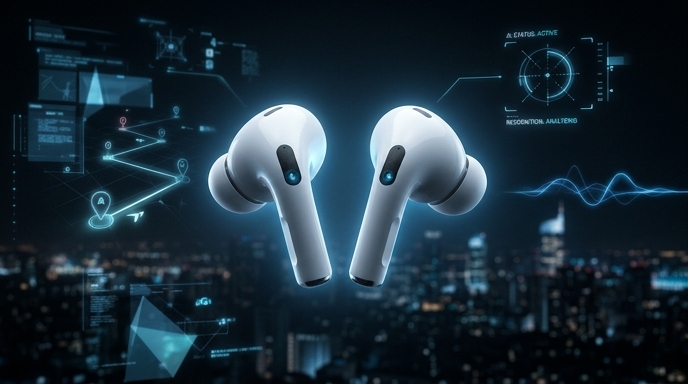
The tiny camera rumor refuses to die
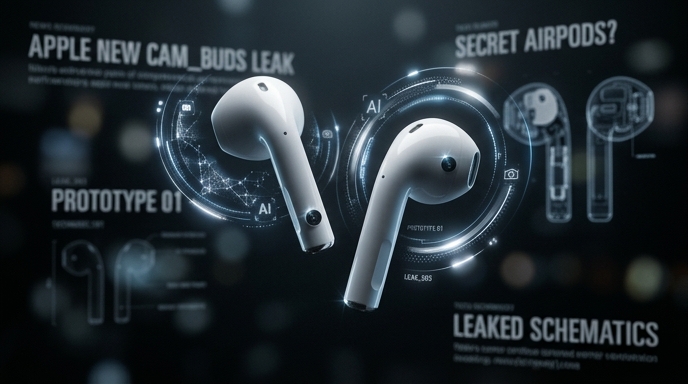
Apple’s next strange little AI gadget may not be glasses. It may not be a pendant. It may be something already sitting in millions of ears: AirPods.
According to reporting summarized by The Verge, Apple’s rumored AirPods with cameras are now close to early mass-production testing. Bloomberg’s Mark Gurman reports that Apple testers are already using prototypes internally, and that the product has reached the design validation test stage, usually called DVT. That matters because DVT comes before production validation testing, the phase where companies test early mass-production units.
So no, this is not some napkin sketch from a caffeine-damaged product meeting. It appears to be a real project.
Still, let’s not get carried away. Apple has not announced these AirPods. The release date remains unclear. And several reports stress that delays are still possible, especially because the product depends heavily on Apple’s upgraded Siri and visual intelligence features.
These cameras are not for selfies
The most important detail is also the weirdest: the cameras are reportedly not meant for taking photos or recording video.
That sounds backwards. A camera that does not “camera”? Very Apple. Very “we removed the headphone jack for courage.”
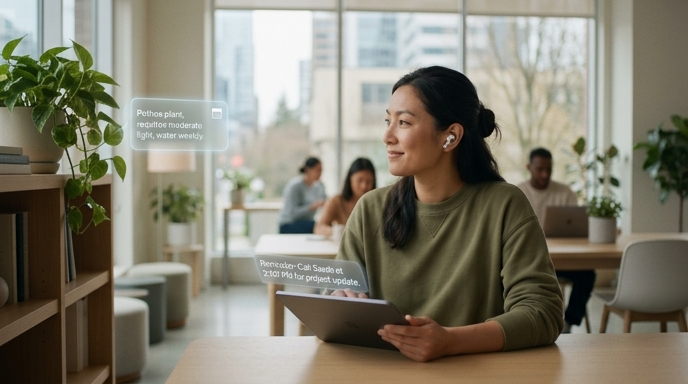
But the idea is simpler than it sounds. The cameras would gather low-resolution visual information so Siri can understand what the user is looking at. The Verge says users might ask Siri what to cook with ingredients in front of them. Android Authority describes the cameras as giving Siri “eyes,” similar in concept to Gemini Live’s camera-feed-sharing feature.
That is the pitch: not photography, but context.
Your AirPods would see enough to help the assistant answer questions about your surroundings. Your phone already does some of this. The difference is that earbuds are worn on your body. They sit there. They listen. Soon, maybe, they glance.
Creepy? Potentially.
Useful? Also potentially.
Apple wants ambient AI, not another camera app
This rumor only makes sense if you see where consumer AI is going.
The first wave of AI chatbots lived in text boxes. Then they moved into phones. Now companies want AI to become ambient. That means the assistant does not wait for you to upload a photo or type a prompt. It senses more of your environment and reacts faster.
Camera-equipped AirPods would fit that strategy.
They could help Siri answer questions about the world around you. They could support turn-by-turn directions. Android Authority also reports that Apple is exploring reminders based on what enters the camera’s view.
Imagine walking past a store and asking, “Did I need anything from here?” Or opening the fridge and saying, “What can I make that won’t taste like sadness?” Siri sees the ingredients and suggests dinner.
That is the dream. The nightmare is Siri confidently recommending mustard yogurt soup. AI giveth. AI gaggeth.
The development stage is the real news
The big update is not merely that Apple is thinking about camera AirPods. The key point is that the project has reportedly advanced.
The Verge says the prototypes are in DVT, and Apple testers are actively using them. AppleInsider adds that DVT is generally the second-to-last step before production, followed by PVT units used to test manufacturing in larger quantities.
AppleInsider also notes that DVT often lasts three to six months, while AirPods PVT has historically lasted two to four months, with full production generally beginning about two months before release.
That does not guarantee a launch soon. Hardware timelines slip. AI timelines slip harder. Put them together and you get a product schedule made of pudding.
But the reporting suggests this is no longer vaporware. It is edging toward manufacturability.
Do not bet the farm on 2026
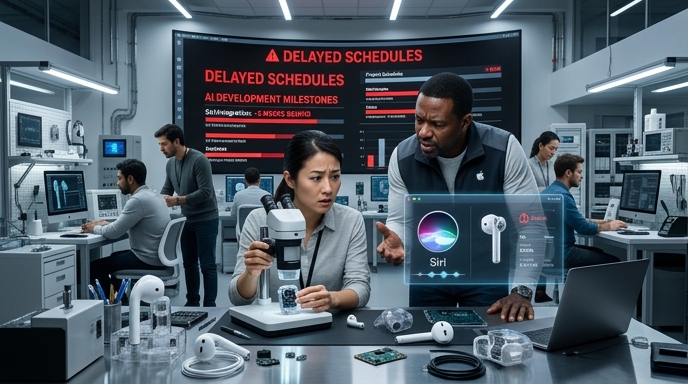
Several reports agree on one thing: 2026 is uncertain.
The Verge reports that Apple once wanted to launch these new AirPods as early as the first half of 2026, but that plan was pushed back because of delays to the upgraded Siri.
AppleInsider’s headline is even more cautious: “AirPods Pro with cameras probably aren’t arriving in 2026, but they are close.” The outlet says the release date is still unclear, even though prototypes with near-final design are reportedly being tested.
Android Authority also says delays remain possible if Apple is unhappy with the quality of the AI features.
That is the correct reading. The hardware may be close. The experience may not be.
And with Apple, the experience is the product. A camera in an earbud is just a component. A camera that makes Siri useful without making everyone uncomfortable? That is the hard part.
Why Siri is the bottleneck
Apple’s camera AirPods would live or die by Siri.
If Siri cannot understand the question, identify the scene, and respond quickly, the product becomes a tiny expensive embarrassment. Nobody wants earbuds that say, “Here’s what I found on the web,” while staring at a tomato.
The Verge reports that the AirPods delay followed delays to Apple’s upgraded Siri, though Gurman says the improved Siri is on track for September.
That connection matters. A visual AI product needs a strong assistant. It needs speech recognition, object recognition, reasoning, and a fast response pipeline. The user should not feel like they are filing a support ticket with their own earbuds.
Apple has excellent hardware discipline. Its AI rollout has been less convincing. So the blunt question is this: can Apple make Siri smart enough before the hardware is ready?
Confidence: moderate. Apple can ship polished hardware. Its current challenge is shipping AI that feels inevitable rather than late.
The privacy light is not a small detail
The rumored AirPods may include a small LED light that shows when visual data is being sent to the cloud. The Verge and Android Authority both mention this indicator.
That detail matters because camera earbuds could make people nervous fast.
Smart glasses already raise questions. Earbuds may be stranger. People understand glasses with cameras because the camera sits near the eyes. Earbuds are more subtle. They are also common in public spaces. A visible LED would help signal when visual data is active.
But an LED is not a full privacy solution. It is a warning label.
Apple would need to explain exactly when the cameras activate, what they capture, what goes to the cloud, what stays on device, and whether people nearby can trust the indicator. Without that clarity, the product risks becoming socially radioactive.
Nobody wants to wonder whether someone’s left ear is uploading the room.
The design problem is hilarious and serious
AppleInsider raises a practical issue through its article and reader comments: where would these cameras point?
Human eyes sit in front of the head for a reason. AirPods sit in ears, on the sides of the head. Earbud angles vary from person to person. Hair can block the view. A stem may point downward, forward, sideways, or somewhere into the metaphysical unknown. (AppleInsider)
That is not a minor nitpick. It is the core hardware challenge.
For visual AI, “roughly seeing something” may be enough for simple tasks. But if Siri must identify ingredients, read signs, or support directions, camera angle becomes important. The system needs usable visual input. Otherwise, users will start turning their heads like confused owls.
Could Apple solve this? Maybe.
The reports say the new model may resemble AirPods Pro 3 but with longer stems because of the camera technology.
Longer stems could help positioning. Software could compensate for weird angles. Low-resolution context may not require perfect framing. But the ergonomics still look tricky.
No hand gestures, apparently
One rumored use for camera-equipped AirPods was gesture control. That now seems less likely.
AppleInsider reports that hand gesture controls are not currently expected to be supported by the cameras.
That is interesting because hand gestures sound like an obvious camera feature. Wave to skip a song. Pinch to answer a call. Flick away a notification. Very futuristic. Very easy to demo.
But Apple may be aiming elsewhere. The current reporting centers on Siri context, object awareness, reminders, and directions.
That makes the product less like a controller and more like a sensor.
In plain English: Apple may not want AirPods to watch your hands. It may want them to help Siri understand your world.
The Vision Pro connection has history
This rumor did not appear from nowhere in 2026.
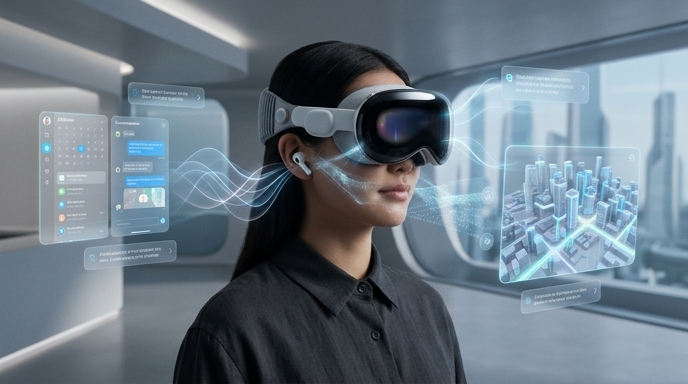
AppleInsider notes that early rumors in June 2024 from analyst Ming-Chi Kuo suggested camera-equipped AirPods could enhance Spatial Audio with Apple Vision Pro. AppleInsider also says Apple filed a June 2025 patent related to cameras on AirPods, including proximity sensing and identifying types of matter.
That history matters because Apple often builds product families, not isolated gadgets.
AirPods already support Apple’s broader ecosystem. They connect to iPhones, Macs, Watches, and Vision Pro. If they gain visual sensors, they could become another input layer for spatial computing.
The first use may be Siri. The longer-term play could be richer context for Apple’s wearables.
That is very Apple: make the accessory smarter until it quietly becomes infrastructure.
Meta is already in the room
Apple is not building in a vacuum.
The Verge points out that Apple’s AI gadget push would put it in competition with Meta, which has had success with smart glasses. The same report also says Apple is developing smart glasses and an AI pendant that could launch as soon as early 2027, according to Gurman.
That competitive frame is crucial.
Meta’s smart glasses put cameras near the eyes. That is the obvious design. Apple’s rumored AirPods take a stranger route. But Apple has one massive advantage: AirPods are already mainstream. People wear them everywhere. They do not scream “prototype.” They scream “I am ignoring you politely.”
If Apple can add useful visual AI without making AirPods bulky or socially awkward, it could sneak into the ambient AI race through a product people already understand.
That is the strategic genius. Or the strategic delusion. The difference will be execution.
The phone is still the obvious rival
Here is the strongest counterargument: why not just use the iPhone?
Your iPhone already has cameras. Good cameras. Properly aimed cameras. Cameras with screens, Cameras with processing power. Cameras that do not sit beside your cheekbone hoping for the best.
AppleInsider’s reader discussion makes this point sharply: if you need to scan something, pulling out your phone may be easier than wearing camera-equipped earbuds.
That objection is strong.
For camera AirPods to work, they must offer something the phone cannot. Speed is one answer. Hands-free use is another. Constant availability is a third.
But “constant availability” only works when users are actually wearing the AirPods. Many people wear them during commutes or calls, not all day. People remove them during conversations. People leave them in cases. Batteries die.
So the product’s usefulness may depend on lifestyle. Heavy AirPods users may love it. Casual users may shrug.
Battery life could be brutal
Camera sensors need power. Wireless transmission needs power. AI processing needs power. AirPods are tiny.
AppleInsider’s comment section raises this concern bluntly, noting that current AirPods Pro 3 already pack a lot into a small shell and questioning where the extra hardware and battery capacity would go.
That is not just internet grumbling. It is basic physics wearing a forum avatar.
Apple can reduce the pain with low-resolution sensors, short activation windows, efficient chips, and iPhone offloading. The reports also say the cameras are not intended for user photos or video, which implies they may not need high-resolution capture.
Still, battery life will be a make-or-break issue.
If visual AI drains AirPods fast, people will disable it. If it works only in brief bursts, Apple must design the feature around brief bursts. Ask, glance, answer, stop.
That might be enough.
The cloud question will annoy people
The rumored LED indicates when visual data is being fed into the cloud. That suggests at least some processing may happen remotely.
This creates two problems.
First, latency. If the AirPods need to capture visual input, send it to the cloud, wait for AI processing, and return an answer, the interaction must still feel fast. Otherwise, the magic dies.
Second, trust. Apple has built much of its brand on privacy. If camera AirPods send visual data to the cloud, Apple must explain the boundaries with unusual clarity.
People tolerate microphones because phone calls and voice assistants trained them to. Cameras feel different. A microphone records sound. A camera records context, objects, people, spaces, documents, screens, and accidents.
Apple can manage that. But it cannot hand-wave it.
The best use case may be navigation

The reports mention turn-by-turn directions as a possible use.
That might be the killer feature.
Imagine walking through a city with your phone in your pocket. Siri says, “Turn right after the pharmacy,” because the AirPods recognize the storefront. Or, “The entrance is across the street.” Or, “You passed it; yes, again.”
This kind of visual navigation could be genuinely useful. It would also fit AirPods perfectly because earbuds already deliver audio instructions.
The phone can do this, but you must hold it up. Smart glasses can do it, but not everyone wants glasses. AirPods could provide a middle path: less immersive than glasses, more ambient than a phone.
That is where the product starts to make sense.
Not as an always-on camera, not as a spy toy. Not as a photo device. As a contextual navigation and assistant sensor.
The kitchen demo is cute, but limited
The “what can I cook with these ingredients?” example appears in multiple reports.
It is an easy demo because everyone understands food. Open fridge. Ask Siri. Get recipe. Dinner saved.
But it may not be the strongest real-world case.
Fridges are dark. Items overlap. Labels face away. Containers hide leftovers of uncertain origin. AirPod cameras may not have the best angle. Your phone would probably do better.
That does not mean the feature is useless. It means Apple should avoid over-selling kitchen magic.
The stronger pitch is quick environmental awareness: signs, objects, directions, reminders, maybe accessibility support. Those tasks may require less perfect framing and less detailed visual capture.
A fridge demo is charming. Navigation may be practical.
This could help accessibility
The reports do not frame the product mainly as an accessibility device, so we should not pretend Apple has announced that angle. It has not.
But from first principles, camera-equipped earbuds could support accessibility features if Apple designs them that way.
A visual assistant could describe nearby objects, signs, doors, or hazards. Audio output through AirPods makes sense. Hands-free interaction makes sense. The form factor is discreet.
Again, this is inference, not confirmed product detail.
Still, Apple has a long history of accessibility features across its devices. If camera AirPods ship, accessibility may become one of the most compelling areas to watch.
Confidence: moderate as a plausible use case, low as a confirmed launch feature.
Why Apple may choose AirPods before glasses
Smart glasses are more obvious for visual AI. They see what you see, they can display information. They look like the natural home for camera-based assistants.
So why AirPods?
Because glasses are socially and commercially harder. People care about style, prescription lenses, fit, weight, battery, and whether they look like a person or a beta test.
AirPods already won the social battle. They are normal, they are accepted. They are boring in the best way.
That may make them a safer bridge product.
Apple can test visual AI behaviors in a familiar accessory before launching full smart glasses. The Verge reports Apple is also developing smart glasses, which suggests AirPods may be one part of a broader AI hardware roadmap.
AirPods with cameras might not be the destination. They might be the rehearsal.
The risk: a solution hunting for a problem
The harshest read is simple: this sounds like a gadget in search of a reason to exist.
Camera earbuds face obvious issues: angle, battery, privacy, usefulness, Siri quality, cloud processing, and social acceptance. The phone already has a camera. Smart glasses make more anatomical sense. The whole thing could become a very expensive way to ask Siri what is in front of you while Siri sees mostly your hair.
That critique is fair.
But Apple has built major products out of “why would anyone need that?” before. AirPods themselves looked odd at launch. Apple Watch needed years to find its center. The iPad was mocked as a giant iPhone.
The lesson is not that Apple always wins. It does not. The lesson is that weird Apple accessories sometimes become normal after the use case sharpens.
Camera AirPods need that sharpening badly.
What would make this product work
The product needs four things.
First, Siri must be fast and competent. Not “better than before.” Actually good.
Second, the cameras must capture useful context despite the awkward ear position.
Third, privacy must be obvious. The LED helps, but Apple needs clear controls and plain-language explanations.
Fourth, the feature must save time. If pulling out an iPhone is easier, the AirPods lose.
The best version works like this: you ask a question, the AirPods briefly gather visual context, Siri answers naturally, and the interaction ends. No fiddling, No app, No “hold your head three degrees to the left.” No nonsense.
That would feel magical.
The bad version feels like a Bluetooth fever dream.
The bottom line
Apple’s rumored camera-equipped AirPods now look more real than ridiculous. The project has reportedly reached DVT. Employees are reportedly using prototypes. The cameras are reportedly designed for Siri’s visual context, not personal photos or videos. The launch timing remains uncertain, and delays are possible if Apple’s AI features are not ready.
The concept is strange. It may also be important.
If Apple pulls it off, AirPods become more than audio accessories. They become sensory devices for AI. They listen, speak, and see just enough to help.
If Apple fumbles, the product becomes a meme with battery drain.
Confidence: moderate that Apple is actively developing camera-equipped AirPods. Moderate that they are near a later testing stage. Low on exact launch timing. Unknown on whether consumers will actually want them.
The hardware may be close. The real question is whether Apple can make the experience feel obvious.
Because “Siri with eyes in your ears” is either the future of ambient computing or the funniest product pitch in Cupertino. Possibly both.
Sources
- The Verge — “Apple’s AirPods with cameras for AI are apparently close to production”
- AppleInsider — “AirPods Pro with cameras probably aren’t arriving in 2026, but they are close”
- Android Authority — “Apple’s camera-equipped AirPods take a big step toward launch”
- 4sysops activity link provided by user — page could not be retrieved by the browser tool during verification, so I did not rely on it for factual claims.
Apple Hardware Roadmap
Apple AI Hardware Context
Apple Smart Home Hardware
Apple Device Leadership
Apple AI Wearables
The Kingy Brief
Get future Kingy Brief editions.
Source-checked AI changes, original tests and one practical thing to try.
Free · Choose your subjects · Double opt-in · Unsubscribe anytime
Regular sending is paused; no restart date is set.