
Kingy AI engineering note
Short version: Kingy Score v2 turns AI launch scoring into a gated process. Before a record can receive a launch score, the library checks for recycled language, cross-field repetition, formatting artifacts, weak specificity, audience-label problems, and score integrity. Only then does the deterministic weighted composite run.
Image note: Kingy Score v2 treats scoring as the final step after validation, not as a substitute for editorial review.
AI launch coverage has a recurring problem: a score looks precise even when the underlying record is vague. A single number can hide missing sources, generic prose, repeated caveats, or a verdict that sounds confident because it is polished rather than because it is well supported. Kingy Score v2 is designed to push against that failure mode.
The v2 library identifies itself as a pure PHP 7.4 validation and scoring layer with no WordPress dependency. That detail matters. A scoring system attached directly to a WordPress theme, plugin screen, or importer can become hard to test and easy to bypass. A small, WordPress-agnostic library can be run in unit tests, import jobs, backfills, and editorial tooling before anything touches the public site.
Kingy verdict: The important idea in Kingy Score v2 is not the exact math. It is the order of operations. Validation comes first. A record has to survive quality gates before the score can carry any editorial meaning.
What The Library Does
Kingy Score v2 separates two jobs that often get blended together. The first job is validation: is the record specific, source-grounded, distinct from prior boilerplate, and internally consistent? The second job is scoring: if the record clears those checks, what weighted composite should it receive?
The library starts with text helpers for stripping markup, tokenizing words, computing Jaccard similarity, and building n-grams. Those helpers support the validation layer. Then it defines eight validators, a hard-fail function, a five-component weight table, a composite-score function, and a banding function.
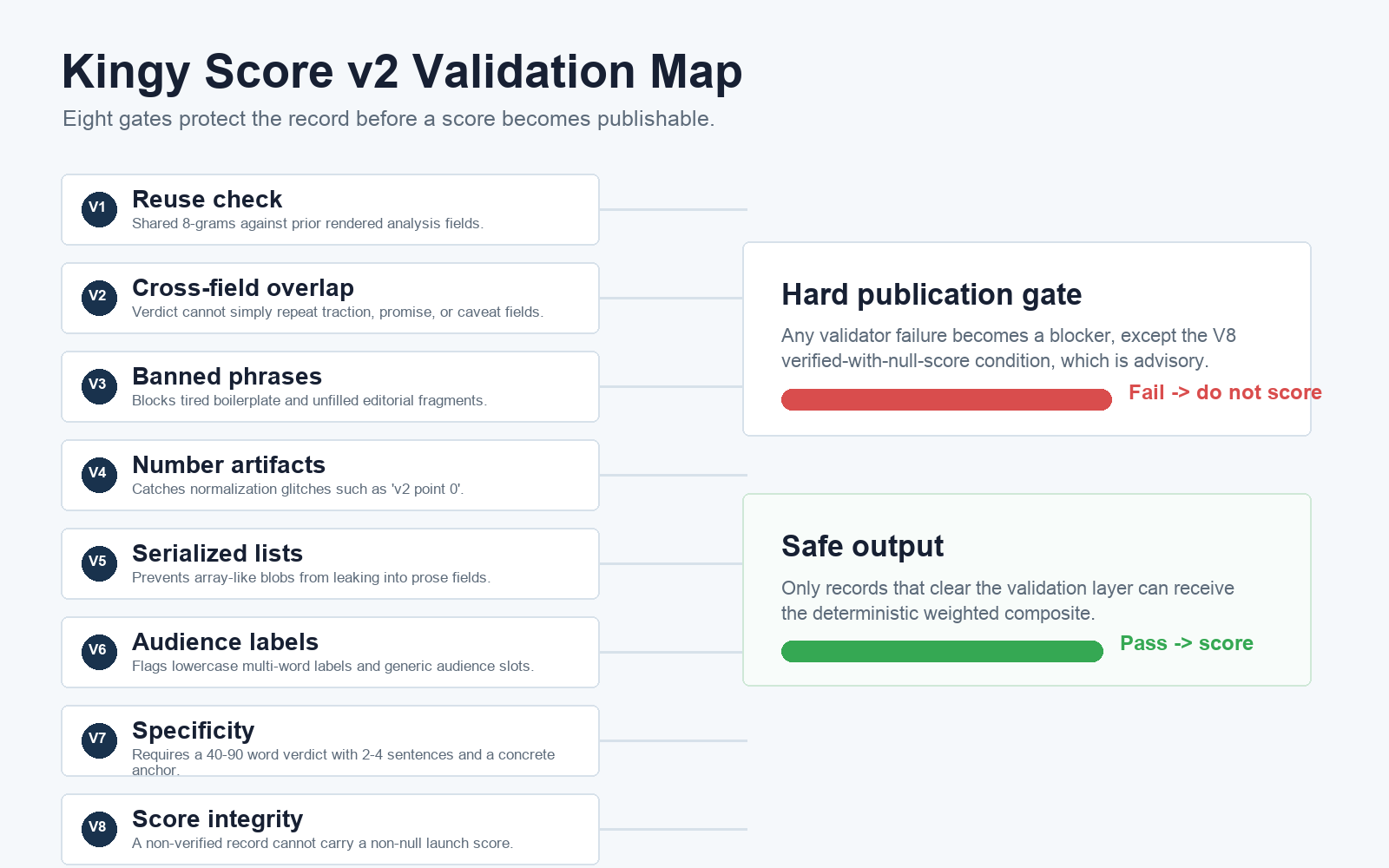
The Eight Validation Gates
The validator set is opinionated because AI-generated editorial systems need opinionated guardrails. The code is not merely checking whether fields are present. It checks whether the prose has become repetitive, generic, malformed, or overconfident relative to verification status.
| Gate | What it catches | Why it matters |
|---|---|---|
| V1 | Shared eight-word n-grams across prior rendered analysis fields. | Blocks recycled verdict language from becoming invisible background noise. |
| V2 | High overlap between the verdict and other fields. | Prevents one statement from being pasted into multiple sections with light edits. |
| V3 | Banned phrases and known boilerplate fragments. | Keeps weak editorial templates from leaking into public records. |
| V4 | Number-normalization artifacts such as “point” phrasing. | Catches machine-generated wording that makes the page feel unreviewed. |
| V5 | Serialized list artifacts in prose fields. | Stops arrays and JSON-like blobs from being treated as finished analysis. |
| V6 | Weak audience labels and unfilled audience slots. | Forces the record to say who the launch is actually for. |
| V7 | Verdicts outside the target length, sentence count, or specificity requirements. | Requires a compact, anchored verdict rather than vague praise or filler. |
| V8 | Score integrity mismatches between verification status and score value. | Ensures unverified records cannot carry a real launch score. |
The V7 specificity rule is especially practical. It asks the verdict to land between 40 and 90 words, use two to four meaningful sentences, and contain at least one concrete anchor such as a digit, month, domain, or comparator. That does not guarantee truth. It does raise the cost of vague output.
Why N-Grams And Similarity Checks Belong Here
Editorial repetition is harder to catch than a missing field. A sentence can be grammatical, plausible, and still be functionally empty because it has appeared across dozens of records. The V1 n-gram index addresses that by building a map of phrases that occur across prior records. If a new record repeats an eight-word sequence that appears in enough existing records, the validator can stop it.
V2 catches a related problem inside a single record. If the verdict is too similar to the traction notes, the promising section, or the unproven section, the page may look filled out while saying the same thing repeatedly. The Jaccard similarity check is simple, but that is part of its appeal. It is transparent enough for editors to understand and cheap enough to run anywhere.
Score Integrity Comes Before Score Math
The most important gate is V8. In the source, a non-verified record carrying a non-null score is a hard failure. That rule prevents a familiar publishing mistake: letting an attractive number imply confidence that the verification workflow has not earned.
There is a softer case too. A verified record with a null score is flagged, not treated as a hard fail. That distinction is useful. A verified record may still be missing enough component data to deserve review, but it is not the same integrity problem as an unverified record with a score.
The Weighted Composite
After validation, the composite function uses five components. C1 and C2 each contribute 25 percent, C3 contributes 20 percent, and C4 and C5 contribute 15 percent each. The function clamps component values to the 0-10 range, skips null optional values, and returns a one-decimal weighted average.
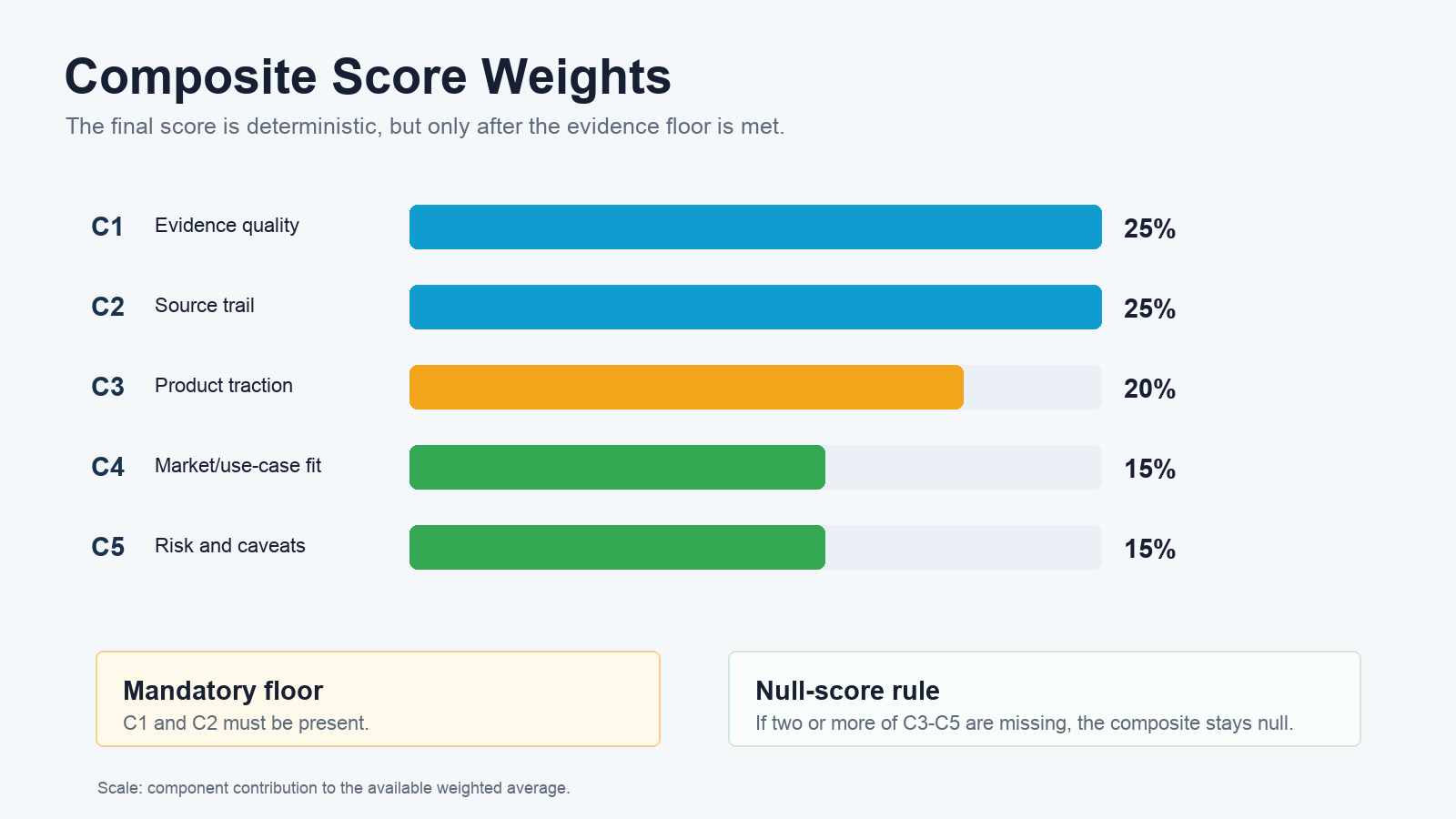
The null rules are more interesting than the weights. C1 and C2 are mandatory. If either is missing, the composite is null. Among C3, C4, and C5, one missing optional component can be tolerated; two or more missing optional components make the composite null. In plain English: the model can be incomplete in one secondary dimension, but it cannot be thin across the core evidence layer.
Score Bands
The banding function turns a numeric composite into a plain-language label. Null scores become “Needs review.” Scores below 5 become “Weak.” Scores from 5.0 through 6.9 are “Mixed.” Scores from 7.0 through 8.4 are “Solid.” Scores from 8.5 through 9.4 are “Strong.” Scores at 9.5 or above are “Exceptional.”
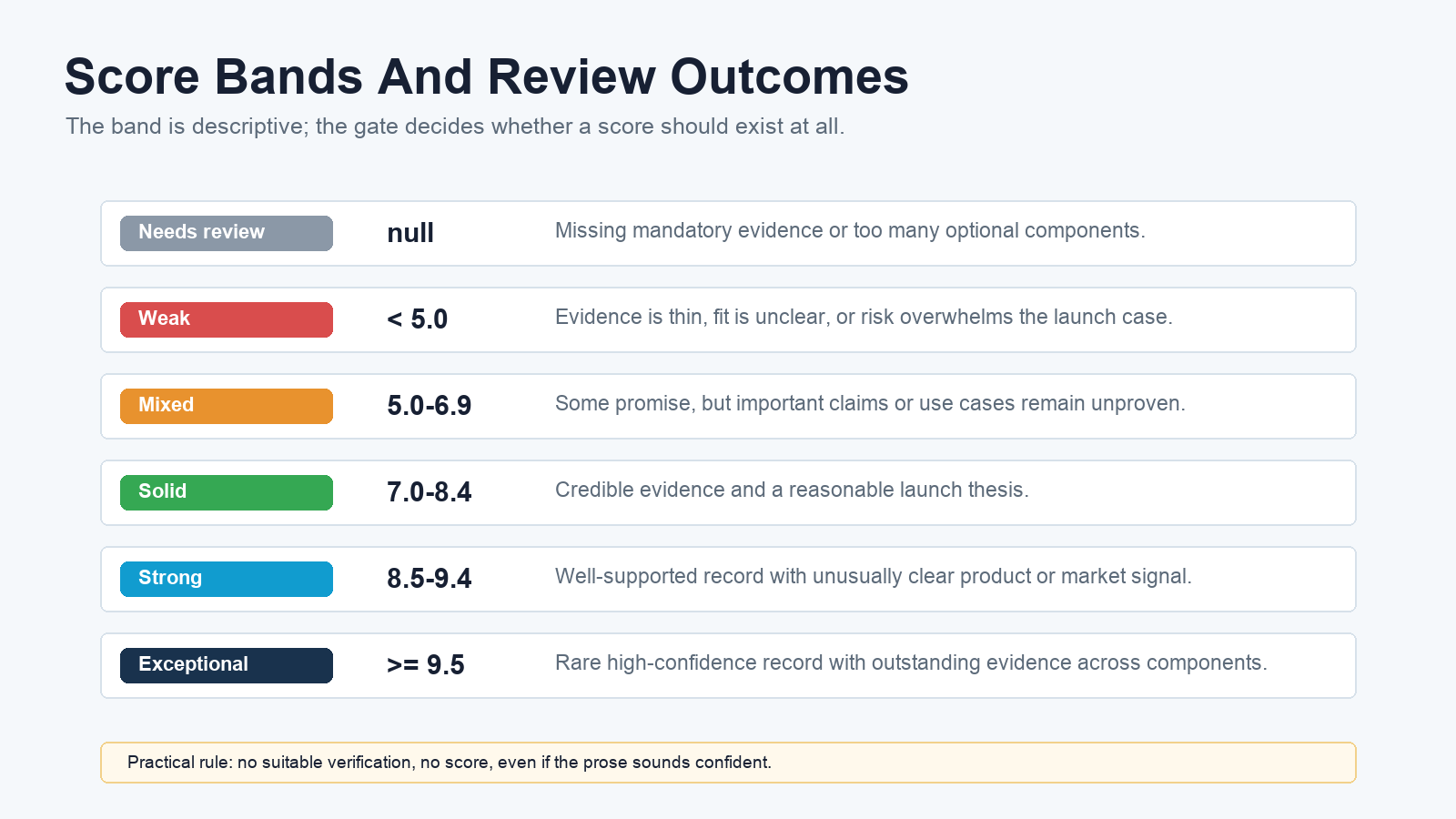
This is deliberately conservative. A launch record does not get to sound “Solid” because the prose is upbeat. It gets there only if the evidence-bearing components support the composite and the validation checks do not find a blocker.
What Makes This Useful For AI Launch Tracking
AI product launches are messy. Some have official docs, pricing pages, changelogs, model cards, customer examples, and public benchmarks. Others have a demo video, a waitlist, a press release, or a founder thread. Kingy Score v2 does not make those records magically comparable. It creates a repeatable discipline for saying when comparison is appropriate and when review is still needed.
For editors
It catches stale phrases, weak verdicts, and copied field language before a page reads more confident than it should.
For developers
It keeps validation pure, testable, and portable across importers, scheduled jobs, review queues, and publishing flows.
For readers
It makes the published score less likely to be a decorative number and more likely to reflect an evidence-aware process.
What It Does Not Solve
Kingy Score v2 is a guardrail, not a newsroom in a function file. It cannot independently verify a launch source, judge whether a benchmark is fair, inspect a product UI, or know whether a vendor has changed pricing after publication. It also cannot decide whether a banned phrase list is complete. Those responsibilities still need source collection, human review, test coverage, and periodic updates.
The library also encodes editorial taste. The verdict-length rule, the selected banned phrases, and the band thresholds are choices. That is not a flaw if the choices are visible and maintained. It becomes a flaw only if the team treats the output as objective truth rather than a consistent editorial scoring method.
Implementation Notes
The source is small enough to remain readable. The main functions have narrow jobs: tokenize text, compute overlap, find n-grams, run validators, identify hard failures, calculate a composite, and map that composite to a band. That shape makes the library easier to unit test than a monolithic WordPress callback.
The WordPress-agnostic design is also useful for migration. The same scoring rules can run before a record is imported, after a record is edited, during a nightly quality audit, or inside a command-line backfill. If the public publishing layer changes, the validation logic does not have to move with it.
Final Takeaway
The best scoring systems do not start with the score. They start with reasons a score should not exist yet. Kingy Score v2 is a compact example of that philosophy: block repetition, block vague verdicts, block malformed fields, block unverified scores, and only then calculate the number.
For Kingy AI, the practical benefit is simple. The launch score becomes less of a decorative label and more of an endpoint in an editorial workflow. That is the right direction for any AI market database that wants to be useful over time rather than merely fresh on publication day.
FAQ
What is Kingy Score v2?
Kingy Score v2 is a PHP validation and scoring library for AI launch records. It checks record quality first, then computes a weighted launch-score composite when the record has enough verified evidence.
Why does the library block repeated language?
Repeated language can make many records sound reviewed even when they share the same generic template. The n-gram and similarity checks help catch that problem before publication.
Why can a record become “Needs review” instead of receiving a low score?
Missing evidence is not always the same as weak evidence. If mandatory components are absent, the safer outcome is a null score and review status rather than a misleading low numeric score.
Does this replace human review?
No. It supports human review by catching mechanical and editorial defects early. Source interpretation, claim verification, and final judgment still need human accountability.
Source note: this article is based on the Kingy Score v2 PHP library and its documented validation/scoring behavior.
The Kingy Brief
Get The Kingy Brief.
AI changes, original tests and one practical thing to try. Fridays at 09:00 Vancouver time.
Free · Double opt-in · Unsubscribe anytime
Sign up for The Kingy Brief on Beehiiv.
Signup help and newsletter schedule
Signup form provided by Beehiiv. After submitting, check your inbox for "Confirm your subscription to The Kingy Brief" and open its confirmation link. Check Spam or Promotions if you cannot find it.
Fridays at 09:00 Vancouver time: source-checked AI changes, original tests and one practical thing to try. The weekly restart begins October 9, 2026. We skip a week when there is not enough verified material. Free. Unsubscribe anytime.