If you read the headlines from the last eighteen months, you’d be forgiven for thinking middle management is already a smoking ruin. Amazon flattened layers. Meta pushed managers back into individual-contributor roles. Microsoft is reorganizing around AI bets. Google trimmed VPs. Block cut its headcount roughly in half. By December 2025, the outplacement firm Challenger, Gray & Christmas counted nearly 55,000 U.S. job cuts attributed to AI in a single year, and the figure kept rising into 2026.
It is tempting to draw a straight line from those announcements to a tidy conclusion: AI is coming for the org chart, starting with the people in the middle.
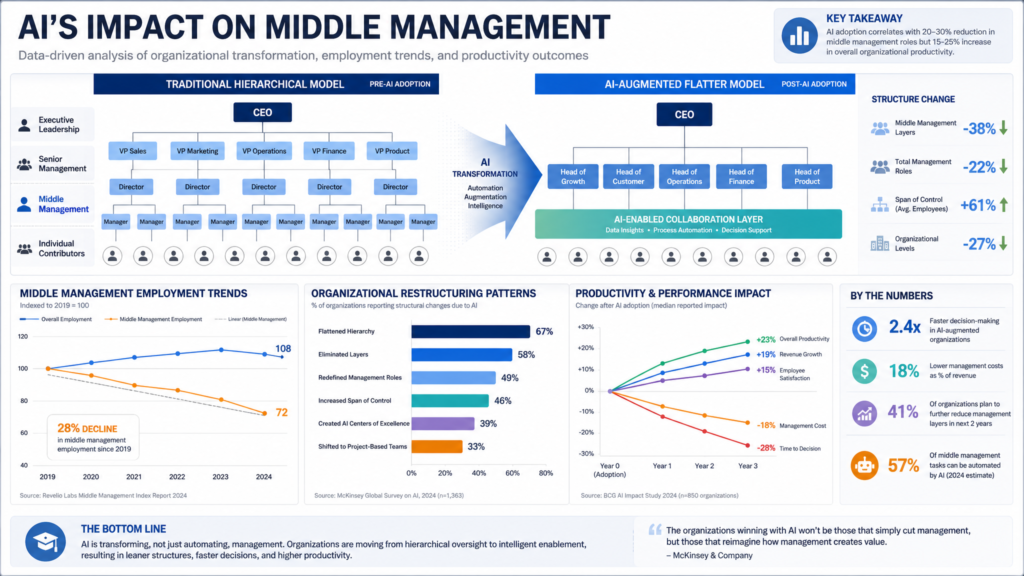
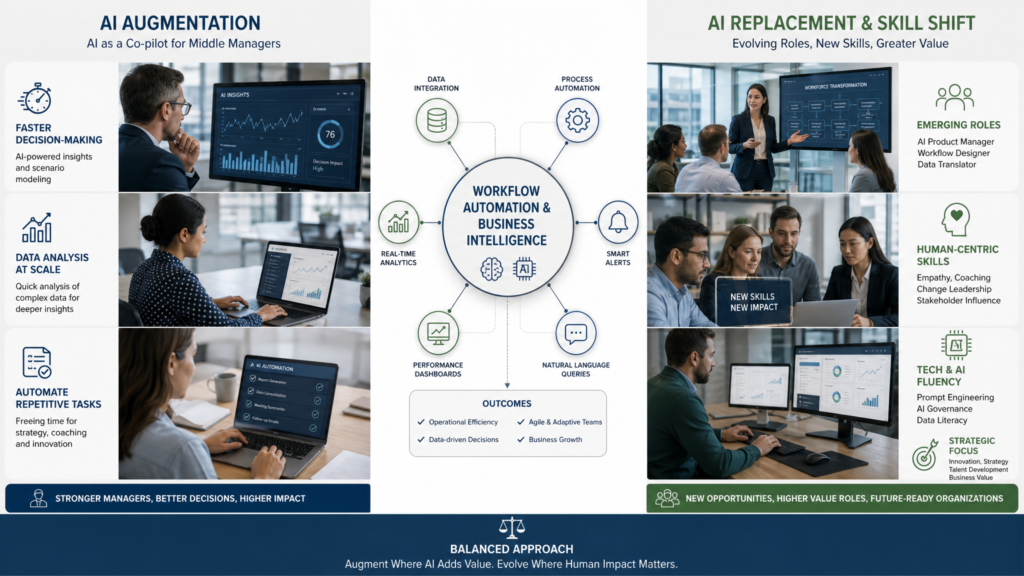
The actual evidence is more interesting, and more useful, than that. When you sit with the labor data, the capability research, and the company filings together, a different picture emerges. AI is far more likely to reshape and selectively reduce middle management than to eliminate the category. The parts of management that look like reporting, status-chasing, and approval routing are genuinely exposed. The parts that look like judgment, accountability, coaching, and political translation are surprisingly durable. The honest answer to “will AI replace middle managers?” is: some of them, in some places, doing some of the work, on a timeline that is faster than five years ago but slower than the press releases suggest.
Here is what the data actually shows, what companies are actually doing, and what it means if you manage people, run an organization, or are trying to figure out where your own career fits.
The short answer most evidence supports
The cleanest framing comes from looking at where management work concentrates and how exposed each cluster is to current AI.
Text-heavy, metrics-heavy, workflow-coordination tasks — the parts of management that look like moving information from one place to another — are the most exposed. Socially contingent, politically sensitive, high-accountability tasks — the parts of management that look like deciding who gets promoted, whose project gets killed, and how to break news no one wants to hear — are the least exposed. That split shows up in three independent places: U.S. labor-market projections, the choices companies are actually making, and the capability frontier of the AI systems themselves.
In the U.S. Bureau of Labor Statistics’ 2024–2034 occupational projections, management occupations overall are still projected to grow 6.1%. Inside that aggregate, the picture splits sharply. First-line supervisors of office and administrative support workers are projected at −0.3%. First-line supervisors of retail sales workers are projected at −5.0%. By contrast, general and operations managers are at +4.4%, human resources managers at +5.0%, production supervisors at +1.2%, transportation supervisors at +3.7%, and medical and health services managers at a striking +23.0%.
That is not the signature of category extinction. It is the signature of selective compression: thinning in routine, narrow-span, admin-heavy supervisory roles, and continued demand in roles where management is intertwined with regulation, exception handling, and physical or clinical complexity.
The picture sharpens further when you look at what companies are actually doing.
What firms are doing, and what they are actually saying
The strongest publicly verifiable statement comes from Amazon. CEO Andy Jassy told the company that each S-team organization should increase its ratio of individual contributors to managers by at least 15%, and that “having fewer managers will remove layers and flatten organizations.” In October 2025, Amazon followed through with roughly 14,000 corporate role eliminations, with SVP Beth Galetti tying the move to AI-enabled efficiency and the need to operate “more leanly, with fewer layers and more ownership.”
Meta’s “Year of Efficiency” announcement in 2023 set the tone for the broader trend. Mark Zuckerberg’s public memo described roughly 10,000 job cuts and an explicit push toward a flatter structure, with many managers and directors moving into individual-contributor roles or leaving altogether. Microsoft has cut around 15,000 jobs across 2025 while publicly framing the change as part of repositioning around AI, with CEO Satya Nadella describing the shift “from a software factory to an intelligence engine.” Google CEO Sundar Pichai reportedly told staff the company had cut manager, director, and VP roles by about 10%, with later reporting suggesting more than a third of managers overseeing very small teams were eliminated.
The list of companies citing AI in workforce decisions has gotten long enough to be its own genre. Programs.com’s running tracker of AI-cited layoffs catalogues more than 45 CEOs who have announced workforce reductions tied at least in part to AI efficiencies. Salesforce’s Marc Benioff said publicly that he had reduced his customer-support headcount from 9,000 to about 5,000 because, in his words, he needed “less heads.”
Block CEO Jack Dorsey announced that Block was cutting its workforce nearly in half, telling shareholders that “intelligence tools have changed what it means to build and run a company.” Citigroup expects roughly 20,000 fewer positions over the coming restructuring as automation absorbs middle-office work. C.H. Robinson cut about 1,400 logistics jobs after deploying AI for pricing, scheduling, and tracking. Accenture announced roughly 11,000 cuts and said employees who could not be reskilled would be exited.
There is enough volume here to take seriously. But there is also an important asterisk. In nearly every public statement, companies frame the moves as a combination of efficiency, bureaucracy reduction, AI investment, and cost discipline. Very few say, in so many words, “AI replaced this group of managers.” That distinction matters. It is the difference between observing that organizations are getting flatter while spending more on AI, and proving that AI itself is doing the substituting.
That gap has not gone unnoticed.
The “AI as cover story” critique
A growing body of reporting argues that some share of the AI-cited layoffs is at least partly post-hoc rationalization. The Oxford Internet Institute’s Fabian Stephany has argued publicly that companies are “scapegoating” AI for what are, in many cases, traditional cost cuts and corrections to pandemic-era overhiring. A widely cited MIT study found that roughly 95% of enterprise AI investments to date have yielded zero measurable return on profitability, and the New York Federal Reserve found only about 1% of service-sector firms reported AI-driven layoffs in a recent six-month window.
That doesn’t mean the layoffs aren’t real. It means the causal story is messier than the press releases. If AI is delivering returns at only 5% of investing firms, but a much larger share of those firms are still citing AI when they cut staff, then “AI made us do it” is doing real narrative work — softening market perception, justifying delayering decisions that executives might have wanted anyway, and giving CFOs a story to tell quarterly investors.
For middle management specifically, that ambiguity is consequential. A reduction-in-force that gets badged as “AI restructuring” can sweep up management layers that were already targets for cost reasons. The result looks like AI replacing managers. The underlying cause may be a mix of overhiring correction, macro pressure, copycat benchmarking, and a genuine belief that delayered organizations move faster.
The SHRM CEO Academy made this point sharply in late 2025: SHRM’s own data brief, drawn from a 20,000-worker U.S. sample, found that 15.1% of jobs are at least half automatable in principle, but only about 6% are both highly automatable and free of the nontechnical barriers — client expectations, regulation, trust, tacit knowledge — that prevent actual displacement. That is materially less than the headlines suggest, and it is consistent with the broader picture: a lot of work is technically exposed, much less is operationally ready to be cut.
What “middle management” actually means
Before going further, it’s worth tightening the definition, because a lot of the noise in this debate comes from people arguing about different things.
There is no single official statistical category for “middle manager.” In labor data, the practical proxy is a mix of departmental and functional managers — general and operations managers, HR managers, clinical managers, plant managers — plus the first-line supervisors who directly coordinate operational staff. In management scholarship, middle managers are typically described as actors positioned between senior leadership and frontline execution, with a boundary-spanning role connecting strategy to the people doing the work.
A functional definition is more useful than a statistical one: middle managers are the people who translate plans into operating decisions, coordinate across units, supervise employees or team leaders, and report performance and exceptions upward. That excludes the C-suite and excludes purely individual-contributor specialists. It includes the layer that historically does the translation work — taking a strategy deck and turning it into a sprint, a shift schedule, a quarterly plan, a budget allocation, a difficult performance conversation.
Within that functional definition, the work splits cleanly into three buckets:
Programmed decisions — scheduling, routine approvals, status reporting, KPI reviews, policy reminders, standard communications. Highly structured, text- and data-rich, easy for AI to handle with human review.
Semi-structured decisions — performance-review drafts, staffing reallocations, budget-variance analysis, escalation triage, cross-team dependency management. Bounded but with real judgment required. Increasingly augmentable, not safely fully automated.
Unstructured decisions — conflict resolution, coalition building, culture repair, judgment under ambiguity, crisis leadership, translating vague strategy into local execution. Long-horizon, high-context, often with no clear correct answer. Difficult to delegate to a model on any near-term timeline.
The reason middle management isn’t going to vanish is that almost every middle-management job contains all three buckets. The reason some of these jobs are shrinking is that the proportion varies enormously by role, sector, and span of control.
What AI can actually do — and what it still can’t
The capability evidence supports a measured view. The International Labour Organization’s 2025 update on generative AI and jobs estimates that about one in four workers globally is in an occupation with some degree of generative-AI exposure, but emphasizes that most jobs are likely to be transformed rather than made redundant, because human input remains structurally necessary.
The World Economic Forum’s 2025 employer survey, covering more than 1,000 employers representing over 14 million workers across 55 economies, found that 40% of employers expect to reduce their workforce in areas where AI can automate tasks. That is real pressure. But pressure on intent is not the same as realized substitution, and the WEF data also shows widespread expectations that AI will create new roles and reshape existing ones, not just eliminate them.
The clearest capability frontier evidence comes from METR’s 2025 work on long-task autonomy. METR measured the length of task that frontier systems could reliably complete and found that, at the time of the study, the “50%-success time horizon” was roughly 50 minutes of equivalent human task time, and that this horizon had been doubling roughly every seven months. That is fast progress. It is also a long way from the multi-week, multi-stakeholder, ambiguous decision cycles that characterize the most consequential parts of managerial work.
A useful way to think about this is by task cluster:
- Routine information processing — meeting notes, status summaries, KPI digests, policy Q&A, dashboard narration, draft emails, basic scheduling. Automatable now, with human review.
- Standardized coordination — performance-review language, first-pass hiring screens, resource-planning scenarios, compliance reminders, cross-team progress tracking. Automatable with human-in-the-loop, increasingly so as agent reliability improves.
- Coaching on known playbooks — codifying best practices, surfacing recommended next steps, suggesting answers for routine cases. Already producing real productivity gains.
- High-stakes people decisions — promotions, terminations, misconduct, compensation exceptions, labor disputes. Unlikely to be safely delegated soon because of legal risk, fairness requirements, incomplete information, and the need for legitimate human accountability.
- Strategic translation and political coordination — turning rough strategy into local plans, aligning conflicting stakeholders, handling ambiguity, securing buy-in. A long-term hard problem — long-horizon, multi-party, sparse feedback, often no objectively correct answer.
- Culture and emotional buffering — building trust, sensing burnout, defusing conflict, maintaining morale through change. The least automatable.
Research from Erik Brynjolfsson, Lindsey Raymond, and Danielle Li on generative AI in customer support is the most-cited empirical study of where current AI actually moves the needle. They found a 14% average productivity gain across support workers, with a 34% gain for novices and low-skilled workers and almost no effect on the most experienced. The interpretation matters: AI is good at codifying and distributing the knowledge that less experienced workers would otherwise have learned slowly, often from supervisors. That doesn’t eliminate managers, but it does reduce some of the routine coaching load and makes wider spans of control feasible.
That last point is the practical mechanism behind most of what’s happening in corporate flattening. A manager who used to oversee six people can plausibly oversee ten if AI is handling the coaching for routine cases, the drafting of performance summaries, the dashboard narration, and the meeting follow-ups. Stretch that across a 5,000-person organization and you can credibly cut a couple of layers without losing the work — if the cuts target the right people.
The good-manager paradox
Here is where the conversation gets uncomfortable for the “just delete the middle” crowd.
The most-cited empirical work on the value of bosses, by Lazear, Shaw, and Stanton, found large supervisor effects: replacing a boss in the bottom 10% of quality with one in the top 10% increased a team’s output by about as much as adding one extra worker to a nine-person team. The NBER write-up summarized that swapping a bad boss for a good one raises subordinate output by more than 10%, and that better bosses also reduce turnover.
That finding cuts in two directions. It means delayering can raise performance when the layers being removed are weak or redundant. It also means delayering can destroy real value when good managers — the ones doing actual coordination, talent development, and judgment work — get caught in the same RIF as the marginal ones.
This isn’t a fringe view. The work of Nick Bloom, John Van Reenen, Raffaella Sadun, and coauthors on management practices has repeatedly shown that differences in management practices are associated with substantial productivity differences across firms and countries. If good management is a real input to productivity, then “AI reduces middle management” is not automatically a productivity story. It only becomes a productivity story if AI is removing low-value coordination overhead without removing the high-value judgment and organizational learning underneath it.
The classic field research of Quy Huy reinforces this. His work on middle managers during organizational change argued that middle managers help organizations avoid both inertia and chaos — that they are the human glue that absorbs the emotional shocks of change while keeping execution moving. Strip that layer too aggressively and what looks on paper like efficiency can show up six months later as attrition, missed commitments, culture decay, and quiet failures of follow-through.
Bob Goodwin’s analysis at the SHRM CEO Academy put it pointedly: middle management is “the organization’s connective tissue,” and indiscriminate removal of midlevel talent trades agility for instability. Deloitte’s 2025 Global Human Capital Trends report, cited in the same piece, found that fewer than 4 in 10 managers feel equipped for the people side of transformation. Yet those same managers are the ones expected to translate strategy, coach new leaders, and handle the exceptions algorithms can’t.
This is the central trade-off. Flatter structures can improve speed, reduce approval latency, and cut bureaucracy. Middle managers also perform translation, escalation, quality control, tacit knowledge transfer, and emotional stabilization during change. The effect of AI on organizations is likely positive when it deletes reporting theater. It is likely negative when it deletes human glue.
Three scenarios through 2030
If you put the labor data, the company evidence, the capability trajectory, and the management research side by side, three rough scenarios emerge for the next five years.
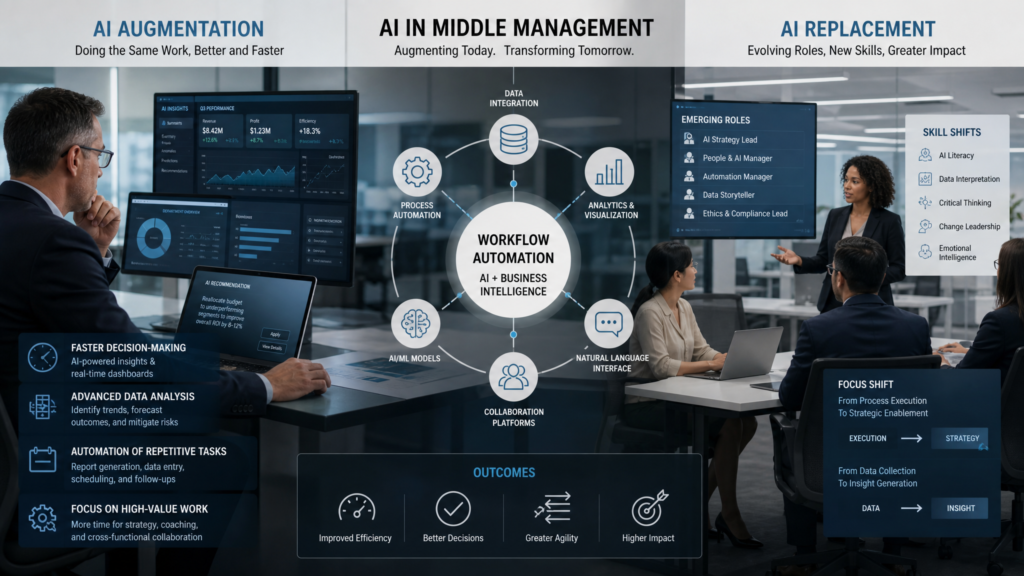
The most probable is selective reduction and role redesign. AI keeps improving on bounded workflows. Firms continue flattening, especially in corporate and admin-heavy contexts. Legal and accountability constraints keep humans in charge of consequential people decisions. The category survives but thins, especially in transaction-heavy supervisory work and small-team corporate layers. Many surviving managers become “player-coaches” with wider spans of control, more direct work, and AI tooling for synthesis, planning, and review.
A plausible net reduction in admin-heavy corporate middle-management headcount lands somewhere in the range of 5–15% by 2030, with greater compression in some sectors and growth in others. This is the scenario the BLS projections, the company patterns, and the SHRM data all most directly support.
A secondary scenario is complementary upgrade. Firms learn — sometimes the hard way — that indiscriminate delayering hurts execution and culture, and they pull back. AI is used mainly to remove administrative burden. Total middle-management employment is roughly stable, but the work shifts: less time on reporting, more time on coaching, exceptions, and cross-functional problem solving. The work gets better; the headcount doesn’t move much. This scenario is more consistent with the Lazear-Shaw-Stanton view of bosses as a real productivity input, and with the recent SHRM critique of premature delayering.
A third, less likely but real, scenario is aggressive delayering shock. AI hype, macro pressure, and copycat benchmarking push firms to cut faster than the tools are actually ready. Some companies see 15–30% cuts in corporate middle-management layers, followed by burnout, quality failures, and partial rehiring. This is the scenario that critics of the current wave — including the Hunt Scanlon and nexus IT group analyses arguing that AI is being used as a “scapegoat” for traditional cost cuts — would predict, and it is the one that requires the most assumptions to play out broadly.
Notably, none of these scenarios involve middle management disappearing as a class. Full category elimination would require enormous gains in agent reliability and accountability, and a willingness by firms, regulators, and customers to absorb the resulting control risk. The current evidence does not support that.
What this means in practice
For organizations, the practical implications are clear enough to act on without waiting for more data.
Automate reporting before cutting layers. The lowest-risk, highest-leverage use of AI in management is to remove the rote synthesis, summary, and routing work that consumes more managerial time than most leaders admit. That alone widens spans of control safely.
Measure before and after. Spans of control, employee engagement, error rates, attrition, decision latency, and time-to-hire are the right metrics. If a flattening initiative pushes any of these in the wrong direction, the reorganization is cosmetic.
Keep humans accountable for high-stakes people decisions. Hiring, pay, promotion, discipline, safety, and regulatory decisions all carry legal and ethical exposure that organizations cannot meaningfully delegate to a model in the foreseeable medium term. Manager roles will get safer, faster, and more valuable when they’re built around those decisions, not around routing information.
Retrain managers in workflow design, AI evaluation, and exception handling. The most defensible managerial work in 2030 will combine domain depth, tough judgment, people credibility, and orchestration of AI-enabled systems. Managers who can both run the AI-assisted workflow and step outside it when reality stops fitting the workflow are exactly the ones companies will want more of.
For managers personally, the asymmetry is real. The least defensible roles are those built mostly around chasing status updates, forwarding information, approving low-stakes routine work, and supervising tiny teams whose work is already software-mediated. The most defensible roles combine genuine technical or domain expertise with the people skills that compound — hiring well, coaching, conflict resolution, translation across functions, change leadership. The path forward isn’t to compete with the AI on synthesis. It’s to take the synthesis it produces and do something with it that requires standing in front of other humans and being accountable.
For policymakers and workforce leaders, the question that matters isn’t whether the title survives. It’s whether the conditions of managerial work change in ways that workers and institutions can absorb — wider spans of control, more surveillance, more direct work, more pressure to deliver in compressed timelines. Training, transparency, and internal mobility matter more than title preservation. The ILO has argued explicitly that AI transitions should be managed through social dialogue and with attention to working conditions. In practice, that means treating “management reduction” not as a cost-cutting line item but as an organizational redesign with real distributional consequences.
What the data can’t tell you
It’s worth being honest about the limits of this analysis.
The biggest is measurement. There is no clean global statistical category for middle management, so every estimate of the size and trajectory of the group depends on proxies. Most hard labor-market evidence is U.S.-based; global evidence relies more heavily on surveys. Company cases are hard to interpret causally — firms regularly reduce layers and invest in AI at the same time, which does not prove AI itself substituted for the people who left. Capability projections are uncertain; METR’s task-horizon results are important but are not a direct measurement of real-world managerial work, which unfolds over weeks and quarters and depends on context the benchmarks don’t capture.
There is also a timing question that won’t resolve quickly. If the optimists on agent reliability are right, the curve could steepen sharply in the next two to three years and pull the realized outcome closer to the aggressive-delayering scenario. If the critics are right that current AI deployments are mostly failing to deliver promised returns, the realized outcome will sit closer to the selective-reduction scenario, and the “AI-cited” share of layoffs will look, in retrospect, partly like narrative cover.
What we can say with reasonable confidence is this. AI will reduce some middle-management headcount, especially in routine, admin-heavy, narrow-span contexts. It is unlikely to eliminate middle management as a class in the foreseeable medium term. The more probable future is fewer layers, wider spans of control, heavier use of AI copilots and workflow agents, and a sharper premium on managers who contribute real judgment, coordination, and trust.
The honest version of the headline, then, is the one that’s hardest to fit into a tweet. AI is not coming for “middle management.” It is coming for the parts of middle management that look like paperwork, and it is making the parts that look like judgment more valuable. Which of those two pictures dominates in any given company depends less on the technology than on the choices the people running the company are about to make.
That, more than the headline number on this week’s layoff announcement, is what’s worth watching.
Continue Reading
- AI bureaucracy and middle-manager analysis
- Block just cut 4,000 jobs to go all-in on AI — the canary in the coal mine
- How Meta’s Performance-Based Cuts Caught Even Top Performers Off Guard
- Is HR Cooked? AI and the Potential End of Human Resources
Recent Launches
- Microsoft’s $500 Million AI Windfall Amid Mass Layoffs: A Tale of Two Realities
- Everyone Says AI Killed Entry-Level Jobs. The Reality Looks More Complicated
Latest News
Compare
The Kingy Brief
Get future Kingy Brief editions.
Source-checked AI changes, original tests and one practical thing to try.
Free · Choose your subjects · Double opt-in · Unsubscribe anytime
Regular sending is paused; no restart date is set.