
A transparent review of the public evidence on YouTube creator sponsorship pricing, sponsor activity and campaign measurement, with AI-specific gaps left visible rather than filled with invented precision.
Editor’s note
This article was revised after an editorial audit found that the original version described several vendor articles as “primary sources,” blended rate estimates without publishing the weighting method, and presented anonymous deal outcomes without visible supporting records.
Version 2 makes four changes. It separates direct observations from vendor estimates, identifies the scope of every dataset, labels calculations as scenarios rather than results, and removes claims that could not be traced to adequate evidence. Kingy AI has not independently observed enough AI sponsorship contracts to publish an AI-specific market rate.
The short answer
Among the public sources reviewed for this audit, none disclosed enough AI-specific transaction data to support a defensible market rate card.
Published guides agree on a few practical points: recent views matter more than subscriber count, audience and product fit affect what a sponsor can afford, and dedicated videos usually cost more than integrations. The sources disagree on the size of those effects, however, and most do not publish enough transaction-level detail to support a precise AI benchmark.
That does not make the available evidence useless. It changes how it should be used. The public numbers below are negotiation references and planning inputs, not verified market prices.
Start with three different metrics
YouTube’s official definitions separate platform advertising from direct sponsorships:
- CPM is the advertiser’s cost per 1,000 ad impressions before YouTube’s revenue share.
- RPM is the creator’s total YouTube revenue after revenue share per 1,000 video views. It can include ads, YouTube Premium, memberships, Super Chat and Super Stickers. It includes views that were not monetized.
- Sponsorship CPM is an informal planning metric: the sponsorship fee divided by an agreed or observed view count, multiplied by 1,000.
YouTube states that partners who accept the Watch Page Monetization Module receive 55% of net watch-page advertising revenue. That does not make RPM a fixed percentage of CPM because the two metrics use different denominators and RPM can include other YouTube revenue sources.
Sources: YouTube Help: Understand ad revenue analytics, YouTube Help: Partner earnings overview
This article uses “sponsorship CPM” only for direct brand deals. It does not describe AdSense earnings.
What the public pricing guides establish
The major pricing pages are useful, but they do not form one coherent dataset.
| Source | What it publishes | Visible scope | How to use it |
|---|---|---|---|
| SponsorRadar pricing guide | Niche, creator-tier and format ranges | SponsorRadar says the guide draws on its database of 50,000+ brands and creator partnerships. The page does not publish the transaction sample, inclusion rules, distribution or calculation method behind each range. | Proprietary vendor estimate; directional. |
| OutlierKit rate card | Tier, niche, format and modifier ranges | The rate-card page does not publish a transaction sample or rate-estimation method. It was updated July 18, 2026. | Vendor planning estimate; directional. |
| Modash pricing guide | Broad YouTube integration prices and CPMs by channel size | The page says the figures are broad numbers based mostly on U.S. integrations and “what we’re seeing.” It is not AI-specific. | Broad comparison, not an AI rate. |
| Shopify pricing guide | YouTube prices by creator tier | Shopify says its ranges are averages of online estimates from several sources and should be used as directional guidance. It was updated June 22, 2026. | Secondary synthesis; directional. |
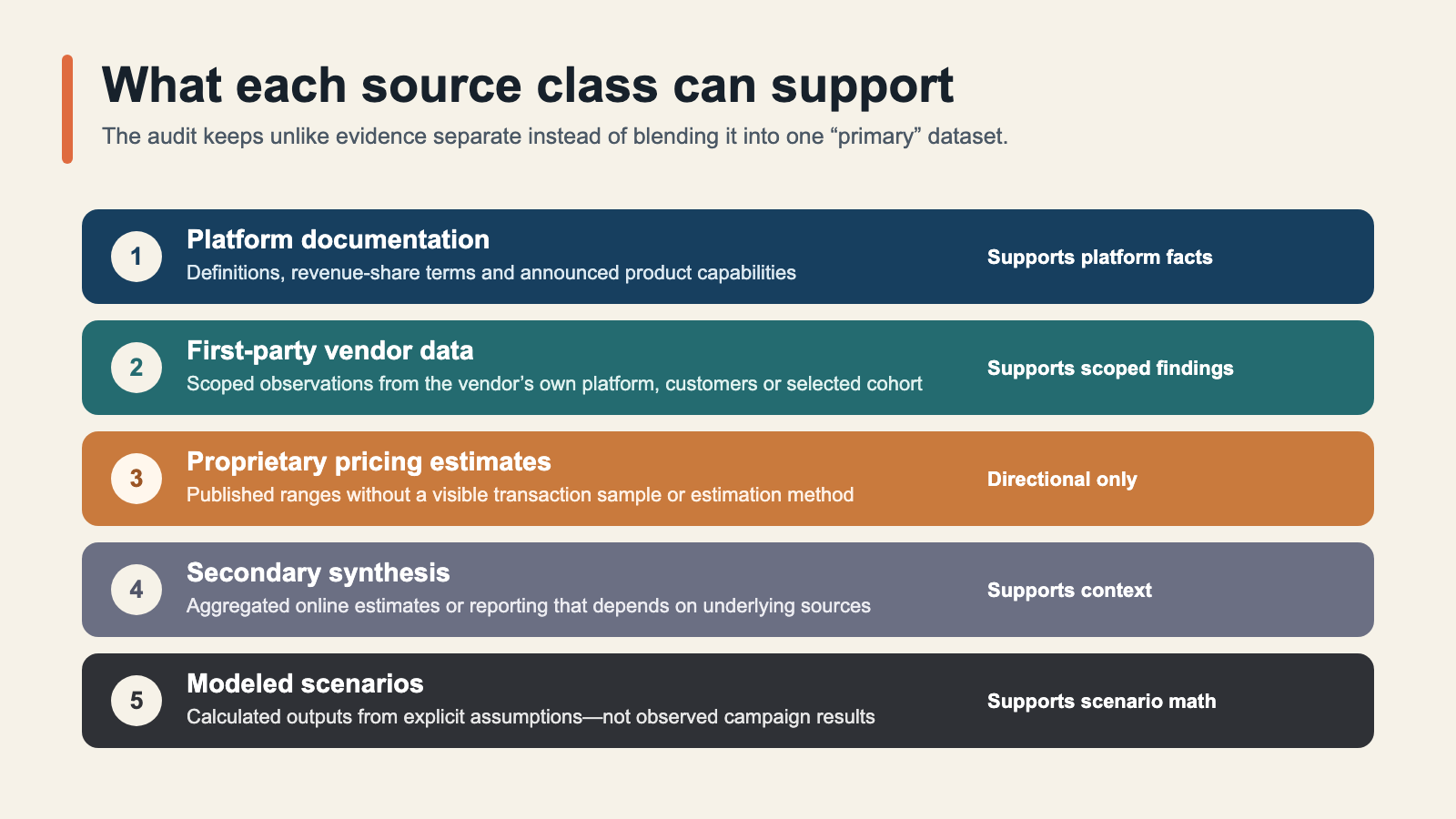
These sources should remain separate. Averaging or widening their ranges would create a new number without creating new evidence.
The most defensible planning formula is:
Expected views × negotiated sponsorship CPM ÷ 1,000 = base fee
Use median views from a defined recent window rather than subscriber count or a channel’s largest upload. Then price the deliverable, usage rights, exclusivity, revisions, production demands and performance component separately.
What the guides say about format
SponsorRadar says dedicated videos generally cost 1.5–2 times a standard mid-roll integration, while pre-roll mentions receive a 0.5–0.7 multiplier. It describes multi-video package discounts of 10–20% and usage-rights premiums of 20–50%.
OutlierKit publishes a different set of estimates: dedicated videos at 1.3–1.5 times an integration, standalone Shorts at roughly 0.4–0.6 times long-form CPM, usage rights at an additional 25–100%, exclusivity at 25–50%, and packages of three or more videos at a 20–30% discount.
Those ranges are vendor guidance, not observed AI-market distributions. Their disagreement is useful: it shows why the contract scope matters more than a universal multiplier.
The AI-specific rate gap
None of the reviewed public sources disclosed enough agreed AI sponsorship fees to support separate CPM tables for developer tools, AI art, AI news, automation, agents, consumer tutorials and product reviews.
AI content can attract different buyers. A developer-tool sponsor may value an audience of engineering leaders differently from a consumer app seeking broad trial volume. That is an economic reason to investigate sub-niches, not evidence that one sub-niche commands a specific CPM.
Until Kingy AI has a documented sample, the following should remain unpublished:
- AI sub-niche CPM ranges or confidence grades.
- Claims that B2B AI sponsorships command a fixed premium over consumer AI sponsorships.
- AI-specific conversion, engagement or customer-acquisition benchmarks.
- Counts of “mega” AI channels or claims about how their deals are normally structured.
A limited view of who is sponsoring AI and productivity channels
OutlierKit provides one reproducible public observation of sponsor frequency. Its Sponsor Intelligence report says it scanned the previous 90–180 days of videos across 20+ competitor channels per niche. Frequency means appearances across the selected cohort, not the number of campaigns across YouTube, spend, conversion performance or market share.
For its AI tools and productivity cohort, OutlierKit names AI Foundations, Tiago Forte, Jeff Su, Rick Mulready and Matt Wolfe as sample channels. Its published snapshot reports these established sponsors:
| Sponsor | Appearances across the cohort |
|---|---|
| Recall | 6 |
| Higgsfield AI | 6 |
| Zapier | 4 |
| HubSpot | 3 |
| Sunsama | 3 |
The report also lists Comet Browser, Granola, Norton Neo, Coursera Plus and Durable as one-appearance emerging sponsors.
Source: OutlierKit: Most Common YouTube Sponsors in 2026
This is evidence that those sponsors appeared in that cohort during the scan window. It does not establish that they are the largest AI sponsors, that they buy directly rather than through agencies, or that the cohort represents the whole AI creator market.
What campaign-performance data can support
Agentio’s January 2026 playbook says it analyzed more than 10,000 YouTube integrations run through its platform with first-party performance data. Across that platform dataset, Agentio reports:
- Nearly 40% of views and 30% of clicks happened more than 30 days after publication.
- Each repeat integration with the same creator improved click-through rate by 10% on average.
- Conversion rate was about 1.9 times higher by the sixth integration.
Source: Agentio: The Ultimate 2026 YouTube Creator Marketing Playbook
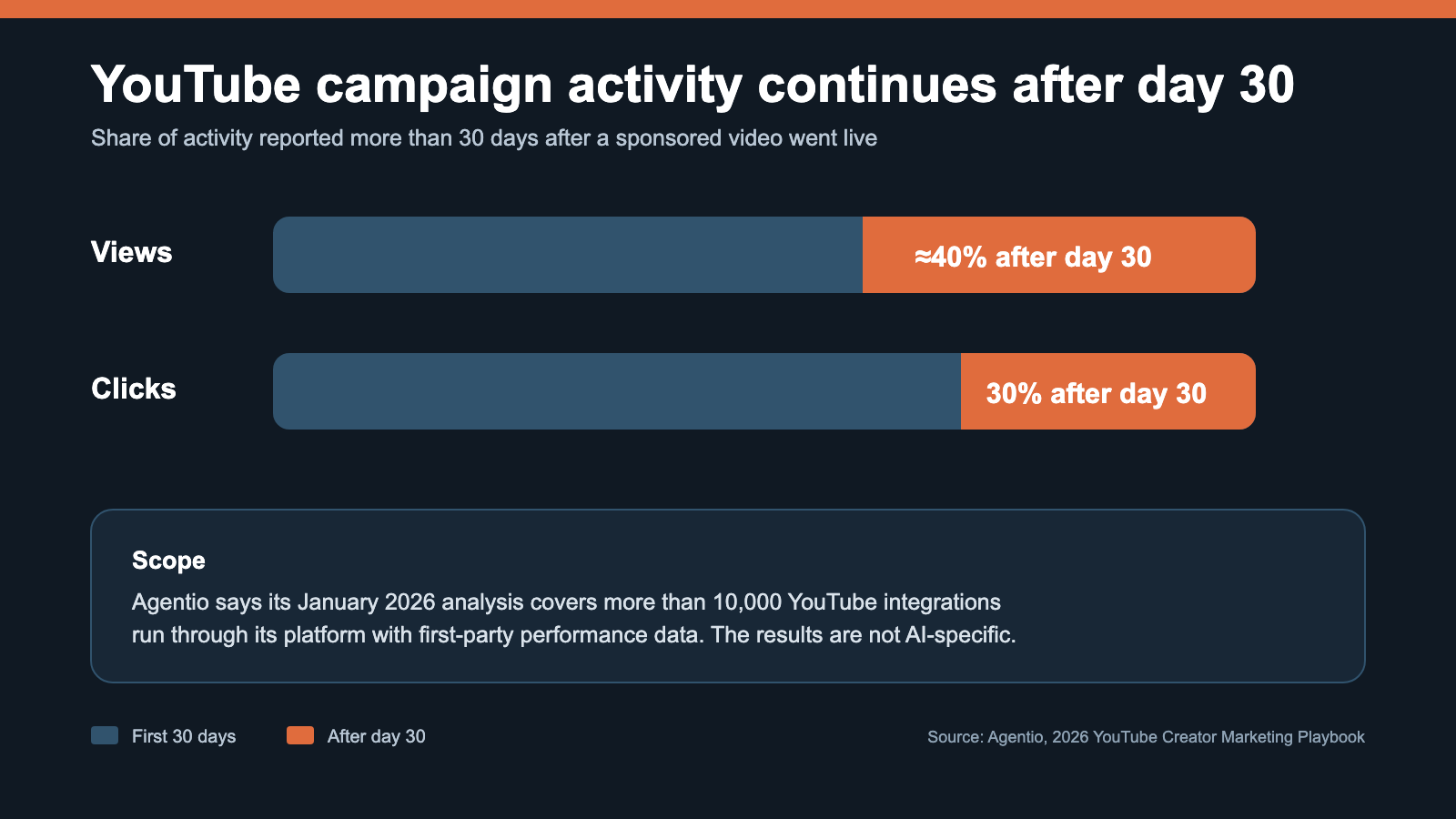
These are first-party findings from Agentio’s customers and integrations. The public page does not break the results out for AI sponsors, so they should not be presented as AI-specific conversion benchmarks. They support a longer measurement window and a reason to test repeat placements. They do not guarantee that any individual campaign will improve.
Two planning scenarios, not predicted results
The following examples show how assumptions flow through a model. They are not observed campaigns or benchmark outcomes.
Scenario A: annual-contract SaaS
Assumptions:
- Campaign fee: $12,000
- Expected views: 75,000
- Assumed click-through rate: 3%
- Assumed click-to-trial rate: 4%
- Assumed trial-to-paid rate: 20%
- Annual contract value: $1,200
- Assumed customer life: 24 months
The model produces 2,250 clicks, 90 trials and 18 customers. Modeled CAC is $666.67. If the full $1,200 annual contract value repeats for two years, modeled customer revenue is $2,400 and the revenue-to-CAC ratio is 3.6. This is not a margin-adjusted LTV calculation and it excludes churn, servicing costs, discounts, refunds and attribution uncertainty.
Scenario B: monthly consumer subscription
Assumptions:
- Campaign fee: $4,000
- Expected views: 30,000
- Assumed click-through rate: 2%
- Assumed click-to-paid rate: 6%
- Subscription price: $20 per month
The model produces 600 clicks, 36 customers and $720 in starting monthly recurring revenue. Dividing campaign cost by starting MRR gives a gross-revenue payback period of 5.56 months. Actual payback would be longer after churn, gross margin, discounts, refunds and other campaign costs.
Kingy AI’s calculator now uses blank fields by design and does not preload a rate, conversion benchmark or promised outcome. Source: Kingy AI sponsorship ROI calculator
Market signals that are broader than AI
Gospel Stats’ December 2025 launch release reported 65,759 sponsored YouTube videos in the first half of 2025, up 53.9% year over year. It reported 19.1 billion views on those videos, up 27.9%. The release says Gospel Stats tracks sponsorship activity across tens of millions of creators, but it does not publish the channel-language rules, minimum-view threshold, counting window or validation method behind these totals.
Source: Gospel Stats launch release, republished by TradingView/Refinitiv
If Gospel Stats applied consistent definitions and detection methods in both periods, the release indicates growth within its reported dataset. It does not establish that sponsorship demand grew faster than creator supply, that AI creator inbound inquiries doubled, or that AI rates will rise during 2026.
Aspire’s 2026 report draws on first-party platform data and surveys of nearly 900 marketers and creators. It says 62% of brands were increasing YouTube Shorts ad spend. The report does not state the question-level response count beside that finding. It describes cross-industry plans, not measured AI sponsorship rates.
Source: Aspire: The State of Influencer Marketing 2026
YouTube has also announced swappable sponsorship slots for long-form videos and a Creator Partnerships Hub in Google Ads. These are platform capabilities, not proof of higher sponsorship prices.
Source: YouTube Blog: New ways for creators to earn with brand partnerships
B2B and consumer sponsors should model different economics
A sponsor’s customer value, margin, sales process and acceptable acquisition cost affect what it can pay. That is true even when two sponsors buy the same creator and receive the same number of views.
A B2B company should document its qualified-pipeline definition, sales-assisted conversion rate, gross margin and measurement horizon. A consumer subscription should document direct conversion, churn, refunds and gross margin. Neither should borrow an “AI benchmark” that was calculated from an unrelated product or funnel.
The creator’s rate can also vary by scope. A deal with category exclusivity, paid usage rights or extensive approval requirements is not economically identical to a standard integration.
A defensible buying and pricing process
For creators:
- Use recent median views, audience geography and audience role as the factual core of the media kit.
- Separate the content fee from usage rights, exclusivity, revisions and performance compensation.
- Ask brands to define the conversion event and attribution window before accepting a performance component.
- Keep prior quotes, agreed fees and results in a private deal ledger. Those records are stronger evidence than public rate calculators.
For brands:
- Define the audience and business outcome before choosing creators.
- Model the campaign with your own funnel, margin and customer-value inputs.
- Use at least a 90-day view of YouTube performance when the measurement setup permits it; Agentio’s dataset shows substantial activity after day 30.
- Test more than one creator or creative approach before treating one result as a channel verdict.
- Record the fee, deliverable, rights, view window and outcome definition so later comparisons remain comparable.
Methodology and limitations
Source classes
- Platform documentation: YouTube definitions and product announcements.
- First-party vendor data: Agentio platform integrations, Aspire platform and survey data, Gospel Stats’ published tracking totals, and OutlierKit’s sponsor-frequency scan. These sources report on their own systems or proprietary datasets and are not independent audits.
- Proprietary vendor estimates: SponsorRadar and OutlierKit pricing guidance where the public page does not expose transaction-level methodology.
- Secondary synthesis: Shopify’s aggregation of online estimates.
- Modeled: The two scenarios calculated from explicitly stated assumptions.
- Editorial guidance: The buying and pricing process above.
Inclusion rules
This revision retains a quantitative claim only when the linked page supports the number and its scope can be stated. It does not treat a vendor’s ownership of proprietary data as independent validation. It does not convert public sponsor appearances into prices or outcomes.
All live sources in this revision were accessed on July 27, 2026. Dated source snapshots and a checksum manifest are part of the publication record because vendor pages may change after review.
Known limitations
- Kingy AI does not yet have a publishable transaction-level sample of AI creator sponsorship contracts.
- Vendor datasets may reflect their own customers, selected channels or platform definitions.
- Published rate guides may change after this article’s revision date.
- Private rates and conversions are often confidential, which creates survivorship and reporting bias in public examples.
- None of the cited findings guarantees an individual campaign result.
What changed
- Reclassified the source list instead of calling every item a primary source.
- Removed the blended AI tier rate card and AI sub-niche CPM table.
- Removed unsupported conversion-rate ranges, engagement ranges, geography multipliers and B2B-versus-consumer rate claims.
- Removed five anonymous deals whose cited pages did not contain the described contracts or outcomes.
- Replaced claimed campaign results with two clearly labeled planning scenarios and corrected their limitations.
- Linked directly to Agentio’s report for long-tail and repeat-integration findings.
- Narrowed the OutlierKit sponsor list to the cohort and scan method disclosed by the source.
- Corrected CPM and RPM definitions using YouTube documentation.
- Added source classes, inclusion rules, limitations and a dated change log.
Change log
| Date | Version | Change |
|---|---|---|
| May 11, 2026 | 1.0 | Original article published. |
| July 27, 2026 | 2.0 | Completed sentence-level evidence audit; removed unsupported claims; added scoped direct sources, modeled-scenario labels and methodology. |
The Kingy Brief
Get The Kingy Brief.
AI changes, original tests and one practical thing to try. Fridays at 09:00 Vancouver time.
Free · Double opt-in · Unsubscribe anytime
Signup help and newsletter schedule
Signup form provided by Beehiiv. After submitting, check your inbox for "Confirm your subscription to The Kingy Brief" and open its confirmation link. Check Spam or Promotions if you cannot find it.
Fridays at 09:00 Vancouver time: source-checked AI changes, original tests and one practical thing to try. The weekly restart begins October 9, 2026. We skip a week when there is not enough verified material. Free. Unsubscribe anytime.