Daily AI Launch Radar: June 13, 2026
TL;DR: This daily Radar summarizes source-checked AI launch candidates for Kingy AI readers, with pricing notes, use cases, and human-review caveats where details are still emerging.
Launch Snapshot
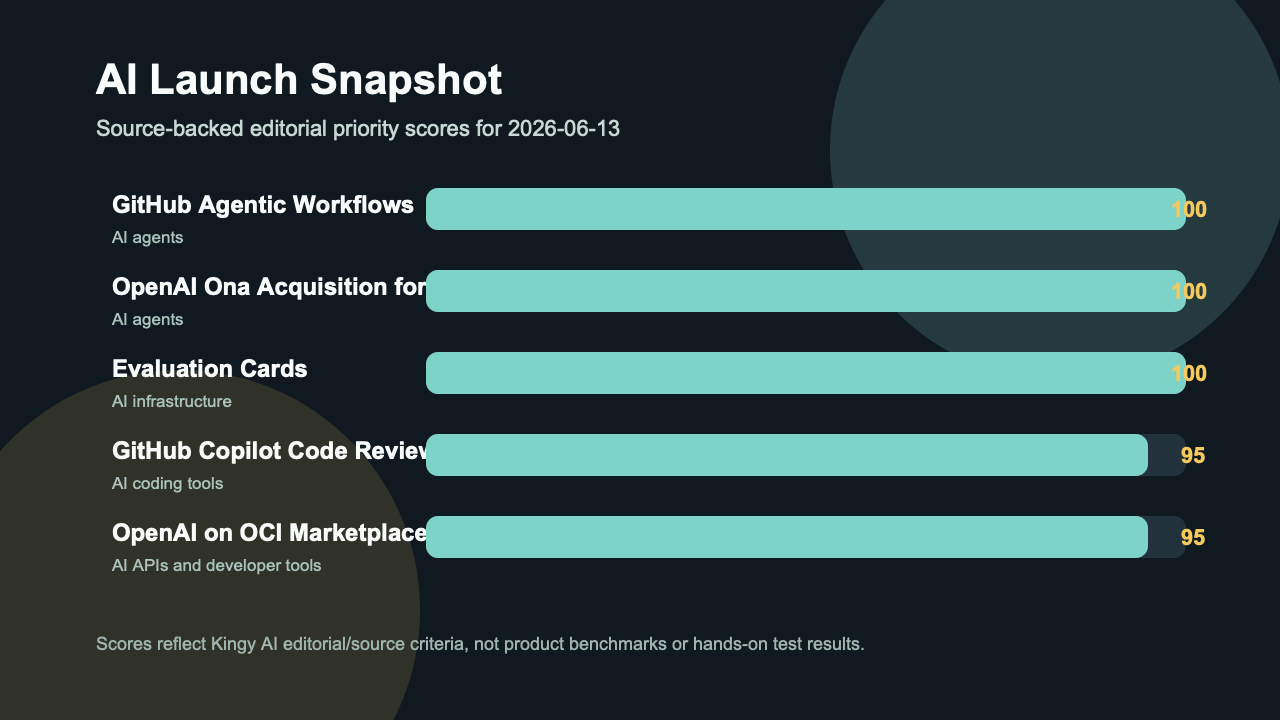
The snapshot below compares the strongest source-checked launches by Kingy AI score. It is a research-priority visual, not a benchmark chart or hands-on test result.
Strongest Launches
GitHub Agentic Workflows
GitHub Agentic Workflows is a public-preview system that turns natural-language Markdown automation definitions into GitHub Actions workflows powered by coding agents.
Checked launch source, docs, GitHub repo for the current Radar entry.
Why it matters: Agentic software work is moving from ad hoc chat sessions into repeatable CI/CD workflows. GitHub Agentic Workflows matters because it gives engineering organizations a way to put coding agents into governed automation paths while reusing the security and operational controls they already use for Actions.
Who should care: AI Platform Teams, AI Engineers, Developers, Operators
Pricing: GitHub did not publish separate Agentic Workflows pricing in the launch post. Usage likely depends on GitHub Copilot/GitHub AI Credits, GitHub Actions runners, and the organization plan; GitHub states one GitHub AI Credit equals $0.01 and that agent work and Copilot CLI consume AI Credits, while Actions usage may consume normal runner minutes. Confirm current pricing on the official pricing/source page.
What launched: GitHub announced GitHub Agentic Workflows in public preview on June 11, 2026, letting teams automate reasoning-heavy tasks such as issue triage, CI failure analysis, documentation updates, dependency work, and compliance reporting inside GitHub Actions. See the official launch source.
What feels promising: Agentic software work is moving from ad hoc chat sessions into repeatable CI/CD workflows. GitHub Agentic Workflows matters because it gives engineering organizations a way to put coding agents into governed automation paths while reusing the security and operational controls they already use for Actions.
What feels unproven: [‘Public preview behavior may change before general availability’, ‘Exact pricing and plan availability were not fully specified in the launch post’, ‘Agent output still needs human review before merge or production use’, ‘Teams must review repository permissions, runner access, and data exposure policies’]
Editorial note: Strong candidate for a full article draft after editorial review.
Evaluation Cards
Evaluation Cards is an open-source beta tool for interpreting AI evaluation results with reproducibility, completeness, provenance, and comparability signals.
Checked launch source, docs, GitHub repo, Hugging Face page for the current Radar entry.
Why it matters: AI benchmark claims are increasingly hard to interpret because scores often omit settings, provenance, and benchmark caveats. Evaluation Cards matters because it gives researchers, model builders, and policy teams a structured way to inspect how reliable or comparable a reported evaluation actually is.
Who should care: AI Product Teams, AI Platform Teams, AI Engineers, Developers
Pricing: No paid pricing was verified. The launch describes Evaluation Cards as an open-source beta project and invites community contribution; operating costs, hosted service limits, or future paid offerings were not specified. Confirm current pricing on the official pricing/source page.
What launched: The EvalEval Coalition beta-launched Evaluation Cards on June 11, 2026 through a Hugging Face launch article and public EvalCards app. See the official launch source.
What feels promising: AI benchmark claims are increasingly hard to interpret because scores often omit settings, provenance, and benchmark caveats. Evaluation Cards matters because it gives researchers, model builders, and policy teams a structured way to inspect how reliable or comparable a reported evaluation actually is.
What feels unproven: [‘The product is in beta and depends on continued community contribution’, ‘Evaluation data completeness varies by source and extraction quality’, ‘Interpretive signals should not be mistaken for direct model benchmarks’, ‘No hosted service commitments or long-term funding model were verified’]
Editorial note: Strong candidate for a full article draft after editorial review.
GitHub Copilot Code Review Controls
GitHub added new Copilot code review controls for organization-level runner defaults, content exclusions, and larger repository custom-instruction files.
Checked launch source, docs for the current Radar entry.
Why it matters: AI code review is most useful when it follows the same data boundaries, runner policies, and review rules as the engineering organization. These controls make Copilot code review more practical for larger teams that need centralized governance instead of repository-by-repository setup.
Who should care: AI Platform Teams, AI Engineers, Developers, Enterprises
Pricing: No separate price was listed for these controls. GitHub’s pricing page says Copilot code review usage can be billed in GitHub AI Credits and that, beginning June 1, 2026, code review workflows also consume GitHub Actions minutes for private repositories. Confirm current pricing on the official pricing/source page.
What launched: On June 12, 2026, GitHub announced new configurations and controls for Copilot code review: organization-level runner type settings, support for Copilot content exclusion policies, and removal of the 4,000-character read limit for repository custom instruction files under .github. See the official launch source.
What feels promising: AI code review is most useful when it follows the same data boundaries, runner policies, and review rules as the engineering organization. These controls make Copilot code review more practical for larger teams that need centralized governance instead of repository-by-repository setup.
What feels unproven: [‘Pricing depends on organization plan, AI Credit usage, and GitHub Actions consumption’, ‘Content exclusions reduce exposure but do not replace broader security review’, ‘Longer custom instructions can improve fit but may also add noisy or conflicting guidance’, ‘Teams should verify whether their organization plan exposes every setting described’]
Editorial note: Strong candidate for a full article draft after editorial review.
OpenAI Academy Work Courses
OpenAI added three Academy courses designed to help workers move from AI basics to repeatable workflows and agent-assisted work.
Checked launch source, docs for the current Radar entry.
Why it matters: Many organizations have access to powerful models but lack repeatable operating habits. OpenAI Academy Work Courses matter because they package AI adoption guidance into a public learning path that teams can use to turn one-off prompts into reviewed, reusable workflows.
Who should care: Small Business Owners, Marketers, Students, Operators
Pricing: OpenAI did not list a price for the three courses in the announcement. Earlier OpenAI Academy materials describe the Academy as a publicly available resource hub; current course access should be confirmed on the Academy site because enterprise training arrangements may differ. Confirm current pricing on the official pricing/source page.
What launched: OpenAI announced three new OpenAI Academy courses on June 12, 2026: AI Foundations, Applied AI Foundations, and Agents and Workflows. See the official launch source.
What feels promising: Many organizations have access to powerful models but lack repeatable operating habits. OpenAI Academy Work Courses matter because they package AI adoption guidance into a public learning path that teams can use to turn one-off prompts into reviewed, reusable workflows.
What feels unproven: [‘Current course pricing and enterprise access details were not fully visible from the announcement’, ‘Courses teach practice patterns but do not replace company-specific data, security, and legal policy’, ‘Teams should still validate workflows against their own tools, privacy rules, and quality standards’, ‘Completion certificates signal training progress, not independent skill certification’]
Editorial note: Strong candidate for a full article draft after editorial review.
OpenAI Ona Acquisition for Codex
OpenAI announced plans to acquire Ona to expand Codex with secure, persistent cloud execution environments for long-running software and knowledge work agents.
Checked launch source, docs for the current Radar entry.
Why it matters: Coding agents are shifting from short local edits toward work that can run for hours or days. Ona matters to Codex because persistent environments could make agent work easier to govern, resume, audit, and deploy across production workflows.
Who should care: AI Platform Teams, AI App Builders, AI Engineers, Developers
Pricing: OpenAI did not announce separate Ona/Codex acquisition pricing. OpenAI’s Codex pricing page says Codex is included in ChatGPT Free, Go, Plus, Pro, Business, Edu, and Enterprise plans, with Pro from $100/month and API-key usage priced by token usage. Confirm current pricing on the official pricing/source page.
What launched: OpenAI announced on June 11, 2026 that it will acquire Ona, a cloud development environment company, to bring secure cloud execution and orchestration technology into Codex. See the official launch source.
What feels promising: Coding agents are shifting from short local edits toward work that can run for hours or days. Ona matters to Codex because persistent environments could make agent work easier to govern, resume, audit, and deploy across production workflows.
What feels unproven: [‘The acquisition is announced but specific Ona-backed Codex features and timing were not fully detailed’, ‘Long-running agents require careful credential scoping, audit trails, and human review’, ‘Pricing may vary by ChatGPT plan, Codex usage, API tokens, and future cloud environment usage’, ‘Organizations should wait for concrete product availability before planning migrations’]
Editorial note: Strong candidate for a full article draft after editorial review.
Tracker-Only Mentions
- OpenAI on OCI Marketplace: OpenAI and Oracle announced that eligible Oracle customers will be able to use Oracle Universal Credits to access OpenAI frontier models and Codex through OCI Marketplace.
Related Kingy AI Links
For more launch tracking and founder resources, see AI Launches, AI Tools, and the AI Sponsored Video ROI Calculator.