
TL;DR: This July 11 catch-up covers Hugging Face deep links into SageMaker Studio, Robostral Navigate, ChatGPT Work, Meta’s Model API, and browser-side LiteRT.js inference.
Launch Snapshot
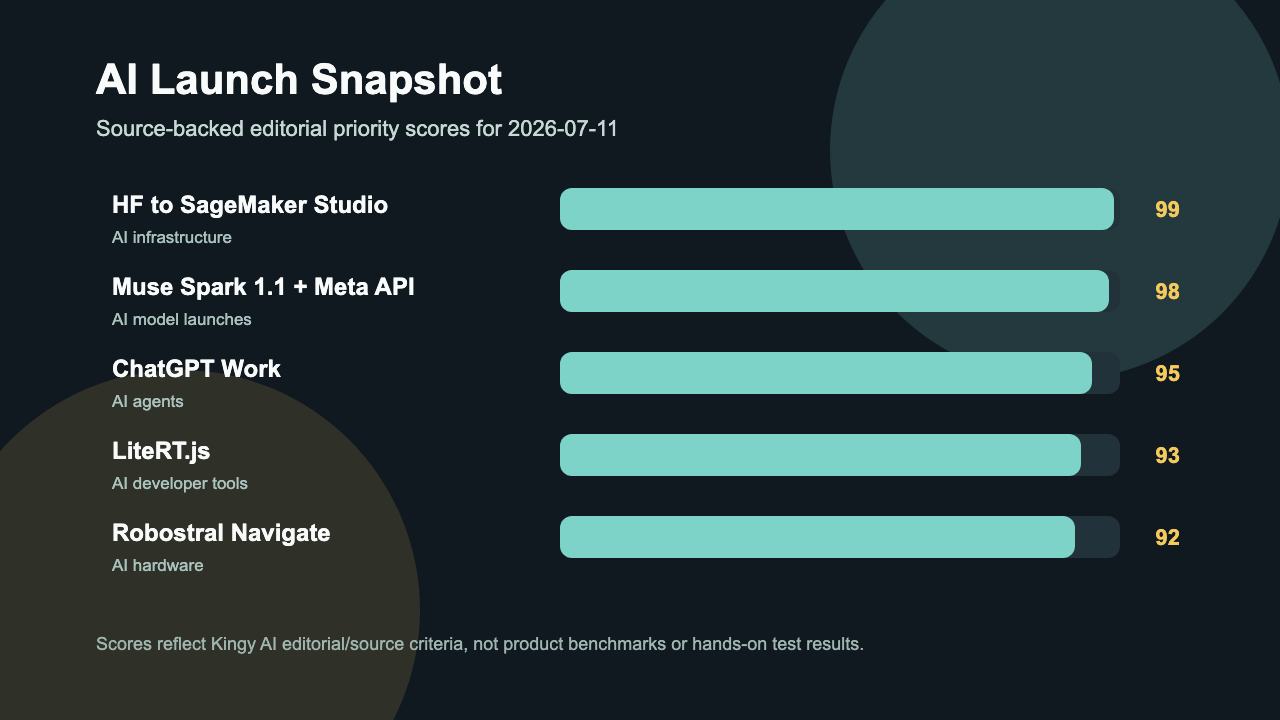
The July 11 snapshot compares editorial priority across the five reviewed entries. It reflects checked sources and coverage judgment, not laboratory testing or a common performance benchmark.
Strongest Launches
Hugging Face to Amazon SageMaker Studio Deep Links
Hugging Face and Amazon announced one-click deep links from Hugging Face model discovery into Amazon SageMaker Studio workflows.
Sources checked: launch source, docs, Hugging Face page.
Why it matters: It reduces friction between open model discovery and managed enterprise deployment, which is useful for teams standardizing model experimentation on AWS.
Who should care: AI Platform Teams, AI Engineers, Developers, Enterprises
Pricing: The integration itself is announced as a workflow feature; SageMaker, AWS infrastructure, and Hugging Face plan costs may apply and should be confirmed on current official pricing pages. Confirm current pricing on the official pricing/source page.
What remains unproven: Catch-up coverage from July 7; AWS permissions and quota still matter; Actual costs depend on SageMaker instances, endpoints, storage, and Hugging Face/AWS terms
Robostral Navigate
Mistral introduced Robostral Navigate, an 8B model for robot navigation using one RGB camera and natural-language instructions.
Sources checked: launch source, docs.
Why it matters: It points to smaller embodied AI models that can navigate real environments without expensive depth sensors or LiDAR, which could matter for logistics, manufacturing, hospitality, and delivery robots.
Who should care: AI Engineers, Developers, Enterprises, Researchers
Pricing: Robostral-specific pricing and access terms were not verified from the launch page; Mistral’s general plans and API pricing should be checked before any buying decision. Confirm current pricing on the official pricing/source page.
What remains unproven: Pricing and access were not verified; Benchmark claims should be validated in physical deployments; Safety and reliability requirements are higher for robots moving around people
ChatGPT Work
OpenAI introduced ChatGPT Work, an agent in ChatGPT that can act across apps and files, stay with projects for hours, and create finished work artifacts.
Sources checked: launch source, docs.
Why it matters: It pushes ChatGPT from answering questions toward delegated work across desktop and web workflows, which matters for operators, founders, and enterprise teams evaluating AI agents for actual deliverables.
Who should care: AI Product Teams, Enterprises, Founders, Operators
Pricing: ChatGPT Work availability is tied to ChatGPT plans and OpenAI sales channels; GPT-5.6 access varies by Free, Go, Plus, Pro, Business, and Enterprise tiers, and exact organization pricing should be confirmed with OpenAI. Confirm current pricing on the official pricing/source page.
What remains unproven: Availability can vary by plan and rollout; Cross-app work raises permission and data-governance questions; Teams need to verify reliability on their own workflows
Muse Spark 1.1 and Meta Model API
Meta introduced Muse Spark 1.1 and a public preview of the Meta Model API for developers.
Sources checked: launch source, docs.
Why it matters: Meta is moving a frontier-style agentic model into a developer API, giving builders another major platform option to compare against OpenAI, Anthropic, Google, and Mistral stacks.
Who should care: AI Product Teams, AI Platform Teams, AI Engineers, Developers
Pricing: Archived official Meta page metadata from July 9 advertised free credits to start building, but it did not establish who qualified, and public per-token pricing was not fully verified from a stable Meta pricing page during this run. Confirm current pricing on the official pricing/source page.
What remains unproven: Duplicate/canonical risk exists because Kingy covered the launch on July 10; API pricing and geographic availability need confirmation; Safety and deployment caveats in Meta’s report should be reviewed before production use
LiteRT.js
Google announced LiteRT.js, a JavaScript binding for running LiteRT AI models directly in the browser.
Sources checked: launch source, docs, GitHub repo.
Why it matters: It gives web developers a privacy-friendly local inference path for vision, audio, embedding, and other AI features without sending every request to a server.
Who should care: AI App Builders, AI Engineers, Developers, Designers
Pricing: LiteRT.js itself is a developer library; no separate official paid plan was identified in the launch article, though normal cloud, hosting, or development costs may still apply. Confirm current pricing on the official pricing/source page.
What remains unproven: Browser performance varies by hardware and drivers; WebNN support remains experimental in some browsers; Large models still face memory and download constraints
Tracker-Only Mentions
- GPT-5.6: OpenAI launched GPT-5.6 Sol, Terra, and Luna for ChatGPT, Codex, ChatGPT Work, and the OpenAI API.
- AlphaEvolve on Google Cloud: Google Cloud made AlphaEvolve generally available on Gemini Enterprise Agent Platform for algorithm and code optimization.
Related Kingy AI Links
Place these catch-up items in context with Kingy’s AI Launches tracker and AI Tools directory. Later plan and rollout changes belong in the AI News archive; sponsorship scenarios can be estimated with the AI Sponsored Video ROI Calculator.
Sponsor path
Sponsor Kingy AI launch coverage
Launching an AI product that needs clear demos, creator education, and buyer trust? Sponsor a Kingy AI video or launch feature.
The Kingy Brief
Get The Kingy Brief.
AI changes, original tests and one practical thing to try. Fridays at 09:00 Vancouver time.
Free · Double opt-in · Unsubscribe anytime
Sign up for The Kingy Brief on Beehiiv.
Signup help and newsletter schedule
Signup form provided by Beehiiv. After submitting, check your inbox for "Confirm your subscription to The Kingy Brief" and open its confirmation link. Check Spam or Promotions if you cannot find it.
Fridays at 09:00 Vancouver time: source-checked AI changes, original tests and one practical thing to try. The weekly restart begins October 9, 2026. We skip a week when there is not enough verified material. Free. Unsubscribe anytime.