
Last updated: July 9, 2026. The short version: the best AI model API in 2026 is not one model. It is a routing system. GPT-5.6 Sol, Claude Fable 5, Grok 4.5, Muse Spark 1.1, Gemini 3.1 Pro, Gemini 3.5 Flash, Terra, and Luna all make sense in different parts of a production stack.
Practical answer: use GPT-5.6 Sol or Claude Fable 5 when failure is expensive; GPT-5.6 Terra, Grok 4.5, or Gemini 3.5 Flash for everyday production work; GPT-5.6 Luna or Flash-Lite for high-volume simple tasks; Muse Spark 1.1 or Gemini for tool-heavy and multimodal agents; and a logged evaluation loop to keep changing the routing policy.
The Answer Is Not One Model
The model market has exploded. OpenAI now has GPT-5.6 Sol, Terra, and Luna. Anthropic has Claude Fable 5 and restricted Claude Mythos 5. xAI has Grok 4.5. Meta has Muse Spark 1.1 and a new Meta Model API. Google has Gemini 3.1 Pro Preview and Gemini 3.5 Flash. Builders do not need more hype. They need to know which model to put behind which feature.
The mistake is treating model selection like picking a laptop. A production AI product is closer to a database, queue, cache, policy engine, and observability stack. You choose the model for the job, then you measure whether the choice held up.
A single-model app is easy to launch but often expensive and brittle. It pays flagship prices for easy tasks, struggles when the flagship refuses or changes behavior, and hides failure modes until users find them. A routed app can send simple classification to a cheap model, ordinary support to a workhorse, hard code changes to a flagship, long multimodal work to a specialist, and sensitive work through a safety-aware path.
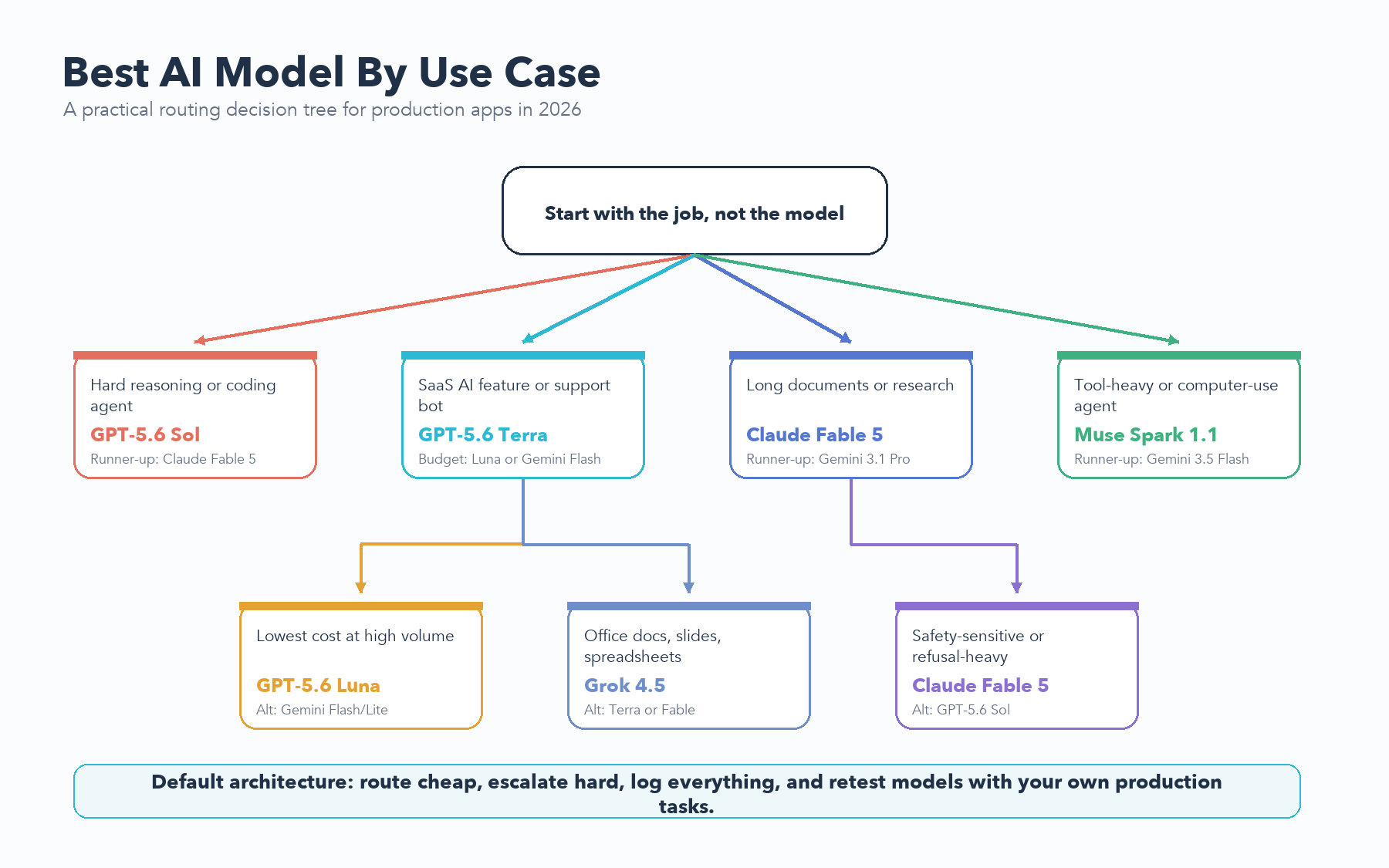
The Model Families Explained
Table 1: Best Model By Use Case
| Use Case | Best Model | Runner-Up | Budget Pick | Why | Caveats |
|---|---|---|---|---|---|
| Coding agents | GPT-5.6 Sol | Claude Fable 5 | Grok 4.5 | Sol is the premium pick for hard reasoning, terminal work, and agent loops; Fable is close for careful codebase work. | Verify context/output limits and refusal behavior before long autonomous runs. |
| SaaS AI feature | GPT-5.6 Terra | Grok 4.5 | GPT-5.6 Luna | Terra is the balanced default when quality matters but every request cannot pay flagship prices. | Do not use Terra for every job. Route easy tasks down and risky tasks up. |
| Summarization and classification | GPT-5.6 Luna | Gemini 3.1 Flash-Lite | Gemini 2.5/3 Flash-Lite | These tasks are usually easy to grade, easy to retry, and output-light. | Use schemas, confidence thresholds, and spot-checking. |
| Research | Claude Fable 5 | Gemini 3.1 Pro Preview | GPT-5.6 Terra | Fable has published 1M context and strong careful reasoning; Gemini is excellent for multimodal and Google-grounded research. | RAG still beats dumping unfiltered documents into context. |
| Finance/legal/business analysis | Claude Fable 5 | GPT-5.6 Sol | Gemini 3.1 Pro Preview | Use the most careful model when the cost of a bad answer is high. | Require citations, assumptions, and human review. |
| Frontend generation | GPT-5.6 Sol | Gemini 3.5 Flash | GPT-5.6 Terra | Sol is strongest for complex component logic; Gemini 3.5 Flash is a serious UI/coding value option. | Always inspect screenshots and run the app. |
| Computer use | Muse Spark 1.1 | Gemini 3.5 Flash | Grok 4.5 | Muse Spark 1.1 is explicitly positioned around agentic, tool, and computer-use workflows. | Meta API access is preview-limited and independent evidence is still forming. |
| Multimodal tasks | Gemini 3.1 Pro Preview | Muse Spark 1.1 | Gemini 3.5 Flash | Gemini remains a clean default for text, image, video, and audio-heavy work. | Pricing varies by modality and context tier. |
| Customer support | GPT-5.6 Terra | Grok 4.5 | GPT-5.6 Luna | Support needs reliability, latency, cost control, and escalation rather than maximum benchmark scores. | Use retrieval, policy checks, and handoff triggers. |
| Low-cost high-volume workflows | GPT-5.6 Luna | Gemini 3.1 Flash-Lite | Muse Spark 1.1 | Luna and Gemini Flash-Lite keep cost low; Muse Spark is attractive for agent steps if access is available. | Cap output tokens. Output is where bills explode. |
| Refusal-sensitive workflows | Claude Fable 5 | GPT-5.6 Sol | Gemini 3.1 Pro Preview | Fable publishes explicit refusal/fallback behavior and is designed around safety boundaries. | Refusal behavior can be a feature or a product bug depending on the workflow. |
| Safety-sensitive workflows | Claude Fable 5 | GPT-5.6 Sol | Gemini 3.1 Pro Preview | Use models with explicit safety documentation, refusal handling, and enterprise controls. | Do not rely on model safety alone. Add policy gates and audit logs. |
| Speed-first workflows | Grok 4.5 | GPT-5.6 Luna | Gemini 3.5 Flash | Grok 4.5 has an unusually attractive price/performance profile and is framed for fast coding/office work. | Published comparable TPS is uneven. Measure in your own region. |
| Benchmark dominance | Claude Fable 5 | GPT-5.6 Sol | GPT-5.5 / Opus 4.8 | Artificial Analysis placed Fable 5 at the top of its Intelligence Index before the latest GPT-5.6 public release. | Leaderboards move fast and rarely match your exact task mix. |
Best Model For Coding Agents
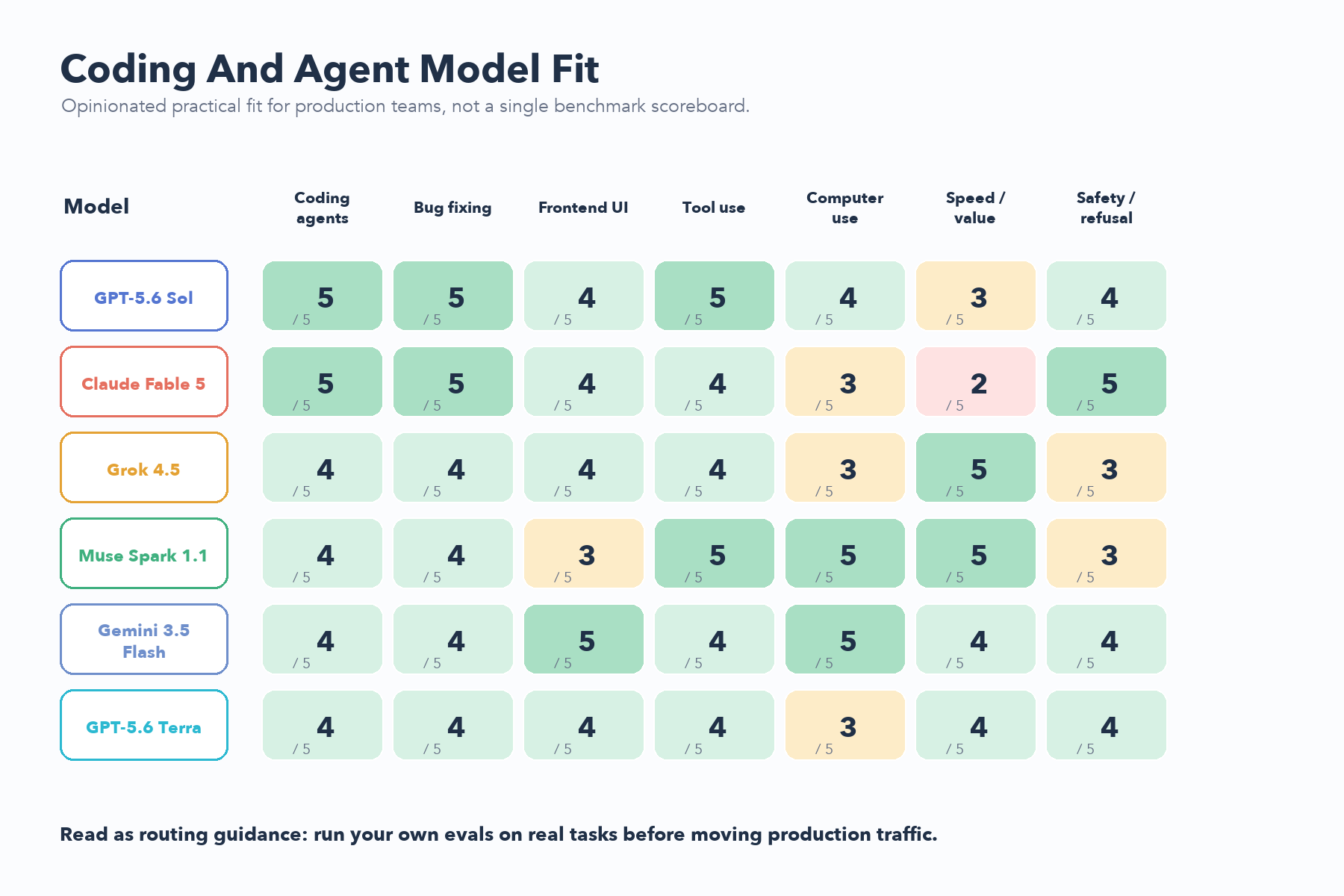
For coding agents, start with GPT-5.6 Sol and Claude Fable 5. They are the two obvious premium candidates when the task involves planning, editing, tests, debugging, retries, and tool use across a real repository. Grok 4.5 deserves serious testing because its price is much lower than the premium models and xAI is positioning it around code and agentic work. Gemini 3.5 Flash belongs in the eval set for UI generation and fast coding loops. Muse Spark 1.1 belongs in the eval set if your agent is mostly tools, browser actions, computer use, or multi-agent orchestration.
The important thing is that “coding” is too broad. A model that writes a nice React component may not be the model you want for a multi-hour migration. A model that is brilliant at bug analysis may be slow or expensive for boilerplate. A good coding stack routes within the coding workflow: cheap issue triage, workhorse implementation, flagship review, browser verification, and a final safety pass for secrets or risky shell commands.
Benchmark Signals To Read Carefully
| Model | Published Signal | Practical Interpretation |
|---|---|---|
| GPT-5.6 Sol | OpenAI reports state-of-the-art Terminal-Bench 2.1 and strong science/cyber evals. | Best premium coding-agent candidate for high-value workloads. |
| Claude Fable 5 | Artificial Analysis reported 64.9 on its Intelligence Index; Anthropic reports strong coding and long-context behavior. | Excellent for careful codebase work, research, and safety-aware analysis. |
| Grok 4.5 | xAI docs list grok-4.5 with 500k context and configurable reasoning; Artificial Analysis changelog places it near frontier intelligence. |
Very attractive value for coding, office docs, and fast production loops. |
| Muse Spark 1.1 | Meta positions it around agentic performance, tool use, computer use, and multimodal input; independent 1.1 evidence is still early. | Prototype for tool-heavy agents when API access is available. |
| Gemini 3.1 Pro Preview | Google lists 1M/64k and strong Gemini 3 agentic/multimodal positioning. | Strong for multimodal research and Google-stack workflows. |
| Gemini 3.5 Flash | Google positions Flash as high-efficiency, agentic, multimodal, and computer-use capable. | Great for UI generation, multimodal assistants, and cost-aware agents. |
Best Model For AI App Backends
Most SaaS AI features should not default to the most expensive flagship. Product features have very different economics from demos. A customer-support answer, CRM summary, internal search explanation, lead enrichment pass, or document rewrite may need reliability more than maximum reasoning depth.
GPT-5.6 Terra is the clean default for many OpenAI-backed app features. Grok 4.5 is compelling when speed and price matter and the workflow is coding, office, or knowledge-work adjacent. Gemini 3.5 Flash is a strong choice when you already use Google Cloud, need multimodal input, or want computer-use pathways. GPT-5.6 Luna is the right first test for classification, labeling, routing, extraction, simple rewriting, and other easy-to-grade tasks. Muse Spark 1.1 is unusually interesting for agent steps where tool use dominates raw prose quality.
Best Model For Long-Context Research
OpenAI’s current model documentation lists a 1.05M-token context window and 128K maximum output for GPT-5.6 Sol, Terra, and Luna. Anthropic lists 1M context and up to 128K output for Claude Fable 5, while Google lists 1M input and 64K output for Gemini 3.1 Pro Preview. Muse Spark 1.1 is also positioned with a 1M-token context window, although its public API is newer and access can be more constrained.
For research, do not confuse context length with research quality. Long context helps only if the model can find the right evidence, preserve citations, reject contradictions, and avoid over-weighting irrelevant pages. In serious research workflows, a retrieval system plus a model with good long-context behavior usually beats dumping a giant folder into a prompt.
Best Model For Business Documents, Spreadsheets, And Presentations
For office work, the winner is often not the smartest model on a leaderboard. It is the model that can follow formatting instructions, preserve structure, extract from files, produce usable tables, and run cheaply enough that users can ask for iterations. Grok 4.5, GPT-5.6 Terra, Gemini 3.5 Flash, and Claude Fable 5 are the models I would test first.
Use Grok 4.5 for fast business analysis, docs, spreadsheets, and office-style tasks when xAI access fits your stack. Use Terra for a balanced OpenAI production backend. Use Fable 5 when the document task is high-stakes, long, or legally/financially sensitive. Use Gemini when the task is deeply multimodal or tied to Google Workspace and files.
Best Model For Multimodal And Computer Use
Muse Spark 1.1 is the model to watch for computer-use and tool-heavy agents. Meta is explicitly positioning it around agentic performance, tool use, computer use, multimodal inputs, and multi-agent workflows. Gemini 3.5 Flash also belongs near the top of this list because Google is pushing it into agentic and computer-use surfaces, and the Gemini family is natively multimodal.
GPT-5.6 Sol and Claude Fable 5 can still be better choices for hard reasoning inside a multimodal workflow. For example, use Gemini or Muse Spark to inspect a screen or coordinate tools, then escalate the final high-stakes reasoning step to Sol or Fable. That is the routing thesis in miniature.
Best Model For Speed And Cost
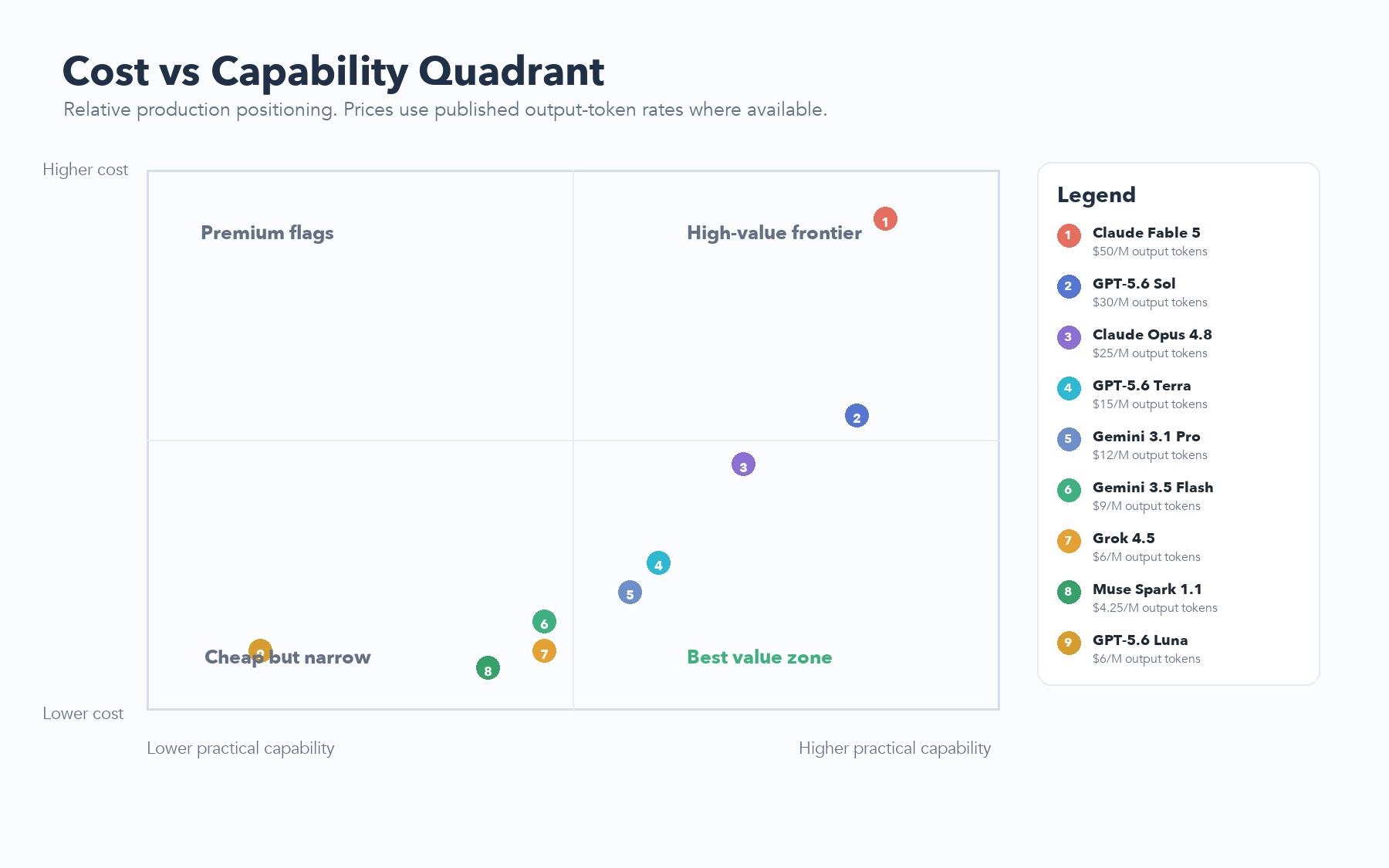
The practical cost comparison starts with output tokens. Output is more expensive than input for every major model in this guide, and reasoning-heavy models can produce many internal or visible tokens. If you pay for every easy task with Claude Fable 5 or GPT-5.6 Sol, your unit economics will punish you quickly.
Published comparable tokens-per-second data is still uneven across providers and regions. Artificial Analysis tracks output speed and price, and xAI/Google/Meta are emphasizing efficiency, but the only speed number that matters for your product is the one you measure with your prompts, tools, region, streaming setup, and retry policy.
Best Model For Safety-Sensitive Workflows
Claude Fable 5 is the most explicit model in this guide about refusal and fallback behavior. Anthropic’s docs describe Fable 5 as the safeguarded form of a Mythos-class model and document refusal/fallback pathways. That makes it attractive for finance, legal, policy, cyber, enterprise knowledge work, and other areas where the model should sometimes say no.
GPT-5.6 Sol also belongs in safety-sensitive evals, especially where hard reasoning, coding, science, or cyber analysis is needed. Gemini 3.1 Pro is strong for multimodal and enterprise workflows. But model safety is not enough. You still need policy gates, permissions, logging, human review, and a plan for false positives and false negatives.
Table 2: Production Routing Matrix
| Workflow | Recommended Model | Reasoning Setting | Cost Tier | Latency Concern | Notes |
|---|---|---|---|---|---|
| simple classification | GPT-5.6 Luna | low / none | low | low | Use schemas, thresholds, and sample auditing. |
| summarization | GPT-5.6 Luna or Gemini Flash-Lite | low | low | low | Route only difficult summaries upward. |
| RAG | GPT-5.6 Terra | medium | medium | medium | Retrieval quality matters more than flagship choice. |
| coding | GPT-5.6 Sol | high | high | medium | Use Fable 5 as a second pass for tricky reviews. |
| bug fixing | Claude Fable 5 | high | high | medium | Good for careful analysis and regression risk. |
| frontend UI | GPT-5.6 Sol or Gemini 3.5 Flash | medium/high | medium | medium | Verify in browser with screenshots. |
| office docs | Grok 4.5 | medium | medium | low/medium | Strong value for business document and spreadsheet-style tasks. |
| slide decks | GPT-5.6 Terra | medium | medium | medium | Use templates and visual checks. |
| long-document research | Claude Fable 5 | high | high | medium/high | Published 1M context and 128k output help, but RAG is still cleaner. |
| browser agents | Muse Spark 1.1 | medium/high | medium | medium/high | Good fit where tool use and computer control matter. |
| computer-use agents | Muse Spark 1.1 or Gemini 3.5 Flash | medium/high | medium | high | Measure action success rate, not just answer quality. |
| cyber defense | Claude Mythos 5 where approved; otherwise Fable 5/Sol | high | high | medium | Access controls and policy review are part of the architecture. |
| science | GPT-5.6 Sol | high | high | medium | Use expert review and source-grounding. |
| multimodal input | Gemini 3.1 Pro Preview | medium/high | medium | medium | Best default for mixed text, image, video, and audio. |
| high-volume chat | GPT-5.6 Luna | low/medium | low | low | Escalate only angry, regulated, or ambiguous cases. |
Table 3: Operational API Constraints for Routing
For benchmark-by-benchmark analysis and complete family pricing, see the full GPT-5.6 family benchmarks and pricing. This table retains only the constraints needed for routing decisions.
Spec caveat: model documentation changes quickly. OpenAI’s July 9 documentation lists a 1.05M context window and 128K maximum output for Sol, Terra, and Luna. Recheck provider documentation before production deployment.
| Model | API Model ID | Context | Output Limit | Input Price | Output Price | Tool Support | Multimodal Support | Reasoning Controls | Availability |
|---|---|---|---|---|---|---|---|---|---|
| GPT-5.6 Sol | gpt-5.6-sol |
1.05M tokens | 128K tokens | $5.00/M | $30.00/M | Responses API tools, structured outputs, prompt caching | Text/image input; text output | Reasoning tier/effort controls; cache breakpoints | General availability began July 9 across ChatGPT, Codex, and the API; product and plan access varies. |
| GPT-5.6 Terra | gpt-5.6-terra |
1.05M tokens | 128K tokens | $2.50/M | $15.00/M | Same GPT-5.6 platform family | Text/image input; text output | Balanced reasoning/cost tier | General availability began July 9 across ChatGPT, Codex, and the API; product and plan access varies. |
| GPT-5.6 Luna | gpt-5.6-luna |
1.05M tokens | 128K tokens | $1.00/M | $6.00/M | Same GPT-5.6 platform family | Text/image input; text output | Low-cost tier | General availability began July 9 across ChatGPT, Codex, and the API; product and plan access varies. |
| Claude Fable 5 | claude-fable-5 |
1M tokens | 128k tokens | $10.00/M | $50.00/M | Tools, code execution, memory, fallback/refusal handling | Vision input; text output | Adaptive thinking; effort parameter | Generally available per Anthropic docs |
| Claude Mythos 5 | claude-mythos-5 |
1M tokens | 128k tokens | $10.00/M | $50.00/M | Trusted-access tool workflows | Vision input; text output | Adaptive thinking; fewer safeguards for approved use | Restricted trusted access |
| Grok 4.5 | grok-4.5 |
500k tokens | Check current xAI docs/account limits | $2.00/M | $6.00/M | Agentic tool calling | Verify current multimodal endpoint support | Configurable reasoning | New xAI/SpaceXAI API model |
| Muse Spark 1.1 | muse-spark-1.1 |
1M tokens | Not clearly pinned in public launch snippets | $1.25/M | $4.25/M | MCP, custom skills, primary/subagent orchestration | Text, image, video, document, audio inputs | Reasoning and agent orchestration controls | Meta Model API public preview; US/waitlist caveats |
| Gemini 3.1 Pro Preview | gemini-3.1-pro-preview |
1M input | 64k output | $2/M under 200k; $4/M over 200k | $12/M under 200k; $18/M over 200k | Function calling, structured output, custom tools | Text, image, video, audio | Thinking/reasoning controls | Preview in Gemini API/Vertex |
| Gemini 3.5 Flash | gemini-3.5-flash |
1M input | 64k output | $1.50/M | $9.00/M | Function calling, agent/computer-use surfaces | Text, image, video, audio, PDFs | Thinking levels | Available through Gemini/Google Cloud surfaces |
| Claude Opus 4.8 baseline | Check current Claude model overview | Published Claude 4.x long-context surfaces vary by account | Check current docs | $5/M commonly listed baseline | $25/M commonly listed baseline | Claude tool family | Vision input; text output | Thinking variants | Useful comparison baseline |
| GPT-5.5 baseline | gpt-5.5 |
1M tokens in OpenAI launch material | Check current model docs | $5.00/M | $30.00/M | OpenAI tool family | Text/image input; text output | Reasoning controls | Useful comparison baseline |
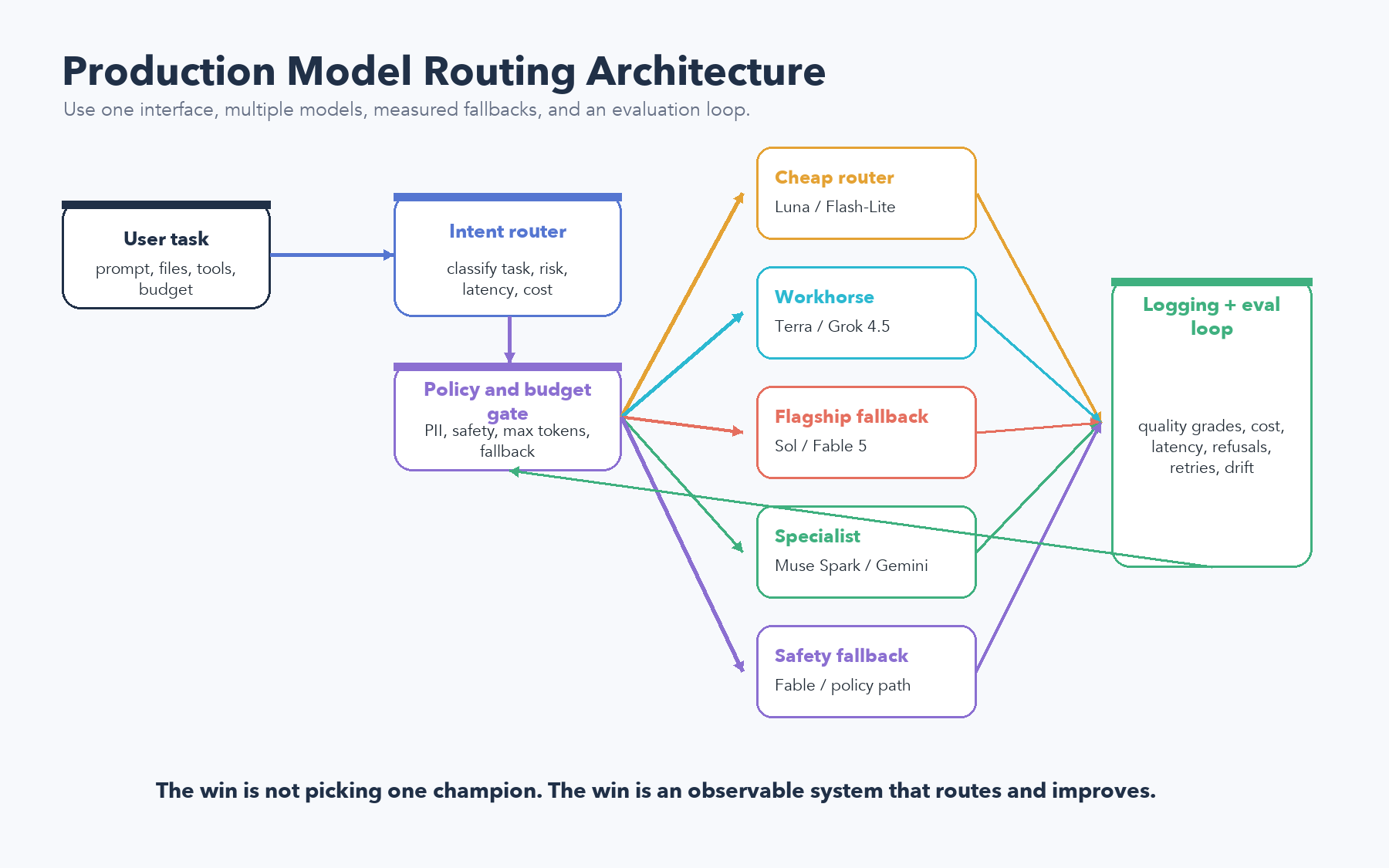
Table 4: Model Routing Architecture
| Architecture Layer | Example Model(s) | What It Does |
|---|---|---|
| cheap router model | GPT-5.6 Luna or Gemini Flash-Lite | Classify task type, risk, difficulty, and likely cost before spending premium tokens. |
| medium workhorse model | GPT-5.6 Terra, Grok 4.5, or Gemini 3.5 Flash | Handle everyday production work: RAG answers, support, docs, app features, and most agent steps. |
| flagship fallback model | GPT-5.6 Sol or Claude Fable 5 | Escalate when the router sees hard coding, high-stakes analysis, weak confidence, or failed validation. |
| specialized model | Muse Spark 1.1, Gemini 3.1 Pro, Claude Mythos 5 where approved | Use for computer use, multimodal reasoning, long-context research, or trusted cyber-defense workflows. |
| safety/refusal fallback | Claude Fable 5 plus your own policy gate | Route sensitive requests through a model and policy layer designed to decline or hand off safely. |
| logging/evaluation loop | Human grades, cost, latency, refusal rate, retry rate | Every route decision should become training data for the next routing policy. |
Recommended Model Stacks
Bootstrap Startup Stack
Use Luna or Gemini Flash-Lite as the router, Terra as the workhorse, and Sol or Fable 5 as the fallback. This gives you a low bill while still preserving an escape hatch for hard tasks.
AI Coding Tool Stack
Use GPT-5.6 Sol for core coding, Claude Fable 5 for careful review and tricky debugging, Grok 4.5 for fast low-cost iterations, and Gemini 3.5 Flash for frontend/browser-heavy checks.
Enterprise Knowledge-Work Stack
Use Claude Fable 5 for high-stakes analysis, Gemini 3.1 Pro for multimodal and long-document workflows, Terra for everyday answers, and a strict retrieval/audit layer for citations.
High-Volume Content Operations Stack
Use Luna or Flash-Lite for drafts, classification, summaries, and metadata. Escalate brand-sensitive or legal-sensitive content to Terra, Fable, or Sol.
Multimodal Agent Stack
Use Muse Spark 1.1 or Gemini 3.5 Flash for screen, file, tool, and computer-use steps. Escalate final reasoning or policy decisions to Sol or Fable.
Legal/Finance Research Stack
Use Claude Fable 5 or GPT-5.6 Sol for analysis, Gemini 3.1 Pro for multimodal source packets, and a retrieval system that preserves citations and document boundaries.
Cyber Defense Stack
Use Claude Mythos 5 only where approved, Fable 5 or Sol for general defense workflows, and a policy layer that separates legitimate defensive tasks from unsafe requests.
Creator/Tools/Content Stack
Use Gemini 3.5 Flash for multimodal drafting, Terra for structured content systems, Luna for bulk metadata, and Sol/Fable when the content involves complex research or code.
How To Evaluate Models Yourself
Do not let a leaderboard become your product strategy. Build a small eval harness before moving traffic. Twenty real tasks are enough to expose surprises.
- Define 20 real tasks from your app, not synthetic prompts.
- Run each model with the same tools, retrieval results, and output schema.
- Grade outputs for correctness, usefulness, tone, citation quality, and format compliance.
- Calculate total cost, including input, output, cached input, retries, tool calls, and failed attempts.
- Measure latency and time to first usable token in your region.
- Test refusal behavior with allowed, borderline, and disallowed requests.
- Test long-context performance with documents that include contradictions and irrelevant sections.
- Track retries, tool-call failures, JSON failures, hallucinated citations, and integration complexity.
- Route 5-10% of low-risk traffic through challenger models and compare live outcomes.
- Re-run the eval monthly because the model market is changing too quickly for a static decision.
Final Recommendations
- Best overall flagship: GPT-5.6 Sol if OpenAI access and model behavior fit your app; Claude Fable 5 if you value published long-context specs and careful safety/refusal behavior.
- Best value: Grok 4.5 and Muse Spark 1.1 are the most interesting value challengers, with Terra and Gemini 3.5 Flash close behind depending on workflow.
- Best for agents: GPT-5.6 Sol for hard agent reasoning, Muse Spark 1.1 for tool-heavy/computer-use agents, and Gemini 3.5 Flash for multimodal agent work.
- Best for coding: GPT-5.6 Sol first, Claude Fable 5 second, Grok 4.5 and Gemini 3.5 Flash as serious value tests.
- Best for office work: Grok 4.5, GPT-5.6 Terra, and Gemini 3.5 Flash.
- Best for multimodal: Gemini 3.1 Pro Preview for high-stakes multimodal research; Gemini 3.5 Flash and Muse Spark 1.1 for agentic multimodal work.
- Best for high-volume apps: GPT-5.6 Luna, Gemini Flash-Lite, and routed Terra.
- Best for enterprises: Claude Fable 5, GPT-5.6 Sol, Gemini 3.1 Pro, and a strict eval/governance layer.
- Best model stack for most startups: Luna router, Terra workhorse, Sol/Fable fallback, Muse/Gemini specialist, and logged evals.
Related Kingy.ai Coverage
- AI Models
- AI Tools
- AI Launches
- AI Agents: OpenAI Codex boom
- AI Coding Tools: 2026 state of the market
- full GPT-5.6 family benchmarks and pricing
- GPT-5.6 vs Claude, Grok, Muse and Gemini
- Claude Fable 5 vs GPT-5.5
- Grok 4.5 benchmarks and pricing
- Muse Spark 1.1 benchmarks and specs
- Gemini 3.5 Flash computer use
Sources
- OpenAI: Previewing GPT-5.6 Sol
- OpenAI model docs
- OpenAI pricing docs
- OpenAI Help: GPT-5.6 Sol, Terra, and Luna pricing/model IDs
- Anthropic: Claude Fable 5 and Claude Mythos 5
- Claude Platform: Fable 5 and Mythos 5 docs
- xAI Grok 4.5 announcement
- xAI model docs
- xAI pricing docs
- Meta: Introducing Muse Spark
- Meta: Build with Muse Spark
- Google Gemini 3 Developer Guide
- Google Gemini API pricing
- Artificial Analysis
- Artificial Analysis changelog
- LMArena leaderboard
Source Caveats
- OpenAI’s published model documentation lists Sol, Terra, and Luna at 1.05M context and 128K maximum output. Production applications should still recheck live documentation before deployment.
- Muse Spark 1.1 is very new. Meta’s positioning is clear, but independent benchmarks and real-world developer reports will need time to catch up.
- Published speed/TPS numbers are not comparable across providers. Run your own latency and output-speed tests in the region and stack you actually use.
- Claude Mythos 5 is restricted. Do not design a normal commercial workflow around it unless you already have approved access.
The Kingy Brief
Get The Kingy Brief.
AI changes, original tests and one practical thing to try. Fridays at 09:00 Vancouver time.
Free · Double opt-in · Unsubscribe anytime
Signup help and newsletter schedule
Signup form provided by Beehiiv. After submitting, check your inbox for "Confirm your subscription to The Kingy Brief" and open its confirmation link. Check Spam or Promotions if you cannot find it.
Fridays at 09:00 Vancouver time: source-checked AI changes, original tests and one practical thing to try. The weekly restart begins October 9, 2026. We skip a week when there is not enough verified material. Free. Unsubscribe anytime.