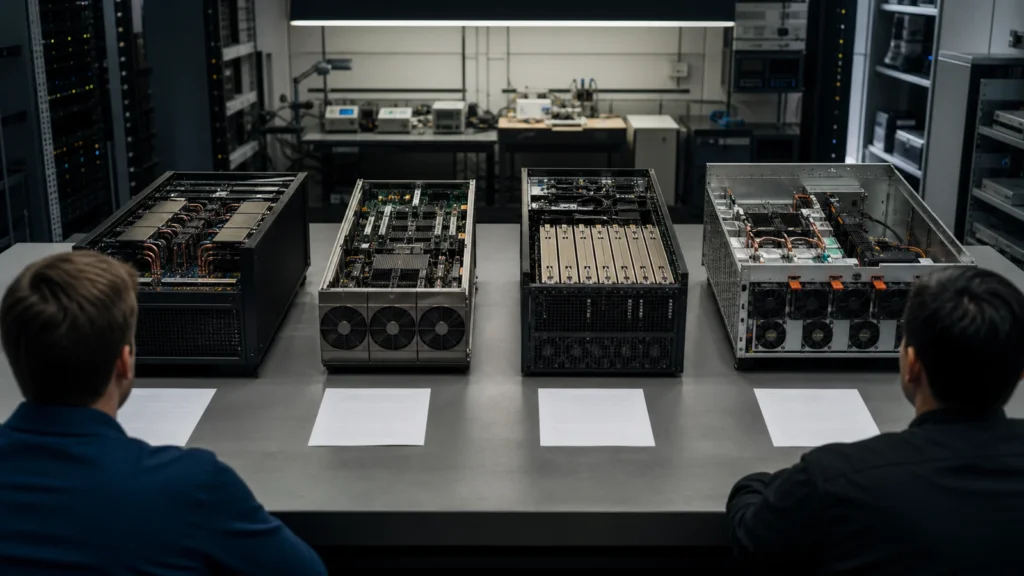
Reviewed July 28, 2026. Official model pages, API pricing and linked benchmark sources were rechecked. Kingy has not independently rerun every benchmark.
Verdict: Claude Fable 5 has the strongest published high-end scorecard in several preserved launch rows, while GPT-5.6 Sol offers the broadest production stack. Anthropic now recommends Fable 5.1 when its current Opus model falls short. Grok 4.5 is the value contender. Muse Spark 1.1 remains promising but less completely documented. Pick from workload evidence, not a single leaderboard.
Bottom line: the frontier AI models 2026 race is no longer a clean contest for the highest raw benchmark score. It is a triangle: intelligence, cost, and agentic usefulness. GPT-5.6 Sol is OpenAI’s flagship and the best full-stack bet for hard coding, professional agents, and computer use. Claude Fable 5 has the strongest published high-end scorecard in several preserved rows, but Fable 5.1 is Anthropic’s current high-capability choice. Grok 4.5 is the surprise cost-efficiency threat. Muse Spark 1.1 is Meta’s multimodal-agent wager, but several API fields and independent scores are still missing. Gemini 3.1 Pro and Gemini 3.5 Flash are the Google alternatives evaluated wherever the reviewed sources publish comparable rows.
This comparison only uses published sources and labels the evidence. Vendor-reported numbers, internal evals, independent Artificial Analysis results, and missing data are separated. If a benchmark number, price, context window, output limit, model ID, safety classification, or availability claim was not found in the reviewed sources, the table says not published or not independently verified.
Commercial relationship for this article: None. This is based on Curtis Pyke’s direct confirmation on October 7, 2026.
The Frontier Model Race In July 2026
The model race changed in one release window. OpenAI moved GPT-5.6 Sol, Terra, and Luna into general availability on July 9, 2026, after the restricted June preview. xAI launched Grok 4.5. Meta introduced Muse Spark 1.1 and the public preview of Meta Model API. Anthropic restored Claude Fable 5 and Claude Mythos 5 in July, then released Fable 5.1 and Mythos 5.1 on September 1. The tables below retain Fable 5 because the reviewed source rows do not provide equivalent Fable 5.1 results for every benchmark. The useful comparison is the model that wins for your workload, budget, latency target and tool stack.
For more background, see Kingy.ai’s AI Models, AI Launches, and AI Tools coverage, plus our GPT-5.6 Sol, Terra and Luna specs and pricing, best AI model API use-case and routing guide, and separate deep dives on Grok 4.5 and Muse Spark 1.1.
The Models At A Glance
GPT-5.6 family primer: Sol is OpenAI’s flagship for the hardest reasoning, coding, tool-use, and professional-agent workloads; Terra is the balanced production tier; Luna is the lower-cost, high-volume tier. All three share the family platform, but they target different quality, latency, and cost envelopes.
Claude Fable 5.1 is Anthropic’s most capable widely released model. This article keeps Claude Fable 5 in its benchmark tables because those are the models the cited evaluations tested. Claude Mythos 5 shares the original Fable-class specs but is limited to trusted-access programs with certain safeguards lifted. Grok 4.5 is xAI’s speed, coding, knowledge-work, Cursor, and Office play. Muse Spark 1.1 is Meta’s multimodal reasoning model for agentic workflows and Meta Model API preview. Gemini 3.1 Pro and Gemini 3.5 Flash represent Google’s higher-capability and faster model lanes in this comparison.
Specs Comparison
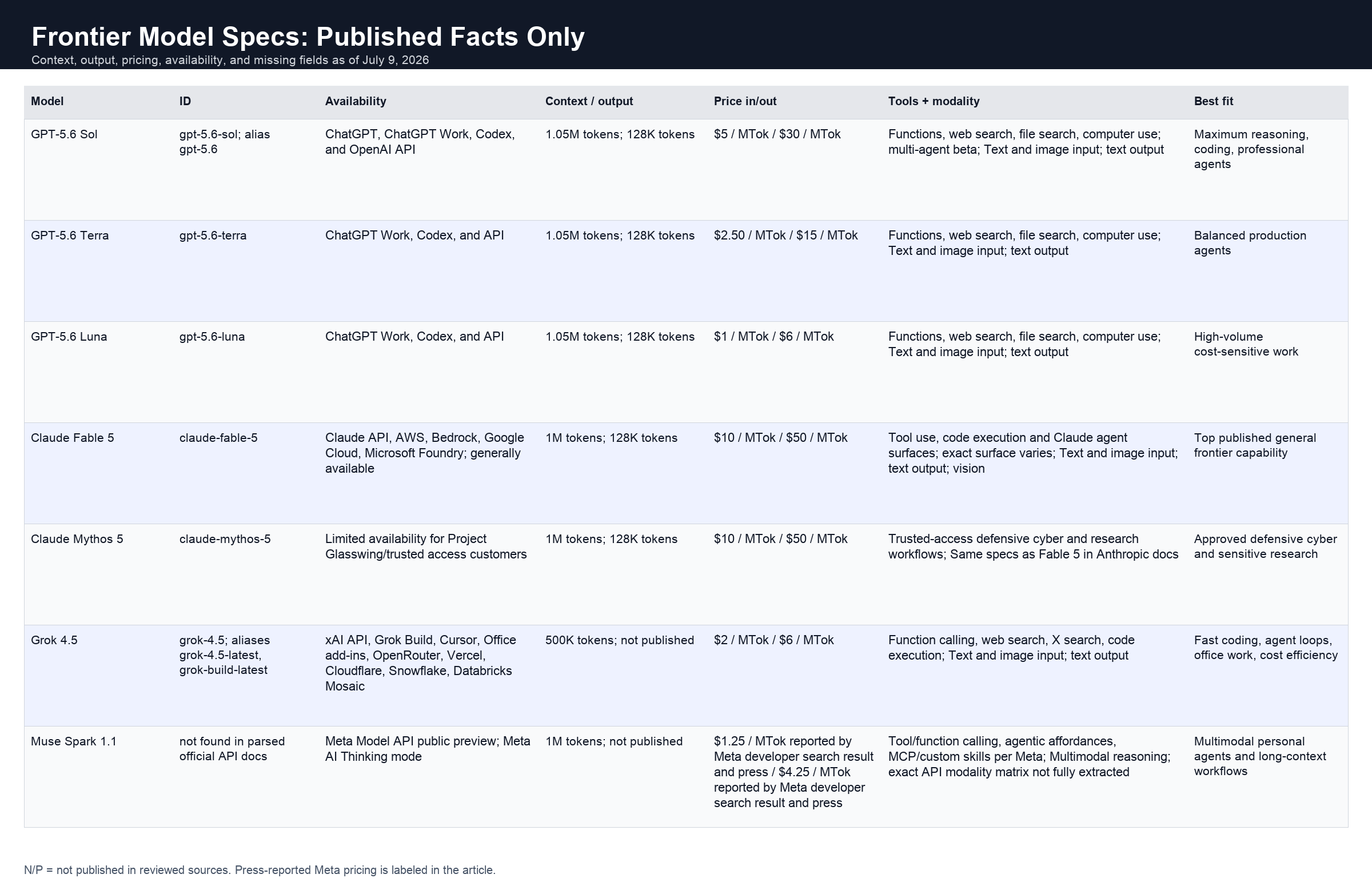
| Model | Company | Model ID | Availability | Context Window | Max Output | Input Price | Output Price | Reasoning Mode | Tool Support | Multimodal Support | Best Use Case |
|---|---|---|---|---|---|---|---|---|---|---|---|
| GPT-5.6 Sol | OpenAI | gpt-5.6-sol; alias gpt-5.6 | ChatGPT, ChatGPT Work, Codex, and OpenAI API | 1.05M tokens | 128K tokens | $5 / MTok | $30 / MTok | none, low, medium, high, xhigh, max | Functions, web search, file search, computer use; multi-agent beta | Text and image input; text output | Maximum reasoning, coding, professional agents |
| GPT-5.6 Terra | OpenAI | gpt-5.6-terra | ChatGPT Work, Codex, and API | 1.05M tokens | 128K tokens | $2.50 / MTok | $15 / MTok | none, low, medium, high, xhigh, max | Functions, web search, file search, computer use | Text and image input; text output | Balanced production agents |
| GPT-5.6 Luna | OpenAI | gpt-5.6-luna | ChatGPT Work, Codex, and API | 1.05M tokens | 128K tokens | $1 / MTok | $6 / MTok | none, low, medium, high, xhigh, max | Functions, web search, file search, computer use | Text and image input; text output | High-volume cost-sensitive work |
| Claude Fable 5 | Anthropic | claude-fable-5 | Claude API, AWS, Bedrock, Google Cloud, Microsoft Foundry; generally available | 1M tokens | 128K tokens | $10 / MTok | $50 / MTok | Adaptive thinking, always on | Tool use, code execution and Claude agent surfaces; exact surface varies | Text and image input; text output; vision | Top published general frontier capability |
| Claude Mythos 5 | Anthropic | claude-mythos-5 | Limited availability for Project Glasswing/trusted access customers | 1M tokens | 128K tokens | $10 / MTok | $50 / MTok | Adaptive thinking | Trusted-access defensive cyber and research workflows | Same specs as Fable 5 in Anthropic docs | Approved defensive cyber and sensitive research |
| Grok 4.5 | xAI / SpaceXAI | grok-4.5; aliases grok-4.5-latest, grok-build-latest | xAI API, Grok Build, Cursor, Office add-ins, OpenRouter, Vercel, Cloudflare, Snowflake, Databricks Mosaic | 500K tokens | not published | $2 / MTok | $6 / MTok | low, medium, high; default high | Function calling, web search, X search, code execution | Text and image input; text output | Fast coding, agent loops, office work, cost efficiency |
| Muse Spark 1.1 | Meta | not found in parsed official API docs | Meta Model API public preview; Meta AI Thinking mode | 1M tokens | not published | $1.25 / MTok reported by Meta developer search result and press | $4.25 / MTok reported by Meta developer search result and press | Meta evals use xhigh effort; public control names not found | Tool/function calling, agentic affordances, MCP/custom skills per Meta | Multimodal reasoning; exact API modality matrix not fully extracted | Multimodal personal agents and long-context workflows |
Two corrections matter. First, OpenAI’s current API docs list GPT-5.6 Sol, Terra, and Luna at 1.05M context and 128K max output, with prices of $5/$30, $2.50/$15, and $1/$6 per million input/output tokens. Second, Meta’s launch page publishes the 1 million-token context claim for Muse Spark 1.1, but the exact public API model ID and max output were not found in the parsed official pages.
Benchmarks Comparison
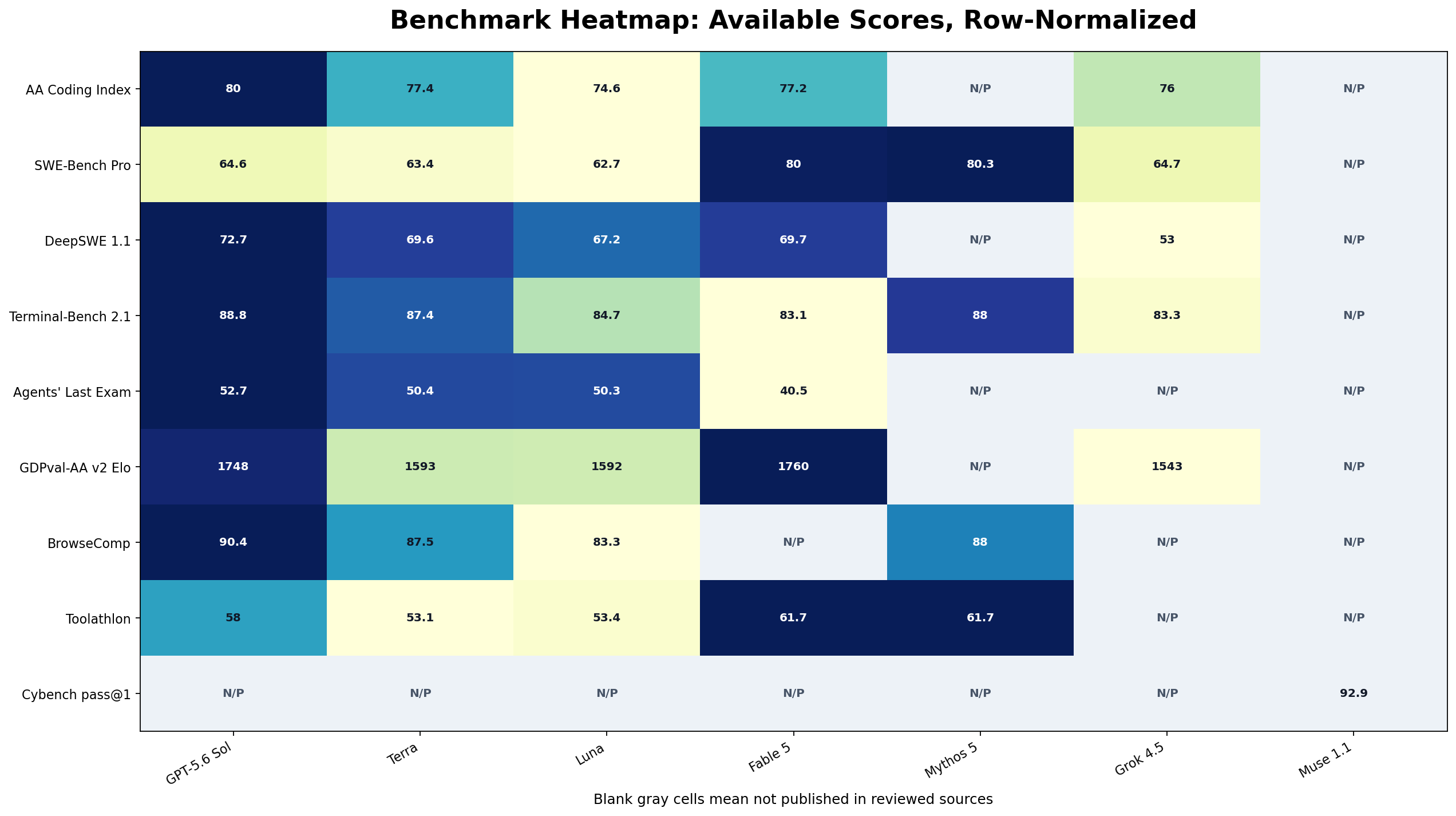
The hardest part of this article is resisting false precision. These benchmarks are not one universal tournament. Some are vendor-run; some are internal; some come from Artificial Analysis; some are public leaderboards; and some were run with different reasoning settings or tool harnesses. The tables below are useful because they show the direction of the race, not because every cell is perfectly apples-to-apples.
Coding Benchmarks
| Benchmark | Source type | GPT-5.6 Sol | Terra | Luna | Claude Fable 5 | Claude Mythos 5 | Grok 4.5 | Muse Spark 1.1 | Caveat |
|---|---|---|---|---|---|---|---|---|---|
| SWE-Bench Pro | OpenAI/xAI vendor tables | 64.6% | 63.4% | 62.7% | 80.0% | 80.3% | 64.7% | not published | Scale AI coding tasks; mixed vendor/self-reported sources |
| DeepSWE 1.0 | xAI launch, provider harness | not published | not published | not published | 66.1% | not published | 62.0% | not published | Provider-harness result; not neutral across all vendors |
| DeepSWE 1.1 | OpenAI/xAI tables | 72.7% | 69.6% | 67.2% | 69.7% | not published | 53.0% | not published | mini-swe-agent style harness; better cross-model signal |
| Terminal-Bench 2.1 | OpenAI/xAI tables | 88.8% | 87.4% | 84.7% | 83.1% | 88.0% | 83.3% | not published | Agentic terminal benchmark |
| Artificial Analysis Coding Agent Index v1.1 | OpenAI + Artificial Analysis | 80 | 77.4 | 74.6 | 77.2 | not published | 76 | not published | Independent AA index for coding-agent harnesses where published |
| SWE Marathon | Reviewed public sources | not published | not published | not published | not published | not published | not published | not published | No reliable published result found for this comparison set |
For GPT-5.6 Sol vs Claude Fable 5 on coding, the answer depends on the benchmark. Fable leads SWE-Bench Pro in OpenAI’s own comparison table. Sol leads DeepSWE 1.1 and Terminal-Bench 2.1 against Fable, and it benefits from OpenAI’s Codex, computer-use, and multi-agent infrastructure. Grok 4.5 is weaker than Fable on the xAI/OpenAI coding rows, but Artificial Analysis says it reaches a Coding Agent Index score of 76 at far lower task cost than Fable in Claude Code.
Agentic And Computer-Use Benchmarks
| Benchmark | Source type | GPT-5.6 Sol | Terra | Luna | Claude Fable 5 | Claude Mythos 5 | Grok 4.5 | Muse Spark 1.1 | Caveat |
|---|---|---|---|---|---|---|---|---|---|
| Agents’ Last Exam | OpenAI table / ALE site | 52.7% | 50.4% | 50.3% | 40.5% | not published | not published | not published | Agentic long-horizon tasks; Grok/Muse values not found in reviewed primary tables |
| BrowseComp | OpenAI table | 90.4% / 92.2% Ultra | 87.5% | 83.3% | not published | 88.0% | not published | not published | Agentic browsing; OpenAI table omits Fable in this row |
| OSWorld 2.0 | OpenAI table | 62.6% | 50.2% | 45.6% | not published | not published | not published | not published | Computer-use workflows on desktop VMs |
| AutomationBench | OpenAI table | 18.1% | 15.2% | 14.9% | 17.4% | not published | not published | not published | Zapier-style automation tasks |
| Toolathlon | OpenAI table | 58.0% | 53.1% | 53.4% | 61.7% | 61.7% | not published | not published | MCP-style tool use across many tools |
| Muse Spark agent evals | Meta eval report | comparison discussed | comparison discussed | comparison discussed | comparison discussed | comparison discussed | not published | reported, but Figure 44 numeric labels were not extractable | Includes OSWorld-Verified, OSWorld 2.0, WebArena-Verified, GDPval-AA, JobBench, MCP Atlas, Toolathlon-Verified |
| Grok Build / Office workflow evals | xAI + Artificial Analysis | not published | not published | not published | not published | not published | AA Coding Agent Index 76; Office add-ins available | not published | Office availability is published; no Office benchmark table found |
The computer-use story favors OpenAI on published numbers: GPT-5.6 Sol posts 62.6% on OSWorld 2.0 and 90.4% on BrowseComp, with an Ultra BrowseComp number of 92.2%. But this is also where Muse Spark 1.1 becomes interesting. Meta’s release is explicitly about tool use, computer use, multi-agent orchestration, and context management, even though several public numeric labels are locked inside figures that were not extractable from the PDF text.
Knowledge Work And Business Benchmarks
| Benchmark | Source type | GPT-5.6 Sol | Terra | Luna | Claude Fable 5 | Claude Mythos 5 | Grok 4.5 | Muse Spark 1.1 | Caveat |
|---|---|---|---|---|---|---|---|---|---|
| GDPval-AA v2 | OpenAI table + Artificial Analysis | 1747.8 Elo | 1593 Elo | 1591.8 Elo | 1759.6 Elo | not published | 1543 Elo | not published | Blind professional deliverable comparisons |
| Big Finance Bench | OpenAI table | 53% | 51% | 36% | not published | not published | not published | not published | OpenAI-published table; Fable value not listed |
| Hebbia Finance Benchmark | Anthropic launch | not published | not published | not published | Anthropic says highest score; exact public number not in text | not published | not published | not published | Vendor claim and partner benchmark, not an independent unified table |
| Management consulting tasks | OpenAI internal | 43.2% | 37.2% | 35.4% | 35.5% | not published | not published | not published | Internal OpenAI evaluation; use directional caution |
| Office/document/spreadsheet/presentation workflows | OpenAI, Anthropic, xAI launch docs | customer-reported gains | included in GPT-5.6 family | included in GPT-5.6 family | partner reports strong spreadsheets/legal | not published | Office add-ins available; no score found | Meta AI product surfaces; no office score found | Real-world workflow evidence, not one independent benchmark |
GDPval-AA v2 is the cleanest business-work comparison in the public tables: Fable 5 leads at 1759.6 Elo, GPT-5.6 Sol follows at 1747.8 Elo, Grok 4.5 is reported by Artificial Analysis at 1543 Elo, and Terra/Luna land around 1593 Elo. That says a lot about the new race. The best overall model is not always the best API default, because knowledge-work cost, formatting quality, and workflow integration can matter as much as a headline Elo.
Science, Math, And Reasoning
| Benchmark | Source type | GPT-5.6 Sol | Terra | Luna | Claude Fable 5 | Claude Mythos 5 | Grok 4.5 | Muse Spark 1.1 | Caveat |
|---|---|---|---|---|---|---|---|---|---|
| GPQA Diamond | OpenAI table | 94.6% | 92.9% | 92.3% | 92.6% | 94.1% | not published | not published | Also lists GPT-5.5 93.6%, Opus 92%, Gemini 3.1 Pro 94.3% |
| FrontierMath Tier 1-3 v2 | OpenAI table | 86.0% | 84.9% | 78.6% | 87.0% | not published | not published | not published | Fable leads this published row |
| FrontierMath Tier 4 v2 | OpenAI table | 65.9% | 68.3% | 58.5% | 87.8% | not published | not published | not published | GPT-5.5 listed at 72.5%; Fable leads |
| ARC-AGI-3 | OpenAI table | 7.78% | 0.8% | 0.18% | not published | not published | not published | not published | OpenAI reports ARC-AGI-3; Opus 4.8 1.5%, Gemini 3.1 Pro 0.42% |
| GeneBench Pro | OpenAI table | 28.7% | 23.3% | 10.8% | refuses majority per OpenAI note | not published | not published | not published | OpenAI excludes Fable because of advanced biology refusals |
| LifeSciBench | OpenAI table | 59.9% | 56.0% | 51.2% | not published | not published | not published | not published | Opus 4.8 listed at 53.6% |
| MedChemBench | OpenAI internal | 48.3% | 35.0% | 30.4% | not published | not published | not published | not published | OpenAI internal benchmark |
| HealthBench Professional | OpenAI table | 60.5% | 57.7% | 55.7% | 60.9% | not published | not published | not published | OpenAI notes scoring is not comparable to Anthropic system-card scoring |
| STEM-related Grok evals | xAI launch/docs | not published | not published | not published | not published | not published | coding/math/science framing; no GPQA/FrontierMath score found | not published | xAI emphasizes science/engineering/math training data, but not all requested STEM scores are published |
Science is also where safety posture directly affects visible performance. OpenAI reports that Claude Fable 5 refuses the majority of questions in the GeneBench Pro setup, so Fable’s absence there is not proof of weak biology skill. It is evidence that benchmark score and deployment policy are now entangled. Meta’s report makes the same point from the other side: unmitigated Muse Spark 1.1 reaches high-risk thresholds in chemical/biological and cyber capability assessments, but Meta says deployment mitigations reduce residual risk to moderate or lower.
Cybersecurity And Safety
| Benchmark / posture | Source type | GPT-5.6 Sol | Terra | Luna | Claude Fable 5 | Claude Mythos 5 | Grok 4.5 | Muse Spark 1.1 | Caveat |
|---|---|---|---|---|---|---|---|---|---|
| Capture-the-Flag challenges | OpenAI table | 96.7% | 91.8% | 85.2% | not published | not published | not published | not published | Vendor table; no comparable Fable/Grok/Muse score found in same row |
| SEC-Bench Pro | OpenAI table | 71.2% / 74.3% Ultra | 57.7% | 48.9% | not published | not published | not published | not published | Proof-of-concept generation on complex software |
| CyberGym | OpenAI + Meta tables | 84.5% | 81.8% | 77.9% | not published | 83.8% | not published | 59.0% pass@1 | Meta and OpenAI tables use different comparison sets |
| ExploitBench | OpenAI table | 73.5% | 52.9% | 33.2% | not published | 78.0% | not published | not published | OpenAI says measures progress toward arbitrary code execution |
| ExploitGym | OpenAI + Meta tables | 33.7% | 23.2% | 12.4% | not published | not published | not published | 0.8% pass@1 | Meta table also lists GPT-5.5 14.8% and Gemini 1.4% |
| Cybench | Meta eval report | not published | not published | not published | not published | not published | not published | 92.9% pass@1; 97.0% pass@10 | Professional-level CTF benchmark in Meta’s preparedness report |
| Preparedness classification | System cards/reports | High cyber and bio/chem; not Critical | High cyber and bio/chem; not Critical | High cyber and bio/chem; not Critical | safeguarded GA; fallbacks for cyber/bio/chem/distillation | safeguards lifted in approved areas | no comparable system card found | unmitigated high in CB and cyber; residual moderate/lower after mitigations | Safety postures are not directly comparable |
The safety differences are not decorative. OpenAI classifies all three GPT-5.6 models as High capability in cybersecurity and biological/chemical risk, but not Critical. Anthropic keeps Fable 5 broadly available with classifiers that fall back to Opus 4.8 for cyber, biology/chemistry, and distillation-sensitive requests, while Mythos 5 is limited to approved users with safeguards lifted in specific areas. Meta says Muse Spark 1.1 would reach high thresholds before mitigation in chemical/biological and cyber domains, but residual risk is moderate or lower after mitigations. I did not find an xAI system card comparable to OpenAI’s, Anthropic’s, or Meta’s reports for Grok 4.5.
Cost-Performance
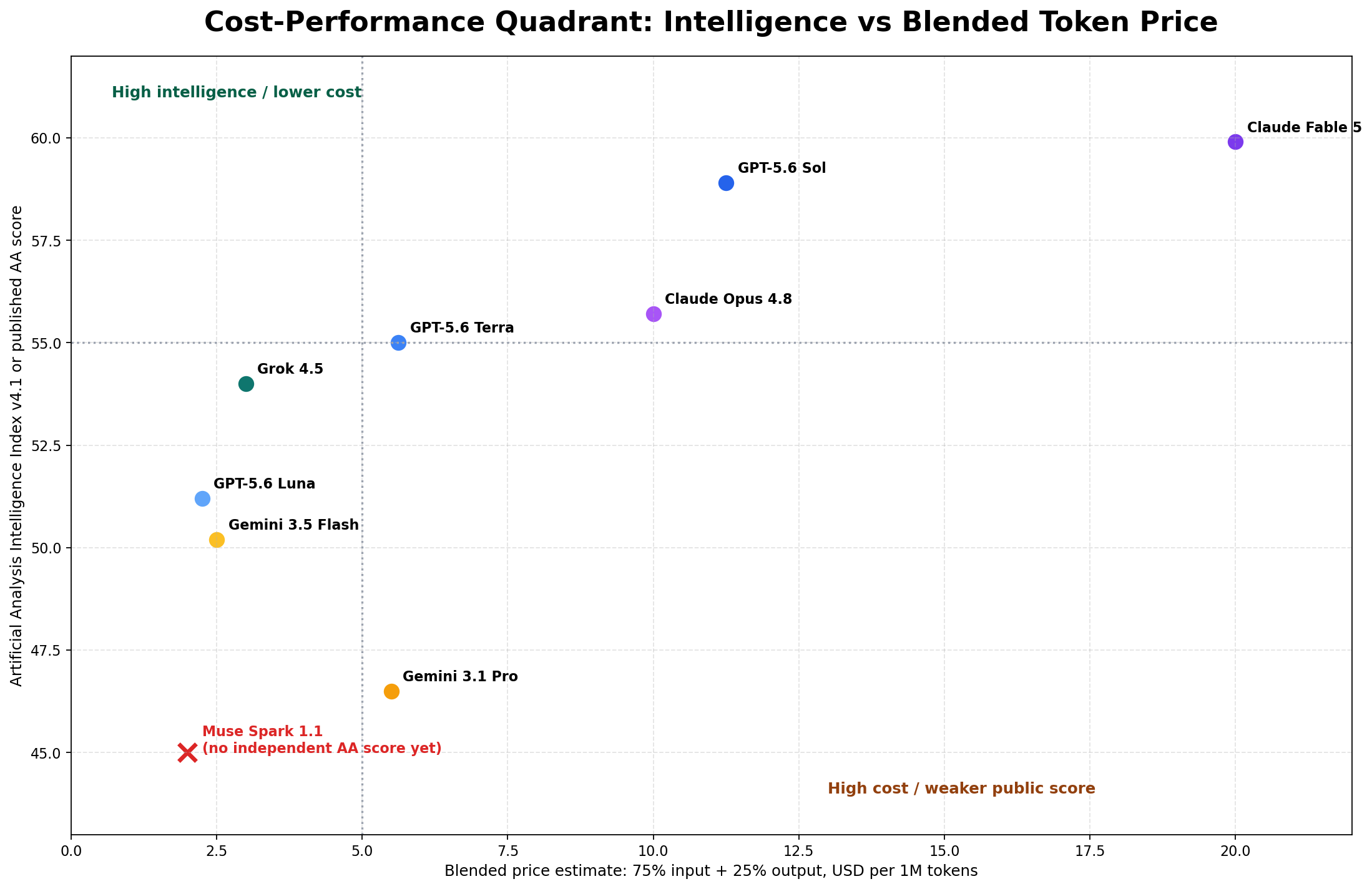
| Model | Input price | Output price | Cache pricing | AA Intelligence Index | Estimated task cost | Speed / token efficiency | Best cost-performance fit |
|---|---|---|---|---|---|---|---|
| GPT-5.6 Sol | $5 | $30 | cache reads 90% off; writes 1.25x input | 58.9 | not published | not published | Best for maximum raw reasoning and hard agents |
| GPT-5.6 Terra | $2.50 | $15 | same GPT-5.6 cache policy | 55.0 | not published | not published | Best OpenAI balance model |
| GPT-5.6 Luna | $1 | $6 | same GPT-5.6 cache policy | 51.2 | not published | not published | Best OpenAI high-volume tier |
| Claude Fable 5 | $10 | $50 | $1 cache hits; $12.50 5m writes; $20 1h writes | 59.9 | AA Coding task: $11.80 in Claude Code | Anthropic says token-efficient vs past Claude models | Best published capability if budget allows |
| Claude Mythos 5 | $10 | $50 | same as Fable 5 | not published | not published | not published | Best for approved defensive cyber/research access |
| Grok 4.5 | $2 | $6 | $0.50 cached input | 54 | $0.31 Intelligence Index task; $2.49 Coding Agent task | xAI says 80 tps; AA says low token usage | Best intelligence-per-dollar challenger |
| Muse Spark 1.1 | $1.25 reported | $4.25 reported | not published | not published | not published | not published | Best low-cost multimodal-agent bet if preview access fits |
Grok 4.5 is the cost-performance disruptor. Artificial Analysis reports a 54 Intelligence Index score, a $0.31 Intelligence Index task cost, a $2.49 Coding Agent task cost in Grok Build, and much lower token use than Fable 5 in Claude Code and GPT-5.5 in Codex. That does not make Grok the smartest model. It makes it one of the most dangerous commercial wedges because a near-frontier model that is cheap and fast can win many production workloads.
GPT-5.6 Sol vs Claude Fable 5
This is the real flagship fight. Fable 5 wins several rows that matter: GDPval-AA v2, SWE-Bench Pro, FrontierMath, and HealthBench Professional in OpenAI’s published table. GPT-5.6 Sol counters with OpenAI’s deeper agent stack, strong DeepSWE 1.1 and Terminal-Bench 2.1 results, OSWorld 2.0, BrowseComp, multimodal/design evidence, and a much lower API price than Fable 5. If you are buying pure peak quality for high-value professional work, Fable is hard to ignore. If you are building an agent product that needs tools, computer use, file search, web search, and broad OpenAI platform integration, Sol is the more complete platform bet.
The safety difference is practical. Fable 5’s fallback system can protect dangerous areas, but it may surprise developers who expected the same model to answer every request. Sol’s safeguards are also stricter than prior models, and OpenAI explicitly says the system starts conservatively, with lower-capability retry options when benign users hit friction.
GPT-5.6 Sol vs Grok 4.5
In GPT-5.6 vs Grok 4.5, Sol is the stronger published all-around model. It leads Grok on the public OpenAI/AA-style rows where both are visible and has a larger context window at 1.05M versus Grok’s 500K. But Grok 4.5 is more practical than a pure leaderboard read suggests. It is cheaper than Sol, much cheaper than Fable, available in Cursor and Office add-ins, and explicitly built for coding, agentic tasks, and knowledge work.
For a startup running thousands of coding-agent or office-agent loops, the question is not whether Grok beats Sol on every benchmark. The question is whether Grok succeeds often enough at a lower total cost and latency. That is why the best Grok 4.5 benchmarks story is efficiency, not supremacy.
GPT-5.6 Sol vs Muse Spark 1.1
Muse Spark 1.1 vs GPT-5.6 is the least settled matchup because Meta has published a deep safety and evaluation report but has fewer clean API-table facts available in easily parsed documentation. GPT-5.6 Sol has clearer independent-style benchmark visibility and a mature developer platform. Muse Spark 1.1 has a different bet: multimodal reasoning, multi-agent orchestration, tool/function calling, computer-use workflows, and a 1 million-token context window inside Meta’s massive consumer ecosystem.
If you need the best published benchmark certainty today, choose Sol. If you are experimenting with personal agents, media-heavy workflows, images/videos/documents, or Meta AI distribution, Muse Spark 1.1 deserves a serious test. Just keep the caveat visible: its API model ID, max output, independent Artificial Analysis score, and several public benchmark numbers were not independently verified during this review.
GPT-5.6 vs Gemini 3.1 Pro and Gemini 3.5 Flash
Gemini is not a footnote in this comparison. On the published rows already summarized above, GPT-5.6 Sol scores 80 versus 42.7 for Gemini 3.1 Pro Preview on the Artificial Analysis Coding Agent Index, 88.8% versus 70.7% on Terminal-Bench 2.1, 90.4% versus 85.9% on BrowseComp, and 7.78% versus 0.42% on ARC-AGI-3. GPQA Diamond is much closer at 94.6% for Sol and 94.3% for Gemini 3.1 Pro. Those rows favor Sol overall, but they are benchmark-specific and should not be read as universal product superiority.
Gemini 3.5 Flash belongs in a different deployment conversation: fast multimodal and high-throughput work rather than a simple flagship-versus-flagship contest. The reviewed tables do not publish every comparable Gemini price, output-limit, safety, or agent-harness field, so this article leaves those cells blank instead of importing assumptions from another model generation.
The practical decision is to test the OpenAI and Google options on the same repository, document set, tool harness, latency target, and budget. Sol has the stronger published showing across the cited coding, browsing, and agent rows; Gemini remains a serious alternative when a team’s production stack and multimodal workloads are already centered on Google’s model ecosystem.
Terra And Luna May Be The Bigger Story
Sol gets the headline, but Terra and Luna may matter more for production apps. Terra keeps much of the GPT-5.6 tool/context package at half Sol’s listed input/output price. Luna is the high-volume tier at $1 input and $6 output per million tokens, yet OpenAI still lists the same 1.05M context and 128K output limit. That makes Luna the model to test for summarization, classification, extraction, draft generation, and background agent steps where the most expensive reasoning model would be wasteful.
Against Grok 4.5, Terra is more expensive but has the broader OpenAI platform package and stronger published rows. Luna matches Grok’s output price and undercuts Grok’s input price, while Grok’s advantage is token efficiency, Cursor/Office availability, and xAI’s focused coding-agent push. Against Muse Spark 1.1, Terra and Luna have better public benchmark comparability, while Muse has the lower press-reported price and a distinctly multimodal consumer-agent angle.
Which Model Should You Actually Use?
| Use case | Recommended model | Why |
|---|---|---|
| Best for coding agents | Claude Fable 5 or GPT-5.6 Sol | Fable leads SWE-Bench Pro in the OpenAI table; Sol leads or competes on DeepSWE and Terminal-Bench. |
| Best for everyday AI app backend | GPT-5.6 Terra | Large context, strong scores, broad tools, and lower cost than Sol/Fable. |
| Best for high-volume summarization/classification | GPT-5.6 Luna or Grok 4.5 | Luna is the cheapest OpenAI frontier tier; Grok has strong cost and token-efficiency evidence. |
| Best for long-context document analysis | Claude Fable 5, GPT-5.6 Sol/Terra, or Muse Spark 1.1 | All publish about 1M-token context; choose by safety, tools, and access. |
| Best for multimodal computer use | GPT-5.6 Sol or Muse Spark 1.1 | Sol has published OSWorld/BrowseComp wins; Muse is explicitly built for multimodal agentic workflows. |
| Best for frontend/design generation | GPT-5.6 Sol | OpenAI publishes the strongest design/product-work story and customer evidence. |
| Best for cybersecurity defense | GPT-5.6 Sol with Trusted Access or Claude Mythos 5 if approved | Both vendors gate the most sensitive capabilities. |
| Best for finance/legal/professional work | Claude Fable 5 or GPT-5.6 Sol | Fable leads GDPval-AA in OpenAI’s table; Sol has broad finance and document-work evidence. |
| Best for low-cost production deployment | Grok 4.5 or GPT-5.6 Luna | Grok sits on the AA cost frontier; Luna has OpenAI tooling at $1/$6. |
| Best for maximum raw reasoning | Claude Fable 5 or GPT-5.6 Sol | Fable leads several published rows; Sol is the strongest OpenAI model and has excellent tool depth. |
Safety And Refusal Differences
For the release-stage safeguards and controlled-access history, see the GPT-5.6 limited-preview safety and rollout history.
OpenAI’s GPT-5.6 system card says Sol, Terra, and Luna are High capability in cybersecurity and biological/chemical risk, but do not reach the Critical threshold. It also says safeguards are layered through model training, classifiers, monitoring, account controls, and Trusted Access for high-risk defensive work.
Anthropic’s Fable/Mythos split is more visible to users. Fable 5 is the general model with classifiers; Mythos 5 is limited-access and has safeguards lifted in approved areas. Anthropic says more than 95% of Fable sessions do not trigger fallback, but that still means some harmless requests can route to Opus 4.8 instead of Fable 5.
Meta’s Muse Spark 1.1 report is unusually explicit about pre-mitigation versus residual risk. The unmitigated model may meet high-risk thresholds in chemical/biological and cybersecurity domains, but Meta says deployment mitigations reduce residual risk to moderate or lower. For Grok 4.5, I found strong product and benchmark documentation, but not a comparable public system card.
What The Benchmarks Do Not Tell You
The benchmarks do not tell you how often a model fails gracefully in your production stack. Vendor-selected benchmarks can overrepresent a provider’s strengths. Internal evals can be useful but should not be treated like independent measurements. Availability labels in this article are dated to July 9, 2026 and should be rechecked before deployment. Different reasoning settings can move scores and cost dramatically. A model that wins on a benchmark may lose after you include latency, tool-call errors, refusal behavior, cache misses, context compaction, and human review time.
The right workflow test is boring and decisive: run each candidate on the same 30 to 100 real tasks, with the same tool permissions, the same budget cap, and the same acceptance rubric. Measure completion rate, rework, latency, total tokens, failure mode, refusal rate, and downstream user satisfaction. That will beat almost every launch-day chart.
Final Verdict
Best overall frontier model: Claude Fable 5 if you weight published benchmark quality most heavily; GPT-5.6 Sol if you weight platform depth, tools, computer use, and production agent infrastructure. Best coding model: Claude Fable 5 on SWE-Bench Pro, GPT-5.6 Sol on DeepSWE/Terminal-style work, and Grok 4.5 for cost-efficient coding agents. Best value model: Grok 4.5 today, with GPT-5.6 Luna as the OpenAI value pick. Best business/office model: GPT-5.6 Sol or Claude Fable 5, with Grok 4.5 worth testing because of Office availability. Best multimodal agent model: GPT-5.6 Sol for published certainty; Muse Spark 1.1 for Meta’s multimodal-agent ecosystem bet.
For Kingy.ai readers building products, the practical default is not one model forever. Use Sol or Fable for the hardest reasoning and agent steps, Terra/Luna or Grok for high-volume production paths, and test Muse Spark 1.1 or Gemini when the workload is multimodal, ecosystem-specific, or tied to Meta or Google distribution. The frontier model war is now about matching the right intelligence to the right workload at the right cost.
Sources And Verification Notes
| Source | Link | Used for |
|---|---|---|
| OpenAI GPT-5.6 launch | OpenAI launch page | availability, pricing, benchmark tables, safety summary |
| OpenAI API model docs | OpenAI model docs | model IDs, context, output, tools, prices |
| OpenAI GPT-5.6 system card | Deployment safety hub | preparedness and safeguard claims |
| Anthropic Fable/Mythos launch | Anthropic announcement | Fable/Mythos launch, safety classifiers, availability |
| Anthropic model and pricing docs | model docs / pricing docs | model IDs, context, output, prices, caching |
| xAI Grok 4.5 docs | Grok 4.5 docs / model page | model ID, availability, tools, context, price |
| xAI Grok 4.5 launch | xAI announcement | coding benchmark table and launch claims |
| Artificial Analysis Grok 4.5 | Artificial Analysis article | Grok Intelligence Index, Coding Agent Index, task-cost and token-efficiency data |
| Meta Muse Spark 1.1 | Meta launch / evaluation report | 1M context, API preview, tool/function calling, safety report, Cybench/CyberGym/ExploitGym |
| Google Gemini 3.5 family | Google model-family announcement | Gemini 3.5 family positioning and model context |
| Not verified | N/A | Muse Spark 1.1 max output, exact API model ID in parsed docs, independent AA/LMArena scores for Muse, and a Grok 4.5 system card comparable to OpenAI/Anthropic/Meta |
FAQ
What is the best AI model in 2026?
There is no single universal winner. Claude Fable 5 has the strongest published peak-quality scorecard in several rows, GPT-5.6 Sol has the strongest OpenAI platform package, Grok 4.5 is the cost-efficiency challenger, and Muse Spark 1.1 is Meta’s multimodal-agent bet.
Is GPT-5.6 Sol better than Claude Fable 5?
It depends on the workload. Fable 5 leads several published benchmark rows, including SWE-Bench Pro and GDPval-AA v2. GPT-5.6 Sol has broader OpenAI tooling, computer use, Codex integration, and lower API pricing than Fable 5.
Is Grok 4.5 a frontier model?
Artificial Analysis places Grok 4.5 near the frontier with a 54 Intelligence Index score and strong cost-efficiency. It is not the top raw model, but it is one of the most commercially interesting releases because of price and token efficiency.
Is Muse Spark 1.1 available through an API?
Meta says Muse Spark 1.1 is available through the public preview of Meta Model API and in Meta AI Thinking mode. Some API fields, including exact model ID and max output, were not found in the parsed official pages.
Which model is best for startups building AI products?
Startups should test GPT-5.6 Terra or Luna for OpenAI-native production paths, Grok 4.5 for cost-sensitive agents, Sol or Fable for hardest tasks, and Muse Spark 1.1 for multimodal personal-agent workloads.
The Kingy Brief
Get The Kingy Brief.
AI changes, original tests and one practical thing to try. Fridays at 09:00 Vancouver time.
Free · Double opt-in · Unsubscribe anytime
Signup help and newsletter schedule
Signup form provided by Beehiiv. After submitting, check your inbox for "Confirm your subscription to The Kingy Brief" and open its confirmation link. Check Spam or Promotions if you cannot find it.
Fridays at 09:00 Vancouver time: source-checked AI changes, original tests and one practical thing to try. The weekly restart begins October 9, 2026. We skip a week when there is not enough verified material. Free. Unsubscribe anytime.