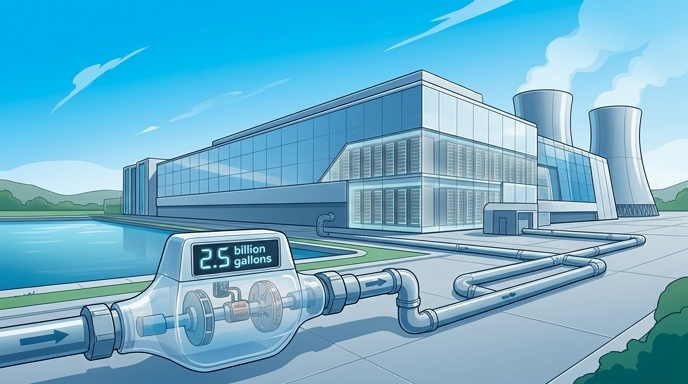
The Cloud Has a Water Bill
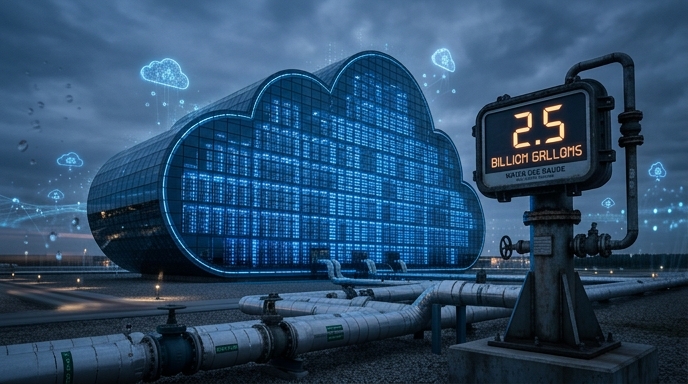
Amazon just gave the public a peek behind the curtain of its cloud empire, and the number is not exactly a sip.
The company says its global data center operations withdrew about 2.5 billion gallons of water in 2025. That water helped cool the servers behind Amazon Web Services, AI workloads, shopping systems, streaming tools, business software, and the endless digital machinery we all poke every day without thinking much about the plumbing.
That disclosure matters because data centers have become the new industrial boomtowns. They do not belch smoke like old factories. They hum. They blink. They sit behind fences with clean logos and security gates. But they still need land, power, and, in many cases, water.
Amazon wants the story to be about efficiency. Critics want the story to be about scale. Both sides have a point. That is what makes this more interesting than the usual corporate sustainability confetti cannon.
Amazon says it is using less water per unit of computing than the industry average. It also says its total water withdrawals at directly owned and operated sites fell from 2024 to 2025, even as its data center footprint grew.
But 2.5 billion gallons is still 2.5 billion gallons. Put that number in a headline and people sit up straighter. Put it near the letters “AI,” and suddenly the room gets louder.
Why Data Centers Need Water At All
Servers are tiny furnaces with opinions.
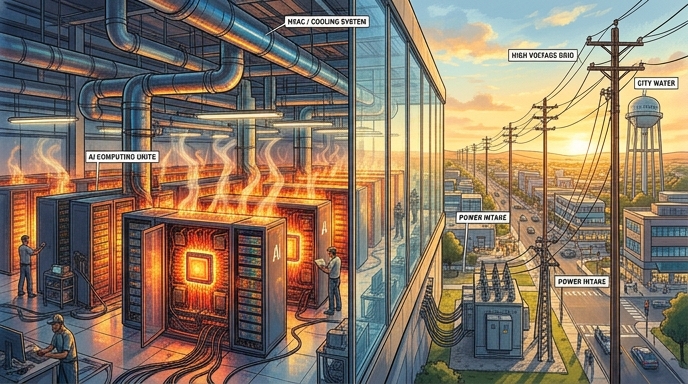
Every time a data center runs cloud software, hosts a video call, trains a model, processes a payment, or answers a query, its chips generate heat. Too much heat can hurt performance or damage equipment. So data centers need cooling, constantly.
Amazon says its data centers use free-air cooling about 90% of the time. That means they pull in outside air, move it across equipment, carry heat away, and send it back out. Simple idea. Big industrial execution.
When the weather gets too hot, Amazon uses evaporative cooling. Think of it as sweating, but for machines. Water evaporates, pulls heat from the air, and lowers the temperature. It works well. It can also use a lot of water.
The company argues that this tradeoff can make sense because mechanical chillers, which act more like massive air conditioners, often require more electricity. Amazon says chillers can demand 25% to 35% more power than its evaporative approach during peak heat.
That matters because the hottest days are also when local power grids strain hardest. Everyone has the air conditioner running. Fans spin. Utilities sweat. Then data centers show up asking for another giant serving of electricity.
So Amazon’s argument is not “water good.” It is more nuanced: use air most of the time, use water during the worst heat, avoid heavier power demand, and keep the servers alive.
Not exactly beach reading. Still important.
The Efficiency Claim
Amazon’s headline efficiency number is 0.12 liters of water per kilowatt-hour of electricity used by its global data center operations in 2025.
That metric is called water usage effectiveness, or WUE. It measures how much water a data center uses relative to its energy consumption. Lower is better.
Amazon says the industry average is about 0.84 liters per kilowatt-hour, which would make Amazon’s 2025 rate roughly seven times more efficient. The company also says its own WUE has improved by 52% since 2021.
That is not nothing. If the numbers hold up under scrutiny, Amazon has improved the machine. It has also done something other tech giants should copy: it disclosed a specific global figure.
Transparency does not solve the water problem. But secrecy makes the problem worse. Communities cannot evaluate tradeoffs when companies hide the bill.
Still, efficiency can also become a magician’s scarf. Pull it long enough, and it distracts from the elephant.
A data center can use less water per unit of computing while using more water overall if total demand grows fast enough. That is the central tension of the AI era. Efficiency races in one direction. Demand gallops in the other, wearing a rocket pack and yelling about productivity.
Amazon says its directly owned and operated sites used 2% less water in 2025 than in 2024 despite growth. That is a meaningful data point. But the real test comes over several years, especially as AI computing demand keeps climbing.
The AI Boom Changed the Temperature
The timing of Amazon’s disclosure is no accident.
AI has turned data centers into political infrastructure. A few years ago, most people thought of the cloud as a fuzzy metaphor. Now they see server farms as physical neighbors. Those neighbors need power lines, backup generators, land, fiber, substations, and water.
That has changed the public conversation.
Communities are asking harder questions. Where does the water come from? Is it drinking water? Is it reclaimed wastewater? What happens during drought? Who pays for utility upgrades? Do local residents get jobs, lower taxes, or just higher bills and a hotter grid?
Amazon’s disclosure landed as data centers face rising scrutiny across the United States. The Verge noted that the announcement came shortly after Seattle enacted a one-year moratorium on new data centers. That moratorium reportedly had support from some Amazon employees concerned about environmental impact.
That detail adds spice. The pressure is not only coming from outside activists or irritated neighbors. Some of it is coming from inside the house.
And that is the problem for Big Tech. AI may be thrilling in product demos, but infrastructure always gets local. Nobody lives “in the cloud.” People live near aquifers, rivers, substations, and zoning boards.
The future may be digital. The consequences are absolutely physical.
Amazon’s Reclaimed Water Pitch
Amazon does not want to be seen as a company drinking from the municipal tap while smiling at a sustainability conference.
So it is leaning hard into reclaimed water.
The company says it already operates 26 facilities using 100% reclaimed water and has 130 more contracted globally. Reclaimed water usually comes from wastewater treatment systems. It is not drinking water. It would otherwise be discharged or go unused for higher-value purposes.
That is a better story than using potable water, especially in regions where residents already worry about supply.
Amazon also says it has announced more than 50 water projects expected to return more than 5.8 billion gallons annually once fully implemented. These projects include aquifer storage, watershed restoration, and infrastructure that redirects or improves water availability for communities.
The company says it is now 75% of the way toward its goal of becoming “water positive” by 2030. In plain English, Amazon wants to return more water to communities than it uses in its direct data center operations.
That sounds good. It may even be good.
But the details matter. Water “returned” in one place does not automatically offset water withdrawn in another. A gallon restored in a wetter region does not help a dry town dealing with local stress. Water is not a spreadsheet cell. It is geography, seasonality, infrastructure, politics, and luck wearing a blue hat.
The Big Caveat: What Is Not Counted
Amazon’s disclosed number focuses on its global data center operations. That gives the public a useful starting point. It does not give the full planetary invoice.
The Verge pointed out an important limitation: Amazon’s data does not include indirect water use tied to power plants supplying electricity for data centers. It also does not include water used in construction.
That caveat is huge.
Power generation can require water, depending on the energy source. Building data centers also consumes materials, concrete, steel, chips, and construction resources. Chip manufacturing can be water-intensive too, though that sits further up the supply chain.
So the 2.5 billion gallon number answers one question: how much water did Amazon withdraw across its data center operations in 2025?
It does not answer every question about the water footprint of AWS, AI, or Amazon’s broader infrastructure.
That distinction matters because companies naturally prefer clean numbers. Clean numbers fit in press releases. Messy systems do not.
A fair reading gives Amazon credit for releasing a global operational water figure. A tough reading says the number is incomplete. The adult answer is: both are true. Welcome to infrastructure reporting. Bring coffee.
Competitors Are Now on Notice
Amazon’s disclosure puts pressure on Microsoft, Google, Meta, and other major cloud and AI players.
The company claims it is more water-efficient than several Big Tech rivals. The Verge noted that Amazon’s own comparison points to Microsoft, Google, and Meta data showing higher water use per kilowatt-hour over recent years. It also flagged that comparisons can get tricky because companies may report different scopes, workloads, and categories.
That is the reporting equivalent of “measure twice, argue forever.”
Still, Amazon has now placed a marker. It gave the public a global figure. It gave an efficiency metric. It tied those numbers to a 2030 goal. Competitors will have a harder time saying, “Nothing to see here, please enjoy this vague sustainability PDF.”
The next phase should be standardized reporting. Not vibes. Not cherry-picked dashboards. Not heroic case studies from one shiny facility. The industry needs consistent definitions, location-level disclosures, potable versus reclaimed water breakdowns, and indirect water estimates.
Investors should want that. Regulators should want that. Communities definitely want that.
Efficiency bragging is not enough. Total withdrawals matter. Local withdrawals matter more. A low WUE number in a water-stressed area can still trigger political backlash.
That is not anti-tech. That is basic arithmetic with a map.
Why the Number Feels So Shocking
Part of the public reaction comes from scale shock.
Most people do not think in billions of gallons. A gallon is milk. Gasoline. A jug in the fridge. Then a tech company says “2.5 billion” and everyone’s brain briefly leaves the meeting.
Amazon tries to put the number in context. It says Americans use roughly 3.3 trillion gallons of water each year watering lawns and gardens, according to EPA data cited in Amazon’s post. By that comparison, Amazon’s data center water withdrawal is much smaller.
That comparison is useful, but also a little slippery.
Yes, lawn irrigation is enormous. Yes, data centers are not agriculture. Yes, many other industries use more water. But “someone else uses more” does not automatically settle whether a new data center makes sense in a specific community.
Water politics is local. A billion gallons in a water-rich place and a billion gallons in a stressed watershed are not the same story.
The better question is not only “How big is the number?” It is “Where is the water coming from, what kind of water is it, when is it used, and who else needs it?”
That is where public debate should go next. Not panic. Not corporate happy talk. Specifics.
The Real Story Is Tradeoffs
This story does not have a cartoon villain. It has tradeoffs.
Data centers power useful things. Hospitals, banks, schools, businesses, logistics systems, emergency tools, entertainment platforms, and AI services all rely on cloud infrastructure. Nobody serious wants the internet to run on hopes and desk fans.
But cloud computing has costs. AI raises those costs because it demands more dense computing power. Denser chips run hotter. Hotter chips need better cooling. Better cooling requires engineering choices. Those choices ripple into water and power systems.
Amazon’s engineers appear to be making real improvements. Raising server temperature tolerances, using air cooling most of the time, expanding reclaimed water, and reducing WUE all matter.
But Amazon is also building for a world where compute demand keeps exploding. Efficiency gains can get swallowed by growth. That is the rebound problem. Make something cheaper and more efficient, and people often use more of it.
So the question is not whether Amazon can make each unit of compute cleaner. It probably can. The question is whether the company can keep total impacts under control while selling more compute to everyone, everywhere, all the time.
That is a much harder game.
And unlike a software bug, it cannot be patched overnight.
What Comes Next

Amazon’s disclosure should become the floor, not the ceiling.
The company has shown that large cloud providers can publish water data without the sky falling. Now the industry should go further.
Report total withdrawals. Break out potable and reclaimed water. Show location-level stress. Include indirect water from electricity where possible. Explain construction impacts. Track year-over-year changes. Use consistent definitions. Stop hiding behind sustainability poetry.
Amazon deserves credit for releasing a clear headline number. It also deserves scrutiny for what that number leaves out.
That is not contradiction. That is accountability.
The cloud is no longer invisible. AI made sure of that. Every prompt, purchase, stream, search, and enterprise workload runs somewhere. Somewhere has weather. Somewhere has neighbors. Somewhere has pipes.
In 2025, Amazon says its data centers withdrew 2.5 billion gallons of water. The company says it is using that water more efficiently than the industry average and moving toward a water-positive goal by 2030.
Good. Now prove it again next year.
And the year after that.
Because the cloud may feel weightless, but the water bill is very real.
Sources
- The Verge — “Amazon’s data centers used 2.5 billion gallons of water last year”
- Crypto Briefing — “Amazon withdraws 2.5 billion gallons of water for data centers in 2025”
- PCMag — “Amazon: Our Data Centers Used 2.5 Billion Gallons of Water Last Year”
- Amazon — “How Amazon is making its data centers more water-efficient”
- The Wall Street Journal — “Amazon Says Its Data Centers Used 2.5 Billion Gallons of Water in 2025”
- Yahoo Finance / Bloomberg — “Amazon Says Its Data Centers Use 2.5 Billion Gallons of Water”
The Kingy Brief
Get the next Kingy Brief.
Source-checked AI changes, original tests and one practical thing to try.
Free · Choose your subjects · Double opt-in · Unsubscribe anytime