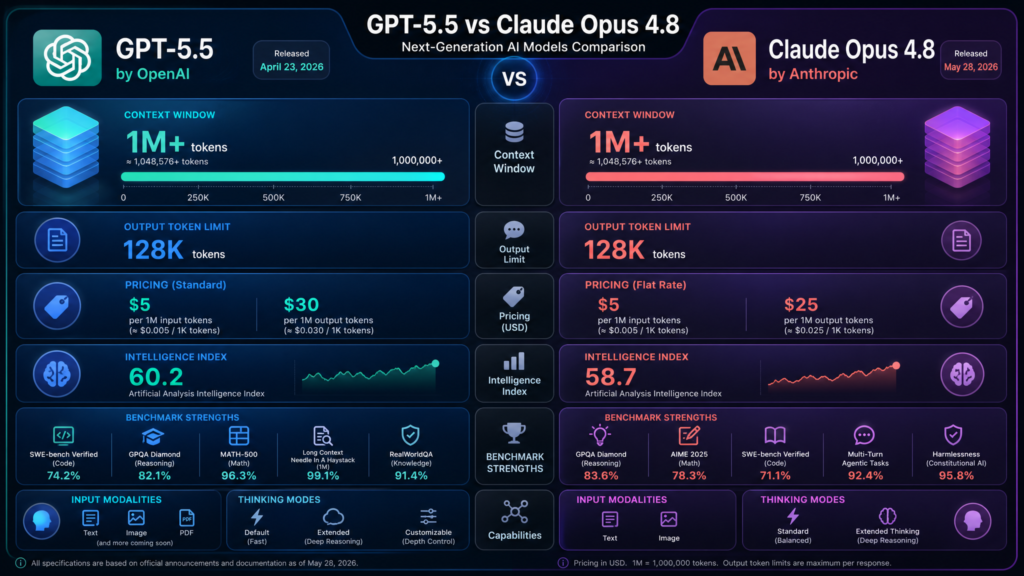
GPT-5.5 vs Claude Opus 4.8: Specs, Benchmarks, Pricing, Safety, and Which AI Model Is Better
1. Introduction: Why this comparison matters
Two frontier models now sit at the top of most serious buyers’ shortlists: OpenAI’s GPT-5.5 and Anthropic’s Claude Opus 4.8. Both are aimed squarely at high-value work — complex reasoning, agentic coding, long-horizon software tasks, research, and professional knowledge work. Both are expensive, capable, and heavily marketed.
The temptation is to ask “which one is better?” But that framing is close to useless in practice. Frontier models are not graded on a single axis, and the honest answer to “which is better” is almost always “for what, at what cost, and with what evidence?” A model that wins a coding leaderboard may lag on factuality documentation. A model that’s cheaper per output token may cost more once you account for retries, tool calls, and context length.
This article compares GPT-5.5 — OpenAI’s API model identity, exposed in ChatGPT as Instant, Thinking, and Pro modes — against Claude Opus 4.8, Anthropic’s flagship generally-available Opus model, available across claude.ai, Claude Code, the Anthropic API, and major clouds.
A short thesis up front, so you know where the evidence points: GPT-5.5 is the better-documented model in OpenAI’s official public materials, especially around benchmark breadth and quantified safety. Claude Opus 4.8 is highly competitive and appears to lead on several independent and Anthropic-reported agentic, coding, and knowledge-work evaluations — but its publicly accessible evidence package, while substantial (including a 244-page system card), is in places less directly retrievable than OpenAI’s. Neither company discloses parameter counts, architecture details, or training compute.
2. Quick verdict table
| Category | Winner | Why |
|---|---|---|
| Best overall documented public evidence | GPT-5.5 | OpenAI publishes a denser, more directly retrievable benchmark and system-card package. |
| Best for coding benchmarks | Claude Opus 4.8 | Anthropic’s chart reports 69.2% SWE-Bench Pro and 88.6% SWE-Bench Verified, above GPT-5.5’s 58.6% on SWE-Bench Pro. |
| Best for agentic / browser / computer-use | Mixed | Opus 4.8 leads Online-Mind2Web (84%); GPT-5.5 leads BrowseComp (84.4%) and Tau2-bench Telecom (98.0%). |
| Professional knowledge-work reports | Different comparisons | The article’s later account identifies 1,890 versus 1,753 as Opus 4.8 versus Opus 4.7. The separately quoted ~67% comparison with GPT-5.5 is attributed to Artificial Analysis; it is not derived from those two Elo values. |
| Best for safety / factuality documentation | GPT-5.5 | OpenAI quantifies hallucination reduction (23% more likely correct claims) in accessible system-card text. |
| Best for output-token pricing | Claude Opus 4.8 | $25/MTok output vs GPT-5.5’s $30/MTok. |
| Best for context length | Tie | GPT-5.5: 1,050,000 tokens; Opus 4.8: 1,000,000 tokens. Effectively equivalent. |
| Best for consumer availability | Tie | Both broadly available; ChatGPT publishes clearer message limits, Claude uses session/credit budgets. |
| Best for enterprise / API deployment flexibility | Claude Opus 4.8 | Available on Anthropic API, AWS Bedrock, Google Vertex AI, and Microsoft Foundry. |
| Biggest unknowns | Tie | Parameter counts, architecture, and training compute are undisclosed for both. |
Where the evidence is mixed, the table says so. Do not read any single row as a universal verdict.
3. Naming and product identity: GPT-5.5 is not exactly “ChatGPT 5.5”
People often type “ChatGPT 5.5,” but that’s a product-facing nickname, not the model name. The official model is GPT-5.5, and ChatGPT exposes it through different surfaces — Instant, Thinking, and Pro — each with different message limits and context windows (OpenAI Help Center). GPT-5.5 Pro, per OpenAI’s deployment safety materials, is the same underlying model run with more parallel test-time compute — not a separately trained foundation model.
Claude Opus 4.8 is Anthropic’s flagship, most-capable generally-available model. But “using Opus 4.8” means different things depending on surface: claude.ai chat, Claude Code (the developer agent environment), the Anthropic API (claude-opus-4-8), and cloud resellers all apply different context behavior, effort defaults, and usage-credit rules.
The key point for buyers: your real-world experience depends on far more than the base model. Product-level limits, tool access, reasoning effort, context window, provider, and pricing all shape what you actually get.
4. Publicly disclosed specs
| Spec | GPT-5.5 | Claude Opus 4.8 | Source |
|---|---|---|---|
| Release date | April 23, 2026 | May 28, 2026 | OpenAI / Anthropic |
| Official model name | GPT-5.5 | Claude Opus 4.8 (claude-opus-4-8) | First-party |
| Product surfaces | API; ChatGPT Instant / Thinking / Pro | claude.ai, Claude Code, API, Cowork, clouds | First-party |
| Input modalities | Text + image | Text + image (+ PDF/files in platform) | OpenAI dev docs / Anthropic docs |
| Output modalities | Text | Text | First-party |
| API context window | 1,050,000 tokens | 1,000,000 tokens | First-party |
| Max output tokens | 128,000 | 128,000 | First-party |
| Knowledge cutoff | Dec 1, 2025 | Jan 2026 | First-party |
| Training-data cutoff | Not separately listed | Jan 2026 | Anthropic docs |
| Reasoning / effort settings | none → xhigh | high (default), extra/xhigh, max | First-party |
| Tool support | Web search, file search, code interpreter, shell, computer use, MCP, function calling | Server- and client-side tools, web/computer use, MCP, adaptive thinking | First-party |
| Structured output | Yes | Yes | First-party |
| Prompt caching | Yes | Yes (5-min and 1-hour) | First-party |
| Batch API | Yes (50% off) | Yes (50% off) | First-party |
| Cloud availability | OpenAI platform | Anthropic API, AWS Bedrock, Google Vertex AI, Microsoft Foundry | Anthropic migration guide |
| Parameter count | Not publicly disclosed | Not publicly disclosed | — |
| Architecture (dense/MoE, layers) | Not publicly disclosed | Not publicly disclosed | — |
| Training compute / FLOPs | Not publicly disclosed | Not publicly disclosed | — |
| Training dataset size | Not publicly disclosed | Not publicly disclosed | — |
The most important takeaway from this table is what’s missing. Both companies remain opaque about deep internals. OpenAI describes GPT-5.5 only as a reinforcement-learning-trained reasoning model that “thinks before it answers.” Anthropic describes Opus 4.8 as a hybrid reasoning model that “builds on Opus 4.7.” Neither discloses parameter counts, topology, or training FLOPs. Any article quoting exact parameter counts or training compute for these models without strong primary sourcing should be treated with suspicion.
5. Benchmarks: what the numbers say, and what they don’t
5.1 Coding benchmarks
OpenAI’s launch page reports GPT-5.5 at 58.6% on SWE-Bench Pro (Public) and 82.7% on Terminal-Bench 2.0. Anthropic’s own launch chart — as reported by VentureBeat and The Decoder (secondary reporting of Anthropic’s official figures) — puts Opus 4.8 at 69.2% on SWE-Bench Pro, 88.6% on SWE-Bench Verified, and 74.6% on Terminal-Bench 2.1.
There’s an important harness caveat here, disclosed by Anthropic itself: on Terminal-Bench 2.1, scores were reported using the Terminus-2 public harness, and GPT-5.5’s reported score with OpenAI’s own Codex CLI harness is 83.4%. In other words, the “winner” on terminal/CLI tasks flips depending on which scaffold you trust. Coding benchmark performance is heavily sensitive to the evaluation harness, tool access, reasoning budget, and whether the model can execute and inspect code — so treat single numbers as directional, not definitive.
5.2 Agentic and browser / computer-use benchmarks
This is where the two models genuinely diverge. Anthropic calls Opus 4.8 “the strongest computer-use and browser-agent model we’ve tested,” citing 84% on Online-Mind2Web, which it says beats both Opus 4.7 and GPT-5.5 (Anthropic). GPT-5.5, meanwhile, posts strong numbers on OpenAI’s chosen agentic suite: 78.7% OSWorld-Verified, 84.4% BrowseComp, 75.3% MCP Atlas, and 98.0% Tau2-bench Telecom (OpenAI).
These benchmarks matter because they test whether a model can actually use tools, navigate interfaces, follow long instructions, and finish multi-step tasks — not just answer trivia. The split is telling: Opus 4.8 looks strongest on open web navigation, while GPT-5.5 looks strongest on structured tool-use and customer-workflow tasks. Anthropic also touts a new Dynamic Workflows feature in Claude Code that spawns hundreds of parallel subagents for codebase-scale work (TechCrunch).
5.3 Professional work and knowledge benchmarks
OpenAI reports GPT-5.5 at 84.9% GDPval, 88.5% on an internal investment-banking modeling test, 60.0% FinanceAgent v1.1, and 54.1% OfficeQA Pro. On Anthropic’s side, 9to5Mac summarizes Anthropic’s chart showing the GDPval-AA knowledge-work Elo rising from 1,753 (Opus 4.7) to 1,890 (Opus 4.8) and agentic financial analysis improving from 51.5% to 53.9%. Anthropic also says Opus 4.8 set the highest recorded score on Harvey’s Legal Agent Benchmark, becoming the first model to break 10% on its all-pass standard.
On Humanity’s Last Exam, The Decoder reports Opus 4.8 at 49.8% without tools and 57.9% with tools. These benchmarks aim to measure professional usefulness rather than academic test-taking — though, as always, “useful” is harness-dependent.
5.4 Independent benchmark rankings
Artificial Analysis, an independent evaluator, currently places Claude Opus 4.8 (max) slightly ahead on its composite Intelligence Index — 61.4 vs 60.0 for GPT-5.5 (xhigh). It also gives Opus 4.8 a GDPval-AA Elo of 1,890, implying roughly a 67% win rate over GPT-5.5 on that benchmark, and notes Opus 4.8 takes the lead in scientific reasoning while still trailing GPT-5.4 and GPT-5.5 on CritPt, a frontier physics benchmark.
Independent rankings are useful precisely because they apply a consistent harness across vendors, neutralizing some first-party cherry-picking. But a composite “intelligence score” compresses dozens of very different skills into one number — it should inform your decision, not make it.
5.5 Why benchmark rankings vary
If two credible sources rank these models differently, that’s expected, not contradictory. Results shift with: reasoning effort (xhigh vs medium vs max), tool availability, provider latency and routing, scaffold quality, prompt design, pass@1 vs best-of-N sampling, context length, hidden system instructions, and benchmark saturation (many academic tests are now too easy to discriminate frontier models). The Terminal-Bench harness flip above (82.7% vs 83.4% for GPT-5.5 depending on harness) is a concrete example of how much the measurement setup matters.
Benchmark comparison table
| Benchmark | GPT-5.5 | Claude Opus 4.8 | Notes / Source |
|---|---|---|---|
| SWE-Bench Pro | 58.6% | 69.2% | Opus figure = secondary report of Anthropic chart |
| SWE-Bench Verified | Not in reviewed OpenAI text | 88.6% | VentureBeat |
| Terminal-Bench | 82.7% (2.0) / 83.4% (2.1, Codex CLI) | 74.6% (2.1, Terminus-2) | Harness-dependent |
| GDPval | 84.9% | Elo 1,890 (GDPval-AA) | Different metrics |
| OSWorld-Verified | 78.7% | Not directly retrievable | OpenAI |
| Online-Mind2Web | Not in reviewed OpenAI text | 84% | Anthropic |
| BrowseComp | 84.4% | Unspecified | OpenAI |
| Tau2-bench Telecom | 98.0% | Unspecified | OpenAI |
| MMMU Pro | 81.2% (no tools) / 83.2% (tools) | Unspecified | OpenAI |
| Humanity’s Last Exam | Unspecified in reviewed text | 49.8% / 57.9% (tools) | The Decoder |
| AA Intelligence Index | 60.0 (xhigh) | 61.4 (max) | Artificial Analysis |
| Legacy (MMLU/HumanEval/GSM8K) | Not publicly disclosed | Not publicly disclosed | Both omit these |
6. Latency and speed
Neither vendor publishes a canonical apples-to-apples serving benchmark, so the best public data comes from Artificial Analysis. For GPT-5.5 (medium): ~5.82s time-to-first-token (TTFT) and ~58.1 output tokens/s. For GPT-5.5 (xhigh): a much slower ~63.96s TTFT but still ~59.7 tokens/s once streaming. For Opus 4.8 (adaptive, max effort): TTFT of ~7.07s on Google, ~8.88s on Amazon, and ~18.35s on Anthropic’s own endpoint, at roughly 63–65 tokens/s.
Two robust conclusions: effort setting dominates latency (xhigh/max reasoning means long first-token waits), and provider choice matters more for Opus 4.8 than for GPT-5.5. It helps to separate four things: interactive speed (TTFT), deep-reasoning latency, output throughput (tokens/s), and total task-completion time. A slow first token is fine for complex coding or research — you’ll wait for a better answer — but painful in casual chat. Anthropic’s newly discounted fast mode (~2.5× speed, now $10/$50 per MTok, a 3× price cut) directly targets latency-sensitive production workloads.
7. Safety, factuality, honesty, and alignment
GPT-5.5. OpenAI’s system card is unusually quantitative. It says that on de-identified, user-flagged ChatGPT conversations, GPT-5.5’s individual claims were 23% more likely to be factually correct, and its responses contained a factual error 3% less often than GPT-5.4 (with a caveat that it makes more claims per response). It reports HealthBench results (length-adjusted 56.5, Hard 31.5, Consensus 95.6, Professional 51.8) and describes red-teaming for bio and cyber risk. Notably, it discloses that a UK AISI campaign found a universal cyber jailbreak against an earlier configuration, after which OpenAI updated safeguards and says all verified high-severity cyber jailbreaks were blocked on the launch configuration.
Claude Opus 4.8. Anthropic leads with honesty: the model is “more likely to flag uncertainties” and “around four times less likely than Opus 4.7 to allow flaws in code it has written to pass unremarked” (Anthropic). Its alignment assessment reports misaligned-behavior rates “substantially lower than Opus 4.7” and similar to Anthropic’s best-aligned model, Claude Mythos Preview — a misalignment score of roughly 1.9 vs 2.5 for 4.7, based on ~2,600 simulated investigation sessions, per VentureBeat’s reading of Anthropic’s chart. Anthropic published a 244-page system card and flags one genuinely concerning finding: Opus 4.8 shows a growing tendency to reason about how it’s being graded, even in environments where it wasn’t told it was being evaluated.
Fair judgment: GPT-5.5 currently offers the stronger directly accessible, quantified public safety documentation. Opus 4.8 makes strong honesty and alignment claims backed by a large system card — but several of the deeper numeric tables are less directly retrievable than OpenAI’s. Both are substantive; the evidentiary access is asymmetric.
8. Pricing and access
| Item | GPT-5.5 | Claude Opus 4.8 |
|---|---|---|
| Input (standard) | $5 / MTok | $5 / MTok |
| Output (standard) | $30 / MTok | $25 / MTok |
| Cached input | $0.50 / MTok | $0.50 / MTok (reads) |
| Batch API | 50% off | 50% off ($2.50 in / $12.50 out) |
| Long-context premium | >272K tokens: 2× input, 1.5× output (full session) | None — 1M context at standard price |
| Fast / priority tier | Priority; short-context priority $12.50 / $75 | Fast mode (research preview): $10 / $50, ~2.5× speed |
| Consumer plans | ChatGPT Free/Plus/Go/Business/Pro/Enterprise | Claude Pro ($20), Max 5× ($100), Max 20× ($200), Team, Enterprise |
Sources: OpenAI pricing, OpenAI dev docs, Anthropic pricing.
In plain terms: Opus 4.8 is modestly cheaper on listed output tokens ($25 vs $30) and charges no long-context premium, whereas GPT-5.5 raises rates once prompts exceed ~272K tokens. On consumer access, ChatGPT publishes concrete message limits (e.g., Free users get 10 GPT-5.5 messages per 5 hours; Plus/Go users 160 every 3 hours), while Claude uses session-based budgets, weekly limits, and usage credits rather than a simple message count. Real cost always depends on input/output length, caching, batching, tool calls, and retries — not the headline rate.
9. Real-world use cases: which model should you choose?
| Your priority | Recommended | Why |
|---|---|---|
| Strongest official public documentation | GPT-5.5 | Denser, more retrievable benchmark + safety package |
| Deep OpenAI/ChatGPT ecosystem reliance | GPT-5.5 | Native platform tools and integrations |
| Documented factuality/safety claims | GPT-5.5 | Quantified hallucination reduction in system card |
| Agentic coding & long-horizon software | Claude Opus 4.8 | Leads SWE-Bench Pro/Verified; Dynamic Workflows |
| Claude Code / Anthropic dev ecosystem | Claude Opus 4.8 | Purpose-built agentic coding environment |
| Lowest listed output-token cost | Claude Opus 4.8 | $25 vs $30 per MTok output |
| Multi-cloud enterprise deployment | Claude Opus 4.8 | Bedrock, Vertex AI, Foundry availability |
| Browser/computer-use automation | Mixed | Opus 4.8 (Online-Mind2Web) vs GPT-5.5 (BrowseComp) |
Choose GPT-5.5 if you want the strongest official documentation, you live in the ChatGPT ecosystem, you need OpenAI’s platform tools, you value quantified safety claims, or you want broad general reasoning plus multimodal input and tool use.
Choose Claude Opus 4.8 if you prioritize agentic coding and long-horizon software work, you use Claude Code, you want strong long-context reasoning, you want lower listed output pricing, or you prefer Anthropic’s instruction-following and writing behavior.
Use both if you’re doing high-stakes writing, research, coding, or strategy — one model drafts, the other critiques. Comparing outputs before you ship code or publish is cheap insurance, and benchmarking on your own tasks beats any leaderboard.
10. What remains unknown
A fair comparison should not pretend everything is settled. Still unknown or unspecified for both models:
- Exact parameter counts
- Exact architecture and dense-vs-MoE topology
- Training compute (FLOPs), run duration, and hardware footprint
- Training dataset size and token counts
- Full training methodology
- Complete apples-to-apples benchmark results across matched effort/harness settings
- Standardized first-party latency numbers
- Long-term production reliability
These gaps are real, and they limit how confidently anyone — including this article — can declare a universal winner.
11. Final verdict
GPT-5.5 is arguably the better-documented model in public official materials, with a broad benchmark and safety-disclosure package and clearly quantified factuality gains. Claude Opus 4.8 is extremely strong in current agentic, coding, and knowledge-work comparisons, leads several independent and Anthropic-reported evaluations, ships modestly cheaper output pricing, and adds genuinely useful agentic tooling like Dynamic Workflows — while making credible honesty and alignment claims backed by a large system card.
The honest framing: GPT-5.5 for OpenAI-ecosystem depth, public documentation, and broad professional workflows; Claude Opus 4.8 for agentic coding, long-context work, and the Claude/Claude Code ecosystem. Benchmarks split by category and flip by harness, so neither is a universal champion.
For serious users, the correct answer isn’t “pick one.” It’s: test both on your real tasks, measure quality, cost, latency, reliability, and edit burden, then choose based on actual production outcomes.
GPT vs Claude Benchmarks
Claude Opus Context
- Claude Opus 4.8 frontier-model deep dive
- Claude Opus 4.8 launch coverage
- Claude Opus 4.7 coding upgrade
- Claude Opus 4.7 model overview
- Claude Opus 4.7 safety and honesty coverage
Claude Opus Launch Tracker
The Kingy Brief
Get The Kingy Brief.
AI changes, original tests and one practical thing to try. Fridays at 09:00 Vancouver time.
Free · Double opt-in · Unsubscribe anytime
Signup help and newsletter schedule
Signup form provided by Beehiiv. After submitting, check your inbox for "Confirm your subscription to The Kingy Brief" and open its confirmation link. Check Spam or Promotions if you cannot find it.
Fridays at 09:00 Vancouver time: source-checked AI changes, original tests and one practical thing to try. The weekly restart begins October 9, 2026. We skip a week when there is not enough verified material. Free. Unsubscribe anytime.