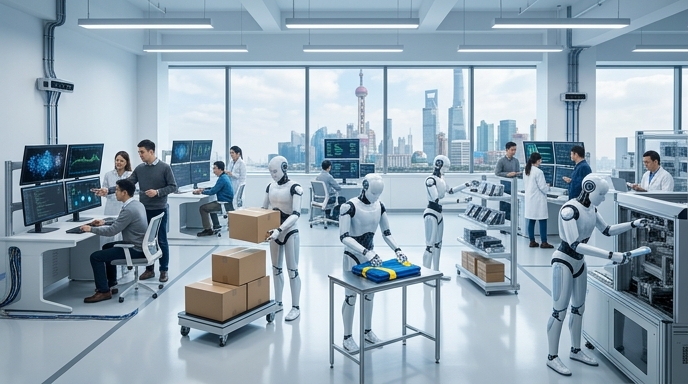
The Class of 2026 Has Bolts, Batteries, and Homework
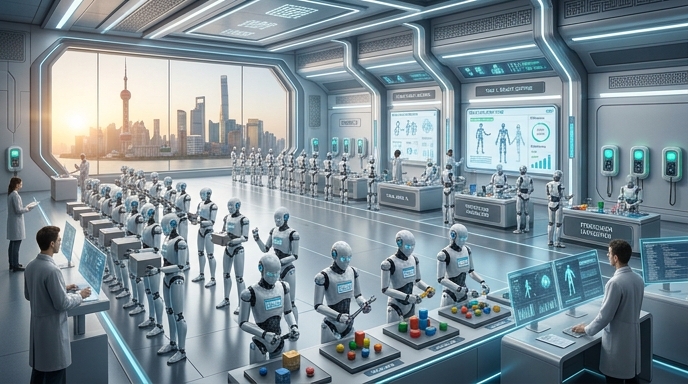
China is not just building humanoid robots anymore. It is training them.
That sounds like the opening line of a cyberpunk novel written after too much coffee, but it is now a real industrial project. In Shanghai’s Zhangjiang district, a new humanoid robot training center is expected to open fully in July 2026. The facility covers about 5,000 square meters and will host more than 100 robot models from more than a dozen companies, according to reporting from New Atlas and summaries of related Chinese media coverage.
This is not a school in the cute sense. No tiny desks, No lunch trays. No robot principal confiscating unauthorized charging cables.
It is a training ground for embodied AI: robots that must learn how to move, grasp, carry, place, sort, clean, and eventually work in places designed for humans. The big idea is simple. If humanoids are supposed to help in factories, hospitals, hotels, farms, shops, and homes, they need practice. Lots of it. Painfully repetitive practice.
The robots will train on basic physical skills first. Think grasping an object, moving it, placing it somewhere else, and transporting items. These sound easy because humans perform them without thinking. For robots, they are the mechanical equivalent of walking across a banana-peel factory in roller skates.
Why Robots Need Job Training
A humanoid robot can look impressive on stage and still be useless in a warehouse.
That is the uncomfortable truth behind this whole push. Viral robot videos often show dancing, waving, running, or performing tidy demonstrations in controlled spaces. Real work is nastier. Objects vary. Floors surprise you. Shelves sit at awkward heights. Humans walk in the way. Somebody leaves a cable where no cable should be. The robot still has to function.
China’s training centers aim to close that gap. The Shanghai center plans to teach humanoids “atomic skills,” or basic action units, such as picking, placing, grasping, and transporting. These small movements can later combine into longer tasks, like stocking shelves, tidying equipment, or moving materials across a workspace.
That matters because humanoids do not merely need stronger motors. They need better judgment. They must understand a human instruction, map that command onto a physical environment, and complete a sequence of actions without needing someone to babysit every joint movement.
CNBC’s reporting, summarized by Let’s Data Science, described government-backed robot learning centers, including a Beijing-based Humanoid Robot Data Training Center, where technicians expose robots to workplace scenarios. Kenneth Ren of RealMan Intelligent Technology described the work as teaching robots to “think on their own.”
That line sounds dramatic. It should also be read carefully. These robots are not becoming office philosophers. They are being trained to convert data into action.
The Secret Ingredient Is Data
The real product of these centers may not be the robots themselves. It may be the data.
The Shanghai center expects to collect roughly 50,000 data points per day, adding up to around 10 million pieces of training information per year, according to New Atlas. That data will come from many robot types, not just one company’s machine.
That matters. A single robot can teach engineers something about its own hardware. A mixed class of robots can teach engineers something broader: how different body designs perform, where they fail, which motions transfer well, and which training methods scale across manufacturers.
In plain English, China is trying to build a robot learning commons.
That is a big deal. Robotics has often suffered from fragmentation. One company builds a robot. Another builds a different robot. Each gathers its own data. Each learns slowly. The Shanghai project points toward a more shared model, where infrastructure, data collection, and training environments support a larger ecosystem.
Xu Bin, general manager of the center, told People’s Daily Online that the facility was created to enable large-scale data sharing and use across the industry, according to New Atlas.
That is the less flashy part of the story. It is also the most important. The future of humanoid robots may depend less on one heroic breakthrough and more on boring, relentless data collection. Glamorous? Not really. Powerful? Absolutely.
From Entertainment to Employment
China’s humanoid robots have already had their showbiz moment.
They have appeared in public demonstrations, promotional videos, exhibitions, and performances. That stuff helps attract investors, customers, engineers, and government attention. It also makes good social media bait. A robot doing a dance routine will always beat a spreadsheet in the attention economy. Sadly for spreadsheets. They try their best.
But the tone of the current reporting has shifted. CNBC framed China’s humanoid push as a move from entertainment toward employment, according to a summary of its video report. The key question is no longer whether robots can perform a polished trick. It is whether they can work.
That shift raises harder standards. Work requires uptime. Repeatability. Safety. Cost control. Integration with existing processes. A robot that succeeds nine times out of ten may look impressive in a demo. In a factory, that tenth failure can jam a line, damage goods, or annoy a supervisor into unplugging the expensive metal intern.
The new training centers appear designed for this harsher test. Robots will learn in workplace-like settings. Trainers will guide them. Engineers will measure them. Companies will compare performance. The machines will repeat tasks again and again until the data becomes useful.
That is not science fiction. That is vocational school with more torque.
Why China Is Moving So Fast
China has a structural advantage in robotics: it builds things at scale.
New Atlas describes China’s robotics sector as an ecosystem of startups, established companies, shared suppliers, manufacturing clusters, and innovation hubs. Competition remains fierce, but companies can often draw from the same pools of components, hardware expertise, factory capacity, and technical talent.
That creates speed. It also creates price pressure. If one company makes a component cheaper, others can adapt, If one training method works, others can copy or improve it. If a city backs a testing site, multiple companies can benefit.
This is where China’s model differs from a lone-company moonshot. The humanoid race is not just about building the coolest robot. It is about building the industrial plumbing around the robot: data centers, training facilities, supply chains, test sites, policy support, and customers willing to pilot early machines.
Let’s Data Science reports that China has multiple state-backed facilities training humanoids for real-world tasks. It also cites reporting about centers in Beijing, Shanghai, Wuhan, and other provincial programs focused on robot data collection and training.
This looks less like a gadget launch and more like an industrial campaign. China is not waiting for humanoids to become perfect. It is building the gym where they might become useful.
The Demographic Clock Is Ticking
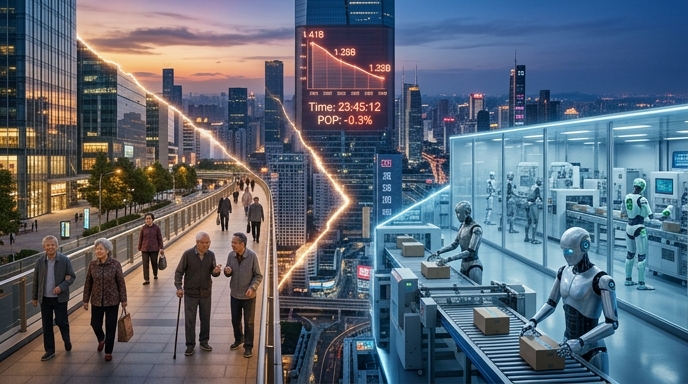
The robot-school story becomes much bigger when you zoom out.
China’s population is aging. Its workforce is shrinking. Barclays estimated that China’s labor force could fall by about 37 million people over the next decade, assuming labor-force participation stays around 65%, according to reports carried by The Star, eWeek, and The Next Web.
That is not a small HR problem. That is an economy-sized headache.
Manufacturing accounts for roughly a quarter of China’s economy, and a shrinking labor force could put pressure on the industrial machine that helped make China the world’s factory floor. Barclays argued that humanoid robots could offset as much as 60% of the projected labor-force decline by 2035 under optimistic assumptions.
The number that grabs attention is 24 million. Barclays said China’s cumulative installed stock of humanoid robots could approach that figure by 2035 in its optimistic scenario. That would equal almost 4% of the country’s labor force.
That does not mean 24 million robots are guaranteed. They are not. Barclays itself treated the estimate as optimistic and dependent on fast innovation, deployment, utilization, and domestic absorption. But it shows why Beijing cares. Robots are not just toys. They are a demographic hedge.
Twenty-Four Million Robots Is Not a Forecast to Swallow Whole
The 24 million figure deserves attention, not blind belief.
Barclays’ scenario depends on several big assumptions. Costs must keep falling. Robots must become more reliable. Companies must actually buy them. Factories must integrate them. Training centers must produce useful data. The robots must do enough productive work to justify their price, maintenance, supervision, and downtime.
That is a lot of “must.”
The Star’s Bloomberg-sourced report notes that Barclays called the 60% offset an upper-bound estimate based on relatively optimistic assumptions around utilization, depreciation, and domestic absorption.
Translation: this is not destiny. It is a possible path if the technology, economics, and policy all cooperate.
Humanoids also face a brutally practical problem. Human environments are messy. Traditional industrial robots thrive in controlled environments, where the same task repeats in the same place. Humanoids promise flexibility because they can operate in spaces designed for people. But that flexibility is exactly what makes them hard to perfect.
A robot arm bolted to a factory floor has one job. A humanoid walking through a workplace has many. It must balance, perceive, decide, manipulate, recover from mistakes, and avoid becoming a very expensive workplace incident report.
So yes, 24 million is possible in a broad optimistic scenario. But useful humanoids at that scale? That is the real mountain.
The Jobs Question Will Not Stay Polite
The obvious question is whether these robots will replace workers.
The honest answer: in some tasks, yes. That is the point. A humanoid robot deployed to offset a labor shortage is still a machine doing work a person might otherwise do. Nobody should pretend otherwise.
But the more interesting answer is messier. China is not facing the same labor-market equation as a young, fast-growing country. If the working-age population keeps shrinking, automation may substitute for workers who no longer exist in sufficient numbers. In that case, robots do not merely displace labor. They preserve output.
Barclays framed humanoids as a partial offset to demographic decline, not a magic wand. The bank said ordinary productivity gains may not fully counter China’s demographic headwinds, strengthening the case for automation and robotics.
Still, transitions hurt. Even when robots solve macroeconomic problems, they can create local pain. A factory manager may see efficiency. A worker may see a machine that never asks for a raise. A city may see new technical jobs. An older employee may see a labor market moving faster than retraining programs.
Robot trainers may become one new job category. Maintenance, supervision, safety testing, data annotation, integration, and workflow design may grow too. But those jobs will not automatically land in the same hands that lose older roles.
The robots may be humanoid. The politics will be very human.
What the Robots Will Learn First
The first wave of training focuses on the boring stuff. That is good.
Robots need to master basic tasks before they can handle anything fancy. New Atlas reports that Shanghai’s center will train robots in skills tied to domestic labor, industrial settings, and tourism. The tasks include folding clothes, moving objects, tidying shelves, and cleaning equipment.
Those tasks may sound modest. They are not.
Folding clothes is difficult for robots because fabric changes shape constantly. Shelves create depth, occlusion, and object variation. Cleaning equipment requires pressure, positioning, and judgment. Moving objects means recognizing weight, grip points, obstacles, and destination.
A human can look at a messy table and understand the assignment. A robot must convert light, depth, language, and sensor readings into action. Then it must move without knocking everything over like a caffeinated toddler.
This is why repetitive training matters. A scientist or trainer may guide a robot through the same core motion hundreds of times in one day, according to New Atlas.
That repetition builds datasets. The datasets improve models. The models improve future robots. That loop is the engine.
It is not magical. It is grind. The future, apparently, has homework.
The “Super Brain” Idea
One of the most striking concepts in the Shanghai project is the idea of pooling data from many different robots.
New Atlas reports that the training center expects to create a shared data-exchange model that lets robotics firms access learning data and improve their machines. It also describes plans to use pooled data to support a broader “super brain” model that can help robots from different manufacturers learn together.
This is where the strategy gets ambitious.
If each robot company trains alone, progress may stay uneven. One robot learns warehouse handling. Another learns room cleaning. Another learns basic hospitality tasks. But if a training center can gather cross-vendor performance data, engineers may identify general principles that apply across designs.
That could shorten development cycles. It could also create standards. Companies might begin to build robots that train more easily in shared environments. Software models might become more transferable. Buyers might compare robots against common benchmarks rather than marketing videos.
Of course, data sharing also raises competitive questions. Companies do not usually love handing their hard-won performance data to rivals. China’s state-backed ecosystem may make some coordination easier, but commercial incentives will still matter.
The “super brain” idea sounds splashy. The real test will be whether shared data produces robots that perform better outside the lab.
The Race Is Industrial, Not Just Technological
-The humanoid race is often described as an AI race. That is only half right.
It is also a manufacturing race, a supply-chain race, a battery race, a motor race, a sensor race, a materials race, and a deployment race. The robot’s “mind” matters, but so do its knees. Ask anyone with knees.
Barclays argued that humanoids are moving toward economic use because of advances in AI, motion control, and battery technology, according to eWeek. It also expects early deployments to focus on repetitive industrial tasks in warehouses, logistics centers, and factories before expanding into service industries and households in the 2030s.
That rollout path makes sense. Factories and warehouses can control the environment more than homes can. They can define tasks, measure output, and calculate payback. Homes are chaos museums. Every drawer is different, Every pet is a liability. Every child is an adversarial test suite with snacks.
China’s advantage may come from matching supply with use cases. If robot makers can work directly with factories, logistics firms, local governments, and training centers, they can iterate faster than companies waiting for perfect general-purpose intelligence.
The winners may not build the most charming humanoid. They may build the one that reliably moves boxes, cleans equipment, or restocks shelves at the lowest total cost.
What This Means for the Rest of the World
China’s robot schools should make other countries uncomfortable.
Not because humanoids are about to take over tomorrow. They are not. The technology still has major limits. Many systems still need human help, supervision, or teleoperation. CNBC’s coverage, as summarized by Let’s Data Science, noted that many current robots still rely on human assistance even as proponents expect autonomy to improve.
The uncomfortable part is the infrastructure.
China is building the training pipeline before humanoids are fully mature. That is strategically smart. When the technology improves, the country may already have facilities, datasets, companies, suppliers, testbeds, and policy channels ready to absorb it.
Other countries can build brilliant prototypes and still lose the deployment race. A prototype proves possibility. Infrastructure creates momentum.
The United States, Japan, South Korea, Germany, and others have deep robotics strengths. But the question is not who can make a robot wave convincingly at a trade show. The question is who can train, deploy, maintain, finance, and improve millions of machines in the real economy.
China appears to be betting that humanoids will become a general labor platform. Maybe that bet lands, Maybe it partially lands. Maybe some robots flop spectacularly and become expensive coat racks.
But the bet is coherent.
The Bottom Line
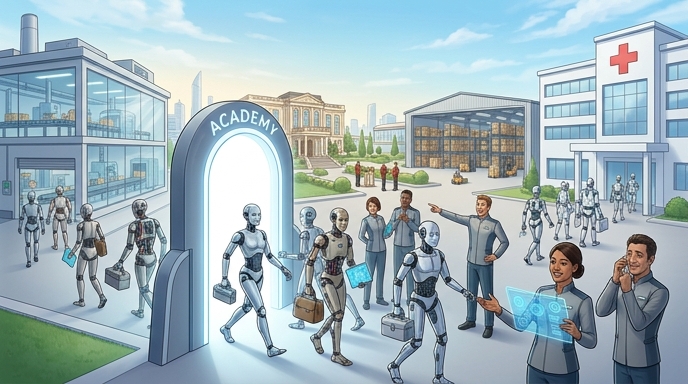
China’s humanoid training centers mark a shift from spectacle to systems.
The story is not simply “robots are going to school,” although, yes, that headline is irresistible. The deeper story is that China is building the institutions needed to turn humanoids from demos into workers: shared training sites, large-scale data collection, government-backed learning centers, industry coordination, and a demographic rationale strong enough to keep funding flowing.
The numbers remain uncertain. The 24 million humanoids by 2035 scenario is optimistic, not guaranteed. The 60% labor-force offset is an upper-bound estimate, not a prophecy. Robots still struggle with tasks humans perform casually. They need training, supervision, and better autonomy.
But the direction is clear.
China sees humanoid robots as part of its answer to aging, labor shortages, manufacturing pressure, and technological competition. The first “students” will learn to grip, lift, move, sort, fold, clean, and carry. They will fail, They will repeat. They will generate data. Then the next class will learn faster.
That is how industrial revolutions usually arrive. Not with one thunderclap. With drill, With factories, With spreadsheets. With workers teaching machines how to work.
The future may not walk in gracefully.
It may stumble into class first.
Sources
- New Atlas: “Humanoids are heading to school as China readies them for real life.” (New Atlas)
- CNBC reporting summarized by Let’s Data Science: “China trains humanoid robots for workforce integration.” (Let’s Data Science)
- Let’s Data Science: “China Opens Training Centers to Ready Humanoids.” (Let’s Data Science)
- NewsMinimalist supplied topic, with the 24-million-by-2035 claim corroborated by eWeek, The Next Web, and The Star/Bloomberg coverage. (eWeek)
The Kingy Brief
Get The Kingy Brief.
AI changes, original tests and one practical thing to try. Fridays at 09:00 Vancouver time.
Free · Double opt-in · Unsubscribe anytime
Signup help and newsletter schedule
Signup form provided by Beehiiv. After submitting, check your inbox for "Confirm your subscription to The Kingy Brief" and open its confirmation link. Check Spam or Promotions if you cannot find it.
Fridays at 09:00 Vancouver time: source-checked AI changes, original tests and one practical thing to try. The weekly restart begins October 9, 2026. We skip a week when there is not enough verified material. Free. Unsubscribe anytime.