
Alibaba’s AI Ambitions Just Got Much Bigger

China’s AI race just shifted gears. Again.
This time, the move came from Alibaba, which recently unveiled a new generation of artificial intelligence chips alongside upgraded large language models. The announcement sent a clear message to the global tech industry: Alibaba no longer wants to depend on Nvidia for the future of AI computing.
That is a massive statement.
For years, Nvidia has dominated the AI hardware market. Its GPUs became the default engines behind everything from ChatGPT to autonomous systems to enterprise AI infrastructure. Most companies trying to build advanced AI systems still rely heavily on Nvidia chips. Alibaba included.
But geopolitical pressure changed the equation.
U.S. export restrictions have made access to Nvidia’s most advanced AI chips increasingly difficult for Chinese technology firms. Instead of waiting for Washington to loosen controls, Alibaba appears to have decided to build its own path.
Enter the Zhenwu AI chip lineup.
The company revealed a new roadmap centered around its Zhenwu M890 AI accelerator, a chip Alibaba claims can rival top-tier global competitors in large-scale AI training and inference workloads. The move positions Alibaba not just as a cloud company or e-commerce giant, but as a vertically integrated AI infrastructure player.
That distinction matters more than people realize.
The future AI war will not be won only by the companies with the smartest models. It will also be won by the companies controlling the hardware stack underneath them. Nvidia understood that early. So did Google with TPUs. So did Amazon with Trainium and Inferentia.
Now Alibaba wants in.
And frankly, it may not have a choice.
The Zhenwu M890 Is More Than Just Another AI Chip
Most chip launches sound identical. Bigger numbers. Faster performance. More efficiency. Endless jargon.
Alibaba tried to frame the Zhenwu M890 differently.
According to reports, the chip was designed specifically for massive AI workloads tied to foundation models and AI agents. That means the company is optimizing hardware not just for chatbots, but for autonomous systems capable of handling complex tasks with minimal human input.
That is where the industry is heading.
AI companies increasingly believe the next evolution of generative AI involves “agentic AI.” These systems do not simply answer questions. They plan tasks, execute workflows, interact with software, and make decisions across multiple steps.
Those systems require brutal amounts of compute power.
Alibaba says the M890 improves efficiency while delivering higher performance for training and inference tasks. Reports indicate the chip also integrates tightly with Alibaba Cloud infrastructure and its broader AI ecosystem.
That integration is strategic.
Owning both the cloud platform and the underlying silicon creates enormous advantages. It reduces dependency on external suppliers, cuts costs over time. It allows tighter optimization between hardware and software.
Apple mastered that formula years ago with its M-series chips.
Alibaba now wants to apply a similar playbook to AI.
And the timing is not accidental.
The AI infrastructure market has become one of the most important battlegrounds in global technology. Every major company wants to reduce reliance on third-party hardware vendors. Even Microsoft, OpenAI’s closest partner, has reportedly explored developing custom AI accelerators.
The logic is simple. If AI becomes the backbone of the digital economy, then whoever controls the chips controls the future.
China’s Tech Industry Faces a Brutal Reality
Behind Alibaba’s flashy launch sits a much harsher truth.
China’s AI sector has been squeezed by export controls for years. Advanced Nvidia chips like the A100 and H100 became difficult or impossible for Chinese firms to access under tightening U.S. regulations.
That forced Chinese companies into a corner.
They could either slow down their AI ambitions or aggressively invest in domestic alternatives. Alibaba chose the second option.
So did Huawei.
And Baidu.
And so did Tencent.
The result has been a sudden acceleration in China’s domestic semiconductor ecosystem. Companies that once depended heavily on Western hardware now treat chip independence almost like a national survival strategy.
That creates both opportunity and risk.
The opportunity is obvious. China has an enormous domestic market, huge cloud infrastructure demand, and deep government support for semiconductor development.
The risk is equally obvious.
Building cutting-edge AI chips is incredibly difficult.
Nvidia did not become dominant overnight. Its leadership came from decades of engineering, software ecosystem development, CUDA optimization, and relentless iteration. Hardware alone is not enough. Developers need mature software tools, stable ecosystems, and scalable infrastructure.
That is where many challengers struggle.
Alibaba appears aware of this problem. Its strategy increasingly focuses on full-stack AI integration rather than isolated chip production. The company is pairing its Zhenwu hardware efforts with its Qwen large language models and Alibaba Cloud services.
In other words, Alibaba does not just want to sell chips.
It wants to build an entire AI operating environment.
The Bigger Goal: AI Independence

The phrase “AI independence” keeps appearing around Alibaba’s recent announcements. That wording matters.
This is not merely about releasing another processor.
It is about reducing strategic vulnerability.
For years, Chinese tech giants benefited enormously from access to American semiconductor technology. That access helped fuel explosive growth across cloud computing, e-commerce, AI, and consumer technology.
Now the environment looks very different.
Washington increasingly sees advanced AI hardware as a national security issue. That means Chinese firms cannot safely assume continued access to leading-edge U.S. chips.
Alibaba’s answer is vertical integration.
The company is building custom hardware, advancing proprietary language models, expanding AI agents, and scaling cloud infrastructure simultaneously. The goal is clear: control as much of the AI stack as possible.
There is also a financial angle here.
Nvidia’s GPUs are staggeringly expensive. Demand remains so high that supply shortages continue to affect global markets. Companies spending billions on AI infrastructure naturally want alternatives.
If Alibaba succeeds in creating competitive AI chips internally, it could dramatically reduce long-term infrastructure costs across its cloud business.
That would strengthen margins while giving Alibaba Cloud a stronger competitive position against rivals.
The company’s stock even reacted positively following the announcements, with investors viewing the chip launch as evidence Alibaba intends to become a more serious AI infrastructure player.
Markets love narratives about independence.
Especially in AI.
Alibaba’s AI Models Are Evolving Alongside the Hardware
The chip announcement did not happen in isolation.
Alibaba also revealed upgrades to its large language models, continuing its push into generative AI. The company has been investing heavily in its Qwen model family, which competes with systems from OpenAI, Anthropic, Google, and DeepSeek.
That competition is fierce.
Every major AI lab now faces the same brutal challenge: better models require exponentially more computing power. Training frontier-scale systems consumes extraordinary amounts of energy, hardware, and capital.
That reality explains why custom chips matter so much.
If Alibaba can optimize hardware specifically for its own models, it gains leverage competitors may lack. Hardware-software co-design allows faster iteration, tighter efficiency, and potentially lower operating costs.
Google already proved this approach works.
Its TPUs helped power Gemini and other AI services internally for years. Amazon followed with Trainium. Microsoft reportedly continues developing Maia AI accelerators.
Alibaba’s strategy mirrors that trend almost exactly.
But there is another dimension here.
China’s domestic AI market remains enormous despite export restrictions. Chinese enterprises still need AI tools. Developers still need inference capacity. Consumers still want generative AI applications.
Alibaba can supply all three.
That creates a self-reinforcing ecosystem where chips power models, models drive cloud demand, and cloud adoption funds further hardware development.
It is an ambitious loop.
And it could work.
Nvidia Still Holds the Strongest Hand
Despite the excitement surrounding Alibaba’s announcement, reality needs some balance.
Nvidia still dominates this market.
By a lot.
The company maintains overwhelming advantages in software maturity, developer adoption, ecosystem depth, manufacturing partnerships, and performance leadership. CUDA remains deeply entrenched across AI development workflows worldwide.
That moat is enormous.
Even if Alibaba produces highly capable chips, matching Nvidia’s ecosystem strength is another challenge entirely. Developers care about compatibility, tooling, documentation, optimization libraries, and deployment stability as much as raw performance.
This is where many AI chip challengers hit a wall.
Excellent hardware does not automatically create a thriving ecosystem.
Still, Nvidia’s dominance is not invincible.
The AI boom has become so large that multiple winners can coexist. Cloud providers increasingly want alternatives to reduce costs and diversify supply chains. Governments also prefer domestic semiconductor capacity for strategic reasons.
That opens the door for regional AI ecosystems.
Alibaba may never fully replace Nvidia globally. But it may not need to.
If the company builds a strong AI hardware ecosystem inside China while serving regional enterprise demand, that alone could create a massive business.
And in technology, scale creates momentum.
Momentum attracts developers.
Developers attract infrastructure investment.
Infrastructure investment attracts customers.
That cycle can become powerful very quickly.
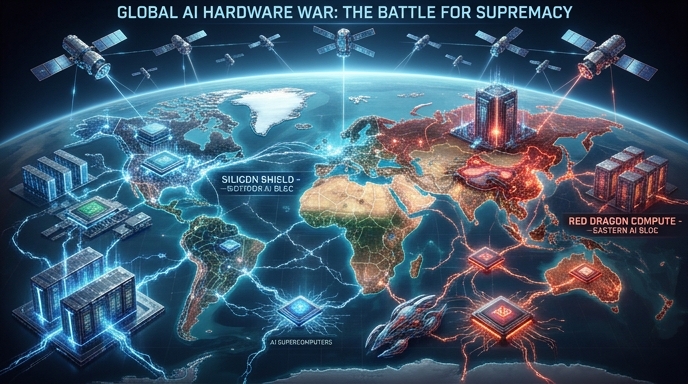
The AI Hardware War Is Just Beginning
For years, people treated AI primarily as a software story.
That phase is over.
The real battle increasingly revolves around infrastructure. Chips. Data centers. Power consumption. Networking. Supply chains. Semiconductor sovereignty.
That is the actual foundation beneath the AI revolution.
Alibaba’s latest announcements reveal how seriously major companies now view this fight. AI leadership no longer means simply building the smartest chatbot. It means controlling the pipelines feeding the models underneath.
The industry is fragmenting into competing AI ecosystems.
The United States has Nvidia, OpenAI, Microsoft, Google, Amazon, and AMD.
China has Alibaba, Huawei, Baidu, Tencent, and DeepSeek.
Europe continues trying to establish relevance.
Meanwhile, governments increasingly treat AI hardware like strategic military infrastructure rather than ordinary commercial technology.
That changes everything.
Alibaba’s Zhenwu roadmap is part business strategy, part geopolitical adaptation, and part survival mechanism. The company understands the next decade of AI may depend less on access to American technology and more on domestic resilience.
Whether Alibaba can truly rival Nvidia remains uncertain.
But that may not even be the right question anymore.
The more important question is whether the world is entering an era where AI ecosystems split into parallel technological spheres — each with its own chips, models, cloud infrastructure, and standards.
Right now, that outcome looks increasingly plausible.
And Alibaba clearly intends to become one of the pillars supporting China’s version of that future.
Sources
- Artificial Intelligence News — Alibaba’s Zhenwu M890 AI agent chip roadmap
- AI Business — Alibaba aims for independence with new AI chips and models
- 4sysops — Coverage of Alibaba AI chip developments
- CNBC — Alibaba reveals more powerful Zhenwu AI chip and new LLM
- TipRanks — Alibaba stock rises on new AI chip launch to rival Nvidia
Alibaba Models
Alibaba AGI Strategy
AI Chip Competition
China AI Strategy
The Kingy Brief
Get future Kingy Brief editions.
Source-checked AI changes, original tests and one practical thing to try.
Free · Choose your subjects · Double opt-in · Unsubscribe anytime
Regular sending is paused; no restart date is set.