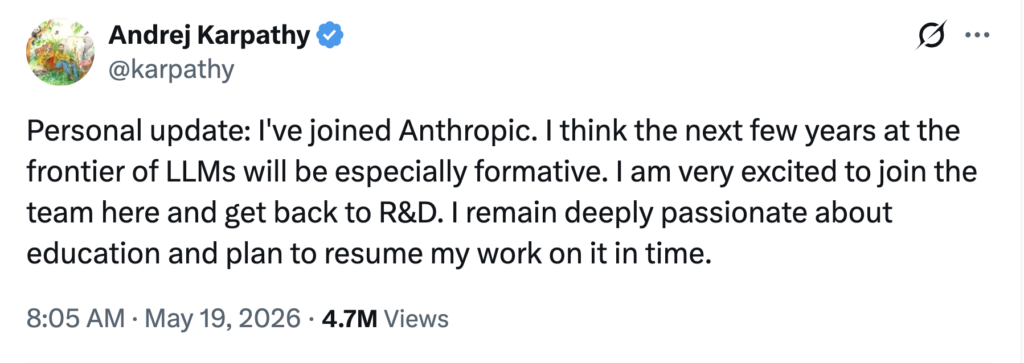
On Tuesday, May 19, 2026, Andrej Karpathy posted on X that he had joined Anthropic. The note was short, in his usual tone: he’s excited to be back in R&D, he thinks the next few years at the frontier of large language models will be “especially formative,” and he plans to return to his education work “in time.”
That last line matters. So does the rest. But before getting to the implications, it’s worth pinning down what is actually known — not rumored, not extrapolated — and then thinking through what it changes.
The confirmed facts
Karpathy will work on Anthropic’s pretraining team, the group responsible for the large, compute-heavy training runs that give Claude its base capabilities. He is reporting into Nicholas Joseph, Anthropic’s Head of Pretraining and an early Anthropic employee (and, like Karpathy, a former OpenAI researcher).
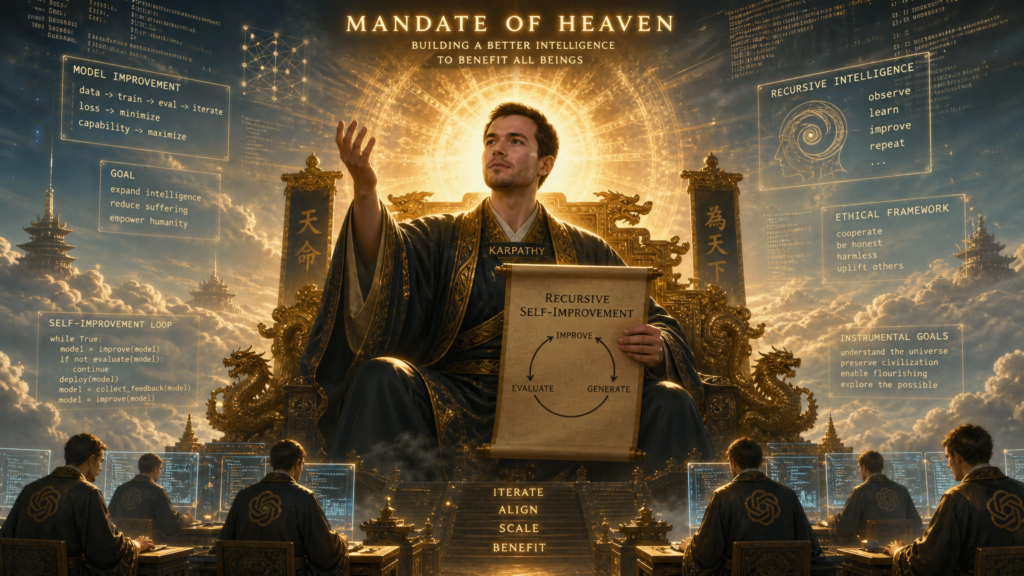
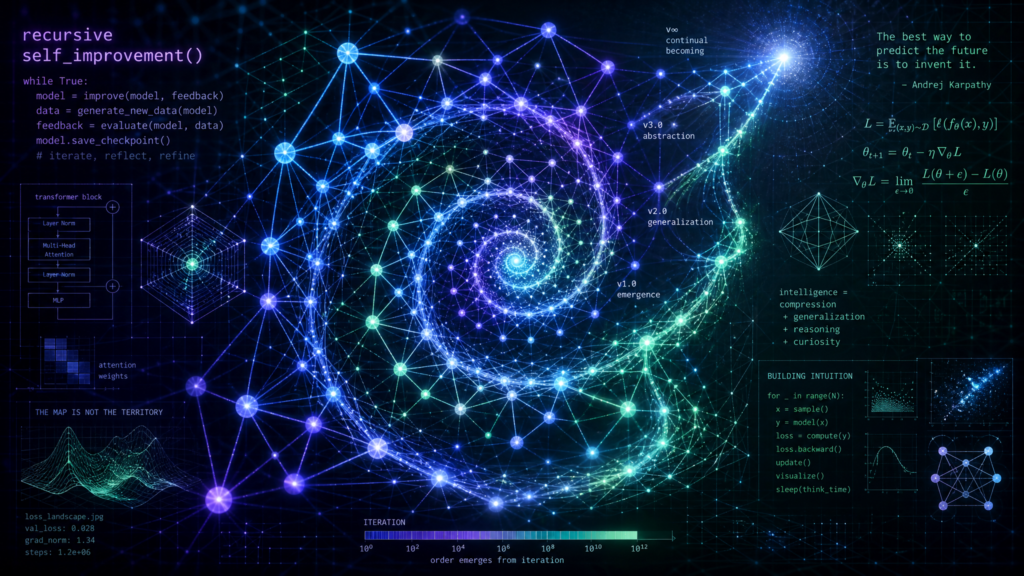
Joseph confirmed the move himself on X, writing that Karpathy will be “building a team focused on using Claude to accelerate pretraining research itself.” Anthropic separately confirmed to multiple outlets — including TechCrunch, VentureBeat, and Axios — that Karpathy will start a new sub-team specifically aimed at applying Claude to the work of building Claude’s successors. Similarly, in a tweet written by Andrew Curran, Karpathy will be forming a new pre-training team focused on Recursive Self Improvement and will be teaching Claude to improve Claude’s training, reporting from Axios.
So this is not a generic “famous researcher joins lab” hire. It is a specific bet on a specific idea: that frontier model progress in 2026 and beyond will come not just from more GPUs and more tokens, but from using current models to do meaningful chunks of the research that produces the next models.
The pedigree, briefly
Karpathy’s résumé has been covered to death, but the relevant parts for this move are narrower than the full biography.
He was one of the founding members of OpenAI in late 2015, working on deep learning and computer vision. He left in 2017 to lead the Autopilot and Full Self-Driving computer vision team at Tesla, where he stayed until 2022. He returned to OpenAI in 2023 and, by his own description on his personal site, built a team there focused on midtraining and synthetic data generation — work that sits very close to what Anthropic is now hiring him to do. He left again in early 2024 to start Eureka Labs, an AI-native education company, and to pour energy into public teaching: the Neural Networks: Zero to Hero series, the LLM lectures on YouTube, and a steady stream of long, often-quoted posts on X.
Two things are worth pulling out of that history.
First, he is one of very few researchers who has worked at scale on both ends of the model pipeline: the messy data and infrastructure side at Tesla, and the model-internals side at OpenAI. Pretraining at a frontier lab is exactly where those two skill sets meet.
Second, the synthetic-data and midtraining work he did at OpenAI in 2023–2024 is directly relevant. Using a current model to generate, filter, or curate training signal for the next model is the most obvious version of “use Claude to accelerate pretraining research.” He has done a version of this before.
What Anthropic is actually buying
A useful way to read this hire is to ignore the celebrity layer and ask: what capability gap does it fill?
Anthropic already has deep pretraining talent. Nick Joseph has been there since the early days. Bringing in Karpathy isn’t about plugging a hole in the org chart. It is about staffing a specific bet — recursive, AI-assisted research — with someone who has the credibility to attract more researchers to it, the experience to actually run it, and the public voice to shape how the work is understood inside and outside the company.
TechCrunch’s framing is reasonable: this is “a clear sign from Anthropic that it believes AI-assisted research, rather than pure compute, is how it stays competitive with OpenAI and Google.” That is consistent with public commentary from Anthropic’s leadership over the past year about automating parts of the research loop, and it’s consistent with what every frontier lab is, in some form, attempting.
The interesting question is whether Anthropic gets there first, or gets there cleanly. Using a model to help train its successor sounds elegant in a blog post and is hard in practice. It involves data generation, evaluation, ranking, distillation, and a long list of decisions about what feedback signals are actually informative versus merely cheap. Someone with Karpathy’s background — who has shipped at Tesla and OpenAI, written the educational explainers, and built nanoGPT and similar small artifacts — is a credible person to lead that.
Why this is awkward for OpenAI
Karpathy’s departure from OpenAI was not acrimonious — he publicly defended Sam Altman during the November 2023 board episode and left amicably in early 2024 — but the optics of him reappearing inside Anthropic’s pretraining group are not flattering for OpenAI.
A few reasons:
- He’s a founding member. Symbolically, an original OpenAI researcher choosing Anthropic over an OpenAI return is a story that writes itself, and one OpenAI’s communications team can’t really counter.
- He picked the team, not just the company. Joining pretraining under Joseph — another ex-OpenAI researcher — reinforces a narrative that has been building for two years: that a meaningful portion of OpenAI’s original technical culture has migrated to Anthropic.
- The mandate overlaps with OpenAI’s own roadmap. OpenAI is also working on AI-accelerated research; this is not a niche idea. But Anthropic now has a marquee name attached to that work, and OpenAI does not have an equivalent public figure leading the equivalent effort.
None of that changes OpenAI’s actual capabilities. OpenAI still has enormous research depth, a huge product surface, and the most-used consumer AI product in the world. But in a year where the AI talent market has been extraordinarily public — see also the well-covered moves between Google DeepMind, Meta’s superintelligence group, and Anthropic — losing this particular person to this particular rival, on a research mandate this specific, is a story OpenAI will have to live with for a while.
Why this matters for Anthropic specifically
Anthropic’s posture for the last few years has been: smaller, more technically credible, more safety-forward than its main rival, and willing to bet on a narrower set of products (Claude, Claude Code, the API, MCP) rather than chase every consumer surface. That posture has held up surprisingly well. Claude is now genuinely competitive at the frontier, and Claude Code has become a meaningful presence in the developer market.
A hire like this fits that posture rather than departs from it. Karpathy is not joining to run a consumer product. He is joining to do research. The specific charter — use the current model to make the next model better, faster, or cheaper to train — is also the kind of bet that, if it works, compounds. The lab that figures out how to make AI research itself meaningfully AI-assisted pulls ahead of the labs that don’t, and the gap widens with each model generation.
It’s worth being honest about the failure mode too. “Use the model to train the model” has a long, mixed history. Synthetic data can collapse. Self-generated feedback can be subtly wrong in ways that show up only at scale. Recursive setups are easy to describe and hard to instrument. Whether Karpathy’s new team produces something useful in six months, eighteen months, or three years is a real open question, and nobody should pretend otherwise.
The education question
The most personally interesting line in Karpathy’s announcement was the last one: “I remain deeply passionate about education and plan to resume my work on it in time.”
Translation, with appropriate hedging: Eureka Labs and the Zero to Hero video work are paused, not killed. He has not said this in those exact words, and Eureka has been quiet for months, but the VentureBeat coverage reads the same signal: the education work is on hold for now.
That is a real loss for the broader AI learning community in the short term. Karpathy’s public lectures are among the most useful free resources for understanding how LLMs actually work, and Eureka Labs’ stated ambition — an AI-native school with courses like LLM101n that walk students through building their own model — is the kind of thing the field needs and rarely gets. If “in time” means a year or two, fine. If it means indefinitely, that’s a different conversation.
What this says about the talent market
The cleanest, least-hyped read of the past 18 months in AI hiring is that a small number of researchers move the needle, and labs are willing to do extraordinary things to acquire or retain them. Meta’s well-publicized recruiting push, Google DeepMind’s reorganization, and Anthropic’s quieter but steady accumulation of senior ex-OpenAI talent are all part of the same story.
What’s different about the Karpathy move is that it is not really a “compensation arms race” story. He left Tesla. He left OpenAI twice. He started his own company. He doesn’t appear, from anything public, to be someone who optimizes primarily for package. The more honest reading is that he wanted to be back inside a frontier lab during a specific window — his words, “the next few years at the frontier of LLMs will be especially formative” — and he picked Anthropic over a return to OpenAI.
You can read that as a vote of confidence in Anthropic’s technical trajectory. You can also read it as Karpathy preferring a smaller team, a tighter research mandate, and a culture he finds easier to work in. Both are probably true. Neither requires hype to be interesting.
What to watch
A few concrete things to track over the next year, in rough order of usefulness:
- Whether the new team publishes anything. Anthropic publishes more than it used to but less than the academic ideal. A paper or technical post from Karpathy’s group on AI-assisted pretraining would be a strong signal that the work is real and that Anthropic wants to set the agenda publicly.
- What happens to the next Claude model’s training reports. Anthropic releases system cards. Watch for language about synthetic data, model-generated training signal, or research workflow automation.
- Whether other senior researchers follow. Hires often come in clusters. The same week as Karpathy’s announcement, Anthropic also brought on cybersecurity veteran Chris Rohlf to its frontier red team. That is unrelated work, but it fits a pattern of senior, named hires.
- Eureka Labs. If the company is wound down or absorbed, that’s one signal. If it continues quietly with other staff, that’s a different one.
- OpenAI’s response. Not a counter-hire necessarily, but watch for how OpenAI publicly frames its own AI-accelerated research efforts in the next few months. The competitive dynamic almost guarantees a response of some kind.
The honest summary
Andrej Karpathy joining Anthropic to lead a team that uses Claude to accelerate Claude’s own pretraining research is, in the most literal sense, exactly the kind of hire that fits the moment. He has the relevant prior experience. The mandate is specific. The team lead — Nicholas Joseph — has the credibility to make the structure work. Anthropic gets a senior researcher and a named anchor for a high-stakes bet. OpenAI loses, again, a person they once founded a company with.
What it does not mean, despite the volume of commentary it’s already generated, is that the AI race is settled, that recursive self-improvement is around the corner, or that Anthropic has decisively pulled ahead. None of those claims are supported by the announcement itself, and most of them are projections that say more about the speaker than the situation.
What’s true is narrower and more interesting: one of the most thoughtful researchers in the field decided that the most useful thing he could do with the next few years was go inside a frontier lab and work on making the lab itself faster at building models. That bet, if it pays off, matters. If it doesn’t, we’ll learn something useful from the attempt.
Either way, it’s the most honest signal in a while about where serious people think the leverage actually is.
Related Guides
Compare
Latest News
The Kingy Brief
Get The Kingy Brief.
AI changes, original tests and one practical thing to try. Fridays at 09:00 Vancouver time.
Free · Double opt-in · Unsubscribe anytime
Signup help and newsletter schedule
Signup form provided by Beehiiv. After submitting, check your inbox for "Confirm your subscription to The Kingy Brief" and open its confirmation link. Check Spam or Promotions if you cannot find it.
Fridays at 09:00 Vancouver time: source-checked AI changes, original tests and one practical thing to try. The weekly restart begins October 9, 2026. We skip a week when there is not enough verified material. Free. Unsubscribe anytime.