Why Xbox quietly stepping away from Copilot AI says a lot about where the entire tech industry is heading
For years, the tech industry sold artificial intelligence like it was a magic potion. Sprinkle AI onto anything — phones, search engines, refrigerators, toothbrushes, game consoles — and suddenly investors would cheer, executives would smile on earnings calls, and every company could pretend it had discovered the future.
Now reality is crashing into the marketing deck.
Microsoft’s recent decision to move away from its ambitious Copilot AI plans for Xbox marks one of the clearest signs yet that the AI gold rush is entering a rougher, more skeptical phase. Not because AI is useless. Far from it. But because companies are discovering something painfully obvious: consumers do not automatically want AI injected into every product they use.
And gamers especially do not.
The story unfolded across several reports from outlets including The Verge, Aftermath, PC Gamer, and MobileSyrup. Together, they paint a picture that feels less like a strategic pivot and more like a corporate reality check.
Xbox is not abandoning AI entirely. Microsoft would sooner unplug Windows than stop talking about AI. But the company is clearly dialing back one of its more visible attempts to merge generative AI with gaming culture.
That matters. A lot.
Because Xbox was supposed to be one of Microsoft’s biggest AI showcases outside Office and Windows. Instead, it became a warning sign.
And the warning is simple: gamers do not want a chatbot sitting between them and their games.
The Dream Microsoft Tried to Sell
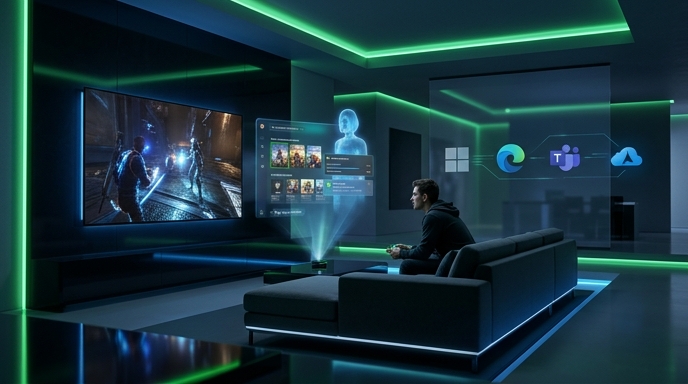
Microsoft originally pitched Copilot for Xbox as a smart gaming assistant. The concept sounded straightforward enough on paper.
Players could supposedly ask questions naturally. The AI would recommend games, help install titles, summarize achievements, offer gameplay tips, and guide users through menus. Executives framed it like a personal gaming companion. A sort of Cortana reboot wearing an Xbox hoodie.
The initiative gained major visibility under Xbox executive Asha Sharma, who became one of the public faces of Microsoft’s AI gaming ambitions.
The pitch aligned perfectly with Microsoft’s broader strategy. The company wanted Copilot everywhere. In Windows, In Teams, In Edge, In Office, In Azure, In security tool, In search. In coding In enterprise software.
And naturally, in gaming.
The problem? Gaming culture does not work like enterprise software culture.
People tolerate AI assistants in spreadsheets because spreadsheets are boring. Nobody forms emotional attachments to Excel formulas. If AI can automate corporate drudgery, users often welcome it.
Games are different.
Gaming is emotional. Personal. Tribal. Players value immersion, mastery, discovery, and control. Many gamers already distrust corporate meddling in games, especially when it arrives wrapped in buzzwords.
So when Microsoft started talking about AI copilots helping players play games, many gamers heard something very different:
“We are about to automate parts of your hobby.”
That landed badly.
Gamers Did Not Ask for This
One striking detail across the reporting is how little organic enthusiasm existed for Xbox Copilot outside Microsoft’s own presentations.
That should have been the first red flag.
When genuinely exciting gaming innovations appear, players erupt immediately. Think cross-play. Steam Deck. Backward compatibility. Mods. Cloud saves. Game Pass in its early days. Those ideas generated instant grassroots energy.
Copilot did not.
Instead, reactions ranged from confusion to annoyance to outright hostility.
Many gamers questioned why they would need AI assistance navigating a console interface that already takes seconds to use. Others mocked the idea of AI-generated gameplay advice, especially when YouTube, Reddit, Discord, wikis, and Twitch already provide infinitely richer gaming communities.
And then there was the deeper fear lurking underneath all of it.
Players worried Microsoft was not stopping at “helpful assistant” features.
They worried AI would eventually shape game development itself.
That concern matters because gamers have watched publishers aggressively chase monetization trends for years. Loot boxes. Battle passes. Live-service mechanics. Microtransactions. Seasonal engagement systems. Algorithmic retention design. The audience already feels manipulated.
AI looked like the next escalation.
Not a tool for players. A tool for corporations.
The Industry’s AI Fatigue Is Becoming Impossible to Ignore
Microsoft is not alone here. The broader tech industry has spent the last two years force-feeding AI into nearly every consumer product imaginable.
The result has been exhaustion.
Consumers increasingly recognize a pattern. Companies announce AI integrations with enormous fanfare. Executives promise revolutionary transformation. Then ordinary users struggle to find practical reasons to care.
Much of modern AI suffers from what economists call a solution looking for a problem.
Some AI tools are genuinely useful. Coding assistants have proven valuable. Language translation improved dramatically. Image generation changed creative workflows. Certain research tools save time.
But many AI integrations feel decorative.
Do you need AI in your notepad app, Your photo gallery, Your grocery list, Your headphones Your browser sidebar, Your smart TV remote?
Probably not.
Gaming exposed this weakness particularly fast because gamers are unusually vocal consumers. They spend enormous amounts of time online. They analyze industry decisions obsessively. And they possess highly sensitive corporate nonsense detectors.
So when Xbox pitched AI copilots, many players immediately saw through the branding.
The industry kept saying “enhanced experience.”
Gamers heard “engagement optimization.”
That gap destroyed trust.
Asha Sharma’s Exit Changed the Equation
The Verge and other reports tied the shift partly to organizational changes surrounding Xbox leadership and Asha Sharma’s departure from the role tied to the Copilot initiative.
Leadership changes often reveal internal realities that press releases hide.
When a major executive champion leaves, projects lose political protection. Internal skepticism becomes louder. Budgets get reevaluated. Priorities shift. Suddenly “transformative innovation” becomes “resource allocation optimization,” which is executive language for “this is not working.”
That appears to be exactly what happened here.
According to reporting, Microsoft is now focusing on stabilizing Xbox’s broader business strategy rather than aggressively pushing Copilot integrations into the gaming ecosystem.
That makes strategic sense.
Xbox faces serious challenges right now.
Game Pass growth has slowed compared to earlier expectations. Hardware sales remain weaker than PlayStation in several markets. Major exclusives have struggled with consistency. Microsoft’s acquisition spree created enormous pressure to deliver results. Meanwhile, gaming development costs continue exploding across the industry.
Under those conditions, experimental AI features become harder to justify.
Especially when players are not asking for them.
The Timing Could Not Be Worse for AI Evangelists
There is another reason Microsoft’s Xbox AI retreat matters: the timing.
The AI industry currently sits at an awkward stage between hype and proof.
Investors poured astronomical money into generative AI expecting rapid monetization. But turning AI excitement into sustainable consumer demand has proven harder than expected.
Many companies now face a brutal question:
What happens if users simply do not care enough?
That sounds simplistic. But it is existential.
Tech history is full of products that impressed demos yet failed to become habits. Google Glass. The metaverse push. 3D televisions. NFTs in gaming. Motion controls outside Nintendo’s ecosystem. Consumers do not adopt technology merely because executives insist it represents the future.
They adopt technology when it improves their lives meaningfully.
Xbox Copilot never convincingly crossed that threshold.
Most players did not see utility. They saw friction.
And once consumers start perceiving AI as intrusive rather than empowering, companies face a dangerous backlash cycle.
That cycle has already started.
AI in Gaming Was Always a Strange Fit
Ironically, AI absolutely has legitimate uses in gaming.
Just not necessarily the ones executives keep advertising.
Developers already use machine learning tools for animation, testing, localization, anti-cheat systems, NPC behavior, procedural generation, and optimization workflows. Those applications largely operate behind the scenes.
Players often benefit without even noticing.
That is probably where AI works best in gaming: invisible infrastructure.
The trouble begins when companies try turning AI into the product itself.
Because games already contain something AI struggles to replicate authentically: human creativity and unpredictability.
Players do not love games because they are efficient. They love games because they are surprising. Weird. Emotional. Social. Messy.
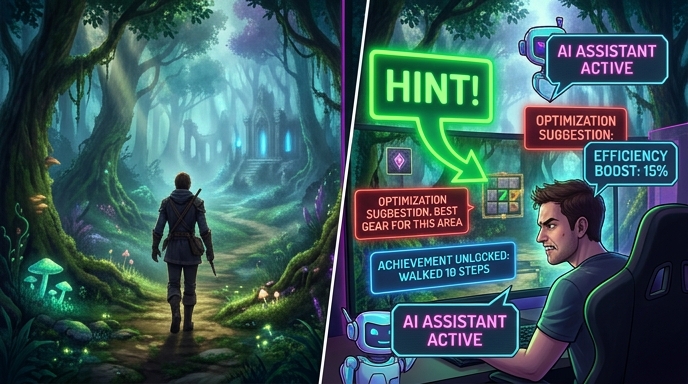
An AI assistant interrupting that experience can feel less like enhancement and more like interference.
Imagine discovering a hidden game mechanic naturally versus having an AI whisper the answer instantly. One creates wonder. The other creates optimization.
Gaming culture historically values the former.
That tension explains why so many players recoiled instinctively from Xbox Copilot.
Microsoft’s Bigger Problem Is Trust
The deeper issue facing Microsoft is not technological capability. Microsoft has enormous AI resources. OpenAI partnerships. Azure infrastructure. Enterprise dominance. Massive compute power.
The company can absolutely build advanced gaming AI tools.
The question is whether players trust Microsoft’s intentions.
Right now, many do not.
Gamers increasingly suspect large publishers prioritize data extraction, monetization metrics, and retention engineering over artistic experiences. AI intensifies those fears because the technology thrives on personalization, behavioral analysis, and predictive systems.
Players worry AI companions could become recommendation engines designed primarily to maximize spending or engagement.
And honestly? That fear is not irrational.
Modern gaming already contains countless psychological optimization systems. Daily rewards. Time-limited events. Battle pass progression. Engagement loops. Dynamic storefronts.
AI could supercharge all of them.
That possibility changes how players interpret every “helpful” AI feature announcement.
The skepticism is earned.
The Quiet Death of Tech Hype Cycles
One fascinating aspect of this story is how familiar it feels.
Tech companies repeatedly fall into the same pattern:
- Discover emerging technology
- Declare it revolutionary
- Rush integrations everywhere
- Ignore consumer skepticism
- Quietly scale back later
We watched this happen with blockchain gaming. Remember when publishers insisted NFTs would transform player ownership? That collapsed almost immediately once gamers reacted with open hostility.
The metaverse hype suffered similar problems. Executives talked endlessly about virtual futures while ordinary consumers mostly shrugged.
Now AI faces its own reality-testing phase.
That does not mean AI disappears. Far from it. The technology has real utility. But the era of indiscriminate AI evangelism may already be ending.
Consumers are becoming selective.
And selective consumers are dangerous for companies that built strategies around universal adoption assumptions.
Xbox Copilot appears to be one of the first visible casualties of that transition.
It will not be the last.
Microsoft Still Wants AI Everywhere
Despite the retreat, nobody should mistake this for Microsoft abandoning AI ambitions.
That is not happening.
PC Gamer noted the company simultaneously continues welcoming AI-focused leadership and investing heavily across its broader ecosystem. Microsoft remains deeply committed to AI as a long-term business pillar.
But the Xbox shift suggests the company may finally recognize an uncomfortable truth:
Different audiences tolerate AI differently.
Corporate users often prioritize productivity. Gamers prioritize experience. Those incentives do not align cleanly.
Microsoft can successfully integrate Copilot into Office because professionals already use software instrumentally. If AI saves time, users often accept tradeoffs.
Gaming audiences behave differently. Entertainment products depend heavily on emotion, identity, immersion, and trust. Intrusive AI risks damaging all four.
That creates a difficult balancing act for Xbox moving forward.
The company still wants technological innovation. But it now appears more cautious about forcing AI directly into player-facing experiences.
Frankly, that caution is overdue.
The Industry Is Learning an Old Lesson Again
Underneath all the AI jargon lies an ancient business principle:
Consumers decide what technology matters.
- Not executives.
- Not investors.
- Not keynote presentations.
Real adoption happens bottom-up, not top-down.
Xbox Copilot struggled because Microsoft approached AI largely from a capability perspective rather than a demand perspective. The company focused on what AI could theoretically do instead of asking whether players actually wanted it.
Those are radically different questions.
The tech industry often confuses possibility with necessity.
Yes, AI can generate gameplay advice instantly.
But many players enjoy figuring things out themselves.
Yes, AI can recommend games conversationally.
But gamers already rely heavily on friends, streamers, communities, reviews, and algorithms that require far less complexity.
Yes, AI can automate interactions.
But automation is not automatically enjoyable.
That distinction matters enormously.
Especially in entertainment.
What Happens Next for Xbox?
Xbox now faces an awkward repositioning challenge.
The company spent months promoting AI-forward messaging. Pulling back without openly admitting failure requires delicate corporate choreography. So expect softer language moving forward.
Words like “refocusing.”
“Streamlining.”
“Prioritizing player value.”
“Aligning with core experiences.”
Corporate communication always becomes poetic when projects quietly die.
Still, Microsoft’s retreat could ultimately benefit Xbox if it redirects attention toward areas players consistently care about:
Better exclusives.
More polished launches.
Stronger platform identity.
Improved preservation.
Consumer-friendly pricing.
Reliable performance.
Gamers rarely beg for AI assistants.
They beg for good games.
That remains the industry’s central truth no matter how advanced technology becomes.
The Bigger Meaning Behind Xbox’s AI Pullback
The most important part of this story is not Xbox itself.
It is what Xbox represents.
Gaming often acts as an early warning system for broader tech culture because gamers respond quickly and loudly to perceived corporate overreach. They rejected NFTs early, They criticized exploitative monetization before regulators noticed. They spotted live-service fatigue years before publishers acknowledged it publicly.
Now they are pushing back on shallow AI integration.
Other industries should pay attention.
Consumers increasingly want technology that feels useful, invisible, and respectful. They do not necessarily want constant AI mediation inserted between themselves and every experience.
The companies that survive this next phase of the AI era will probably not be the loudest evangelists.
They will be the ones disciplined enough to use AI selectively.
Quietly.
Competently.
Without turning every product into a chatbot demo.
Xbox just learned that lesson publicly.
The rest of Silicon Valley may learn it the hard way.
Sources
- The Verge — Microsoft’s Xbox AI leadership changes
- Aftermath — Xbox Copilot AI appears effectively dead
- PC Gamer — Microsoft shifts Xbox priorities away from Copilot AI
- MobileSyrup — Xbox reportedly moving away from Copilot AI plans
The Kingy Brief
Get future Kingy Brief editions.
Source-checked AI changes, original tests and one practical thing to try.
Free · Choose your subjects · Double opt-in · Unsubscribe anytime
Regular sending is paused; no restart date is set.