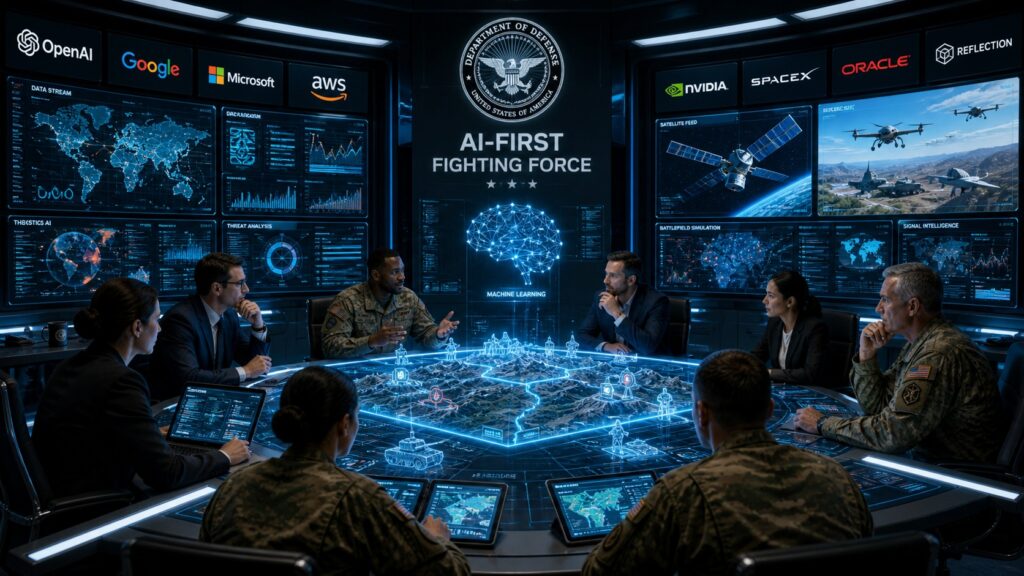
The U.S. military is building an “AI-first fighting force.” Eight tech giants signed on. One very famous name got left out. Here’s everything you need to know.
Silicon Valley Meets the War Room
Okay, let’s be real for a second. When you think about the Pentagon, you probably picture generals, fighter jets, and maybe a few too many acronyms. You probably don’t picture Sam Altman and Sundar Pichai sitting across a conference table from military brass, hammering out classified AI deals.
But that’s exactly what happened.
On May 1, 2026, the U.S. Department of Defense — which the Trump administration now officially calls the “War Department,” by the way — dropped a bombshell announcement. It signed agreements with eight of the biggest names in tech to deploy artificial intelligence across its most classified military networks. We’re talking OpenAI, Google, Microsoft, Amazon Web Services, Nvidia, SpaceX, Oracle, and a startup called Reflection.
The goal? To turn the U.S. military into what the Pentagon is calling an “AI-first fighting force.”
That’s not marketing fluff. That’s the actual language in the official announcement. And it signals something massive — a fundamental shift in how America plans to fight, defend, and dominate on the global stage.
What Does “AI-First” Even Mean for the Military?
Good question. Let’s break it down.
The Pentagon isn’t just buying some fancy chatbots to answer emails. These deals give the participating companies access to the military’s most sensitive network environments — specifically what the DoD calls Impact Level 6 and Impact Level 7 networks. These are the highest-classification tiers. Think: the stuff that doesn’t make it into the news.
According to GeekWire, the technology will be used to analyze data and improve battlefield decision-making. The Pentagon says it’s already working. Over 1.3 million Defense Department personnel have used GenAI.mil — the military’s official AI platform — generating tens of millions of prompts and deploying hundreds of thousands of agents in just five months.
Five months. Hundreds of thousands of agents. Let that sink in.
Officials say the technology has already cut some tasks from months to days. That’s not a small deal. In military operations, speed is everything. Faster intelligence analysis, faster logistics. Faster decisions. AI is making all of that happen at a scale that would’ve seemed like science fiction just a few years ago.
Who’s In — And What They’re Bringing to the Table
Let’s run through the roster, because this is a star-studded lineup.
OpenAI was one of the first to sign on. Their deal includes safeguards against domestic mass surveillance and autonomous weapons, plus cleared engineers who can actually deploy the systems on classified networks. OpenAI has drawn three explicit red lines: no mass domestic surveillance, no autonomous weapons, and no automated high-risk decisions without human oversight.
Google struck a deal that permits “any lawful government purpose” on classified networks — including mission planning and weapons targeting. That’s a broader permission set than OpenAI’s, and it didn’t go unnoticed. Hundreds of Google employees sent a letter to company leadership this week urging them to refuse the deal. “We want to see AI benefit humanity; not to see it being used in inhumane or extremely harmful ways,” they wrote, according to The Washington Post.
Microsoft and Amazon already had deep relationships with the Pentagon, but these new agreements formalize their role in classified AI deployment. Bloomberg reported that the Pentagon negotiated its deal with AWS late into Thursday night — like, literally staying up past midnight to close the deal. That’s how urgent this was. AWS spokesman Tim Barrett said the company looks “forward to continuing to support the Department of War’s modernization efforts.”
Nvidia provides the raw computational muscle. Their chips power virtually every major AI system on the planet, and now they’re officially powering the military’s AI ambitions too. According to Gadget Review, this military demand surge is already rippling through the consumer tech ecosystem — meaning your next GPU might cost more because the Pentagon needs chips too.
SpaceX, Oracle, and Reflection round out the group. Reflection is the newcomer here — a startup that most people haven’t heard of yet. But landing a Pentagon classified AI contract? That’s one heck of a way to introduce yourself to the world.
The Elephant in the Room: Where Is Anthropic?
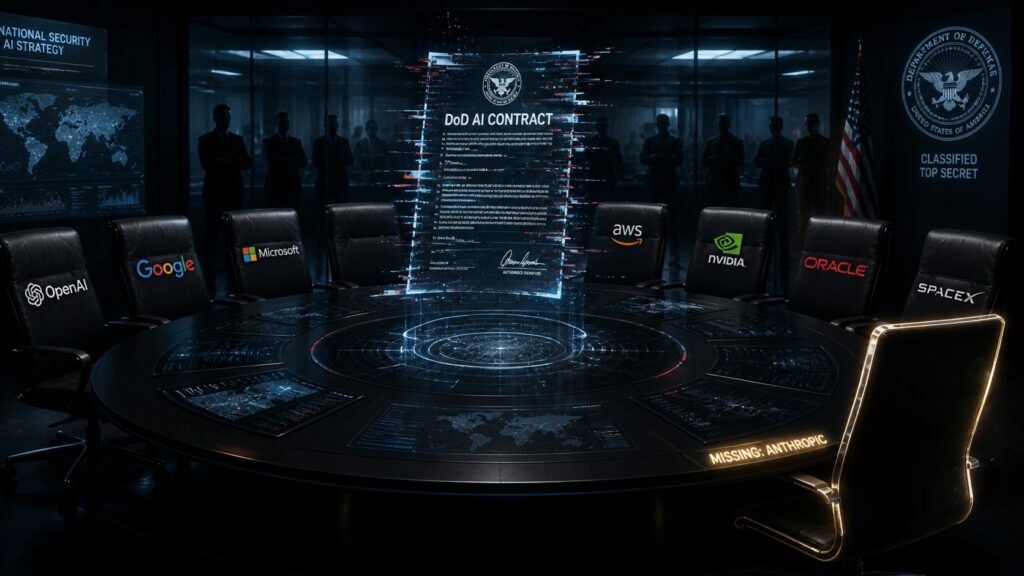
Here’s where things get spicy.
Notice anyone missing from that list? Anthropic — the AI safety company behind the Claude models — is conspicuously absent. And the reason why is one of the most fascinating tech-meets-policy stories of 2026.
Anthropic previously held a $200 million contract with the Pentagon to handle classified materials. That’s not a small deal. But then things went sideways — fast.
The dispute came down to three words: “all lawful use.”
The Pentagon wanted Anthropic to agree that its AI could be used for any lawful government purpose. Anthropic’s CEO Dario Amodei pushed back hard. He argued that current laws leave dangerous loopholes open — including the possibility of mass domestic surveillance through commercial data sets and the deployment of fully autonomous weapons systems.
Anthropic refused to budge on its red lines. The Pentagon didn’t like that. According to The Verge, the Defense Department labeled Anthropic a supply-chain risk and the Trump administration ordered federal agencies to stop using its technology entirely.
Anthropic fought back. The company filed a lawsuit against the federal government — and won a temporary injunction blocking the ban.
But the damage was done. The Pentagon moved on and diversified its AI vendor portfolio. Anthropic was out.
The Drama Gets Personal
If you thought this was just a dry policy dispute, think again.
Defense Secretary Pete Hegseth took things to a whole new level during a Senate Armed Services Committee hearing on Thursday. He called Anthropic CEO Dario Amodei an “ideological lunatic.” Out loud. In a Senate hearing. On the record.
That’s not exactly diplomatic language. But it tells you everything about how heated this standoff has become.
Meanwhile, in a leaked memo, Amodei fired back — dismissing OpenAI’s Pentagon contract as “80% safety theater.” He argued that OpenAI’s red lines don’t mean much without explicit contractual carve-outs. Legal experts seem to agree. Commitments made in press releases aren’t the same as binding legal protections.
So you’ve got the Defense Secretary calling the Anthropic CEO a lunatic. You’ve got the Anthropic CEO calling OpenAI’s deal safety theater. And you’ve got lawyers on all sides sharpening their pencils.
This is not your average tech news cycle.
The Anthropic Wildcard: A Model Called Mythos
Here’s a twist that makes this story even more interesting.
Even though Anthropic is officially labeled a supply-chain risk, the Pentagon’s own Chief Technology Officer Emil Michael told CNBC that Anthropic’s powerful security model — called Mythos — is a “separate national security moment.”
Michael said: “We have to make sure that our networks are hardened up, because that model has capabilities that are particular to finding cyber vulnerabilities and patching them.”
So let’s get this straight. The Pentagon banned Anthropic. Called them a supply-chain risk. Kicked them out of federal contracts. But also quietly acknowledged that one of Anthropic’s models might be uniquely important for national cybersecurity?
The NSA reportedly already has access to Mythos despite the supply-chain risk label. The Decoder reported that this situation is far more nuanced than a simple ban. The relationship between Anthropic and the U.S. government is complicated, contradictory, and — frankly — fascinating to watch unfold.
What This Means for You (Yes, You)
You might be thinking: “Okay, this is interesting, but what does it have to do with me?”
More than you’d think.
First, there’s the chip shortage angle. Gadget Review points out that military AI contracts with Nvidia, Microsoft, and AWS are already driving up demand for the same hardware that powers your gaming rig and your favorite cloud services. More military demand means tighter supply. Tighter supply means higher prices. Your next GPU upgrade just got a little more expensive.
Second, there’s the innovation angle. Military investment in technology has historically driven civilian breakthroughs. The internet itself started as a DARPA project. GPS was military before it was Google Maps. The AI systems being developed and refined for Pentagon use today will almost certainly find their way into consumer products tomorrow.
Third — and this is the big one — there are real questions about where the guardrails are. OpenAI says it won’t allow autonomous weapons. Google’s deal is broader. The Pentagon says everything will be used for “lawful operational use.” But as Anthropic’s Amodei pointed out, “lawful” is a word that can stretch in uncomfortable directions.
These are not abstract philosophical debates. They’re decisions being made right now, in real contracts, with real consequences.
The Bigger Picture: America’s AI Arms Race
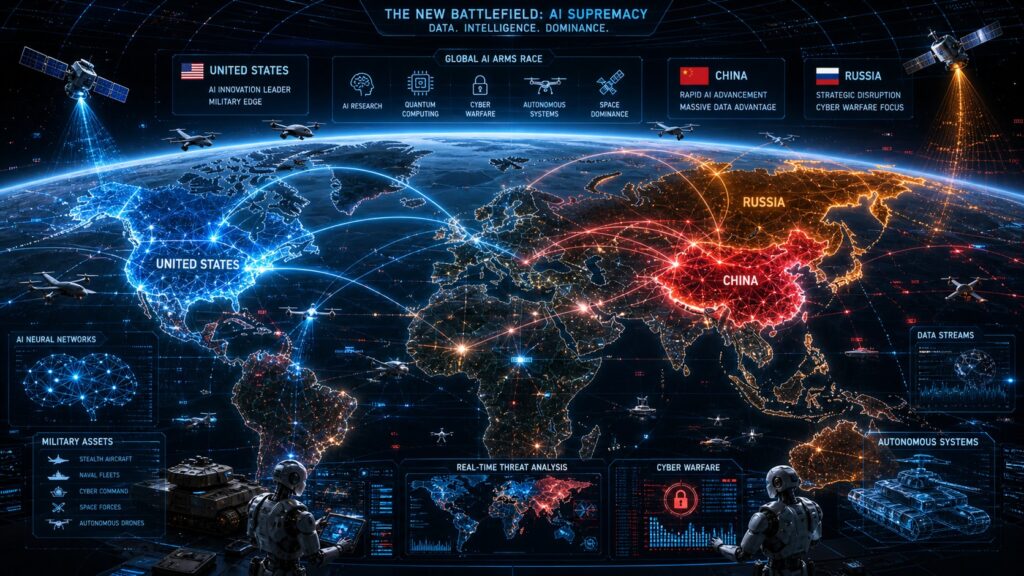
Step back for a moment and look at the full picture.
The U.S. military is moving fast. Really fast. Over 1.3 million personnel using an AI platform in five months. Tasks that used to take months now taking days. Eight of the world’s most powerful tech companies now operating inside classified military networks.
This isn’t just about efficiency. It’s about strategic dominance. The Pentagon’s statement made it clear: “American leadership in AI is indispensable to national security.”
China is investing heavily in military AI. Russia is too. The race is on. And the U.S. government has decided that the best way to win that race is to bring Silicon Valley inside the tent — classified networks and all.
Whether that’s the right call is a debate worth having. The ethical questions are real. The risks are real. But so is the strategic imperative.
One thing is certain: the line between Big Tech and the U.S. military just got a whole lot blurrier. And the AI systems that will shape the future of warfare are being built right now, by the same companies that built your email client, your search engine, and your favorite AI assistant.
Welcome to the age of the AI-first fighting force. It’s already here.
Sources
- The Verge — Pentagon strikes classified AI deals with OpenAI, Google, and Nvidia — but not Anthropic
- The Decoder — Eight tech giants sign Pentagon deals to build an “AI-first fighting force” across classified networks
- Gadget Review — Pentagon Teams With Nvidia, Microsoft, and AWS To Secure Classified Networks
- GeekWire — Microsoft and Amazon join Pentagon’s push to build AI-first military with classified network deals
The Kingy Brief
Get the next Kingy Brief.
Source-checked AI changes, original tests and one practical thing to try.
Free · Choose your subjects · Double opt-in · Unsubscribe anytime