The AI power couple just rewrote the rules of their relationship. Here’s what changed, what it means, and why the whole tech world is paying attention.
Wait, What Just Happened?
Picture this: two tech giants who built one of the most talked-about partnerships in Silicon Valley history just sat down, looked each other in the eye, and said, “We need to renegotiate.” And on April 27, 2026, that’s exactly what Microsoft and OpenAI did.
The two companies announced a sweeping overhaul of their long-standing deal, one that has quietly shaped the AI landscape for years. The changes are big. Like, really big. We’re talking about the end of exclusivity, the death of the famous AGI clause, and a total reshuffling of who pays whom. If you’ve been following the AI space at all, this is the kind of news that makes you put down your coffee and lean in.
So let’s break it all down, no jargon, no fluff, just the good stuff.
The Old Deal: A Quick Refresher
Before we dive into what changed, let’s quickly recap what the original deal looked like. Microsoft poured billions into OpenAI and, in return, got some pretty sweet perks. OpenAI’s products, think ChatGPT, the GPT API, and everything in between, were largely tied to Microsoft’s Azure cloud platform. That meant if you wanted to access OpenAI’s tech at scale, you were going through Azure. Full stop.
On top of that, there was the infamous AGI clause. This was a provision that essentially said: if OpenAI ever achieves Artificial General Intelligence, that sci-fi-sounding milestone where AI can match or surpass human intelligence across the board, then the terms of the deal would shift dramatically. Microsoft’s IP rights to OpenAI’s technology were tied to this milestone. It was a fascinating, slightly surreal piece of contract language that had the entire tech world speculating for years.
And then there was the money. Microsoft was paying OpenAI a revenue share, reportedly around 20 percent of what it earned selling OpenAI models through Azure. OpenAI, in turn, was also paying royalties back to Microsoft. It was a two-way financial relationship, complex and deeply intertwined.
That was then. This is now.
The AGI Clause Is Dead. Long Live the AGI Clause.
Let’s start with the headline grabber: the AGI clause is gone. Completely. Officially. No more “if AGI is declared, then X happens.” No more independent panel deciding whether humanity has crossed the threshold into a new era of machine intelligence, No more existential contract triggers.
According to The Verge, the clause has been replaced with something far more straightforward. Microsoft now holds a non-exclusive license to OpenAI’s models and products through 2032, and that license applies regardless of how advanced the technology gets. AGI or no AGI, Microsoft keeps its access. But here’s the kicker: so can everyone else.
That’s right. The license is non-exclusive. Any competitor can now come in and get similar access. The moat that Microsoft had built around OpenAI’s technology? It just got a lot shallower.
This is the second time the AGI clause has been renegotiated, by the way. The first was back in October when OpenAI completed its controversial for-profit restructuring and needed Microsoft’s blessing to move forward. At that point, Microsoft actually extended its IP rights to include models even after AGI was theoretically declared. Now, the whole framework has been scrapped entirely. As The Verge put it bluntly: “OpenAI may never have to actually announce if it reaches that milestone.”
Goodbye, Azure Exclusivity. Hello, Everyone Else.
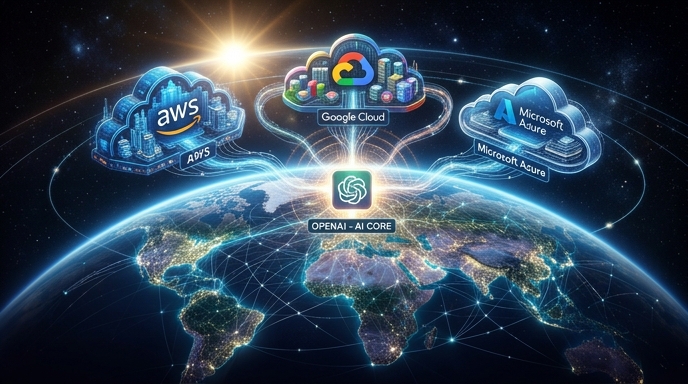
Here’s where things get really interesting for the broader tech ecosystem. Under the new deal, OpenAI can now sell its products through any cloud provider. Not just Azure. Any cloud. That means Amazon Web Services, That means Google Cloud. That means whoever else wants a piece of the pie.
According to The Decoder, the immediate trigger for this renegotiation was OpenAI’s plan to offer AI products on AWS. Microsoft was reportedly concerned this could violate the existing Azure exclusivity contract. Sam Altman and Satya Nadella reportedly hammered out the new terms personally over the past few weeks. That’s two of the most powerful people in tech sitting across from each other, rewriting the rules of AI commerce in real time.
Microsoft does remain OpenAI’s primary cloud partner. OpenAI products will still launch on Azure first, unless Microsoft “cannot and chooses not to support the necessary capabilities.” But the exclusivity? Gone.
9to5Google points out that Google Cloud is likely to benefit significantly here. OpenAI already leverages Google Cloud for ChatGPT, so this isn’t a cold start. And with the exclusivity shackles off, OpenAI can now pursue enterprise customers far more aggressively as it reportedly prepares to go public. More cloud options could also mean more competition, and potentially lower prices for customers.
Follow the Money: Who Pays Whom Now?
Okay, let’s talk dollars. Because the financial restructuring here is just as significant as the technical changes.
Under the old arrangement, money flowed in both directions. Microsoft paid OpenAI a revenue share from Azure sales. OpenAI paid royalties back to Microsoft. It was a complicated, intertwined financial relationship.
Under the new deal, The Decoder reports that Microsoft no longer pays a revenue share to OpenAI. That 20 percent cut Microsoft was handing over from Azure model sales? Gone.
OpenAI, on the other hand, still pays royalties to Microsoft, but only through 2030, and with an overall cap. The percentage stays the same, but it won’t go on forever. And crucially, these payments continue “independent of OpenAI’s technology progress.” That’s a direct reference to the old AGI trigger. No more waiting for a machine to become sentient before the money stops flowing.
Going forward, Microsoft’s primary financial upside comes from being a major shareholder in OpenAI. As OpenAI grows, and it’s growing fast, Microsoft profits directly from that growth. It’s a cleaner, simpler arrangement. Less “complicated relationship,” more “we own a big chunk of your company and we’re rooting for you.”
Seeking Alpha noted that Microsoft shares moved fractionally on the news, with the market digesting what the evolving partnership means for the company’s long-term AI revenue strategy.
What Does This Mean for OpenAI’s Future?
OpenAI is under serious pressure to turn a profit. The company has been burning through investor cash at a staggering rate, racing to acquire compute and chase AGI. The new deal with Microsoft is one more step in a broader strategy to get leaner, more flexible, and more enterprise-ready.
OpenAI has been cutting what it calls “side quests” projects like Sora and planned features that don’t directly drive revenue. It restructured its science department. It’s going all in on enterprise and coding. And now, it’s freed itself from the constraints of Azure exclusivity, opening the door to a much wider customer base.
As 4sysops summarizes it, the transition away from the Azure-only model gives OpenAI “greater operational flexibility” and that flexibility could be the difference between a company that struggles to scale and one that dominates the enterprise AI market.
The two companies also plan to continue collaborating on data centers, chips, and AI for cybersecurity. So this isn’t a breakup. It’s more like a renegotiation of terms between two parties who still need each other, just in different ways than before.
The Bigger Picture: What This Means for AI
Step back for a second and look at the forest, not just the trees. This deal restructuring signals something important about where the AI industry is heading.
The era of exclusive, tightly controlled AI partnerships is ending. OpenAI is no longer content to be Microsoft’s AI engine. It wants to be the AI layer for the entire internet, across every cloud, every enterprise, every platform. And Microsoft, for its part, is pivoting from “we own OpenAI’s output” to “we own a piece of OpenAI’s future.”
The death of the AGI clause is also telling. For years, that clause was a fascinating artifact of AI optimism, a contractual acknowledgment that AGI might actually happen, and that someone needed to plan for it. Now it’s gone. Not because AGI is impossible, but because the business reality of 2026 demands clarity, not contingency planning for a hypothetical future.
The AI race is real. The stakes are enormous. And the rules are being rewritten, sometimes literally, in contract negotiations between two of the most powerful companies on the planet.
Sources
- The Verge — “Microsoft and OpenAI’s famed AGI agreement is dead”
- The Decoder — “OpenAI and Microsoft rewrite their deal: no more exclusivity, no more AGI clause”
- 9to5Google — “OpenAI can use Google and more for cloud providers under updated Microsoft deal”
- Seeking Alpha — “Microsoft in focus as OpenAI partnership evolves, says it will no longer pay revenue share”
- 4sysops — Michael Pietroforte Activity: OpenAI and Microsoft deal summary
Compare
Recent Launches
Latest News
The Kingy Brief
Get the next Kingy Brief.
Source-checked AI changes, original tests and one practical thing to try.
Free · Choose your subjects · Double opt-in · Unsubscribe anytime